Parental Burnout: What Researchers Have Learned
Parental burnout has 4 signs researchers can measure. What a global study, research on risks and resources, and early treatment trials have found.

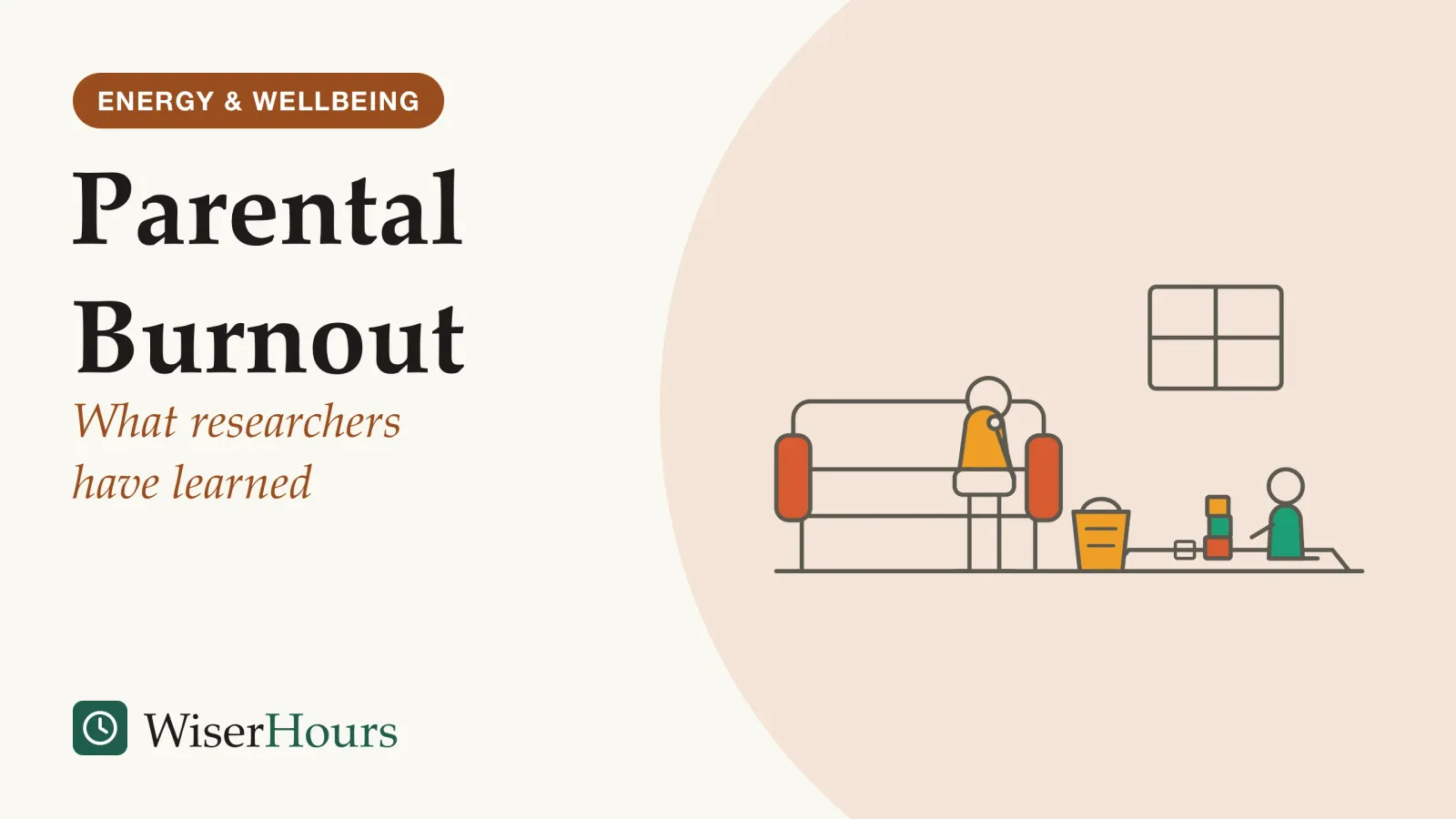
A mother gets everyone fed, signs the reading log and makes the school run on time, then realizes she has not really looked at her son all morning. She used to love these years. Now she mostly feels empty, and a little ashamed of feeling that way.
That pattern has a name. Parental burnout is exhaustion tied to the role of parent rather than to a job, and the research group behind much of the evidence, led by the psychologists Isabelle Roskam and Moïra Mikolajczak at UCLouvain in Belgium, describes four signs: exhaustion, a painful contrast with the parent you used to be, feeling fed up with parenting, and emotional distance from your children.1 Where you live seems to matter too. In a survey of parents on five continents, published in 2021, severe parental burnout was most common in individualistic Western countries, and a country’s individualism was more strongly tied to it than the number of children or the hours parents spent with them.2
What parental burnout is, and how it differs from ordinary tiredness
Parental burnout is not the ordinary fatigue every parent knows. In the Parental Burnout Assessment, the questionnaire Roskam, Maria Elena Brianda and Mikolajczak published in 2018, it is a cluster of four experiences that come often and together: being drained by the parenting role, feeling you are no longer the parent you were, being fed up with it, and pulling back emotionally from your children.1
In the World Health Organization’s classification, burnout is a work term, and the WHO definition of burnout confines it to the job. Parental burnout is therefore a research term, not a WHO category. Earlier researchers had borrowed the word because the pattern resembled burnout at work; Roskam’s team rebuilt the definition from parents’ own words: long interviews with exhausted mothers became questionnaire items, which were tested on 901 parents, mostly in England, Belgium and the US.1
The fourth sign takes a different shape from job burnout for a practical reason. A worn-out employee can pull away from clients by growing cynical; a parent cannot treat a child as a case file. Working with parents of children with conduct problems, the researchers saw that exhausted parents disengage emotionally rather than physically: the meals still get made and the school run still happens, but the parent grows less responsive.1 Picture a father who still packs every lunch but has stopped asking how the day went, and who catches himself thinking he used to be a patient, playful parent.
Two larger studies by the same group, with about 3,500 parents in all, found that parental burnout could be told apart from job burnout and from depressive symptoms, and that it had consequences of its own, according to the abstract, the only part we could read.3
What to watch for, then, is not a hard week but a pattern: the four signs arriving often and together, and a widening gap between the parent you are and the one you were. If several of them fit, the next section shows where the pressure tends to come from, and the last one says when a professional should step in.
Why some parents burn out and others do not
Parental burnout develops when stress-raising factors outweigh stress-easing ones for a long time, according to the Balance between Risks and Resources theory that Mikolajczak and Roskam proposed in 2018. They tested it in two survey rounds six months apart with 923 French-speaking parents, most of them in Belgium, and found a strong link between the balance score and burnout. In Mikolajczak and Roskam’s account, most parents stay in balance because the rewards of raising children make up for the demands. Risks include perfectionism, endless chores and little support from a co-parent or from outside; resources include self-compassion, time for leisure, co-parenting that works and outside help.4
It both taxes and replenishes your emotional resources.
In plain terms, what matters is not only how much parenting takes out of you but how much comes back in to refill it.
- Risks: what raises parenting stress, such as perfectionism, countless duties and chores, or little support from a co-parent or from outside the home
- Resources: what eases it, such as self-compassion, time for leisure, co-parenting that works and help from outside
Two details make the theory useful in daily life. First, a resource is not just the absence of a risk: a partner who does not criticize you is not the same as one who backs you up. Second, in their data, adding family circumstances such as income, single parenthood or the number of children did not improve the prediction once the balance was counted, and the authors argue that even a child’s disability or chronic illness loses its link to burnout once parenting load, leisure time and support are taken into account.4 Two parents of a child with diabetes can end up in very different places if one of them has a partner who shares the night checks and a free evening each week.
- Myth
- Parental burnout mainly happens to parents facing the hardest circumstances, such as a seriously ill child.
- Fact
- In Mikolajczak and Roskam's 2018 study of 923 parents, demographic factors such as income or number of children added nothing once the balance of risks and resources was counted, and the authors argue the same holds for a child's illness.
The wider evidence is thinner than the theory. A 2024 systematic reviewsystematic review: A review that fixes its question and its rules for including studies in advance, then searches out every study that fits and weighs them together. Some systematic reviews pool the results into a meta-analysis; others describe what the studies found without combining the numbers.Full entry in the glossary of 26 studies of risk factors, all of them one-off surveyscross-sectional: Describes a study that measures everyone in its sample at a single point in time. Because the possible cause and the outcome are recorded together, it can show that two things occur together but not which of them came first.Full entry in the glossary, found links with perfectionism, child behavior problems, marital satisfaction and social support, among others, but most factors had been examined in only one or two studies.5
Working on either side of the scale
The theory suggests that taking away one risk or adding one resource can shift the balance, though Mikolajczak and Roskam say this still needs testing in intervention studies. In practice that might mean dropping one standard (a bought birthday cake, a simpler dinner two nights a week), handing one recurring task to a named person on a set day where someone can share the load, or protecting one hour a week that is yours alone.
Where parental burnout is most common
Severe parental burnout affects a small minority of parents in the countries studied so far, and how common it is depends strongly on where they live. The International Investigation of Parental Burnout, a research consortium led by Roskam, gave the same questionnaire to parents on five continents.2
The study
Limited evidence
One questionnaire, 42 countries: the global survey published in 2021
Using a strict cutoff for severe burnout (all 23 feelings at least weekly, or at least 16 of them daily), the share of parents affected ranged from zero in Cuba to about 8% in Belgium and the US. Of six cultural values tested, only individualism was linked to both how common burnout was and parents’ average scores, and it mattered more than income inequality between countries or the number and age of children.2
The finding is a pattern across countries, not a verdict on any one family. Samples were gathered by word of mouth, social media and local networks, mothers were overrepresented, and the questionnaire, its authors concede, may fit parenting in individualistic cultures better than elsewhere. Earlier figures from single countries used different questionnaires and cutoffs, which the authors say makes them difficult to interpret. The paper also discloses that Roskam and Mikolajczak have since founded an institute that trains professionals on parental burnout.2
Treat any single percentage for parental burnout with care, because it depends on where the line is drawn. The same group published formal cutoff scores for the most severe levels only in 2023, from a study comparing burned-out parents with a control group.6
Why would individualism matter? A 2024 follow-up by largely the same team, across 36 countries, points to three routes: a gap between the parent people think society expects and the parent they feel they are, an emphasis on agency and on raising a self-directed child, and less sharing of parenting tasks. The gap between the expected and the actual parent carried the most weight.7 Think of a parent who measures every evening against an ideal of patient, enriching parenting, with no grandparent or neighbor to take a turn. We could read only that study’s abstract, and its routes are statistical links in survey data, not tested causes.
The practical lesson is that part of the pressure comes from standards absorbed from the surrounding culture, not from your children or a personal failing, and those standards are one part of the problem a parent can question.
Why researchers take parental burnout seriously
Higher levels of parental burnout are linked to thoughts of escape and suicide in parents and to neglect of and violence toward children, according to studies by Mikolajczak, Roskam and colleagues. In a 2018 study of 1,551 parents, parental burnout was more closely tied to neglect, violence, and escape and suicidal thoughts than job burnout was.8
Their 2019 follow-up surveyed two groups of parents three times over a year, a design meant to show which changes come first, and the authors concluded that burnout strongly increases escape thoughts, neglect and violence. We had access to the abstract alone, and a longitudinal studylongitudinal study: A study that measures the same people more than once over a period of time, so it can see how they change and which thing came first. Following people over time still does not show that the earlier thing caused the later one.Full entry in the glossary of this kind can show order in time but cannot rule out other causes.9
These findings describe risk across many parents, not a prediction about any one person. They also name something parents rarely say aloud: wishing you could run away, or frightening yourself with a flash of anger, can be part of burnout.
If those thoughts turn to suicide or to hurting your child, the last section lists who to call today.
Can parental burnout be treated? What trials show
Structured programs for parents show promise. A 2026 meta-analysismeta-analysis: A study that combines the results of earlier studies on the same question into one overall estimate. Pooling makes the estimate more precise, but it cannot repair the studies it pools: a meta-analysis of surveys is still survey evidence.Full entry in the glossary pooled 15 studies of psychological and educational programs; in the randomized trials among them, the programs cut parental burnout more than control conditions did, by a margin the authors class as moderate to large, and the effects were still present up to three months later. The programs differed in style but shared five ingredients, the review found: learning how burnout works, stress management and self-regulation, work on values and identity, hands-on practice, and attention to relationships.10 Three months is a short follow-up, though, and we read the abstract only.
The smaller trials fit that picture. Brianda and colleagues tested two group formats, one teaching parents to rebalance risks and resources, the other a supportive group where parents were heard without judgment; both were followed by less burnout, less neglect and less violence. In those early trials, taking part meant a series of group sessions over 8 to 12 weeks, where someone explains how burnout builds and parents try small changes at home between meetings. A 2024 study of 54 parents, with each group led by an experienced psychologist, compared a mindfulness program with the rebalancing program and found improvement in both, with no clear winner; some parents in the mindfulness group scored higher on burnout afterward, and the study had no untreated comparison group.11
| What it is | What the best evidence found | Evidence |
|---|---|---|
| The four signs (Parental Burnout Assessment) | Exhaustion, contrast with your former self, feeling fed up and emotional distance form one measurable syndrome | Questionnaire study, moderate1 |
| Why it happens | A lasting imbalance of risks over resources | Survey study over six months, limited4 |
| How common it is | Rare overall; far more common in individualistic Western countries | Survey across five continents, limited2 |
| What it is linked to | Escape thoughts, neglect and violence toward children | Longitudinal surveys, limited (abstract read)9 |
| What helps | Structured programs reduced burnout in randomized trials, with effects still seen three months later | Meta-analysis, moderate (abstract read)10 |
The evidence covers structured programs, not tips a parent tries alone. The lesson for a parent is where to look: a group or a therapist who understands parenting stress, rather than a new routine layered on top of an already full day.
Who to call, and how soon
Thoughts of suicide or self-harm, or fear that you might hurt your child, need help straight away; low mood lasting two weeks or more calls for a health professional soon. The routes below come from NIMH and US crisis services, the NHS and a UK parenting charity, and the three urgency tiers are WiserHours’ own.
- Now: in the US, text or call 988 for the Suicide & Crisis Lifeline, which costs nothing, is confidential and answers around the clock; for a life-threatening emergency, call 911.1213 A US parent who fears hurting their child can also phone the Childhelp hotline on 800-422-4453, where counselors answer 24/7 and help parents as well as children.14 In the UK, if someone’s life is at risk or you feel you cannot keep yourself or someone else safe, call 999 or go straight to A&E; for urgent help, ring NHS 111 and pick the mental health option, or reach Samaritans free on 116 123.15 Elsewhere, contact local emergency services.
- Soon: NIMH describes depression as symptoms lasting two weeks or longer, present most of the day and nearly every day, and says to talk to a health care provider when signs persist.12 With a baby under a year old, the NHS recommends raising possible postnatal depression with a GP, midwife or health visitor; fathers and partners can have it too.16 In England and Wales, a struggling parent can also call Coram Family Lives’ free, confidential parenting helpline on 0808 800 2222, open daily but not around the clock.17
- Routine: if the four signs keep returning but you are coping, bring them up at your next appointment and ask about a parent support group or a therapist experienced with parenting stress. In other countries, your family doctor plays the GP’s part.
The bottom line
In the researchers’ account, burned-out parents keep doing the chores but lose the connection, and that is a measurable pattern rather than a character flaw. It seems to grow where high standards meet little help. The most useful lesson is the balance: lighten one demand or add one source of support, and if the signs persist, look for a professional or group that treats it.
This article is general information, not medical advice. If you're worried about your health, talk to a doctor or another qualified professional.
Frequently asked questions
Can fathers have parental burnout?
Yes. Fathers took part in the studies that built the Parental Burnout Assessment, and its four signs held up the same way for fathers as for mothers. Most participants in this research have been mothers, though, and in a 2018 Belgian study mothers scored higher on average than fathers, so what we know about fathers rests on smaller samples.
Is parental burnout the same as postnatal depression?
No. When Roskam and colleagues interviewed parents to build their questionnaire, they left out parents of babies under 18 months to avoid confusion with postpartum depression. The NHS says postnatal depression can start up to a year after a birth, can affect fathers and partners too, and should be raised with a GP, midwife or health visitor.
Is there a test for parental burnout?
There is a research questionnaire, not a diagnostic test. The Parental Burnout Assessment asks how often you experience 23 feelings, from never to every day. Formal cutoff scores for the most severe levels were published only in 2023, from a study of 192 parents, so a high score is a reason to talk to a professional, not a diagnosis.
Sources
- A Step Forward in the Conceptualization and Measurement of Parental Burnout: The Parental Burnout Assessment (PBA). Roskam, I., Brianda, M.-E. & Mikolajczak, M. (2018). Frontiers in Psychology, 9, 758
- Parental Burnout Around the Globe: a 42-Country Study. Roskam, I., Aguiar, J., Akgun, E., et al. (2021). Affective Science, 2(1), 58-79
- Is Parental Burnout Distinct From Job Burnout and Depressive Symptoms? Mikolajczak, M., Gross, J. J., Stinglhamber, F., Lindahl Norberg, A. & Roskam, I. (2020). Clinical Psychological Science, 8(4), 673-689
- A Theoretical and Clinical Framework for Parental Burnout: The Balance Between Risks and Resources (BR2). Mikolajczak, M. & Roskam, I. (2018). Frontiers in Psychology, 9, 886
- A systematic review of parental burnout and related factors among parents. Ren, X., Cai, Y., Wang, J. & Chen, O. (2024). BMC Public Health, 24, 376
- Optimizing the Assessment of Parental Burnout: A Multi-informant and Multimethod Approach to Determine Cutoffs for the Parental Burnout Inventory and the Parental Burnout Assessment. Brianda, M. E., Mikolajczak, M., Bader, M., et al. (2023). Assessment, 30(7), 2234-2246
- Three reasons why parental burnout is more prevalent in individualistic countries: a mediation study in 36 countries. Roskam, I., Aguiar, J., Akgun, E., et al. (2024). Social Psychiatry and Psychiatric Epidemiology, 59(4), 681-694
- Consequences of parental burnout: Its specific effect on child neglect and violence. Mikolajczak, M., Brianda, M. E., Avalosse, H. & Roskam, I. (2018). Child Abuse & Neglect, 80, 134-145
- Parental Burnout: What Is It, and Why Does It Matter? Mikolajczak, M., Gross, J. J. & Roskam, I. (2019). Clinical Psychological Science, 7(6), 1319-1329
- A meta-analysis of parental burnout interventions. Urbanowicz, A. M., Verger, N. B., Shankland, R., Rance, J., Bennett, P. & Gauchet, A. (2026). Journal of Affective Disorders, 399, 121022
- Treating Parental Burnout: Impact and Particularities of a Mindfulness- and Compassion-Based Approach. Bayot, M., Brianda, M. E., van der Straten, N., Mikolajczak, M., Shankland, R. & Roskam, I. (2024). Children, 11(2), 168
- Depression. National Institute of Mental Health, National Institutes of Health (NIH Publication No. 24-MH-8079, revised 2024)
- 988 Suicide & Crisis Lifeline. 988 Suicide & Crisis Lifeline (US)
- Childhelp National Child Abuse Hotline. Childhelp (US)
- Where to get urgent help for mental health. NHS (UK), page last reviewed 26 April 2023
- Postnatal depression. NHS (UK), page last reviewed 18 March 2026
- Confidential parenting helpline. Coram Family Lives (England and Wales)
How we researched this
Starting from the research program of Isabelle Roskam and Moïra Mikolajczak, searches ran in Europe PMC, PubMed and Crossref, plus NHS, NIMH and US crisis-service pages, in September 2026, adding the newest systematic review and meta-analysis found. Five studies were read in full; for six, only the abstract was available. The sources run from 2018 to 2026. The main limitation: nearly all studies rely on self-report surveys of volunteer parents, most of them mothers.
Keep reading
Compassion Fatigue vs. Burnout: What Helping Professionals Should Know
Compassion fatigue has 2 parts in its main questionnaire: burnout and secondary traumatic stress. How they differ, what scores mean, and when to get help.
12 Early Warning Signs of Burnout You Shouldn't Ignore
12 early signs of burnout, mapped to the WHO's three dimensions and validated scales, what else each could mean, and when a doctor should look.
How to Recover From Burnout: A Realistic Step-by-Step Plan
A realistic burnout recovery plan in 6 steps: rule out other causes, cut the load, protect rest, and change the job with your manager's help.
What Is Burnout? The WHO Definition in Plain English
What is burnout? The WHO's ICD-11 calls it an occupational phenomenon with 3 dimensions, not a medical condition. What that means, and the depression debate.