Will a Vacation Fix Burnout? What the Evidence Suggests
Burnout symptoms usually ease on vacation. A 2025 review of 32 studies found a large lift, but exhaustion often creeps back within weeks of returning to work.

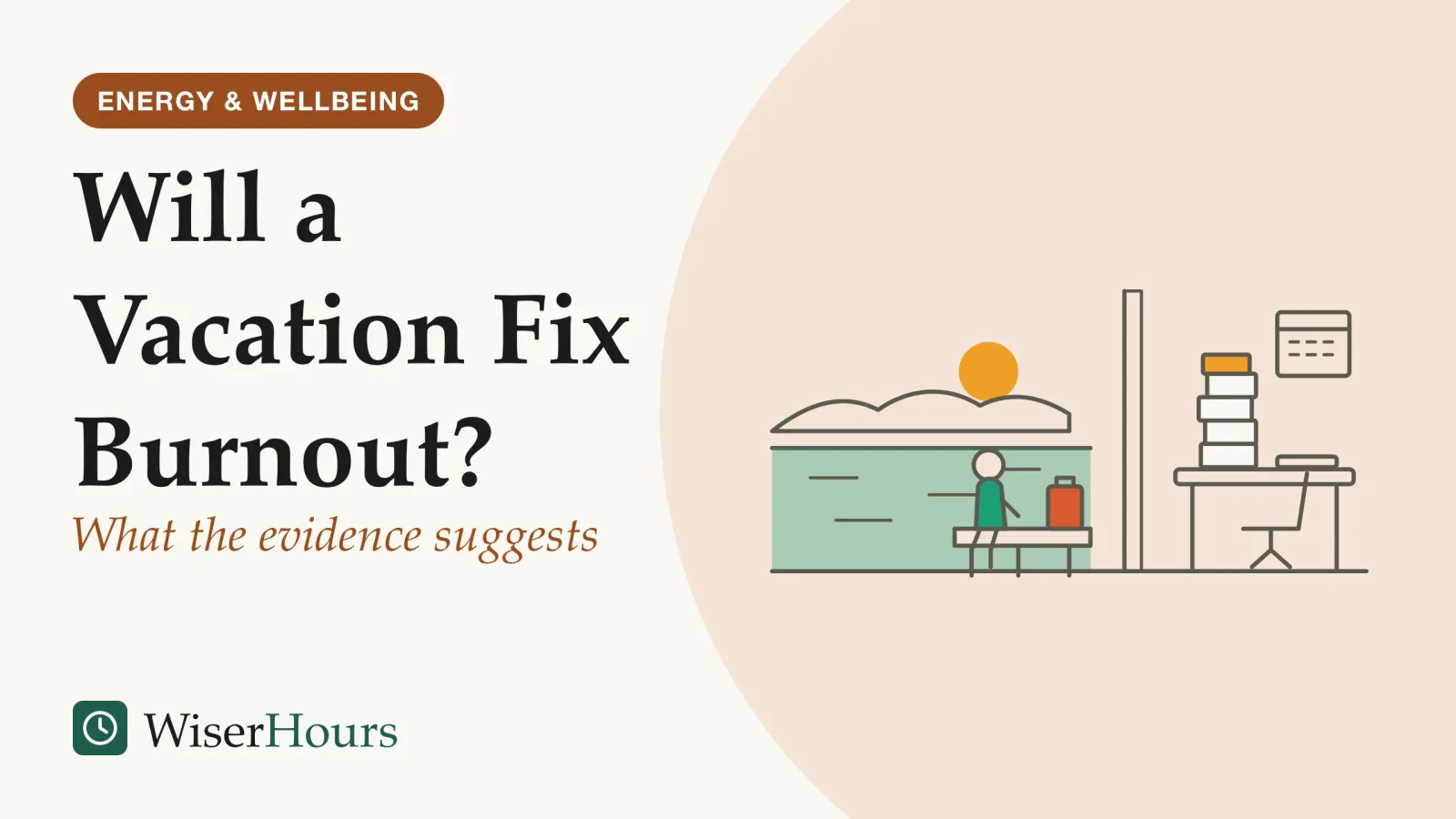
Exhaustion drops during a vacation. In most of the studies that followed people back to work, it climbed again within days or weeks, and in one study of teachers it climbed fastest for those who returned to the heaviest demands.
So, does a vacation help burnout? Exhaustion usually eases while you are away from work. In a 2025 meta-analysismeta-analysis: A study that combines the results of earlier studies on the same question into one overall estimate. Pooling makes the estimate more precise, but it cannot repair the studies it pools: a meta-analysis of surveys is still survey evidence.Full entry in the glossary of 32 studies, Ryan Grant, Beth Buchanan and Kristen Shockley found that vacations had a large effect on employee well-being, one that fades more slowly than an earlier review suggested.1 But the vacation studies described here followed people who were still at work, none tested a break as a treatment for clinical burnout, and when people went back to an unchanged job, the relief usually wore off. Treat a break as a pause that buys time for change.
In practice the evidence points to three moves: keep work out of the break, plan the first week back as carefully as the trip, and spend the rested weeks afterward changing what exhausted you in the first place.
For what burnout is and where it comes from, see the burnout guides on WiserHours; this page stays with what time off can do.
Does a vacation help burnout? Yes, for a while
The two meta-analyses on the question, from 2009 and 2025, agree that well-being rises during a vacation; they disagree about how big the lift is and how long it lasts. The earlier one judged the gain small and short-lived, the later one large and slower to fade.
In 2009, Jessica de Bloom and colleagues at Radboud University in the Netherlands found only seven studies that measured people before and after a vacation. Most were small, five had no comparison group, and all relied on people rating themselves. Across them, health complaints and exhaustion improved, and the gains had shrunk or vanished 2 to 4 weeks after people went back. The authors describe two routes by which a break helps: it lifts daily job demands for long enough to unwind, and it frees time for activities people value and choose for themselves.2
The 2025 review by Grant’s team pooled many more studies, which allowed more precise estimates. From its abstract, the only part available to read, vacation length, national culture and the number of vacation days a country mandates all made the effect larger or smaller.1 Paid leave rules differ widely between countries, so check what your own law and contract allow before you plan around a long break.
Both routes close when the break ends, which is where the fade-out studies below pick up. Picture two weeks at a lake: by the second week you sleep without an alarm and stop checking your inbox, and on your first Monday back the tightness is gone. That relief is real and worth having. Expect exhaustion to be lower for now.
Switching off is the part of the break worth protecting
What people do on a break, and whether they stay out of work, is linked to how much it helps. In a Dutch study of long weekends and midweek breaks by de Bloom’s team, people who felt relaxed and mentally detached from work reported higher well-being during the break, and those who spent more time working on vacation reported lower well-being afterward.3
On longer summer vacations, pleasure in what people did, relaxation, savoring good moments and a sense of control over their own time went with larger gains, while the length of the trip was only weakly related to them.4 The 2025 meta-analysis adds, from eight studies, that psychological detachment and physical activity during a vacation may help most.1 These are correlations, mostly from small samples: good bets.
- A colleague who covers. Name one person for anything urgent, agreed with your manager before you leave.
- What can wait. Say plainly that everything else waits, and settle with your manager beforehand what that covers.
- One agreed check-in (optional). Only if switching off completely is impossible in your role: one short, fixed time, kept to, so the job does not walk back in every evening.
The reason detachment matters follows from the first route above: a break only lifts job demands if the demands stop. A week in which you answer “just a few” emails each evening is a different break from a week with your work phone in a drawer, because the job keeps walking back in. If switching off completely is impossible in your role, agree one short, fixed check-in time before you leave, and keep to it. Add something active, such as walking or swimming, if your health allows.
Before, during and after the break
Download PDF
Why the relief fades within weeks of going back to work
In most studies that measured burnout symptoms before, during and after a break, the gain was mostly gone within weeks of going back to work. The classic example is a 1997 study in Israel by Mina Westman and Dov Eden, in which burnout fell during a vacation and then crept back to where it started.5
Westman and Eden followed 76 administrative clerks, most of whom spent a two-week summer break at home; they were ordinary workers, not people on sick leave, and the study had no comparison group.2 Burnout was partway back 3 days after they returned and all the way back by 3 weeks, in every subgroup the authors analyzed. The pattern is clear, even though one uncontrolled study cannot show what caused it.5
Three later Dutch studies by de Bloom’s team found an even faster fade:
- after ski trips averaging 9 days, health, mood, tension, energy and satisfaction were back to their usual levels in the first week of work;6
- after long weekends and midweek breaks, a small benefit was left on the day people got home and gone within three days;3
- after summer vacations, well-being peaked around the eighth day away and was back to its usual level within the first week of work.4
Not every study agrees. In a 2003 Israeli study, Dalia Etzion compared 51 industrial workers who took their summer vacation with 51 matched colleagues who did not: three weeks after the break, job stress was back at its earlier level, but burnout was still low.7
The usual explanation is that the demands that lifted during the break return on the first morning. The authors of the short-break study suggest that going back to work, with the strain of its stressors, sets off the fade.3 A manager comes back rested to a full inbox, three postponed decisions and a deadline that moved while she was away. By Wednesday she is working late again, so plan the return as carefully as the trip.
A softer landing, untested but cheap
De Bloom’s team floated one idea they did not test: a day or two at home after the trip, before work starts, so unpacking and household catch-up do not land on a full working week.6 Going back midweek, so the first stretch at work is short, follows the same logic; none of the studies here tested it either.
The job you return to may set the pace of the fade
What happens at work after the break may decide how long its benefits last. In a study of German teachers, Jana Kühnel and Sabine Sonnentag of the University of Konstanz found that emotional exhaustionemotional exhaustion: Feeling drained and used up by work, with little energy left. It is the exhaustion dimension of burnout, one of three, and on its own it is not a diagnosis; persistent exhaustion is worth raising with a doctor.Full entry in the glossary came back faster for teachers who faced more time pressure and more pupil misbehavior once school restarted.
The study
Limited evidence
Back in the classroom: how fast exhaustion returned for 131 teachers in Germany
Emotional exhaustion, rated from 0 to 6, fell from 2.9 before the break to 1.5 on the first working day back, then rose to 2.4 after two weeks and 2.9 after four, about where it began. Teachers reporting more time pressure and pupil misconduct after the holiday had higher exhaustion at both follow-ups. Relaxing in free time went with lower exhaustion two weeks after the break, but that link was no longer clear at four weeks.8
This is one occupation, in one country, around one kind of break, and the teachers volunteered, so its numbers may not transfer to other jobs. The authors’ own summary is that job demands after the vacation sped up the fade-out; without a comparison group, that is their reading of a link rather than a tested cause.8 A 2006 German study of 221 university employees also measured workload two days after the break; its abstract says only that workload and vacation experiences predicted some of the outcomes.9
- The break: exhaustion is well below its usual level on the first day back at work
- Heavy demands after the break: more time pressure and more pupil misconduct went with exhaustion climbing back faster
- Relaxing free time after the break: went with lower exhaustion two weeks after the break; by four weeks the link was no longer clear
Two teachers are back from the same two-week holiday. One returns to a settled class; the other to a class that ran through a string of substitutes, with a report deadline brought forward. Same break, but the second is likely to spend its benefit faster.
The most useful vacation planning may therefore happen at work. Before you leave, agree with your manager what can wait, what someone else will cover and what will not land on your desk the day you return. After you return, guard your evenings; the habits in how to stop thinking about work after hours are a reasonable place to start.
A vacation is not a treatment for burnout
None of the vacation studies described on this page tested a break as a treatment for clinical burnout. The 2009 review admitted only healthy working samples and excluded studies of people in psychiatric care, so the “burnout” it covers is a questionnaire score in people who were still working.2 The later studies here also followed people in work: clerks, teachers, industrial workers and university staff.
- Myth
- A long enough vacation will cure burnout.
- Fact
- Vacation studies show relief that usually fades within days to weeks of returning to work. None of those described here tested a break as a treatment for clinical burnout.
The job side matters because a vacation removes the job’s demands for a while; it does not change them, and the fade-out studies above show what happens when the same demands return. For people off sick with burnout, a 2023 systematic reviewsystematic review: A review that fixes its question and its rules for including studies in advance, then searches out every study that fits and weighs them together. Some systematic reviews pool the results into a meta-analysis; others describe what the studies found without combining the numbers.Full entry in the glossary of return-to-work programs found that only a workplace-directed program was linked to a better return, though the authors judged that no firm conclusions could be drawn from the eight studies, which carried moderate to high risk of bias.10
A nurse on a short-staffed ward comes back from two good weeks to the same rota and the same gaps; the break cannot touch the rota. Time away from work is the third of six steps in a burnout recovery plan, next to a conversation about what has to change in the job. The first weeks back, when exhaustion is usually at its lowest, are a good moment to raise one specific change.
If a normal working week already feels impossible, talk to a doctor rather than relying on vacation days alone; the last section says how urgently. How to ask for time off when you are burned out, and whether a longer sabbatical works differently, deserve their own answers, and both depend on your country’s rules and your employer’s.
| Question | What the research shows | Evidence |
|---|---|---|
| Does well-being rise on vacation? | Yes: a large lift that fades more slowly than once thought | Meta-analysis; only the abstract was read1 |
| How long does relief from exhaustion last? | Gains shrank or vanished 2 to 4 weeks after returning | Meta-analysis of 7 small studies, limited2 |
| Does the job after the break matter? | More time pressure went with a faster return of exhaustion | One observational study of teachers, limited8 |
| Does a vacation treat clinical burnout? | Not tested; workplace change has the most support for return to work, and it is weak | Gap; systematic review of 8 studies at moderate to high risk of bias, limited10 |
If rest stops working: a doctor soon, crisis help today
Thoughts of suicide or of harming yourself need help today, before anything else on this page. Stress you can no longer manage warrants a visit to a doctor soon, and exhaustion that returns within weeks of every break is worth raising at your next appointment. The routes come from IASP, the US NIMH and the UK’s NHS, and WiserHours put them in three tiers.
- Today: start with your local emergency number in any emergency where a life may be at stake. To reach a free, confidential helpline in your own country, IASP directs people in crisis to Find A Helpline, which lists verified services in over 150 countries.11 In the US, NIMH’s advice for life-threatening situations is 911 or the nearest emergency room, and for suicidal feelings or emotional distress, a call or text to 988, the Suicide & Crisis Lifeline.12 In the UK, the NHS names 999 or A&E if staying safe feels impossible or a life hangs in the balance, NHS 111 for urgent mental health help, and Samaritans on 116 123 for someone to talk to.13
- Soon: see a GP (a family doctor, outside the UK) if stress feels unmanageable or your own changes have not helped, as the NHS advises.14
- At your next routine appointment: mention it if breaks help for only a few days, or if exhaustion rises again whenever demands do; this suggestion is ours, not a named body’s.
The bottom line
Burnout symptoms usually ease on vacation, and the newest review suggests the lift is larger than once thought. In the studies that followed people back to work, though, exhaustion usually returned within weeks, and in one study of teachers it returned faster where demands after the break were heavier. Take the break, keep work out of it, and use the rested weeks afterward to change the demands that exhausted you.
This article is general information, not medical advice. If you're worried about your health, talk to a doctor or another qualified professional.
Frequently asked questions
Does a longer vacation help more than a short one?
The evidence is mixed. In Jessica de Bloom's Dutch studies, long weekends and midweek breaks gave a lift of about the same size as a 9-day ski trip, and on summer vacations averaging 23 days the gains were only weakly related to how long people stayed away. The 2025 meta-analysis by Grant and colleagues, however, lists vacation length among the factors that made the effect larger or smaller.
Is a vacation at home as good as going away?
Nobody knows yet. The 2025 meta-analysis by Grant, Buchanan and Shockley describes the role of location, away from home, at home or a mix of both, as unclear. In the 1997 Israeli study by Westman and Eden, most of the clerks spent their two-week break at home, and their burnout scores still fell while they were off.
If the benefits fade so fast, is a vacation worth taking?
The researchers who measured the fade-out think so. Jessica de Bloom and colleagues argue that people enjoy a vacation for its own sake, and Jana Kühnel and Sabine Sonnentag suggest that benefits of taking vacations year after year may simply not show up in studies that follow people for a few weeks. The 2025 meta-analysis concluded that vacation is a more effective recovery opportunity than earlier work suggested.
Sources
- I need a vacation: A meta-analysis of vacation and employee well-being. Grant, R. S., Buchanan, B. E. & Shockley, K. M. (2025). Journal of Applied Psychology, 110(7)
- Do We Recover from Vacation? Meta-analysis of Vacation Effects on Health and Well-being. de Bloom, J., Kompier, M., Geurts, S., de Weerth, C., Taris, T. & Sonnentag, S. (2009). Journal of Occupational Health, 51(1)
- Effects of Short Vacations, Vacation Activities and Experiences on Employee Health and Well-Being. de Bloom, J., Geurts, S. A. E. & Kompier, M. A. J. (2012). Stress and Health, 28(4)
- Vacation (after-) effects on employee health and well-being, and the role of vacation activities, experiences and sleep. de Bloom, J., Geurts, S. A. E. & Kompier, M. A. J. (2013). Journal of Happiness Studies, 14(2)
- Effects of a respite from work on burnout: vacation relief and fade-out. Westman, M. & Eden, D. (1997). Journal of Applied Psychology, 82(4)
- Effects of vacation from work on health and well-being: Lots of fun, quickly gone. de Bloom, J., Geurts, S. A. E., Taris, T. W., Sonnentag, S., de Weerth, C. & Kompier, M. A. J. (2010). Work & Stress, 24(2)
- Annual vacation: duration of relief from job stressors and burnout. Etzion, D. (2003). Anxiety, Stress & Coping, 16(2)
- How long do you benefit from vacation? A closer look at the fade-out of vacation effects. Kühnel, J. & Sonnentag, S. (2011). Journal of Organizational Behavior, 32(1)
- Recovery, well-being, and performance-related outcomes: the role of workload and vacation experiences. Fritz, C. & Sonnentag, S. (2006). Journal of Applied Psychology, 91(4)
- Return-to-work interventions for sick-listed employees with burnout: a systematic review. Lambreghts, C., Vandenbroeck, S., Goorts, K. & Godderis, L. (2023). Occupational and Environmental Medicine, 80(9)
- Crisis Centres & Helplines. International Association for Suicide Prevention (IASP), accessed September 2026
- Help for Mental Illnesses. National Institute of Mental Health, US National Institutes of Health (accessed September 2026)
- Where to get urgent help for mental health. NHS (UK), page last reviewed 26 April 2023
- Stress. NHS (UK), page last reviewed 6 March 2026
How we researched this
Europe PMC, PubMed, Crossref and OpenAlex were searched in September 2026 for meta-analyses and studies of vacation effects on burnout, exhaustion and well-being, plus a systematic review of return-to-work programs for burnout and current crisis-help pages from IASP, NIMH and the NHS. Sources span 1997 to 2026; the 2009 meta-analysis and four later studies by de Bloom's team and by Kühnel and Sonnentag were read in full, and five papers, including the 2025 meta-analysis, as abstracts only. Main limitation: most studies are small, observational and self-reported, and none enrolled people with clinical burnout.
Keep reading
What Is a Sabbatical? Who Takes One and What Research Shows
A sabbatical is long leave from a job you keep. Under 1 in 10 US employers offered one in 2023; studies of academics and nonprofit leaders show what it changes.
Nurse Burnout: Causes, Warning Signs, and Sources of Support
Nurse burnout tracks heavy workloads, low staffing and long shifts, a review of 91 studies found. The warning signs, what helps, and support by country.
ADHD and Burnout: The Cost of Constant Compensating
ADHD and burnout: what 4 kinds of evidence show about the cost of compensating, how it overlaps with depression, and steps that lighten the load.
Quiet Quitting From the Employee's Side: Boundary or Warning Sign?
Quiet quitting means doing only what your job requires. Six questions to tell a chosen boundary from a warning sign, mapped to the WHO's 3 burnout dimensions.