Personal Energy Audit: Track What Drains and Restores You for One Week
A personal energy audit: rate your energy 3 or 4 times a day for 7 days, note what you were doing, then sort drains from restorers. With a log and an example.

A flat, heavy 4 p.m. may belong to the clock rather than to the meeting you were in. When 909 working women in Texas rebuilt one workday episode by episode for a 2006 study, tiredness tracked the time of day more than any other feeling they rated: it eased through the morning to a low around lunch, then climbed into the evening.1 Anyone trying to work out what wears them down has to separate the two.
A personal energy audit is a one-week log built for that job. You rate your energy and mood a few times a day for seven days, note what you were doing, then sort what you find into drains, restorers and neutrals. The five steps:
- Pick three or four check-in times and a 1-10 scale
- Log what you did, who you were with, and the basics
- Track for seven days, including a day off
- Compare each rating with your usual level at that hour
- Choose one or two changes to test next week
It works alongside the advice in our energy, nutrition and exercise guides: the log tells you which of it is worth trying first.
Where the method comes from, and why it rates the moment
A personal energy audit is a pocket version of a research method psychologists call experience samplingdiary study: A study in which people record what they do or feel repeatedly, often daily or when prompted at random moments, close to when it happens; the prompted form is called experience sampling. It relies less on memory, but it is still self-report.Full entry in the glossary: people answer a brief questionnaire several times a day over a number of days, noting mood, symptoms and context close to the moment.2 A 2018 review by Inez Myin-Germeys and colleagues at KU Leuven in Belgium presents it as a way around the bias of looking back.2
A lighter cousin, the day reconstruction method that Daniel Kahneman and colleagues published in 2004, has people reconstruct the previous day’s activities and how they felt during them. In the paper that introduced it, the reports of 909 employed women closely matched established findings from experience sampling.3
Both methods exist because memory squashes a week into a verdict. A Tuesday that ended with a tense phone call can feel, by Friday, like a bad day from start to finish, while a note made at 10 a.m. shows a perfectly good morning. Score each check-in on its own and save the judging for the end of the week.
Rate mood as well as energy, because the two move differently. In the 2006 Texas study, what people were doing shifted how much they enjoyed an hour far more than it shifted how tired they felt.1 A meeting can leave you irritated without leaving you drained, and the fix for each is different.
How to do an energy audit on yourself
Doing an energy audit on yourself takes three things: short ratings at fixed points in the day, a line on what you were doing, and a week of patience. The steps below follow the methods researchers use, scaled down to something that fits around a job. None of it requires an app.
1. Pick three or four check-in times and a 1-10 scale
Choose moments you can keep: mid-morning, after lunch, mid-afternoon and early evening suit most office days. At each one, give your energy a score from 1 (empty) to 10 (fully charged) and your mood a second score on the same scale. Set a phone alarm, and vary its minute a little each day; the 2018 review reports that unpredictable prompts make people react less to being measured.2

Rate on the spot whenever you can. In a 2010 UK study, 94 working women rated their tiredness in the moment and also rebuilt the same day afterward. The two methods agreed fairly well, but the reconstruction underrated how tired people felt at bedtime, most clearly on the Friday night before their day off.4 If you miss a check-in, fill it in the same evening and mark it as late.
If you work nights or rotating shifts, set check-ins by hours since waking instead of clock times.
2. Log what you did, who you were with, and the basics
Next to each score, write a few words on the last hour: the activity, and who was there (alone, colleagues, your manager, clients, family, friends). The 2006 study used the same two questions.1 Once a day, add the basics: hours slept, when you ate, when you had caffeine, and any movement or time outdoors.
Write down each coffee or tea with its time, as a fact about the day. MedlinePlus, the consumer health encyclopedia of the US National Library of Medicine, warns that caffeine and other stimulants do not treat fatigue and can deepen it once you stop taking them.5 A log that shows a run of coffees before each mid-afternoon low tells you more than a guess.
Keep the log light
Write what you ate in a word or two, without counting anything. If recording food or numbers makes you anxious, or you have had an eating disorder, leave the food column out: the activity and the ratings carry most of the value.
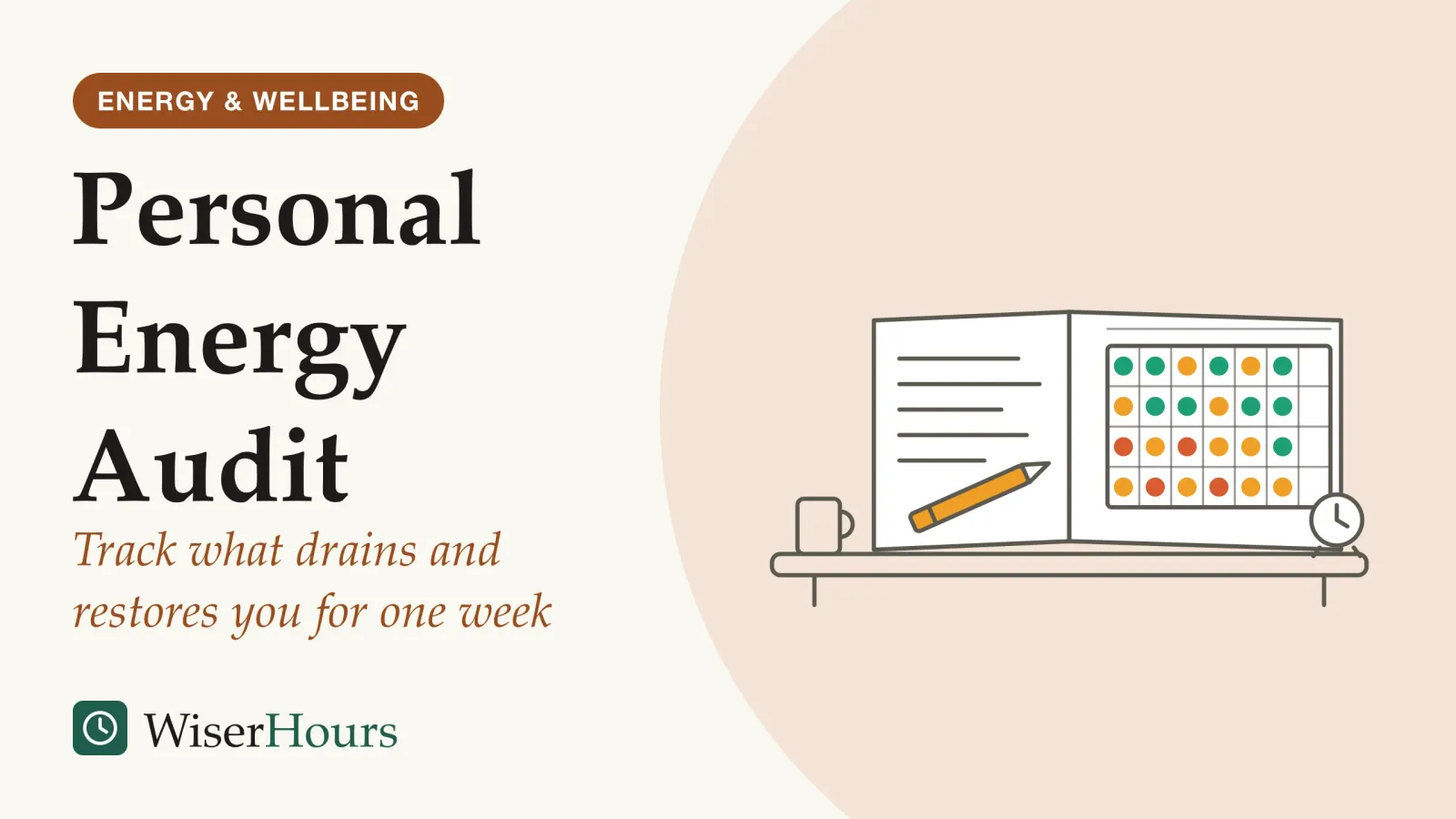
A printable log for one day looks like this; copy it seven times.
| Check-in | Energy (1-10) | Mood (1-10) | What I was doing | Who with | Note |
|---|---|---|---|---|---|
| Mid-morning | |||||
| After lunch | |||||
| Mid-afternoon | |||||
| Early evening | |||||
| Once a day | Sleep: | Meals: | Caffeine and times: | Movement or outdoors: |
3. Track for seven days, including a day off
A week is long enough to see each weekday once and short enough to finish. Research diaries run on a similar scale: the 2018 review notes that many psychiatric studies have used ten prompts a day for six days, and a 2005 study of meetings used five working days.26 Include at least one day off: the authors of the 2006 study expected moods to follow a different rhythm on days without work, though they suspected tiredness would keep much the same shape.1 If the week turns out to be unusual (a deadline, an illness, a sleepless night with a baby), run a second one.
4. Compare each rating with your usual level at that hour
At the end of the week, work out your typical score for each check-in time, then look for activities that sit clearly above or below that typical score on more than one day. This step matters most, because the time of day moves energy on its own.
The study
Moderate evidence
How tiredness rose and fell across one Texas workday (Emotion, 2006)
Arthur Stone and colleagues, Daniel Kahneman among them, asked 909 working women in Texas to rebuild the previous workday as episodes and rate 12 feelings in each. Tiredness was linked to the hour of the day more strongly than any other feeling, sharing about 18 percent of its variation with the clock. It fell to a low around lunchtime and rose steeply afterward, and the activities people were doing barely changed that daily shape.1
The authors suggest the afternoon rise may be largely physical: the longer you have been awake, the more tired you become. They studied only women and only workdays, and the funders were public and charitable bodies, including the US National Science Foundation and National Institute on Aging.1 A 2010 UK study of 94 working women found a similar curve: people felt more tired soon after waking than at midday, and tiredness rose through the evening.4 For the after-lunch slump in particular, see how meals and the afternoon dip interact.
- Morning to lunch: tiredness eases on average
- Lunch to evening: it climbs, and what people were doing barely changed that shape, so compare each rating with the same hour on other days
Compare 3 p.m. with 3 p.m. A presentation rated 4 in the late afternoon may be no drain at all if your late-afternoon average is 4; the same 4 at 10 a.m., against a usual 7, deserves a closer look.
5. Choose one or two changes to test next week
Pick one drain to cut, shorten or move to a better hour, and one restorer to add. Short breaks make a sensible first restorer: researchers in Romania who pooled break experiments in 2022 found slightly more vigor and slightly less fatigue after breaks lasting no more than 10 minutes.7 Keep everything else as it was, log a second week, and compare the same check-ins. If movement is your test, testing whether exercise lifts your energy takes several weeks.
- 1Rateenergy and mood, three or four times a day
- 2Logactivity, people, sleep, food, caffeine, movement
- 3Sortagainst your usual level at each hour
- 4Testone or two changes for a week
Then repeat from “Rate”
Once the second week is logged, its scores become the baseline for the next test.
Your one-week energy audit
How do I know what drains my energy?
An activity is a likely drain when your ratings after it fall below your usual score for that time of day, and do so on more than one day. A restorer is the reverse. Anything that lands near your usual level is neutral, however much you dread it.
Invented numbers for one office worker’s week show how the sorting works.
| Activity (illustrative) | Times logged | Rating after it | Usual at that hour | Verdict |
|---|---|---|---|---|
| Back-to-back video calls | 4 | 4 | 6 | Drain |
| Lunch with a colleague | 3 | 7 | 6 | Restorer |
| Commute by train | 5 | 5 | 5 | Neutral |
| Walk outside after lunch | 2 | 7 | 5 | Restorer, test again |
| Late-afternoon report writing | 4 | 4 | 4 | Neutral; the low score belongs to the hour |
Twice is the minimum for a verdict, which is why the walk earns “test again”. The report writing looks bad until you compare it with the hour.
Meetings, commutes and other workday drains
In daily diary research, one clear energy drain at work is a high number of meetings. In a 2005 study by Alexandra Luong and Steven Rogelberg, 37 full-time employees at a US university logged every meeting for five working days; the more meetings people had in a day, the more fatigued they felt, while the total time spent in meetings showed no clear link.6
The authors read meetings as interruptions: each one pulls you off your own work and leaves something unfinished. With a small sample, mostly in administrative jobs, the finding is a lead to check in your own log.6 Record meetings as a count as well as a duration; a day of five short calls and a day with one long workshop can look the same in hours and feel very different.
Commutes tell a different story in the 2006 Texas data. Commuting and working were linked to more frustration and less enjoyment, but not clearly to more tiredness; socializing and exercising were linked to feeling less tired.1 Rate both energy and mood at the same check-in, so a commute that sours your mood without tiring you shows up as what it is.
What a week of notes can and cannot prove
A personal energy audit shows which activities and low ratings tend to go together, and cannot prove what caused what. The 2018 review of experience sampling makes the same point about the research: most findings come from associations measured at the same time, and causes need evidence on what came first or an experiment.2
Rest shows why. In the 2006 study, napping or resting was the activity most strongly tied to feeling tired.1 The likelier reading is that tired people lie down. Your log can mislead you the same way, and the act of rating may itself change how you feel, which the 2018 review calls measurement reactivity.2
Treat each pattern as a guess and test it in step 5, one change at a time.
| What the audit relies on | What the best evidence found | Evidence |
|---|---|---|
| Tiredness follows the time of day | Lowest around lunch, highest in the evening, little changed by activity | Observational, one day each, 909 US women; moderate1 |
| Rating in the moment | Reconstructing the day afterward matched in-the-moment tiredness fairly well but underrated bedtime tiredness, most clearly before a day off | Observational comparison, 94 UK women; limited4 |
| Counting meetings | More meetings in a day linked to more fatigue; total meeting time was not | Daily diaries, 37 US employees; limited6 |
| Short breaks as a restorer | Breaks lasting no more than 10 minutes were followed by slightly more vigor and slightly less fatigue | Meta-analysis, nine samples each for vigor and fatigue; moderate7 |
If the tiredness stays after a week of changes
An audit can show what to change, but tiredness that hangs on whatever you change is a reason to get checked. The UK’s NHS lists the times to book a GP: weeks of tiredness you cannot explain, tiredness that disrupts your normal day, tiredness alongside other symptoms such as losing weight or shifts in mood, and someone hearing you gasp, snort or choke in your sleep.8 Outside the UK, take the same list to your own doctor or health service, along with the week’s log. The causes they will look for are covered in why you might always feel tired.
A few signs should not wait for an appointment. MedlinePlus says to contact a health provider straight away if fatigue comes with confusion or dizziness, blurred vision, passing little or no urine, new swelling with weight gain, or thoughts of harming yourself.5 If you are in danger or having thoughts of suicide, phone your local emergency number now; in the US, the 988 Suicide & Crisis Lifeline takes calls and texts free and in confidence, day and night.9
The bottom line
Your energy has a daily shape before anything else touches it, so ask which activities push you above or below your usual level for that hour. Start tomorrow: set three or four alarms, rate energy and mood out of 10, write a line on what you were doing, and after seven days pick one drain and one restorer to test.
This article is general information, not medical advice. If you're worried about your health, talk to a doctor or another qualified professional.
Frequently asked questions
Should I use an app or paper for an energy audit?
Either works if it lets you rate in the moment. A 2010 UK study of 94 working women found that rebuilding the previous 24 hours afterward matched in-the-moment tiredness ratings fairly well but underrated tiredness at bedtime, most clearly on the Friday night before a day off. Use whatever you will open three or four times a day: a phone alarm with a notes app, or a printed sheet in your bag.
Can I track energy with a smartwatch instead of ratings?
A watch records sleep and movement, which belong in the log, but it does not record how energetic you feel. The research behind energy audits, such as the day reconstruction method of Daniel Kahneman and colleagues, rests on people's own ratings of their feelings. Keep the watch data as context and still write down your own score.
What if my scores barely change all week?
A flat week is a result too. It may mean your days are much alike, or that a 1-10 scale is too coarse for you; try describing each check-in with one word as well. If you feel drained whatever the week contains, the UK's NHS advises a GP visit once the tiredness has gone on for weeks with no reason you can find; elsewhere, see your own doctor.
Sources
- A population approach to the study of emotion: Diurnal rhythms of a working day examined with the day reconstruction method. Stone, A. A., Schwartz, J. E., Schkade, D., Schwarz, N., Krueger, A. & Kahneman, D. (2006). Emotion, 6(1), 139-149
- Experience sampling methodology in mental health research: new insights and technical developments. Myin-Germeys, I., Kasanova, Z., Vaessen, T., et al. (2018). World Psychiatry, 17(2), 123-132
- A survey method for characterizing daily life experience: the day reconstruction method. Kahneman, D., Krueger, A. B., Schkade, D. A., Schwarz, N. & Stone, A. A. (2004). Science, 306(5702), 1776-1780
- A comparison of affect ratings obtained with ecological momentary assessment and the day reconstruction method. Dockray, S., Grant, N., Stone, A. A., Kahneman, D., Wardle, J. & Steptoe, A. (2010). Social Indicators Research, 99(2), 269-283
- Fatigue. MedlinePlus Medical Encyclopedia, US National Library of Medicine (review date 19 May 2025)
- Meetings and more meetings: the relationship between meeting load and the daily well-being of employees. Luong, A. & Rogelberg, S. G. (2005). Group Dynamics: Theory, Research, and Practice, 9(1), 58-67
- "Give me a break!" A systematic review and meta-analysis on the efficacy of micro-breaks for increasing well-being and performance. Albulescu, P., Macsinga, I., Rusu, A., et al. (2022). PLOS ONE, 17(8), e0272460
- Tiredness and fatigue. NHS (UK), page last reviewed 2 June 2023
- 988 Suicide & Crisis Lifeline. 988 Suicide & Crisis Lifeline (US)
How we researched this
We searched PubMed, PubMed Central and Google Scholar in October 2026 for experience-sampling and day-reconstruction studies of tiredness, daily diary studies of work and fatigue, and reviews of the method, and checked NHS and MedlinePlus guidance on fatigue. We read five studies and both health pages in full; the 2004 day reconstruction paper was read as an abstract only. Sources date from 2004 to 2025. Main limitation: no trial has tested whether a personal energy audit itself improves energy.
Keep reading
Why Am I Always Tired? Common Causes and When to See a Doctor
Why am I always tired? In a review of 26 primary-care studies, depression was found in about 1 in 5 tired patients, serious physical disease in about 4 in 100.
Zone 2 Training Explained: Sorting the Trend From the Evidence
Zone 2 training is easy, conversational cardio. A 2025 review found no good evidence it beats harder exercise for mitochondria or fat-burning capacity.
Healthy Snacks for Work: What to Keep in Your Drawer
Healthy snacks for work in 3 lists (drawer, fridge, bag) built on protein, fibre and healthy fat, with portion sizes and notes for allergies and diabetes.
Walking After Meals: What Research Shows About a Short Stroll
Walking after meals for 10 to 20 minutes eased the rise in blood sugar in small trials. What research shows on timing, pace, digestion and weight.