Applicant Tracking Systems: Facts, Myths, and What Actually Gets Read
An applicant tracking system files, parses, filters and ranks applications. Where the 75 percent rejection myth began, and what really screens you out.

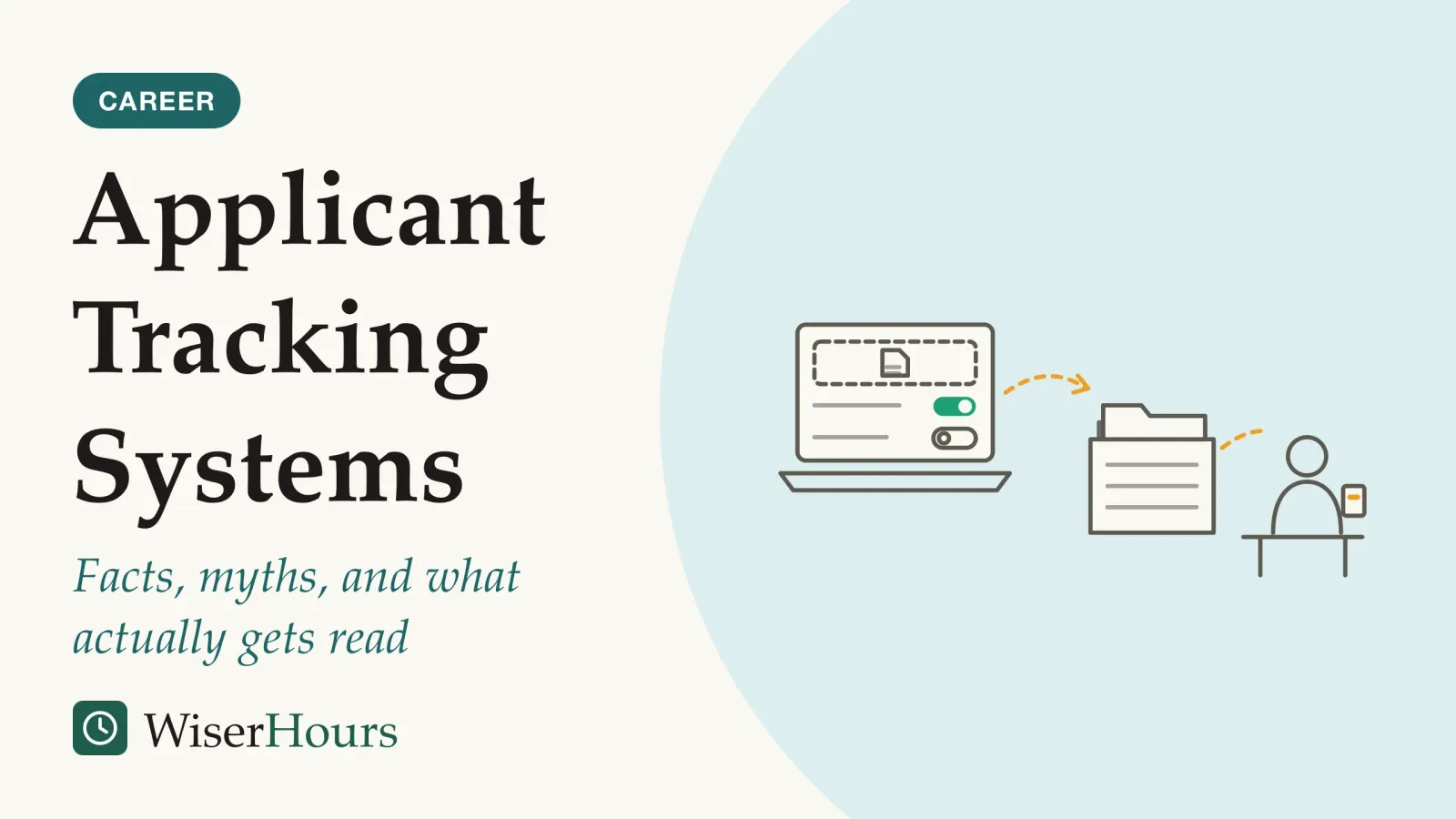
In March 2012, Computerworld passed on a striking claim from Preptel, a company that sold job seekers a service for getting past hiring software: applicant tracking systems, it said, end 75 percent of candidates’ chances of an interview the moment they apply. No study, sample or method came with the figure, and we found none published since.1 An applicant tracking system is mostly a filing and workflow tool: it stores applications, reads resumes (CVs in much of the world) into fields, applies filters the employer switches on, and sorts candidates for a person to review. The automatic rejections that vendors document come from rules an employer sets, mostly knock-out questions about hard requirements such as a required license, not from software judging your layout.2
For an applicant, that leaves three things worth your care: the screening questions on the form, a file the software can read, and when you apply. Each gets a concrete check below.
This page covers one stage of a search, the stretch between pressing submit and hearing back. If you are just beginning, planning the first weeks of a job search comes first.
An applicant tracking system is a filing clerk first
An applicant tracking system is workflow software that records every application and tracks it through each step of hiring, as the 2021 Hidden Workers report from Harvard Business School and Accenture defines it. For an applicant, four of its jobs matter: storing, parsing, filtering and ranking. Filtering and ranking are where decisions start: employers can set requirements, such as a degree or a professional license, to cut the pool, then sort whoever remains by other preferences, such as a minimum period of experience or particular keywords in the resume or application.3
Storing is the dull part and the biggest one. Your application becomes a record holding the file you uploaded, your answers to the form and where you stand in the process. Parsing is the system reading your resume and copying details such as your name, contact details, employers and dates into those fields. Greenhouse, one vendor, describes it in a help page for recruiters adding candidates as scanning a resume and filling in the fields it detects; when that fails, the file is simply attached and someone has to type the details in by hand.4
Large employers almost all use such a system. Jobscan, a company that sells resume-scanning software, reviewed the job listing pages of every Fortune 500 company in 2026 and detected a system at all but 13 of them.5 That is a count of big US firms; in the Hidden Workers survey, use was less common in the UK and Germany than in the US, so a small employer anywhere may still be reading applications from an inbox.3
A made-up but typical case shows the sequence. A clinic advertises a receptionist job and a few hundred applications arrive in a week. The system files every one and parses the resumes into profiles. One form question asks whether applicants have the right to work in the country. A recruiter then opens the list, newest first, and starts reading. Only one step in that sequence rejected anyone without a person, and it was a question on the form.
- Store: every application becomes a record: your file, your answers, your stage
- Parse: the resume is read into fields; a failed parse leaves fields to fill by hand
- Filter: acts only on rules the employer sets, such as knock-out questions; the one step that can reject without a person
- Rank: sorts who a recruiter sees first; the least measured step
Where the “75 percent rejected by a robot” claim came from
The 75 percent figure traces back to a single company, Preptel, which sold job seekers a way past applicant tracking systems; the 2012 Computerworld report that carried it rested on Preptel’s word alone.1
Christine Assaf followed the figure back through career sites and news stories in a 2020 post on the HR blog HRtact. The trails that named any source at all led to Preptel, which, she reported, had gone out of business in August 2013. Her explanation for why the claim lasted is commercial: career services and resume writers benefit when job seekers believe a computer is rejecting them.6
Enhancv, a company that sells a resume builder, is also the source of the most direct recent check. In structured interviews with 25 US recruiters in late 2025, 23 said their systems did not reject resumes automatically for formatting, content or design; the two exceptions had deliberately set match or experience thresholds. The recruiters said they mostly heard the claim from job seekers repeating it on social media, and from career coaches and resume blogs.7 That is a convenience sampleconvenience sample: A group of study participants chosen because they were easy to reach, such as students, app users or online volunteers, rather than drawn at random from the population of interest. Results from such samples may not hold for other people.Full entry in the glossary of one country’s recruiters, collected by a firm with a product to sell, and not peer reviewed. It shows that content-based automatic rejection exists but has to be switched on; it cannot tell you how common it is.
- Myth
- Applicant tracking software rejects 75 percent of resumes before a person sees them.
- Fact
- The figure comes from a 2012 claim by Preptel, a company selling a way past the software. We found no published study behind it.
So when a career post warns that three in four resumes never reach a human and links to nothing, ask who measured it and what they were selling. A number without a method is a slogan, however often it is repeated.
Knock-out questions are where automatic rejection is documented
In the documentation of three widely used systems, Greenhouse, Oracle Taleo and SAP SuccessFactors, automatic rejection runs on answers to application questions, not on the resume. Greenhouse’s auto-reject feature lets an employer reject anyone who gives a chosen answer to a yes-or-no or multiple-choice question, assign a rejection reason and send the email, all without a person.2
The other two work the same way. Oracle’s Taleo documentation describes disqualification questions that hold the minimum requirements for a job, such as whether a candidate is entitled to work in the country, and says the answers decide whether candidates move forward or are automatically disqualified.8 SAP’s knowledge base for SuccessFactors adds a telling detail: free-text questions cannot be set as disqualifiers, because the system has no way to identify a correct answer.9
That detail explains the pattern. In these question features, software can reject automatically only where an answer is clearly right or wrong, and a yes-or-no question is the easiest place to find one. Greenhouse’s own example is a trucking job that asks whether the applicant holds the required class of commercial driver’s license. Even this is optional: in Greenhouse, auto-reject is limited to its higher subscription tiers, and an employer has to create each rule.2
Take an invented example. A form asks whether you have at least five years of experience managing budgets, and you have four and a half. Ticking no may end the application; ticking yes is untrue, and may be tested at interview. The honest options are to answer accurately, or to ask the recruiter before applying whether the minimum is firm.
Read every screening question before you start the form, and answer each one literally: these few clicks carry more weight than any choice of font.
What employers say they filter on
The best evidence on how employers set these rules is a survey, not a measurement. For the Hidden Workers report, Harvard Business School and Accenture asked executives in Germany, the UK and the US which criteria their recruiting software used to rank or filter candidates at the first screen.3
The study
Limited evidence
What 2,275 executives said their hiring software screens for
Of executives whose organizations used recruiting software, more than 90% said it filtered or ranked candidates at the first screen. Among those, the report says 48% filtered middle-skills candidates with a gap in employment of more than six months. And 88% of organizations using such software said their hiring system at least sometimes filters out high-skills candidates who could do the job but do not fit the exact criteria in the job description.3
These are executives describing their own settings, a self-reportself-report: A measure in which people describe their own behavior, feelings or circumstances, usually by answering a questionnaire. When the same person supplies both of the things being compared, shared habits of answering can make the link between them look stronger than it is.Full entry in the glossary, not a count of rejected applications. The question did not separate software filtering from a recruiter applying the same rule by hand, and the report’s own chart seems to file the gap figure under ranking, so read it as ranking or filtering. Two of the authors hold senior roles in Accenture’s talent consulting practice, the lead author is a paid member of an Accenture program, and the survey predates the AI match scores recruiters described in 2025.
The survey and the recruiter interviews look contradictory, but they fit together. A gap filter is a rule on a data field, the dates in your work history, much like a knock-out question on the form. Picture two applicants with the same skills, one of them out of work for eight months last year: where such a rule is switched on, the software reads the dates, not the reason behind them. Recruiters can truthfully say the software does not judge resume content while their employer screens on a rule of this kind. How to present a gap belongs to the guide on explaining an employment gap on a resume.
UK professional guidance leans the same way. The CIPD, the professional body for HR and people development, tells employers to assess any recruitment technology before adopting it, to check it has been properly tested and is fair and inclusive, and to tell candidates in advance what technology the selection process will use.10
Guidance in other countries may differ, but nothing stops you asking. A short question to the recruiter about what the first screening stage involves costs nothing and can tell you where the real filters sit.
Which formatting choices really break parsing
Greenhouse’s help pages list what can make its parser fail or work only partly: resumes uploaded as an image, graphics and word art, tables, headers and footers, columns, contact details placed in a header, footer or text box, and letters spaced apart for style. Files over 2.5 MB cannot be parsed at all.4
The consequence is less dramatic than the myth. A failed or partial parse leaves a profile with missing or garbled fields that someone must correct by hand; the documentation says the file is still attached, not that the application is rejected. That still matters in a busy week, because a profile with no job titles or dates is harder to read quickly. Greenhouse gives the reason for one of them: letters spaced apart for style are not recognized as a single word, so the parser cannot make sense of the data.4 The same page notes that abbreviated job titles and company names without an identifier such as Inc. or Ltd can also parse only partly.
Some famous advice has aged badly. In the 2012 article, Preptel’s chief executive told job seekers never to send a PDF.1 Greenhouse today lists .pdf among the file types it accepts for resumes, alongside .doc, .docx, .rtf and .txt.11 What trips its parser, as the list above shows, is a PDF that is really a picture of text, such as a scan.
The paste test is our own idea and untested as a method; we suggest it because it copies the text out of the file much as a parser must, so an empty or jumbled paste is a warning sign. It says nothing about how well the resume is written, which is a different question.
Ranking: the part nobody has measured
Ranking decides whose application a recruiter opens first, and it is the least measured step. We found no independent study of how rankings inside these systems change who gets an interview.
What exists is documentation and self-report. Taleo’s prescreening flags top candidates from their answers to questions and their stated competencies, and recruiters can reset the thresholds if the pool of top candidates is too small.8 In the Enhancv interviews, several recruiters had match scores available, and most who had them said they used the scores as a rough guide, not a verdict.7 AI-generated match scores are a newer layer with their own evidence, and a topic for another article.
The same interviews point to a more ordinary problem than algorithms: volume. Recruiters described roles that drew hundreds of applications within days, postings paused to catch up, and interviews that began before the last applications were read. About half of those recruiters said applying early helps, because they review applications in the order they arrive; about a third said it makes little difference.7 No study we found has measured the effect, but applying early for roles you want costs nothing.
Here is where each common belief stands.
| Statement | What the best evidence found | Evidence |
|---|---|---|
| Software rejects 75 percent of resumes | Traces to a 2012 claim by Preptel, with no published method | Company claim, no data1 |
| Knock-out questions can reject automatically | Documented as an employer-set rule in Greenhouse, Taleo and SuccessFactors | Vendor documentation8 |
| Employers filter on credentials and employment gaps | Reported by executives in the US, UK and Germany | Survey, limited3 |
| Images, text boxes, columns and tables break parsing | Partial or failed parse, corrected by hand; file still attached | Vendor documentation4 |
| Few recruiters auto-reject on resume content | 23 of 25 US recruiters said their systems did not | Company research, limited7 |
| Rankings change who gets interviewed | Described in vendor documentation; not measured by any independent study we found | Gap8 |
The last five minutes before you apply
A short routine covers the parts of an application that software actually acts on: the questions, the file and the timing. Every item but the paste test comes from the sources above.
Questions, file, timing
What you write in the resume, and how you match it to each advertisement, still decides what the person reading it thinks. Those questions belong to guides on writing the resume itself.
The bottom line
An applicant tracking system is mainly a filing cabinet with a sorting button, and the 75 percent rejection figure has no published study behind it. The automatic rejections that are documented come from rules employers choose, above all knock-out questions, so give those questions your full attention and keep your file plain enough for a parser to read.
Frequently asked questions
How can I tell which applicant tracking system an employer uses?
The job listing's web address is usually the clue. Jobscan, a company selling resume-scanning software, identified the systems used by Fortune 500 companies by reviewing their job listing pages, and says its own tool detects the system from the URL of a job. Knowing the vendor tells you which features exist, not which rules this particular employer has switched on, so the screening questions still matter most.
Are online resume match scores accurate?
We found no independent test of how well commercial match checkers predict what an employer's system does. They estimate how closely your resume's wording matches an advertisement, but each employer configures its own system, and in the 2025 Enhancv interviews most recruiters who had a match score said they used it only as a guide. Treat a score as a prompt to check your wording, not a prediction.
Does a rejection email that arrives within minutes mean software rejected me?
It may. Greenhouse's documentation shows that when an applicant gives an answer the employer has set to trigger auto-reject, the system can assign a rejection reason and send the email without anyone reviewing the application. A near-instant rejection therefore more likely came from one of your answers to the form's questions, not from how your resume looked. Check those answers against the advertisement before applying for a similar role.
Sources
- 5 insider secrets for beating applicant tracking systems. Levinson, M. (2012). Computerworld, 4 March 2012 (by a CIO.com writer); figure attributed to Preptel, a job-search services company
- Auto-reject. Greenhouse Software, vendor help documentation, last updated 30 January 2026 (accessed 2026-09-27)
- Hidden Workers: Untapped Talent. Fuller, J. B., Raman, M., Sage-Gavin, E., Hines, K., et al. (2021). Harvard Business School Project on Managing the Future of Work, with Accenture; employer survey fielded January-February 2020
- Unsuccessful resume parse. Greenhouse Software, vendor help documentation, last updated 2 March 2026 (accessed 2026-09-27)
- 2026 ATS Usage Report. Purcell, K. (20 August 2026). Jobscan, a company selling resume-scanning software; company research, not peer reviewed (accessed 2026-09-27)
- Your job application was rejected by a human, not a computer. Assaf, C. (2020). HRtact blog, 5 October 2020
- Does the ATS Reject Your Resume? 25 Recruiters Explain What Really Happens. Enhancv (2025), a resume-builder company; 25 structured interviews with US recruiters, September-October 2025; company research, not peer reviewed
- Understanding the Prescreening Section in the Requisition. Oracle, Taleo Enterprise Edition: Using Recruiting, vendor documentation (accessed 2026-09-27)
- 2204476 - How Pre-Screening Questions Feature Works in Recruiting Module. SAP SuccessFactors Recruiting Management, SAP Knowledge Base Article, vendor documentation (accessed 2026-09-27)
- Selection methods. CIPD (Chartered Institute of Personnel and Development), UK, factsheet dated 22 September 2026 (accessed 2026-09-27)
- Supported formats for resumes, cover letters and other candidate uploads. Greenhouse Software, vendor help documentation, last updated 19 August 2026 (accessed 2026-09-27)
How we researched this
We searched the web, vendor help centers and Crossref in September 2026 for studies, surveys and documentation on how applicant tracking systems screen applications, and traced the 75 percent claim to its earliest source we could find. Sources date from 2012 to 2026. Main limitation: no independent study measures how many applications these systems reject, so this article relies on an employer survey, vendor documentation and company research, each labelled.
Keep reading
The STAR Method Explained: How to Structure Behavioral Answers
STAR, which DDI says it introduced in 1974, mirrors how structured interviews are rated. What each letter means and how to build an answer a rater can score.

How to Prepare for a Job Interview: A Complete Checklist
A 5-step job interview preparation checklist drawn from coaching studies, US federal hiring guidance and US and British rules on interview questions.

How to Write a Cover Letter That Gets Read
Cover letters are barely studied. What a 2025 study of 183 co-op students, a US audit experiment and hiring research suggest about writing one.

How to Start a Job Search: A Step-by-Step Plan
How to start a job search in 7 steps, built on a 2014 meta-analysis of 47 job search programs, a LinkedIn experiment and US labor data.