12 Early Warning Signs of Burnout You Shouldn't Ignore
12 early signs of burnout, mapped to the WHO's three dimensions and validated scales, what else each could mean, and when a doctor should look.

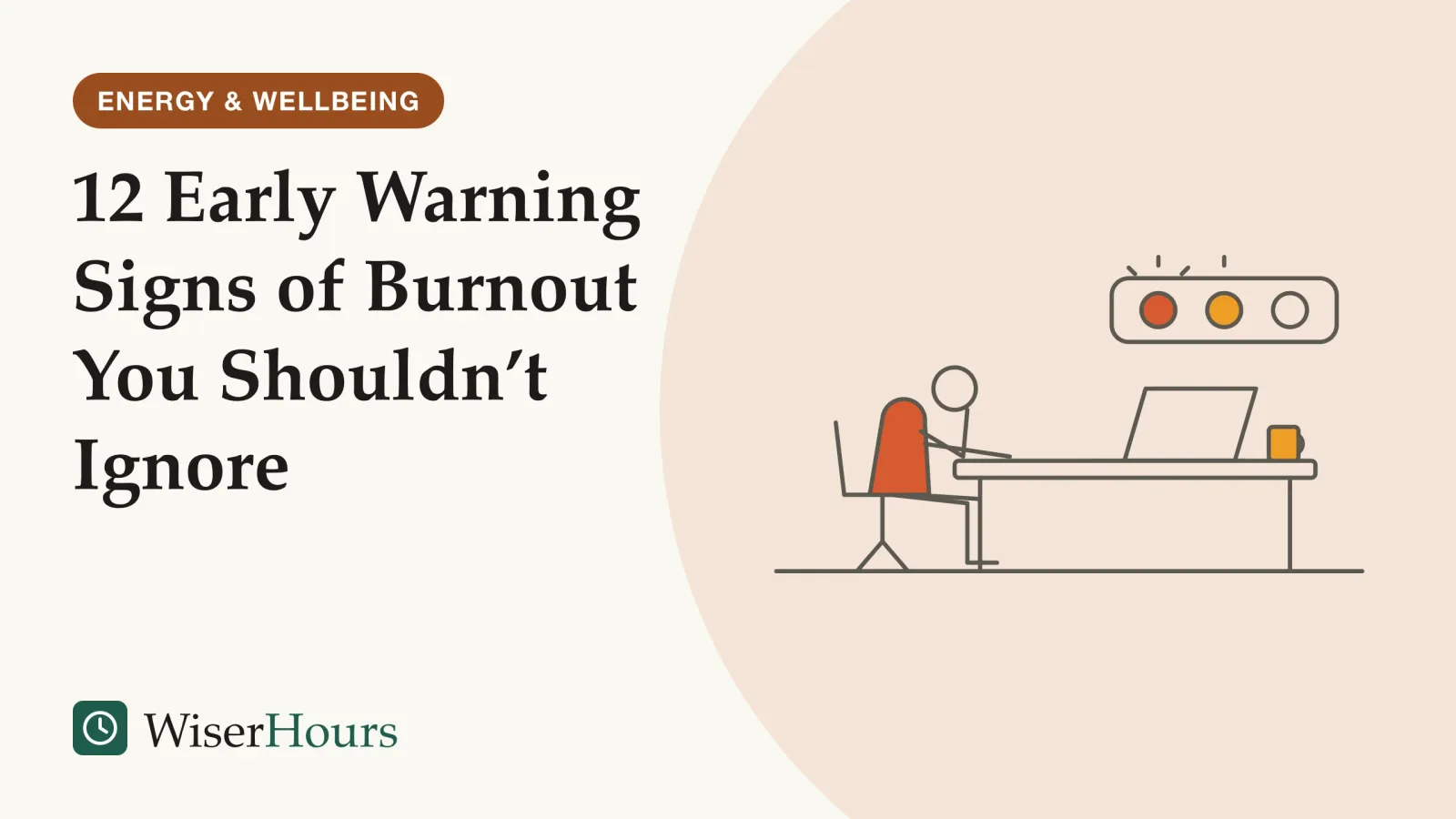
Monday starts with the same heaviness Friday ended with. An email that once took five minutes sits half-written until lunch, and a colleague’s harmless question gets a sharper answer than it deserved. None of it looks like a crisis, which is why moments like these are so easy to explain away.
The early signs of burnout are changes in energy, attitude and performance at work that build over weeks, not a single bad day. They match the three dimensions of burnout in the WHO’s ICD-11ICD-11: The World Health Organization's International Classification of Diseases, eleventh revision, the global standard for recording diseases and health conditions, in effect since 2022. It also lists some factors that are not illnesses, such as burnout, classed as an occupational phenomenon.Full entry in the glossary classification, plus the thinking, emotional and bodily complaints that newer questionnaires add:12
- Tiredness a weekend does not fix
- Every task takes more effort
- Doing the minimum and keeping work at arm’s length
- Cynicism about the job or the people it serves
- Feeling you no longer do the job well
- Trouble concentrating and remembering
- Irritability and outsized reactions
- Sleep that stops restoring you
- Headaches, aching muscles or an unsettled stomach
- Picking up every bug going
- More sick days, or daydreaming about quitting
- Low mood that follows you home
To use the list, mark the signs that are new compared with six months ago and note how many weeks each has lasted. New signs that have held for several weeks, especially tiredness, deserve attention; a single rough week does not. No sign proves burnout on its own, and most overlap with other conditions, so the list tells you when to get checked, not what you have. The full definition is in our guide to the WHO’s burnout definition.
How the early signs of burnout fit the WHO’s three dimensions
In ICD-11, the WHO names three parts of burnout: feeling drained of energy, growing distant or cynical about the job, and feeling less effective at it, all arising from long-running stress at work that has not been handled well.1 Most early signs are small, everyday versions of one of those three, noticed before they settle in.
They also tend to arrive in a rough order. A 2005 Dutch analysis by Toon Taris and colleagues, which followed workers over time, found that exhaustion tended to come first and cynicism to follow, while a falling sense of efficacy developed more on its own.3 Christina Maslach and Michael Leiter describe the distancing as a way of coping with overload: when energy runs low, people pull back from the work that is draining it.4
That coping move can feed the problem. A 2020 meta-analysismeta-analysis: A study that combines the results of earlier studies on the same question into one overall estimate. Pooling makes the estimate more precise, but it cannot repair the studies it pools: a meta-analysis of surveys is still survey evidence.Full entry in the glossary of long-term studies by a German team led by Christina Guthier found that job stressors predicted later burnout, and that burnout predicted a later rise in the stressors people reported even more strongly.5 In plain terms, a worn-out person experiences the same job as harder, which wears them out further.
- 1Heavy demandschronic stress at work
- 2Exhaustionusually the first sign
- 3Pulling awaydistance to save energy
- 4The job feels harderstressors seem bigger
Then repeat from “Heavy demands”
Picture a nurse running low who starts skipping small talk with patients to save energy. The shifts feel more mechanical, the work feels less worth doing, and the next shift feels heavier still. The loop is easier to break at the first lamp than the fifth.
It matters for health, too. A 2017 systematic reviewsystematic review: A review that fixes its question and its rules for including studies in advance, then searches out every study that fits and weighs them together. Some systematic reviews pool the results into a meta-analysis; others describe what the studies found without combining the numbers.Full entry in the glossary of prospective studies, from Brazil, linked burnout to later insomnia, depressive symptoms, heart disease and type 2 diabetes.6 Those are links, not proof that burnout caused them, but they are a good reason to act on the early signs rather than wait.
So keep an eye on your energy before anything else, since exhaustion usually shows up first, and treat a new habit of pulling away as a sign of low reserves rather than a bad attitude.
- Signs 1 to 5: the three WHO dimensions: exhaustion, mental distance or cynicism, and a sense of ineffectiveness
- Signs 6 and 7: trouble thinking clearly and keeping emotions in check, core symptoms in the Burnout Assessment Tool
- Signs 8 to 11: sleep, aches, frequent illness and time off, secondary signs that long-term studies link to burnout
- Sign 12: low mood that follows you out of work, where burnout and depression start to overlap
Signs 1 to 5: running low, pulling away, doubting yourself
The first five signs are the ICD-11 dimensions in everyday form: two for exhaustion, two for mental distance and one for ineffectiveness. They are the best-measured signs on this list, because the main burnout questionnaires, from the Maslach Burnout Inventory to the newer Burnout Assessment Tool, ask about them directly.2
1. Tiredness a weekend does not fix
This is emotional exhaustionemotional exhaustion: Feeling drained and used up by work, with little energy left. It is the exhaustion dimension of burnout, one of three, and on its own it is not a diagnosis; persistent exhaustion is worth raising with a doctor.Full entry in the glossary, the core of burnout in every major model: you rest, and the tank does not refill. It could also be anaemia, diabetes, a thyroid problem, poor sleep or stress outside work. According to the NHS in the UK, tiredness lasting a few weeks with no obvious reason, or that interferes with everyday life, is worth raising with a GP.7 Before blaming the job, it helps to rule out the everyday and medical reasons people feel tired all the time.
2. Every task takes more effort
Exhaustion is mental as well as physical: starting things feels hard, and ordinary tasks take a push they did not used to. NIMH, the US National Institute of Mental Health, lists fatigue, trouble concentrating, irritability, sleep problems and unexplained aches among the symptoms of depression, so this sign and several others on the list cannot tell the two apart on their own.8
3. Doing the minimum and keeping work at arm’s length
Mental distance, the second of the WHO’s three dimensions, looks like camera off, ideas unvolunteered and enthusiasm gone. It can also be a sensible reaction to a job that has changed for the worse, which is why it helps to ask which part of the work is pulling against you.
4. Cynicism about the job or the people it serves
Maslach’s questionnaire first called this depersonalization, from studies of care workers who began to see patients as cases; the version for all jobs renamed it cynicismcynicism: In burnout research, a distant or negative attitude toward one's job, the people in it or its purpose. The WHO's description of burnout names it as mental distance from, or cynicism about, one's job.Full entry in the glossary.4 A burst of it after a genuinely unfair decision is not a warning sign. A steady drift toward “none of this matters” is.
5. Feeling you no longer do the job well
This is the WHO’s sense of ineffectiveness. Because it seems to develop partly apart from exhaustion, as the Taris analysis found, it can show up in people who do not yet feel tired. A new role, missing training or too few resources can produce the same feeling, and deserve a practical fix first.
The pattern worth acting on is several of these five together, lasting weeks, with tiredness usually arriving first.
Signs 6 and 7: when thinking and feelings start to slip
Trouble thinking clearly and keeping emotions in check are core symptoms in the Burnout Assessment Tool, developed in 2020 by Wilmar Schaufeli and colleagues and tested in Belgium and the Netherlands, although the WHO definition does not name them.2 Sweden’s exhaustion disorder, a diagnosis often described as clinical burnout, also lists problems with concentration and memory.9
6. Trouble concentrating and remembering
You reread a paragraph three times, walk into a meeting without the file, or cannot decide between two simple options. Poor concentration is also on NIMH’s list of depression symptoms, so the same fog can have another source.8 If it is constant or getting worse, mention it to a doctor.
7. Irritability and outsized reactions
A frozen laptop gets a slammed lid; a small request gets a sharp reply. The Burnout Assessment Tool calls this emotional impairment, a loss of control over reactions at work.2 Irritability appears on the same NIMH list of depression symptoms, as noted under sign 2.
The lesson from both: a change from your own baseline counts more than the behavior itself. Someone who has always been blunt is not showing a new sign; someone who has always been patient may be.
Signs 8 to 11: what your body and your attendance show
Physical complaints and time off work are secondary signs: they are not part of the WHO definition, but the Burnout Assessment Tool counts psychosomatic complaints as secondary symptoms, and long-term studies link burnout to them. The strongest summary of that evidence is the 2017 review from Brazil.
The study
Moderate evidence
Burnout first, health measured later: prospective studies reviewed in Brazil, 2017
Researchers at the State University of Londrina in Brazil gathered studies that measured burnout first and people’s health and work later. Burnout predicted physical outcomes such as heart disease, type 2 diabetes, musculoskeletal pain, headaches, and gastrointestinal and respiratory problems; psychological outcomes such as insomnia and depressive symptoms; and work outcomes such as sickness absence and job dissatisfaction.6
Measuring burnout before the outcome rules out some explanations but not all: people already becoming ill may have been more likely to burn out. Read each sign below as a link worth checking, not a verdict.
8. Sleep that stops restoring you
Lying awake replaying the day, or waking at 4 a.m. with the inbox in your head, fits insomniainsomnia: Trouble falling asleep, staying asleep or waking too early despite having the chance to sleep, with effects on how you feel or function during the day. It is called chronic when it lasts for months; short spells after stress are common.Full entry in the glossary, one of the outcomes the review found. Sleep problems have many other causes, from shift work to a medical sleep disorder, so read up on why insomnia starts and the forms it takes before blaming work.
9. Headaches, aching muscles or an unsettled stomach
Musculoskeletal pain, headaches and gastrointestinal problems all appear in the review. Each has plenty of ordinary physical causes, and depression can also show up as aches without a clear physical cause, as NIMH notes.
10. Picking up every bug going
Respiratory problems were among the outcomes, but this is the thinnest link on the list. Young children at home, a crowded commute or the time of year can explain frequent colds just as well, so treat this sign as weak on its own.
11. More sick days, or daydreaming about quitting
Sickness absence and job dissatisfaction were among the work outcomes linked to burnout. A sudden run of odd days off, or a job-search tab that stays open, is often the point where others notice.
The sensible order with any new physical symptom is a check-up first and a look at work second.
Sign 12: low mood that follows you home
When low mood and lost interest spread from work into evenings, weekends and things you used to enjoy, the picture may be moving from burnout toward depression. In a Finnish study that followed dentists for three years, Kirsi Ahola and Jari Hakanen found that burnout predicted new depressive symptoms.10
The WHO limits burnout to work; depression has no such boundary. Researchers still disagree about how far the two overlap, and Renzo Bianchi and Irvin Sam Schonfeld caution that calling it burnout can leave depression unrecognized and untreated.11
The practical meaning is that where the low mood lives tells you something, and a quick check makes it visible.
The weekend check
Notice whether your mood lifts on a free day. If it does, work may be a large part of the problem. If it stays flat through weekends and a longer break, see a doctor, whatever the right name turns out to be.
How much weight each sign can bear
The signs on this list do not stand on equal ground. The first five come straight from the WHO definition and decades of questionnaire research; the physical signs rest on long-term observational studies, and some on only a few of them.
| Sign | Where it comes from | Evidence |
|---|---|---|
| 1-5. Exhaustion, distance, cynicism, feeling ineffective | The three ICD-11 dimensions, measured by every major questionnaire | Classification and validated scales, consistent1 |
| 6-7. Thinking and emotional control | Core symptoms in the Burnout Assessment Tool | One validation study in Belgium and the Netherlands, moderate2 |
| 8-11. Sleep, aches, illness, absence | Secondary; outcomes in long-term studies | Systematic review of observational studies, moderate to limited6 |
| 12. Low mood beyond work | Overlap with depression | Long-term study of Finnish dentists, moderate10 |
In practice, give most weight to the first five signs when they persist, and treat the physical signs as reasons for a check-up rather than proof of burnout.
Tiredness, low mood or chest pain: how quickly to act
Thoughts of suicide or self-harm, or sudden chest pain, call for help straight away. Weeks of unexplained tiredness, or low mood most days for two weeks, call for a doctor soon. These routes draw on NHS (UK) and NIMH (US) guidance, and the urgency grouping is ours.
- Now: phone your local emergency number, such as 112 anywhere in the European Union.12 For a life in danger, the NHS in the UK advises 999 or A&E, and Samaritans can be called free on 116 123.13 The US has the 988 Lifeline, reachable by call, text or chat for suicidal crisis or emotional distress.14 In the UK, the NHS treats sudden chest pain that does not go away, or pain spreading to the arms, neck, jaw, stomach or back, as a 999 emergency; anywhere, it is never a burnout sign to wait out.15
- Soon: book a doctor’s appointment for tiredness you cannot explain after a few weeks, or tiredness that arrives with weight loss or changes in mood.7 Feeling low or losing interest on most days for two weeks or more also warrants a doctor’s visit soon.8 For urgent mental health help that is not an emergency, the NHS in the UK points to 111 and its mental health option.13
- At a routine appointment: raise signs 1 to 5 if they keep returning even though you are coping. Wherever you live, start with a family doctor or local primary care service, and check how your own country’s health system works.
Notes to take to the appointment
Once other causes are ruled out, a realistic plan for recovering from burnout covers what to change next.
The bottom line
The earliest sign of burnout is usually tiredness that rest does not fix, followed by a quiet pulling away from work. Most signs overlap with other conditions, so the useful move is not self-diagnosis but a doctor’s check once a sign lasts a few weeks. Act while it is one or two lamps, not twelve.
This article is general information, not medical advice. If you're worried about your health, talk to a doctor or another qualified professional.
Frequently asked questions
Do I need all 12 signs before it counts as burnout?
No. There is no agreed number of signs or cutoff score for burnout, and the WHO's ICD-11 gives no diagnostic criteria. A few signs that persist for weeks, especially exhaustion, are worth taking seriously, while one bad week with several of them may simply be a bad week. The pattern over time matters more than the count.
Do the early signs appear in a fixed order?
Not reliably. A Dutch long-term study by Toon Taris and colleagues found that exhaustion tended to come before cynicism, while a falling sense of efficacy developed more on its own. Popular lists of set stages go further than the research does, so treat any sequence as a tendency, not a timetable.
Is a high score on a burnout questionnaire a diagnosis?
No. Writing in the WHO's Bulletin in 2023, Renzo Bianchi and Irvin Sam Schonfeld point out that no valid diagnosis of burnout exists after decades of research. A questionnaire score shows how you rated your own feelings on one day. It can be a useful prompt to book an appointment, where a doctor can look for other causes.
Sources
- QD85 Burnout. World Health Organization, ICD-11 for Mortality and Morbidity Statistics (2026-01 release)
- Burnout Assessment Tool (BAT): Development, Validity, and Reliability. Schaufeli, W. B., Desart, S. & De Witte, H. (2020). International Journal of Environmental Research and Public Health, 17(24)
- Are there causal relationships between the dimensions of the Maslach Burnout Inventory? A review and two longitudinal tests. Taris, T. W., Le Blanc, P. M., Schaufeli, W. B. & Schreurs, P. J. G. (2005). Work & Stress, 19(3)
- Understanding the burnout experience: recent research and its implications for psychiatry. Maslach, C. & Leiter, M. P. (2016). World Psychiatry, 15(2)
- Reciprocal effects between job stressors and burnout: A continuous time meta-analysis of longitudinal studies. Guthier, C., Dormann, C. & Voelkle, M. C. (2020). Psychological Bulletin, 146(12)
- Physical, psychological and occupational consequences of job burnout: A systematic review of prospective studies. Salvagioni, D. A. J., Melanda, F. N., Mesas, A. E., et al. (2017). PLOS ONE, 12(10)
- Tiredness and fatigue. NHS (UK), page last reviewed 2 June 2023
- Depression. National Institute of Mental Health, National Institutes of Health (NIH Publication No. 24-MH-8079, revised 2024)
- Exhaustion disorder: scoping review of research on a recently introduced stress-related diagnosis. Lindsäter, E., Svärdman, F., Rosquist, P., et al. (2022). BJPsych Open, 8(5)
- Job strain, burnout, and depressive symptoms: a prospective study among dentists. Ahola, K. & Hakanen, J. (2007). Journal of Affective Disorders, 104(1-3)
- Examining the evidence base for burnout. Bianchi, R. & Schonfeld, I. S. (2023). Bulletin of the World Health Organization, 101(11)
- 112: the European emergency number. European Commission
- Where to get urgent help for mental health. NHS (UK), page last reviewed 26 April 2023
- 988 Suicide & Crisis Lifeline. 988 Suicide & Crisis Lifeline (US)
- Chest pain. NHS (UK), page last reviewed 8 August 2023
How we researched this
We started from a research dossier commissioned by the site owner and built on its primary sources: the WHO's ICD-11 entry, the 2020 development study of the Burnout Assessment Tool, systematic reviews and long-term studies of burnout, and NHS and NIMH health guidance, dated 2005 to 2026. Main limitation: most burnout evidence comes from self-report questionnaires, and no single sign has been tested as an early marker on its own.
Keep reading
Compassion Fatigue vs. Burnout: What Helping Professionals Should Know
Compassion fatigue has 2 parts in its main questionnaire: burnout and secondary traumatic stress. How they differ, what scores mean, and when to get help.
Parental Burnout: What Researchers Have Learned
Parental burnout has 4 signs researchers can measure. What a global study, research on risks and resources, and early treatment trials have found.
How to Recover From Burnout: A Realistic Step-by-Step Plan
A realistic burnout recovery plan in 6 steps: rule out other causes, cut the load, protect rest, and change the job with your manager's help.
What Is Burnout? The WHO Definition in Plain English
What is burnout? The WHO's ICD-11 calls it an occupational phenomenon with 3 dimensions, not a medical condition. What that means, and the depression debate.