What Causes Burnout? The Six Areas of Work-Life Mismatch
What causes burnout? Maslach and Leiter name 6 areas where person and job pull apart. Long-term studies back low control and low support the most.

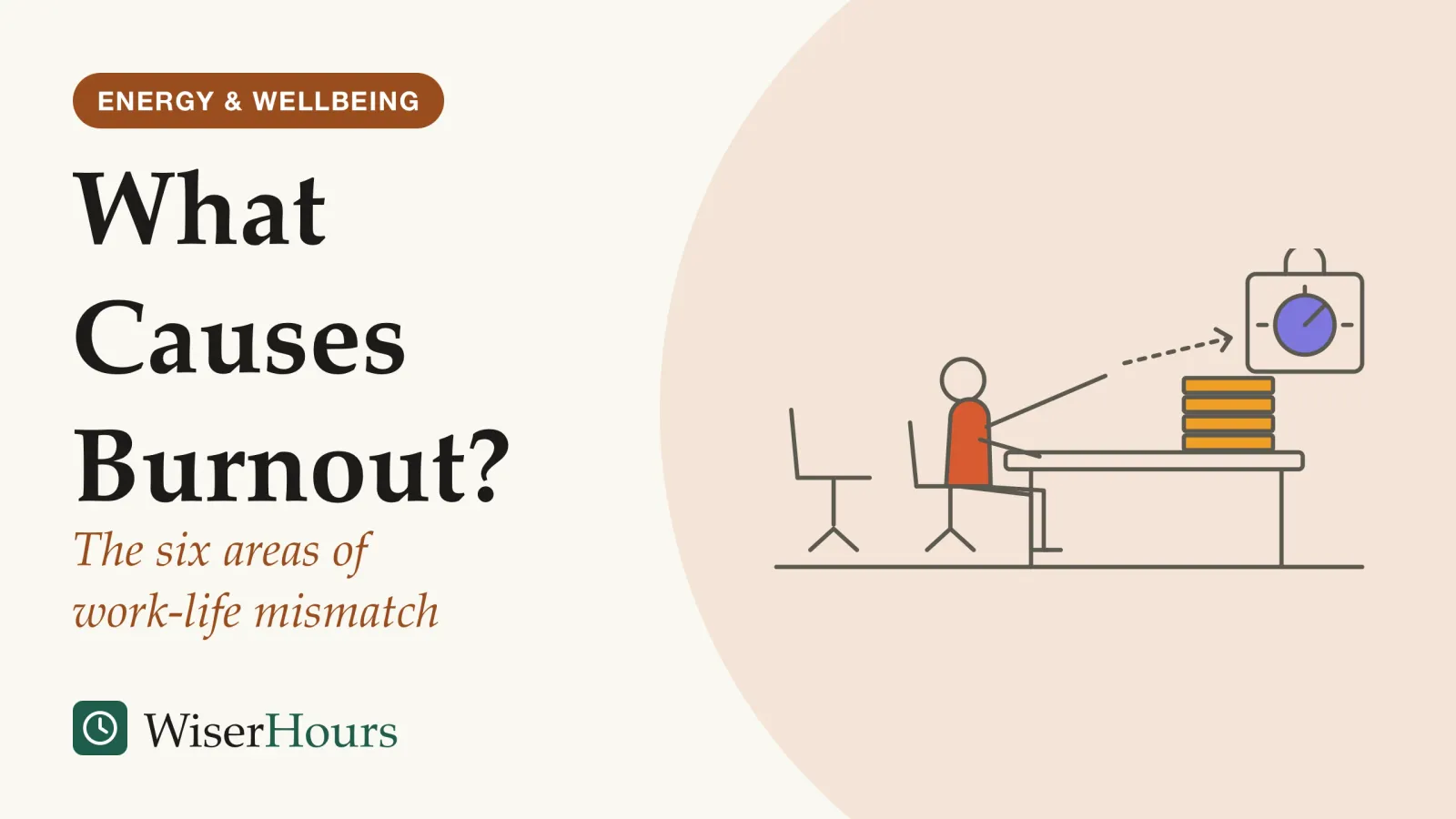
The long-term studies of burnout have their firmest evidence not on how much work there is, but on how little say and support come with it. Hours count; they are just not the whole account.
What causes burnout, in the model most researchers reach for, is a lasting mismatch between a person and their job across six areas of working life: workload and control, reward and community, fairness and values. The World Health Organization ties burnout to chronic workplace stress that has not been successfully managed, and counts it as an occupational phenomenon and not a medical condition; the six areas say where that stress usually comes from.12
For the classification itself, read how the WHO classifies burnout and what it leaves out.
What causes burnout, in six areas where a person and a job pull apart
The six areas come from the psychologists Christina Maslach and Michael Leiter, who framed the sources of burnout as person-job mismatches rather than as a list of bad conditions. In their Areas of Worklife model, the greater the mismatch between the person and the job, the greater the likelihood of burnout, and the greater the match, the greater the likelihood of engagement.1 They built a measure of all six, the Areas of Worklife Scale.3
Each area does its damage differently, in Maslach and Leiter’s account. Chronic overload depletes the capacity to meet the job’s demands and leaves little chance to rest and restore. Lack of control takes away the ability to influence decisions, use judgment and reach what the work needs. Thin recognition devalues both the work and the worker and sits close to the sense of being ineffective, while a broken-down community leaves support and trust missing and conflict unresolved. Unfairness, in how decisions are made and in how people are treated while they are made, is where anger and cynicism are likely to arise. Values are the motivating connection between worker and workplace, so a gap there leaves people trading the work they want to do against the work they have to do.1
- Workload: more work than can be done well, with too little chance to rest and recover; by Tuesday the list is only ever triaged, never finished
- Control: little say over how the work is done, and no reach to what it needs; you can see a faster way and are not allowed to use it
- Reward: pay, recognition or thanks that do not match what the work takes; a hard week ends and nobody who matters knows it was hard
- Community: support and trust missing, or conflict that is never worked out; a problem gets carried around because there is nobody to take it to
- Fairness: decisions, and the way they are reached, that are not seen as even-handed; you hear about a change that affects you from someone else
- Values: a gap between what you think the work is for and what it asks of you; the task you think is pointless takes the morning
The same conditions land differently on different people. Picture two of them on the same support desk, working the same queue. One can settle an awkward case her own way, hears when she has handled it well, and can turn to the person beside her. The other follows a fixed script, hears about his queue only when it slips, and works alone. Their workload is identical. Four of the six areas are not.
The practical move is to stop grading the job as hard or easy and name the area that is out of step. Naming it turns a bad month into something a conversation can be about.
Why a mismatch is harder to shake off than a busy week
A busy week ends. A mismatch does not, because whatever produces it is built into how the job is set up. The broader Job Demands-Resources model, published by Evangelia Demerouti and colleagues in 2001, points at why: it sorts working conditions into demands and resources, and the study behind it tied the two to different parts of burnout.4
In that study of workers in human services, industry and transport, job demands were mainly related to the exhaustion side of burnout, while a shortage of job resources was mainly related to disengagement from the work.4 Tiredness tracks the demands; not caring tracks the missing resources.
- 1Six areas of work lifeworkload, control, reward, community, fairness, values
- 2Mismatchthe job and the person are out of step in one or more areas
- 3Burnoutexhaustion, cynicism, a sense of ineffectiveness
- 4Outcomesjob performance, social behavior, personal wellbeing
Not every demand does the same thing: in a 2010 meta-analytic test, Eean Crawford and colleagues found that demands people read as challenges went with more engagement and demands they read as hindrances went with less, while demands overall were linked to more burnout.5 And resources are not simply the other side of that ledger: reviewing the model in 2017, Arnold Bakker and Evangelia Demerouti describe evidence that job resources soften the impact of demands on burnout.6
So ask two questions of a hard stretch, not one: which demand is draining you, and which missing resource would make it survivable? A deadline you chose and can plan around is a different animal from the same deadline waiting on an approval you cannot chase.
- Myth
- Burnout is what happens when you work too many hours.
- Fact
- Hours are one area of six, and not the best-evidenced one. In a 2017 review of 25 long-term studies, low job control and low support at work had the strongest evidence of coming before later exhaustion, and high workload reached the grade below.
Which of the six areas the long-term evidence actually backs
Most burnout research asks about the job and the exhaustion on the same day, which cannot say what came first; a Swedish expert panel went looking for the studies that can. In their 2017 review of 25 long-term studies, low job control and low workplace support had the best-supported links with later exhaustion; high workload, job demands, low reward, job insecurity and unfair treatment reached only the grade below.7
The study
Moderate evidence
Control and support held the most evidence in a 2017 Swedish review of 25 long-term studies
A group funded by the Swedish Council of Health Technology Assessment screened studies that measured working conditions and burnout at the start and one to five years later, grading each condition on its own. Job strain, high demands combined with little say, rested on a single qualifying study and was graded insufficient.7
Those grades describe the evidence, not the harm. On the panel’s four-step scale, the top step needs randomized trials, and none exist here; observational findings start at limited and rise to moderately strong only when many good-quality studies agree, which happened for just two conditions, job control and workplace support. The bottom step, insufficient, means there was too little to tell.7 So the table below maps what has been tested, not what hurts most: a condition studied ten times can outgrade one studied twice even if both matter.
The authors also warn about the direction of the arrow: because workers described their own conditions, exhaustion may color how the job gets reported, an obvious risk of reverse causation in their words.7
The panel’s companion review on depression pointed the same way. A 2015 systematic review of 59 articles reporting long-term studies, funded by a Swedish government agency, graded the evidence moderately strong that job strain, low control over one’s work and bullying are followed by rising depressive symptoms. For low support, unfairness, job insecurity and long hours it was limited.8
The reviews use occupational health labels and the model uses its own, so lining them up is a reading, not a finding. Where they plainly match:
| Area | What the long-term reviews graded (evidence strength, not harm) |
|---|---|
| Workload | Limited evidence for later exhaustion7 |
| Control | Moderately strong, the top grade reached7 |
| Reward | Limited, from two studies7 |
| Community | Moderately strong for support at work in general; limited for supervisor or co-worker support on its own7 |
| Fairness | Limited, and protective7 |
| Values | Not among the conditions graded7 |
The gap in the last row is honest rather than damning. No long-term study of values conflict met the review’s criteria, which is worth remembering when a survey calls it the top cause of anything.
If you arrived certain that burnout is about hours, this is the turn. Workload sits a grade below having a say in the work and someone to turn to in it. A long week you shaped yourself, on a team that notices, is not the same week as one handed to you by a rota you never see.
How to tell which area is your own mismatch
Start from what has changed, not from what is hard: a job can be demanding in all six areas and still be survivable. The signal is a lasting gap between what the work asks of you and what it gives back, in one named area.
Fairness is worth checking first. In Maslach and Leiter’s own year-long study of 466 employees, those whose burnout scores made an inconsistent pattern at the start were more likely to change over the year than the rest, and among them it was the people also reporting a mismatch in fairness who moved toward burnout rather than engagement.9 One workplace sample, measured twice by the model’s own authors: a lead, not a law. It is also the area people raise least readily, because saying it aloud sounds like a complaint about a person.
Six questions, one per area
A no on one question is ordinary. A no you have been giving for months is the mismatch.
Turning six answers into one sentence
Answer each question for the last three months, not for this week, and mark every no. Then write the worst one as a single sentence naming what you have too little of and what it costs you on a normal day: too little say, for instance, and an afternoon waiting for a sign-off. One sentence is something a manager, a colleague or a doctor can work with; six complaints are not. This is a way of reading the model, not a screening tool, and not a diagnosis.
Who can move each area: you, your manager, or the organization
Once you know the area, ask who holds it: some mismatches you can narrow yourself, some need a manager, and some belong to pay scales and staffing that neither of you controls. Sorting the six this way keeps effort where it can land, and stops a structural problem from reading as a personal failure.
Control and community are often closest to hand, though not in every job: which task comes first, how a report gets written, who you ask for help. Workload and reward need a manager, since they are about what gets assigned and what gets noticed. Fairness and values usually sit with the organization, in how decisions get made and what the place is for.
The evidence is not neutral about where the weight should fall. The World Health Organization’s 2022 guidelines conditionally recommend organizational interventions against psychosocial risks such as low job control and bullying, rating the certainty of that evidence very low, and strongly recommend manager training for mental health on moderate-certainty evidence; stress-management courses for individuals get a conditional recommendation on low-certainty evidence.10 A 2017 meta-analysis of 19 controlled studies of doctors found interventions associated with small average reductions in burnout, and in a prespecified subgroup comparison the organization-directed ones did better than those aimed at the individual doctor.11
Maslach and Leiter name the gap between evidence and practice: burnout interventions have emphasized individual strategies rather than social or organizational ones, despite the research evidence pointing to the primary role of situational factors.1 Whether individual traits matter too is a question for its own article.
Taking one mismatch to your manager
Name the area, not the feeling. Bring the smallest change that would move it, say what you would trade for it, and offer a date to review it. Where your manager does not control the area, pay or staffing for instance, ask them to make the shortfall visible to whoever does. This is what we would suggest, not a script anyone has tested.
Where nothing moves, the honest options narrow to reducing exposure, protecting recovery and planning an exit. What matters is not reading an immovable job as evidence about yourself.
Getting help when changing the work is not enough
Not everything burnout leaves behind is fixed by better job design. Danger to your own life calls for an immediate response whatever set it off, and mood, anxiety or tiredness that will not shift deserves medical attention long before you have settled which area is to blame. Every route below is the UK’s NHS or the National Institute of Mental Health (NIMH) in the US speaking. The three tiers, which signs we put in each, and the line for readers elsewhere, are ours.
- Immediately: NIMH tells anyone in the US facing a life-threatening situation to ring 911 or head for the nearest emergency room, and anyone with suicidal thoughts or in emotional distress to contact the 988 Suicide and Crisis Lifeline, confidential and open by phone or text at any hour.12 NHS advice in the UK is 999 or A&E when a life, yours or someone else’s, is at risk, or when keeping yourself or another person safe feels beyond you, and it insists that such an emergency counts every bit as much as a physical one. Samaritans listen on 116 123 at no charge.13 Readers in other countries: your own emergency number.
- Soon: a GP appointment is what the NHS points to once coping with stress has become a struggle, or once your own efforts have stopped working; in England, NHS talking therapies take self-referrals from people aged 18 and over, or 16 and over in some areas.14 Where help is urgent without being an emergency, England’s route is 111 online or by phone, or an urgent GP appointment.13 NIMH’s first step in the US is a primary care provider, able to screen and refer onward.12 In other countries the family doctor fills that role.
- Later: strain that keeps returning, or the same mismatch grinding you down for months, belongs in an ordinary appointment rather than held back for a crisis. Reading what weeks of unmanaged stress do physically beforehand makes it easier to describe.
The bottom line
The six areas turn “work is too much” into a specific question: where have the job and you stopped fitting?1 The long-term evidence is thinner than the model’s popularity suggests, and what it backs most is having some say over your work and someone to turn to in it, rather than the size of the pile.7 Fix the area you can reach, make the rest visible to whoever owns it, and treat exhaustion that will not lift as a matter for a doctor, not a rota.
This article is general information, not medical advice. If you're worried about your health, talk to a doctor or another qualified professional.
Frequently asked questions
Can more than one of the six areas be wrong at the same time?
Yes, and usually several are. The 2017 systematic review by Gunnar Aronsson and colleagues could only grade one exposure at a time, and the authors say plainly that different classes of exposure may interact and that longitudinal studies of those interactions are missing. So treat the six areas as a checklist for finding your worst mismatch, not as a set of rival explanations.
Does the six-areas model apply outside health care and teaching?
It was built to. Maslach and Leiter report that the six domains turned up across many occupations and countries, and that the general version of their burnout questionnaire was reworded to suit any job. In the 2017 review of long-term studies, results looked similar whether the samples came from the general working population or from specific occupations, and across North America, Europe and the Nordic countries.
Is the six-areas model itself well evidenced?
Weaker than the model's popularity suggests. Maslach and Leiter describe initial empirical support from both cross-sectional and longitudinal studies, and say in the same review that the causal assumptions in burnout models have rarely been tested directly, that most research is cross-sectional, and that many variables come from people's own reports rather than measured behavior or health.
Does changing the job actually reduce burnout, or only sound better?
There is some direct evidence. A 2017 meta-analysis of 19 controlled studies of doctors found interventions associated with small average reductions in burnout, and in a prespecified subgroup comparison the reductions were larger for interventions aimed at the organization than for those aimed at the individual doctor. The authors read this as support for treating burnout as a problem of the whole organization rather than of individuals.
Sources
- Understanding the burnout experience: recent research and its implications for psychiatry. Maslach, C. & Leiter, M. P. (2016). World Psychiatry, 15(2)
- QD85 Burnout. World Health Organization, ICD-11 for Mortality and Morbidity Statistics (2026-01 release)
- Areas of Worklife: A Structured Approach to Organizational Predictors of Job Burnout. Leiter, M. P. & Maslach, C. (2003). Research in Occupational Stress and Well-being, Vol. 3, pp. 91-134
- The job demands-resources model of burnout. Demerouti, E., Bakker, A. B., Nachreiner, F. & Schaufeli, W. B. (2001). Journal of Applied Psychology, 86(3)
- Linking job demands and resources to employee engagement and burnout: A theoretical extension and meta-analytic test. Crawford, E. R., LePine, J. A. & Rich, B. L. (2010). Journal of Applied Psychology, 95(5)
- Job demands-resources theory: Taking stock and looking forward. Bakker, A. B. & Demerouti, E. (2017). Journal of Occupational Health Psychology, 22(3)
- A systematic review including meta-analysis of work environment and burnout symptoms. Aronsson, G., Theorell, T., Grape, T., et al. (2017). BMC Public Health, 17, 264
- A systematic review including meta-analysis of work environment and depressive symptoms. Theorell, T., Hammarström, A., Aronsson, G., et al. (2015). BMC Public Health, 15, 738
- Early predictors of job burnout and engagement. Maslach, C. & Leiter, M. P. (2008). Journal of Applied Psychology, 93(3)
- WHO guidelines on mental health at work. World Health Organization (2022)
- Controlled Interventions to Reduce Burnout in Physicians: A Systematic Review and Meta-analysis. Panagioti, M., Panagopoulou, E., Bower, P., et al. (2017). JAMA Internal Medicine, 177(2)
- Help for Mental Illnesses. National Institute of Mental Health, US National Institutes of Health (accessed September 2026)
- Where to get urgent help for mental health. NHS (UK), page last reviewed 26 April 2023
- Get help with stress. NHS (UK), page last reviewed 6 March 2026
How we researched this
During September 2026 we worked through PubMed Central, Europe PMC, Crossref and the publication pages of the World Health Organization, the NIMH and the NHS, looking for the origins of the Areas of Worklife model and the Job Demands-Resources model, and for systematic reviews of prospective studies that link working conditions to burnout. The 2017 Aronsson systematic review and the Maslach and Leiter review were read in full; six further papers were available to us as abstracts alone, and the material spans 2001 to 2026. Nearly all of this evidence is observational and self-reported, which is the main limitation on everything reported here.
Keep reading
Compassion Fatigue vs. Burnout: What Helping Professionals Should Know
Compassion fatigue has 2 parts in its main questionnaire: burnout and secondary traumatic stress. How they differ, what scores mean, and when to get help.
Parental Burnout: What Researchers Have Learned
Parental burnout has 4 signs researchers can measure. What a global study, research on risks and resources, and early treatment trials have found.
12 Early Warning Signs of Burnout You Shouldn't Ignore
12 early signs of burnout, mapped to the WHO's three dimensions and validated scales, what else each could mean, and when a doctor should look.
How to Recover From Burnout: A Realistic Step-by-Step Plan
A realistic burnout recovery plan in 6 steps: rule out other causes, cut the load, protect rest, and change the job with your manager's help.