What Is Stress? How the Stress Response Works in Plain English
What is stress? How the fast and slow stress response works, which lab tasks 208 studies linked to the biggest cortisol rise, and when to see a doctor.

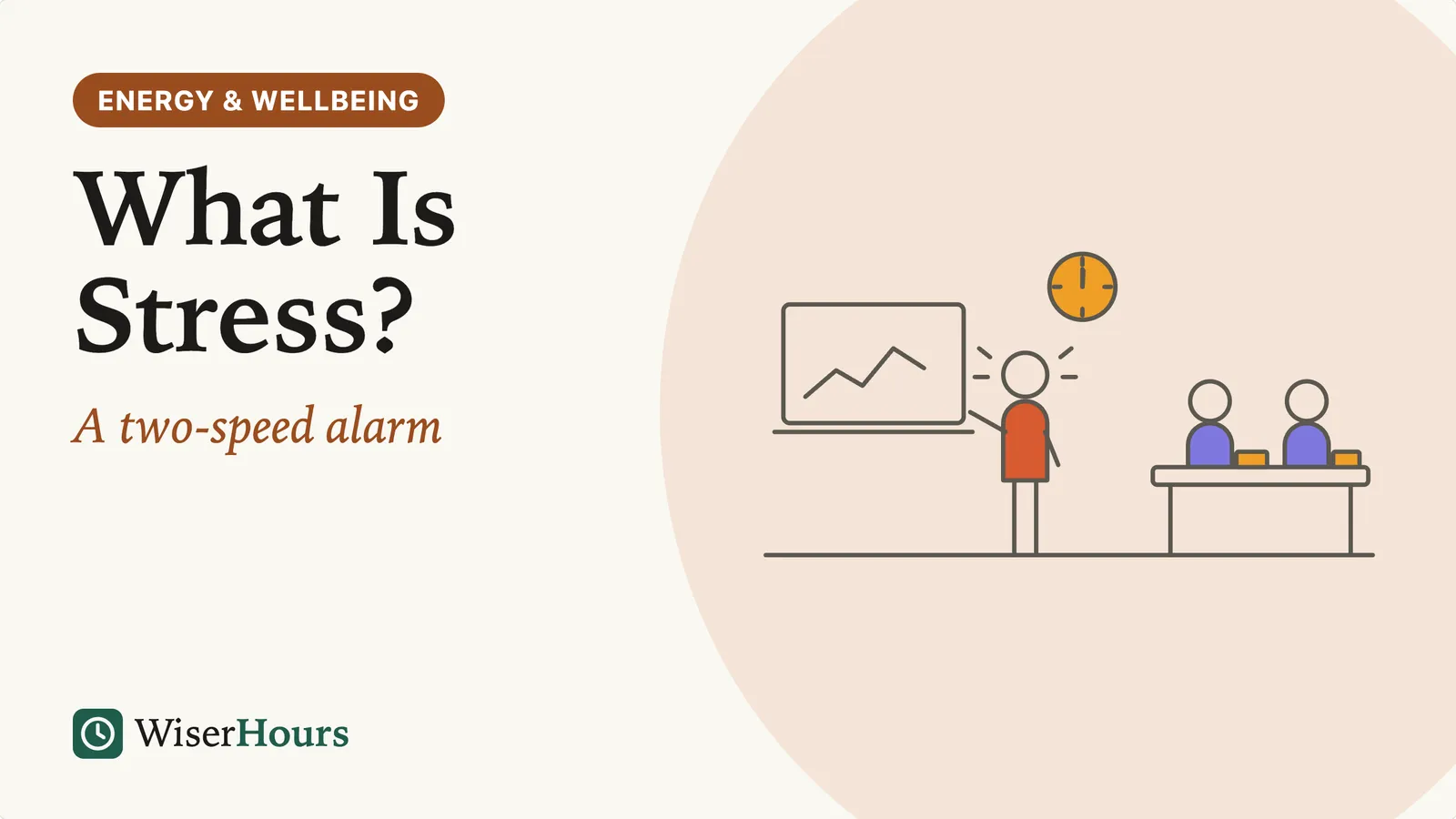
Stress is your brain and body’s response to a challenge or a demand.1 Within seconds, nerve signals and adrenaline speed up your heart, and a slower hormone relay that ends in cortisol follows.2 In a healthy response both settle once the demand passes; the health concern is a response that keeps running for weeks or months.31
That is the physical answer to “what is stress?” Lab research also shows which situations go with the strongest hormonal response. In a 2004 meta-analysis of 208 laboratory studies of healthy adults, tasks that were both uncontrollable and open to judgment by others were linked to the largest rises in the stress hormone cortisol and the slowest return to normal.4
What is stress? The demand, the response and the feeling
The word stress covers three linked things: the demand, the body’s response to it, and the feeling that comes with it. The US National Institute of Mental Health (NIMH) defines stress as the physical or mental response to an external cause, and calls the cause a stressor, which can be a one-time event or something that happens repeatedly over a long time.5 The World Health Organization (WHO) starts from the feeling: a state of worry or mental tension caused by a difficult situation.6
Definition
In a one-page 1936 letter to Nature, Hans Selye, then at McGill University in Montreal, reported that rats harmed by very different agents, from cold and surgical injury to excessive exercise and sublethal doses of drugs, developed the same typical syndrome, which he read as a general response to damage itself.7 Researchers still use the word loosely: a 2004 meta-analysis of 30 years of research on stress and immunity noted that investigators struggle to agree on a satisfactory definition, and that most studies define stress by its causes.8
Feeling stressed is common. In 2025, 40 percent of employees in more than 140 countries and territories told Gallup they had felt a lot of stress during much of the previous day; the figure comes from the company’s World Poll of nationally representative samples, is self-reported and has not been peer-reviewed.9 The WHO calls it natural to feel stressed in situations such as job interviews, exams, unrealistic workloads, an insecure job or conflict with family, friends or colleagues.6
40%of employees in 140+ countries and territories said they felt a lot of stress during much of the previous day (Gallup World Poll, 2025 data, 141,444 employed adults)Source: Gallup, State of the Global Workplace 2026How the stress response works: a fast alarm and a slower hormone wave
The stress response runs on two systems that work at different speeds, according to a 2009 review in Nature Reviews Neuroscience by Yvonne Ulrich-Lai and James Herman: a nervous-system arm that can raise heart rate and blood pressure within seconds, and a two-step hormone relay that is slower and ends in cortisol.2 Both arms involve the adrenal glands, which sit on top of the kidneys: the inner part of each gland releases adrenaline (epinephrine) and noradrenaline (norepinephrine), and the outer part makes cortisol.10
The fast arm is the fight-or-flight response that Walter Cannon and colleagues first described in the early 20th century. Adrenaline, mostly from the adrenal glands, and noradrenaline, mostly from nerves, raise heart rate and the force of each beat and mobilize energy.2
The slow arm, the hypothalamic-pituitary-adrenal (HPA) axis, is a relay. Nerve cells in the hypothalamus release corticotropin-releasing hormone (CRH), which prompts the pituitary gland to release adrenocorticotropic hormone (ACTH), which in turn tells the adrenal glands to release cortisol; cortisol then helps mobilize stored energy.2 In lab studies of short stressors, cortisol peaks 21 to 40 minutes after a stressor starts and, on average, is back to its starting level 41 to 60 minutes after it ends.4
- StartThe brain registers a demand or threat
- Within secondsAdrenaline and noradrenaline raise heart rate and blood pressure
- 21 to 40 minCortisol peaks, counted from the start of the stressor
- 41 to 60 min after it endsCortisol is back to its starting level, on average
Both arms have brakes. The nervous-system response fades quickly because the parasympathetic nervous system, which generally works opposite to the sympathetic one, kicks in by reflex, and cortisol damps down its own relay through negative feedback.2
- The brain: decides what counts as a demand or a threat
- Fast arm, within seconds: nerves and the adrenal glands release noradrenaline and adrenaline, and the heart speeds up
- Slow arm, over minutes: a two-step hormone relay from the brain, via the pituitary gland, ends with the adrenal glands releasing cortisol, which peaks 21 to 40 minutes after a stressor starts in lab studies
- Off switch: the nervous-system response fades quickly, and cortisol damps down its own relay
What counts as a threat is decided in the brain. Bruce McEwen of Rockefeller University called the brain the central organ of the stress response, because it determines what is stressful and how the body responds.3 The response can also start early: Ulrich-Lai and Herman write that responses to psychological stressors can occur in anticipation of a stressful event, not only in reaction to it.2
An audience and no control: the biggest cortisol rises in lab studies
Having to perform a task is not enough to raise the stress hormone cortisol, according to a 2004 meta-analysis in Psychological Bulletin by the psychologists Sally Dickerson and Margaret Kemeny of the University of California, Los Angeles. Cortisol rose when a task was uncontrollable or carried social-evaluative threat, the chance that others will judge the performance negatively, and rose most when it had both. The authors wrote that this contradicts the belief, traced to Selye, that cortisol responds to all types of stressors.4
The study
Moderate evidence
208 lab studies of stress tasks and cortisol (Dickerson and Kemeny, 2004)
The two psychologists pooled 208 laboratory studies in which healthy adults faced a short psychological stressor, such as mental arithmetic, a speech or a provocative film. Passive tasks, and performance tasks with neither element, showed no significant rise in cortisol. Tasks with both, such as a speech and timed arithmetic in front of an evaluating audience, were linked to the largest cortisol and ACTH responses and the slowest recovery: only they were followed by significantly raised cortisol up to 60 minutes after the task ended. These comparisons are between studies, not within one randomized trial.4
Dickerson and Kemeny’s explanation is a theory: the body guards the social self, a person’s esteem and status in other people’s eyes, much as it guards the physical self. Their main caveat is that short lab tasks cannot show how cortisol behaves under real-world stress, though they point out that professional life can supply both ingredients, the potential for failure and negative evaluation by supervisors and peers.4
Later work isolated the audience. In a 2018 randomized experiment co-authored by Dickerson, 142 healthy undergraduates gave a speech either in front of two evaluators or with none present; the evaluators raised cortisol and cardiovascular responses, while a tone-counting task meant to make the speech harder made no clear difference.11 The standard lab stressor, the Trier Social Stress Test, builds in both ingredients: a mock job-interview presentation and then surprise mental arithmetic, in front of a panel that gives no feedback or encouragement.12 A 2025 meta-analysis of 171 studies using it, with 8,452 healthy adults, found that nervous-system responses such as heart rate were stronger than hormonal ones such as cortisol, and that the body’s responses were larger than the change in how people said they felt.13
Further reading
A Stanford neuroscientist's full account of the stress response, from adrenaline and cortisol to why stress that never switches off does harm.
As an Amazon Associate WiserHours earns from qualifying purchases.
Short bursts help; a response that stays switched on does not
Short bursts of stress are normal and can help: the WHO says a little stress is good and can help us perform daily activities, while too much can cause physical and mental health problems.6 MedlinePlus, the US National Library of Medicine’s health site, calls any stress that goes on for weeks or months chronic stress.1
In the short term, MedlinePlus explains, stress hormones help you handle whatever is causing the stress. With chronic stress the body stays alert even when there is no danger, and over time, its consumer summary says, that puts people at risk of health problems including high blood pressure, heart disease, diabetes, obesity, and depression or anxiety.1 Cortisol research is less tidy than a body stuck on alert: a 2007 meta-analysis by Gregory Miller and colleagues found cortisol tends to be raised when a chronic stressor begins and to fall as time passes, with the pattern depending on the kind of stressor and the person.14
McEwen gave the cost of a response that stays switched on a name. In his framework, allostatic load is the wear and tear that builds up from too much stress, or from not turning the response off when it is no longer needed. Allostasis itself, which McEwen glossed as “achieving stability through change,” is the healthy adjustment to a short-term demand. He counted habits that often come with chronic stress, such as poor sleep, eating or drinking too much, smoking and too little exercise, as part of the load.3
- Myth
- All stress is bad for you.
- Fact
- Short bursts are a normal response that helps you meet a challenge; the WHO says a little stress is good. The health concern is stress that goes on for weeks or months.
The immune system shows the same split. In a 2004 meta-analysis of 293 studies with 18,941 people, the psychologists Suzanne Segerstrom and Gregory Miller found that stressors lasting minutes were linked to a potentially adaptive boost in parts of natural immunity, alongside a dip in some other immune functions, while chronic stressors such as caring for someone with dementia or unemployment were linked to suppressed immune function, including weaker antibody responses to flu vaccines. These were immune measurements, not illness: the authors wrote that studies had not yet shown whether such changes are how stress raises the risk of disease.8
How stress shows up in the body, mind and behavior
Stress can show up in the body, the mind and behavior, and it is not always easy to tell that stress is the cause, the UK’s NHS says.15 The table groups the signs the NHS and MedlinePlus list; for chest pain, check the NHS warning signs below.
| Area | Common signs |
|---|---|
| Body | Headaches or dizziness, muscle tension or pain, stomach problems, chest pain or a faster heartbeat, sexual problems15 |
| Mind | Trouble concentrating or making decisions, feeling overwhelmed, constant worry, forgetfulness15 |
| Behavior | Irritability, sleeping or eating too much or too little, avoiding places or people, drinking or smoking more15 |
| Also listed | A stiff jaw or neck, tiredness, lack of energy or focus, using alcohol or medicines to relax1 |
MedlinePlus notes that people sometimes don’t realize their symptoms are caused by stress.1 The WHO adds that coping styles and symptoms of stress vary from person to person.6
Stress, anxiety and burnout are related but not the same
Stress and anxiety differ in what drives them and how long they last, going by the definitions of the US National Institute of Mental Health: stress is generally a response to an external cause that goes away once the situation is resolved, while anxiety is usually a persistent feeling of apprehension or dread that interferes with daily life and can continue even when there is no immediate threat.5
Stressful situations can also cause or worsen mental health conditions, most commonly anxiety and depression, which need health care, the WHO says.6 For anxiety, NIMH names psychotherapy (talk therapy) and medication as the two main treatments, and says many people benefit from a combination of the two.5
Burnout is narrower. The WHO’s International Classification of Diseases (ICD-11) describes it as a syndrome resulting from chronic workplace stress that has not been successfully managed, marked by exhaustion, mental distance from or cynicism about one’s job, and reduced professional efficacy. The WHO classes it as an occupational phenomenon, not a medical condition, and says the term should not be used for experiences in other areas of life.16
Everyday steps the WHO and NIMH suggest
The WHO’s everyday advice for managing stress is a short list of ordinary habits, from a daily routine and plenty of sleep to less time following the news. Its illustrated guide, Doing What Matters in Times of Stress, teaches self-help skills that take a few minutes a day to practice.6
The WHO's everyday habits for managing stress
For sleep, the WHO’s list overlaps with standard advice on how to sleep better: the same bedtime and wake-up time every day, weekends included, a quiet and dark sleeping area, fewer screens before bed, and no large meals, caffeine or alcohol before bedtime.6
NIMH suggests similar steps, plus keeping a journal, trying relaxation exercises such as deep breathing, avoiding too much caffeine, and identifying and challenging negative, unhelpful thoughts; it notes that finding what works may take trial and error.5 The NHS advises against using alcohol, cigarettes, gambling or drugs to relieve stress, because they can all contribute to poor mental health.15 Not every step fits every life: shift work, caregiving or a disability can make a fixed routine hard.
Start with one habit
Pick one of the WHO’s steps for this week and make it concrete: a set time for a walk, a regular bedtime, a standing call with someone you trust, or a cap on news time.6
When stress needs a doctor, and when it needs help right away
Get help right away for thoughts of suicide or self-harm, or for chest pain that could be a heart attack. See a doctor if stress feels overwhelming or stops you working or functioning at home, and raise milder symptoms that keep coming back at your next appointment. We grouped this advice from NIMH, MedlinePlus and the NHS by urgency; the three tiers are ours, and each source’s own wording follows.
- Right away: if you are thinking about suicide or hurting yourself, call or text 988 to reach the free, confidential 988 Suicide & Crisis Lifeline in the US, open 24/7, or call 911 (elsewhere, your local emergency number).1751 In the UK, the NHS says to call 999 or go to A&E if you or someone you know needs immediate help.15 Do not self-diagnose chest pain: call 999 in the UK (the NHS) or 911 in the US (MedlinePlus), or elsewhere your local emergency number, for signs such as sudden chest pain that does not go away, pain that spreads to the arms, neck, jaw, stomach or back, or chest pain with sweating, feeling sick, light-headedness or shortness of breath.1819
- Soon: see a doctor if you feel overwhelmed by stress, it is affecting your health or you notice new or unusual symptoms, MedlinePlus says; it also lists feelings of panic such as dizziness, rapid breathing or a racing heartbeat, being unable to work or function at home, fears you cannot control, and memories of a traumatic event.1 In England, the NHS points to NHS 111 or an urgent GP appointment if you need help urgently but it is not an emergency, and to a GP, as non-urgent advice, if you are struggling to cope or self-help is not working; people aged 18 or over (16 in some areas) can refer themselves to NHS talking therapies.15
- At your next check-up: mention symptoms that keep returning, such as headaches, an upset stomach or poor sleep, or using alcohol or medicines to relax, which MedlinePlus lists among signs that stress may be affecting you.1 NIMH says that when symptoms of stress won’t go away, it may be time to talk to a professional.5
The bottom line
Stress is a two-speed alarm: a nervous-system burst within seconds and a cortisol wave that peaks 21 to 40 minutes later in lab studies, both built to switch off when the demand passes.24 In lab studies, cortisol rises most when people cannot control the outcome and someone is judging them, a mix the researchers say professional life can supply.4 Short bursts are normal; stress that runs for weeks or months, or gets in the way of daily life, is the time to talk to a doctor.15
This article is general information, not medical advice. If you're worried about your health, talk to a doctor or another qualified professional.
Frequently asked questions
Can you be stressed without feeling it?
Partly, yes: the body's stress response and the feeling of stress do not track each other closely. In Dickerson and Kemeny's 2004 meta-analysis, how distressed people said they felt was not related to how much their cortisol rose, and a 2025 meta-analysis of 171 lab studies found body and feeling measures generally only weakly correlated. MedlinePlus adds that people can get so used to chronic stress that they don't realize it is a problem.
Is it normal to feel stressed every day?
Some stress is normal, but stress that never lets up deserves attention. The WHO says everyone experiences stress to some degree and most people manage it and keep functioning. The US National Institute of Mental Health says you may be at risk for an anxiety disorder if you can't manage stress and its symptoms interfere with everyday life, make you avoid doing things or seem always present, and suggests talking to a professional.
Can happy events cause stress?
Yes. Good challenges can cause stress as well as bad ones, according to MedlinePlus, the US National Library of Medicine's health site, which lists getting married, starting a new job, having a baby and retiring among common sources of stress. The UK's NHS likewise says that significant life events such as buying a house, having a baby or planning a wedding could lead to feelings of stress.
Can stress cause chest pain?
It can, but never assume it is stress. The UK's NHS lists chest pain or a faster heartbeat among physical symptoms of stress and says anxiety or a panic attack can cause sharp chest pain. It says to call 999 (elsewhere, your local emergency number) for sudden chest pain that does not go away, pain spreading to the arms, neck, jaw, stomach or back, or chest pain with sweating, sickness, light-headedness or breathlessness.
Sources
- Stress and your health. MedlinePlus Medical Encyclopedia, US National Library of Medicine (review date 15 May 2026)
- Neural regulation of endocrine and autonomic stress responses. Ulrich-Lai, Y. M. & Herman, J. P. (2009). Nature Reviews Neuroscience, 10(6)
- Central effects of stress hormones in health and disease: Understanding the protective and damaging effects of stress and stress mediators. McEwen, B. S. (2008). European Journal of Pharmacology, 583(2-3)
- Acute stressors and cortisol responses: a theoretical integration and synthesis of laboratory research. Dickerson, S. S. & Kemeny, M. E. (2004). Psychological Bulletin, 130(3)
- I'm So Stressed Out! Fact Sheet. National Institute of Mental Health, US National Institutes of Health (NIH Publication No. 20-MH-8125)
- Stress. World Health Organization, questions and answers (30 March 2026)
- A Syndrome produced by Diverse Nocuous Agents. Selye, H. (1936). Nature, 138
- Psychological stress and the human immune system: a meta-analytic study of 30 years of inquiry. Segerstrom, S. C. & Miller, G. E. (2004). Psychological Bulletin, 130(4)
- State of the Global Workplace: 2026 Report. Gallup, Inc. (2026)
- Adrenal glands. MedlinePlus Medical Encyclopedia, US National Library of Medicine (review date 20 May 2024)
- Social-evaluative threat, cognitive load, and the cortisol and cardiovascular stress response. Woody, A., Hooker, E. D., Zoccola, P. M. & Dickerson, S. S. (2018). Psychoneuroendocrinology, 97
- The Trier Social Stress Test: Principles and practice. Allen, A. P., Kennedy, P. J., Dockray, S., Cryan, J. F., Dinan, T. G. & Clarke, G. (2017). Neurobiology of Stress, 6
- Physiological and psychological responses to acute stress: A meta-analysis of the 171 studies of Trier Social Stress Test including 8452 healthy adults. Gu, H., Lei, Y., Yao, Y., Chen, C. & Liu, C. (2025). Psychoneuroendocrinology, 180
- If it goes up, must it come down? Chronic stress and the hypothalamic-pituitary-adrenocortical axis in humans. Miller, G. E., Chen, E. & Zhou, E. S. (2007). Psychological Bulletin, 133(1)
- Stress. NHS (UK), page last reviewed 6 March 2026
- Burn-out an "occupational phenomenon": International Classification of Diseases. World Health Organization (28 May 2019)
- 988 Suicide & Crisis Lifeline. 988 Suicide & Crisis Lifeline (US)
- Chest pain. NHS (UK), page last reviewed 8 August 2023
- Chest pain. MedlinePlus Medical Encyclopedia, US National Library of Medicine (review date 28 April 2026)
How we researched this
We searched PubMed and the websites of the WHO, NIMH, MedlinePlus and the NHS in September 2026, preferring meta-analyses, major reviews and official health guidance to single studies, and read the key 2004 meta-analysis in full. Sources date from 1936 to 2026. Main limitation: most research on what triggers the stress response uses short lab tasks in healthy adults, not everyday life.
Keep reading
Panic Attack vs. Anxiety Attack: What's the Difference?
A panic attack peaks within minutes and brings at least 4 of 13 listed symptoms; an anxiety attack has no separate clinical definition. How to tell them apart.
Heart Rate Variability Explained: What HRV Can and Can't Tell You
Heart rate variability explained: what HRV measures, why breathing, age and time of day move it, what wearables miss, and what 58 biofeedback studies found.
How to Reduce Stress: 15 Everyday Habits With Evidence Behind Them
How to reduce stress: 15 everyday habits, from movement and sleep to email and news limits, sorted by how well research supports each one.
How to Calm Down Quickly: Short Techniques and the Evidence Behind Them
How to calm down quickly: 5 short techniques graded by evidence, from slow breathing (12 trials pooled) to grounding, and who each may not suit.