How Debt Works: Principal, Interest, and Why Time Matters So Much
How debt works: principal, interest and time. In a Canadian regulator's example, paying C$60 instead of C$160 a month cost C$793 in interest, not C$231.

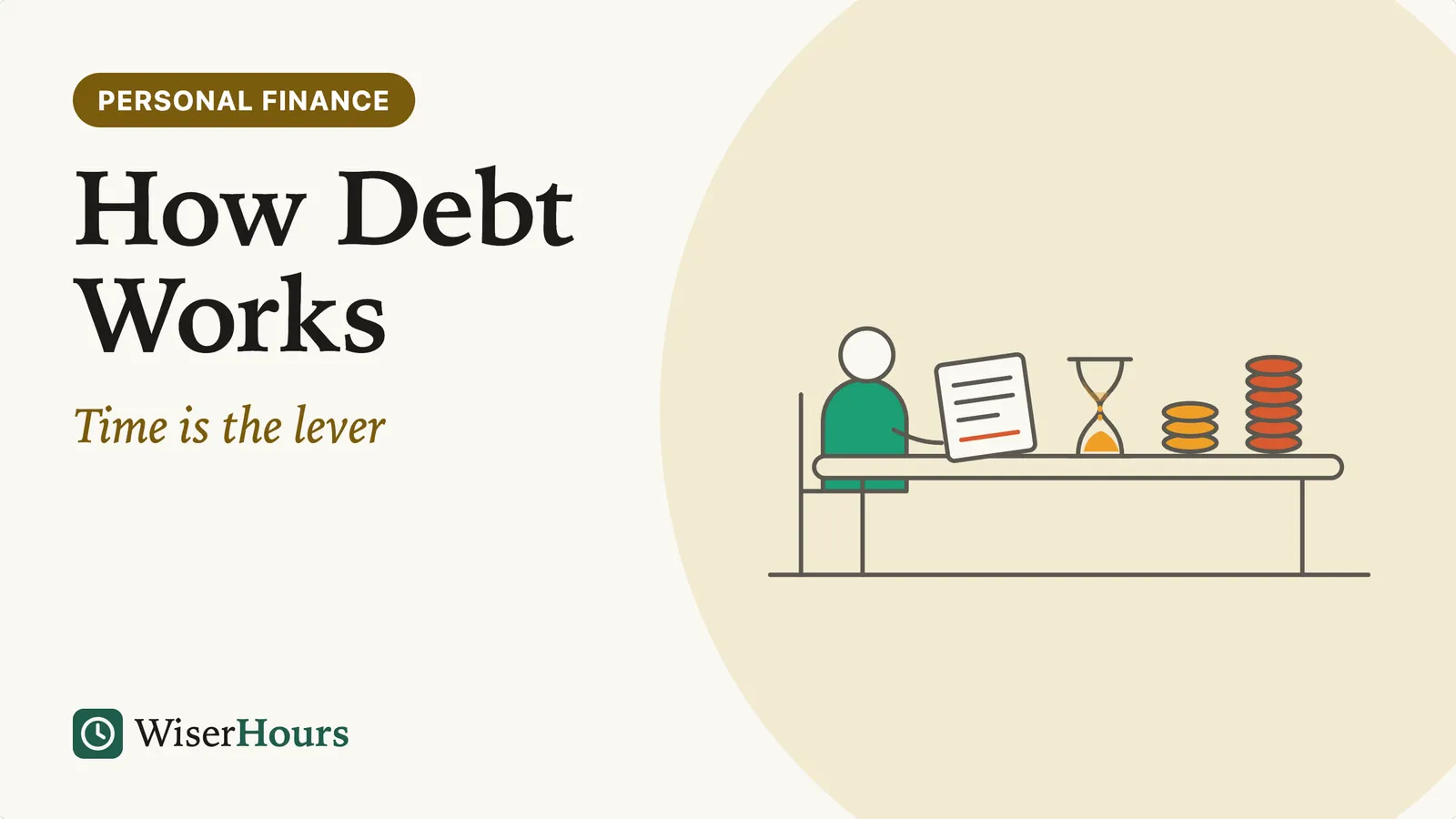
Two people can owe the same amount on a card at the same interest rate, and one can pay more than three times the interest of the other. What separates them is the size of the monthly payment, and through it, time.1
How debt works comes down to three numbers: the principal you borrow, the interest rate charged on whatever is still owed, and the time the balance stays unpaid. Interest is charged again on the remaining balance every day or month, so anything that stretches the time, such as a longer term or a smaller payment, raises the total cost.
How debt works: principal, interest and time
Every debt has the same three parts. The principal is the amount you borrow; interest is the price of borrowing it, and the higher the rate, the more you pay over the life of the loan, as the US Consumer Financial Protection Bureau (CFPB) puts it.2 Time is the third part: on a typical US car loan, the CFPB notes, interest is worked out daily or monthly on the balance still outstanding, so each month a balance stays unpaid adds another round of interest.3
A worked example from Canada’s financial regulator shows how much the third part matters. In an example from the Financial Consumer Agency of Canada (FCAC), a C$2,000 card balance at 18 percent took 47 months and C$793 in interest to clear at C$60 a month, against 14 months and C$231 at C$160 a month.1 Same balance, same rate: only the time changed.
- 1Principalthe amount you borrow
- 2Interest ratethe price, charged on what is still owed
- 3Timehow many rounds of interest the balance faces
- 4Total costprincipal plus all the interest and fees
No one owns this framework: it is the ordinary arithmetic of lending, which the CFPB describes piece by piece. Research suggests people tend to misjudge how interest grows over time.
Simple versus compound interest, and why the gap grows
In the worked example below, simple interest means interest charged only on the original principal. Compound interest, as the US Securities and Exchange Commission (SEC) describes it for savers, earns interest on the money and on the interest it has already earned; a borrower faces the same arithmetic in reverse.4 Card interest can compound daily: the CFPB says some issuers multiply a daily rate by the amount owed at the end of each day and add the result to the balance.5
The word “simple” on a loan contract can mislead. For US car loans, the CFPB uses “simple interest” to mean interest calculated daily or monthly on the balance still owed, far more common than precomputed interest, where the total interest is fixed at the start and spread across the payments. With precomputed interest, extra payments do not reduce the interest owed, though some unearned interest may be refunded.3
Worked example: one year, then five
Illustrative figures in US dollars, our own arithmetic: US$1,000 borrowed at a stated rate of 20 percent a year, with nothing repaid and no fees. Simple interest adds US$200 in a year; compounded daily, the same rate adds about US$221. Leave it for five years and the gap widens: US$1,000 of simple interest, against about US$1,718 compounded daily. The rate never changed; the interest simply started earning interest of its own.
People tend to underestimate this kind of growth. In a 2009 paper in The Journal of Finance, Victor Stango and Jonathan Zinman described exponential growth bias, the habit of treating exponential growth as if it were a straight line, and linked it to underestimating the interest rate implied by a loan’s terms. According to the abstract, the only part we read, households with more of the bias borrowed more and saved less, a link rather than proof that the bias caused it.6
APR, APY and the effective rate: which number to compare
In the US, the annual percentage rate (APR) is the interest rate plus additional fees the lender charges, such as origination charges. The federal Truth in Lending Act requires lenders to disclose it, and the CFPB, in its car-loan guidance, advises comparing APRs with APRs, never an APR with a plain interest rate.2 For credit cards, the CFPB says, the interest rate is typically stated as a yearly rate, and that yearly rate is the APR.7
Annual percentage yield (APY) is the savings-side figure. Under the US Truth in Savings rules (the CFPB’s Regulation DD), it measures the total interest paid on an account based on the interest rate and how often interest compounds.8 For a debt, the same idea gives an effective annual rate. Where a card uses a daily rate, it is the APR divided by the number of days the issuer counts in a year, and it compounds.5 By our arithmetic, a balance left untouched for a year at a 20 percent APR compounded daily grows by about 22 percent, not 20.
Card rates run high in the US and Australia, according to three official sources checked in September 2026:
The Federal Reserve’s figure divides total finance charges by the balances they were charged on, so it already reflects how interest was charged; the average stated APR across all card accounts was a little lower.9 Virtually no investment returns as much as an 18 percent card rate, the SEC says, which is why it suggests clearing expensive debt before you invest.10 Moneysmart’s Australian figure comes from the Reserve Bank of Australia.11
Amortization: the same payment, a shifting split
An amortizing loan has a fixed monthly payment, but a larger share of early payments goes to interest and a larger share of later ones to principal, so the balance falls slowly at first and faster near the end, the CFPB explains. A longer term means lower monthly payments but more interest overall.12
Take an illustrative US$10,000 loan at a fixed 10 percent a year, repaid in equal monthly payments over five years (our arithmetic, interest charged monthly on the remaining balance, no fees). Over the first year, more than a third of what you pay goes to interest; in the fifth, about 5 percent. The payment never changes, but early on much of it only covers the interest, which is why the balance falls slowly at first.
- Year 1: about 36% of the year’s payments go to interest, because the balance is at its largest
- Year 5: about 5% of the year’s payments go to interest; the rest reduces the balance
- Every bar is the same height: the monthly payment never changes (US$212.47 in this illustrative US$10,000 loan at 10% over 5 years)
interest principal (illustrative arithmetic, not a real loan)
Stretching the term lowers the payment but raises the total interest. The table uses the same illustrative loan, fixed rates and monthly payments; real loans add fees, and rates depend on the lender, the borrower and the date.
| Fixed rate | Over 3 years | Over 5 years | Over 7 years |
|---|---|---|---|
| 5% | US$299.71 a month; US$790 interest | US$188.71 a month; US$1,323 interest | US$141.34 a month; US$1,872 interest |
| 10% | US$322.67 a month; US$1,616 interest | US$212.47 a month; US$2,748 interest | US$166.01 a month; US$3,945 interest |
| 20% | US$371.64 a month; US$3,379 interest | US$264.94 a month; US$5,896 interest | US$222.06 a month; US$8,653 interest |
At the highest rate and longest term in the table, the interest comes to close to nine-tenths of the amount borrowed. Paying principal down faster cuts the interest, the CFPB notes for car loans, but payments generally go first to any fees, then to interest, and only then to principal. It suggests asking the lender or servicer whether extra money can go to principal.13
Minimum payments stretch the time the most
Paying only a card’s minimum stretches the time, because the minimum often shrinks as the balance shrinks. In Canada, the FCAC’s guidance (updated October 2025) says the minimum is typically a small flat amount plus interest and fees, or the higher of typically C$10 or 3 percent of the balance; since August 2025 it has been 5 percent for Quebec residents.1
The FCAC’s example holds the payment at C$60. By our arithmetic, if the payment instead follows that C$10-or-3-percent minimum down, recalculated after each month’s interest, with no new purchases or fees, the same balance at the same rate takes about 162 months, well over a decade, and costs about C$1,750 in interest.
Debt payoff time explorer
Starts from the FCAC example: C$2,000 at 18 percent a year. This illustration charges interest monthly.
C$60 a month
- Time to clear
- 3 years 11 months 47 months
- Interest paid
- C$793
C$160 a month
- Time to clear
- 1 year 2 months 14 months
- Interest paid
- C$231
Following the minimum
- Time to clear
- 13 years 6 months 162 months
- Interest paid
- C$1,750
An illustration, not advice. It assumes the rate stays fixed and no new purchases or fees are added; some cards work out interest daily, so your own statement or lender has the real figure. The minimum column uses one of the FCAC’s typical Canadian rules, the higher of C$10 or 3 percent of the balance, worked out here on the balance after that month’s interest. Since August 1, 2025, Quebec residents’ minimum is 5 percent, and your card’s rule may differ. Interest is rounded to the nearest dollar. If repayments are crowding out essentials, see free debt help further down this page.
In the US, Regulation Z requires card statements to carry a bold “Minimum Payment Warning” saying that paying only the minimum means paying more interest and taking longer to pay off the balance.14 Issuers must also show how long the current balance would take to clear at the minimum, and the monthly payment that would clear it in 36 months, assuming no new purchases, the CFPB explains.15
In the UK, the Financial Conduct Authority (FCA) says you are in persistent debt if, over 18 months, you have paid more in interest, fees and charges than you have repaid of the balance, and your card provider must then contact you and offer help. If you are still in persistent debt at 36 months, the provider must offer ways to repay faster, and if you cannot afford that, it must take steps such as reducing, waiving or cancelling interest, fees or charges.16 When it announced the rules in 2018 the FCA said people in persistent debt paid on average about £2.50 in interest and charges for every £1 of borrowing repaid.17
The study
Moderate evidence
Who pays at the minimum: a quarter of the US card market (Keys and Wang, 2019)
Across a data set covering a quarter of the US general-purpose credit card market, 29 percent of accounts regularly paid at or near the minimum. When issuers changed their minimum-payment formulas, at least a fifth of those near-minimum payers, nearly one account in ten overall, shifted payments in a way liquidity constraints alone did not explain and that the authors attribute to anchoring on the minimum.18
On the authors’ reading, the minimum works as a suggestion as well as a floor for some borrowers. The caveats: the 2016 working-paper version, which had not been peer reviewed, puts the data at 2008 to 2013 for US cards, and the study infers anchoring from how payments moved rather than measuring it. In that working paper, fewer than 1 percent of accounts adopted the three-year payoff amount that US statements began showing after the 2009 CARD Act.19
What shortens the time on a debt
US, Canadian and Australian regulators point to a few levers: pay more than the minimum, clear card balances by the due date, choose an order for paying off several debts and talk to lenders early. The FCAC says even a small increase in the monthly payment shortens the payoff a lot.1
| Lever | What the guidance says | Evidence |
|---|---|---|
| Pay more than the minimum | Even a small increase shortens the payoff a lot | Regulator guidance and worked example (Canada)1 |
| Pay the full card balance by the due date | On most cards, this avoids interest on purchases | Regulator guidance (US)7 |
| Choose a payoff order | The SEC describes the highest-rate card first, the minimum on the rest; Moneysmart offers that or the smallest debt first | Regulator guidance (US; Australia)1011 |
| Talk to the lender early | Call before a collector is involved; ask for a lower rate or a payment plan | Regulator guidance (US)20 |
Payoff order is debated: Australia’s Moneysmart presents the smallest debt first, for motivation, and the highest rate first as alternatives.11 On arithmetic alone, with the same payments and no fees, the highest rate first costs the least interest, but in a 2012 study of a debt-settlement firm’s clients, David Gal and Blakeley McShane linked closing whole accounts, whatever their size, to getting out of debt (observational; we read the abstract only).21 We found no randomized field trial comparing these levers. A free debt adviser can talk through the choice. Making a budget from real statements shows how much can go to debt each month.
When debt gets hard to manage: free help, by urgency
Government and regulator sources in the US, the UK, Canada and Australia all point to free debt advice, and several urge acting early. We have sorted their advice by how soon to act.
- Urgent: if money worries come with thoughts of suicide or self-harm, in the US call or text 988, which is free, confidential and open at any hour.22 In a life-threatening situation in the US, call 911.23 In the UK, call Samaritans on 116 123, or call 999 or go to A&E if a life is at risk or you cannot keep yourself safe; in England, the NHS also points to 111, mental health option, for urgent help.24 Elsewhere, call your local emergency number.
- Next few weeks: if repayments crowd out essentials or a UK persistent-debt letter arrives, contact free help. In the US, the CFPB says credit counseling organizations are usually non-profits offering free or low-cost advice, but counselors may charge fees for some services, and the Federal Trade Commission has found that some organizations offering debt management plans have defrauded people; get a price quote in writing and check the organization with your state attorney general and consumer protection agency.25 In the UK, the government’s debt guidance points to MoneyHelper for free debt advice services.26 In Canada, the FCAC notes that both non-profit and for-profit firms offer credit counselling and that no reputable agency charges for a first meeting; licensed insolvency trustees typically assess your situation for free.27 In Australia, the free National Debt Helpline is on 1800 007 007, weekdays; Moneysmart says the earlier you get help, the more options you will have, and that anyone facing legal action should get free legal advice straight away.28 Elsewhere, look for free non-profit or government debt advice and your own financial regulator.
- Before your next big loan: compare APR with APR, and see a regulated adviser for decisions that depend on your own circumstances.2
Before paying anyone to fix your debt
In the US, the FTC warns that debt settlement programs often encourage you to stop paying creditors, so late fees and interest can grow, and that a settlement company cannot collect its fees before settling a debt.20 For a debt management plan, the CFPB suggests confirming that your creditors have accepted it before paying the organization.25 In the UK, the government says to use a debt management company authorised by the Financial Conduct Authority and notes that some charge set-up and payment-handling fees.29 Canada’s FCAC warns that some companies offering debt help mislead consumers, and that fees may still be due if creditors refuse to negotiate.27 Moneysmart says Australian financial counselling is always free.28
The bottom line
A debt’s cost is set by three things, the principal, the rate and the time, and time is the easiest to misjudge: the same card balance cost C$793 in interest over nearly four years in the Canadian regulator’s example, and C$231 over 14 months with a bigger payment.1 Compare loans by APR, read the minimum-payment box on a US card statement as a warning rather than a target, and if repayments are crowding out essentials, contact a free debt adviser early.
This article is general education, not financial advice. For decisions about your own money, speak to a qualified, regulated adviser.
Frequently asked questions
What happens if I miss a minimum payment?
It can raise your costs and hurt your credit. The Financial Consumer Agency of Canada lists the risks as a higher interest rate, damage to your credit score, losing a promotional rate and having the card cancelled. In the US, the Federal Trade Commission says that after 4 to 6 months of missed minimums a creditor may charge off the debt, which you still owe and which may be sold to a debt collector.
Why was I charged interest on my card after making a payment?
Usually because the payment did not clear the whole balance by the due date. On most US cards, the Consumer Financial Protection Bureau says, you avoid interest on purchases only by paying the balance in full each month by the due date. The Financial Consumer Agency of Canada adds that if you do not, interest runs from the date you made each purchase, not from the due date.
Should I pay a company to talk to my creditors for me?
Not necessarily, says the US Federal Trade Commission: you can call your card company yourself, for free, to ask for a lower rate or a payment plan you can afford. It warns that debt settlement programs can leave you owing more in late fees and interest. Canada's FCAC warns that some debt-help companies mislead consumers, the UK government points to MoneyHelper for free debt advice, and Australia's Moneysmart says financial counselling there is always free.
Sources
- Paying off your credit card. Financial Consumer Agency of Canada (date modified 15 October 2025)
- What is the difference between a loan interest rate and the APR? Consumer Financial Protection Bureau (US), last reviewed 28 August 2026
- What's the difference between a simple interest rate and precomputed interest on an auto loan? Consumer Financial Protection Bureau (US), last reviewed 30 January 2024
- Small Savings Add Up to Big Money. U.S. Securities and Exchange Commission, Investor.gov
- What is a "daily periodic rate" on a credit card? Consumer Financial Protection Bureau (US), last reviewed 23 September 2024
- Exponential Growth Bias and Household Finance. Stango, V. & Zinman, J. (2009). The Journal of Finance, 64(6)
- What is a credit card interest rate? What does APR mean? Consumer Financial Protection Bureau (US), last reviewed 28 August 2023
- Appendix A to Part 1030: Annual Percentage Yield Calculation (Regulation DD). Consumer Financial Protection Bureau (US), current regulation as of September 2026
- Consumer Credit - G.19, July 2026. Board of Governors of the Federal Reserve System (US), released 8 September 2026
- Pay Off Credit Cards or Other High Interest Debt. U.S. Securities and Exchange Commission, Investor.gov
- Pay off your credit card. Moneysmart, Australian Securities and Investments Commission (last updated 28 July 2026)
- What is amortization and how could it affect my auto loan? Consumer Financial Protection Bureau (US), last reviewed 24 September 2024
- Is it better to pay off the interest or principal on my auto loan? Consumer Financial Protection Bureau (US), last reviewed 30 January 2024
- § 1026.7 Periodic statement (Regulation Z). Consumer Financial Protection Bureau (US), current regulation as of September 2026
- A box on my credit card bill says that I will pay off the balance in three years if I pay a certain amount. What does that mean? Consumer Financial Protection Bureau (US), last reviewed 22 January 2024
- Help for consumers who are in persistent credit card debt. Financial Conduct Authority (UK), 2020; rules checked against FCA Handbook CONC 6.7.27R, September 2026
- New credit card rules introduced by the FCA. Financial Conduct Authority (UK), press release, 27 February 2018 (last updated 17 July 2026)
- Minimum payments and debt paydown in consumer credit cards. Keys, B. J. & Wang, J. (2019). Journal of Financial Economics, 131(3)
- Minimum Payments and Debt Paydown in Consumer Credit Cards (NBER Working Paper 22742). Keys, B. J. & Wang, J. (2016). National Bureau of Economic Research
- How To Get Out of Debt. Federal Trade Commission (US), Consumer Advice (December 2025)
- Can Small Victories Help Win the War? Evidence from Consumer Debt Management. Gal, D. & McShane, B. B. (2012). Journal of Marketing Research, 49(4)
- 988 Suicide & Crisis Lifeline. 988 Suicide & Crisis Lifeline (US)
- Suicide Prevention. National Institute of Mental Health (US), last reviewed August 2026
- Where to get urgent help for mental health. NHS (UK), page last reviewed 26 April 2023
- What is credit counseling? Consumer Financial Protection Bureau (US), last reviewed 2 August 2023
- Options for dealing with your debts. GOV.UK (UK government)
- Getting help from a credit counsellor. Financial Consumer Agency of Canada (date modified 14 October 2025)
- Financial counselling. Moneysmart, Australian Securities and Investments Commission (last updated 9 September 2026)
- Options for dealing with your debts: Debt Management Plans. GOV.UK (UK government), checked September 2026
How we researched this
In September 2026 we read consumer guidance and rules from the US Consumer Financial Protection Bureau, Federal Trade Commission and Securities and Exchange Commission, the UK Financial Conduct Authority, the Financial Consumer Agency of Canada and Australia's Moneysmart, the Federal Reserve's September 2026 consumer credit release and peer-reviewed studies found through Crossref. Sources date from 2009 to 2026. The worked examples are our own arithmetic. Main limitation: most figures describe the US, and research on repayment behavior is observational.
Keep reading
Buy Now, Pay Later Explained: How It Works and Where the Risks Hide
Buy now pay later usually splits a purchase into four interest-free payments. Where the risks hide, the UK rules since 15 July 2026, and where to get help.
Debt Snowball vs. Debt Avalanche: What the Research Says
Debt snowball vs avalanche: paying the highest rate first costs least, yet in UK card data only about 1 in 10 people did it. Which fits your situation.
How Credit Scores Work: The Factors Behind the Number
How credit scores work: FICO weights payment history at about 35% and amounts owed at 30%. VantageScore and UK agencies weigh your report differently.