Empathy at Work: What It Is and What It Isn't
Empathy at work means understanding and sharing what a colleague feels. A review of 43 definitions shows how it differs from sympathy and compassion.

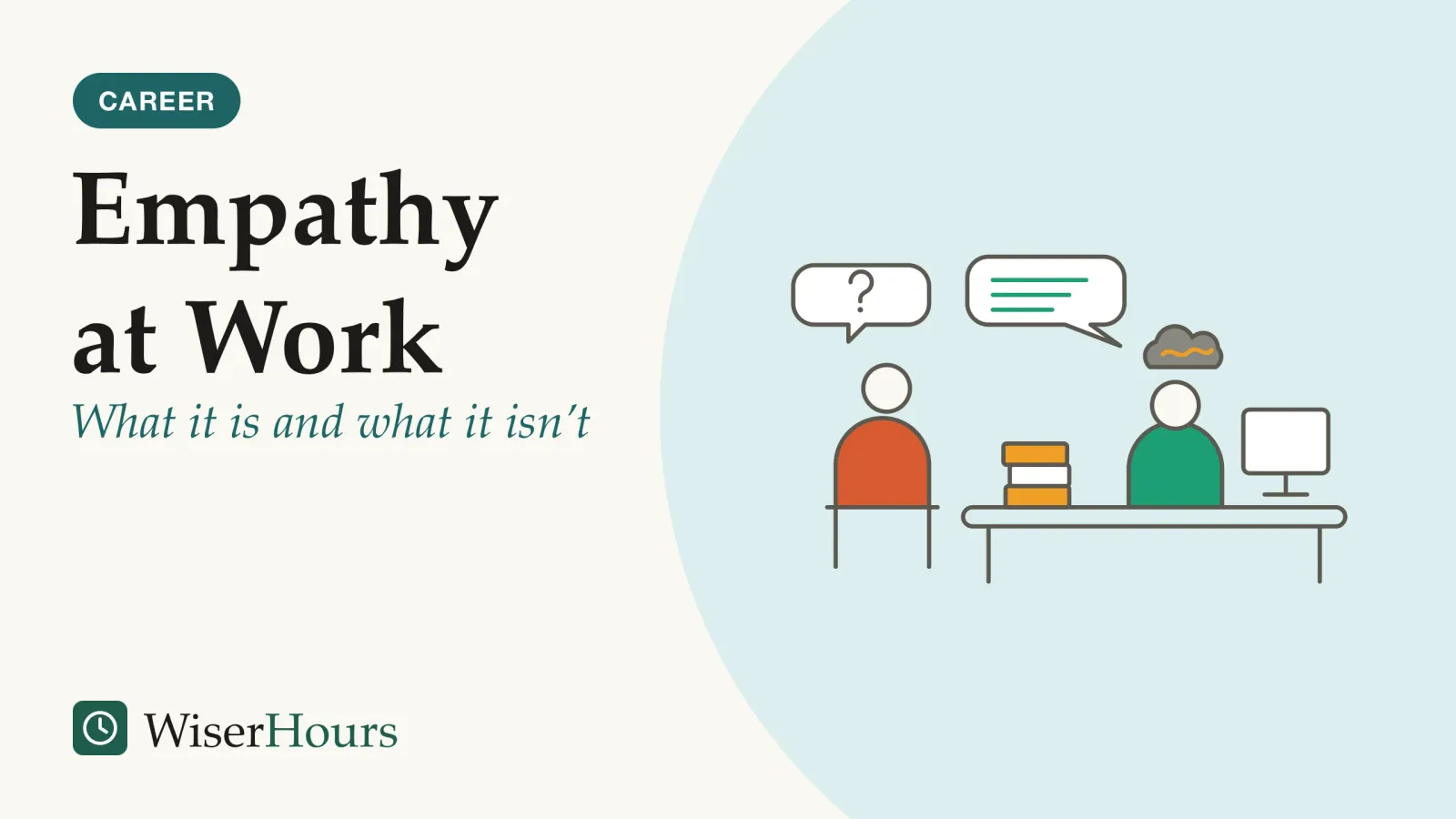
Empathy at work is understanding what a colleague feels and sharing some of that feeling, while staying clear that the feeling is theirs. It does not require agreeing with them, and it is not the same as feeling sorry for them or guessing what is on their mind. A review of 43 definitions by Benjamin Cuff and colleagues, in the journal Emotion Review, arrived at that core: an emotional response built on perceiving and understanding another person’s emotion, with the recognition that its source is not your own.1
Empathy overlaps with the emotion-reading skills described in what emotional intelligence is and how researchers test it. This guide stays with empathy alone, and mostly with what people mistake it for. The biggest surprise concerns accuracy. In a 2018 series of experiments by Tal Eyal, Mary Steffel and Nicholas Epley, imagining another person’s point of view did not make people more accurate about what that person thought or felt; in the final experiment, asking a partner directly did.2
In practice, the research below points to three working habits. Ask what a colleague feels instead of guessing. Say what you understand before you say what you have decided. And agree the rules for exceptions before you hear anyone’s story.
What empathy at work means: understanding plus a shared feeling
Empathy at work means two things happening together: understanding what a colleague is feeling, the cognitive part, and feeling some of it yourself, the affective part, while still knowing whose feeling it is. The 2016 review by Cuff and colleagues concluded that empathy includes both parts, and that what you feel is similar to the other person’s emotion but not identical.1
Definition
Empathy is understanding another person’s emotion and feeling something similar, while recognizing that the emotion is theirs, not yours. What you then do about it is a separate step.1
The boundary matters as much as the feeling. The neuroscientists Tania Singer and Olga Klimecki put it this way in 2014: in empathy you feel with someone without confusing yourself with them, and when that self-other distinction is missing, the right name is emotional contagion, something already present in babies.3
An illustrative case: a colleague comes out of a tense client call and snaps at the team in the next meeting. Understanding is recognizing that she is worried about losing the account. Sharing is feeling a flicker of that tension yourself. The boundary is knowing it is her worry, so you do not start panicking about the account as well. The first two let you take her seriously; the third keeps you useful to her.
Researchers do not fully agree on where empathy stops. Cuff’s definition deliberately leaves out behavior, while a 2019 critical review of organizational research by Malissa Clark and colleagues treats empathy as having cognitive, affective and behavioral dimensions, and reports a lack of consensus on what empathy is and how to measure it.4
Put simply, run two separate checks. Can you name what the other person feels, in their terms rather than yours? And do you feel enough of it to take it seriously, without taking it on as your own? The finer split into kinds of empathy is a subject for a separate guide.
What empathy isn’t: sympathy, agreement or giving in
Empathy is not sympathy, compassion or agreement. The Cuff review, drawing on earlier work by Grit Hein and Tania Singer, puts the difference from sympathy in two phrases: empathy is feeling as the other person, and sympathy is feeling for them.1 Compassion, in the definition Klimecki and colleagues use, is concern for someone’s suffering together with a motivation to help.5
| Term | What it means | How it differs from empathy |
|---|---|---|
| Emotional contagion | Catching someone’s feeling with no self-other distinction | You lose track of the fact that the feeling started with them3 |
| Sympathy | Feeling concern or sorrow for someone | A different emotion: feeling for them, not feeling as them1 |
| Compassion | Concern for someone’s suffering that motivates a wish to help | Centered on your feelings toward their plight, not on sharing their emotion1 |
| Perspective taking | Deliberately imagining a situation from someone else’s point of view | A route people use to reach understanding, and in experiments not a reliable one on its own2 |
Agreement is missing from the table for a reason. Nothing in these definitions requires you to accept that the other person’s view is right, or to do what they ask. Cuff and colleagues explicitly left behavior out of empathy itself: it may lead to action, but the action is a separate choice.1
An illustrative case: a team member asks for a promotion you cannot give this cycle. Empathy sounds like “You expected this after carrying the launch, and it is a real disappointment.” It does not require reversing the decision, and it does not mean pretending you think the decision is wrong. Saying the first sentence without giving in is the whole skill.
The practical lesson is to say understanding and decision in separate sentences: first what you understand about how the person feels, then what you have decided and why. Run together, the two can sound like a promise you never meant to give.
Further reading
Mindwise: How We Understand What Others Think, Believe, Feel, and Want
Epley, a co-author of the perspective-taking experiments in this article, on why guessing what others feel misleads us and why asking works better.

As an Amazon Associate WiserHours earns from qualifying purchases.
Why guessing what a colleague feels often fails
Imagining yourself in a colleague’s shoes feels like understanding, but in experiments by Eyal, Steffel and Epley it did not make people more accurate about other people’s emotions, honesty or opinions. What worked, in the final experiment that tested it, was getting the other person’s perspective directly, by asking them and using what they said.2
The reason is information. Imagining someone’s view works only with what you already know about them. The authors found it reduced people’s tendency to project their own views, but what replaced that projection was not more accurate. Asking brings in something new.2
The study
Moderate evidence
Taking perspective versus getting it: Eyal, Steffel and Epley (2018)
In a pretest survey, about two-thirds of people expected that putting yourself in someone’s shoes would make you more accurate. Across 25 experiments, from reading emotions in faces to spotting lies and predicting a spouse’s opinions, it did not: if anything, accuracy fell, while confidence sometimes rose. In the final experiment, with 104 couples, people who spent five minutes asking their partner about a list of opinions predicted those opinions more accurately, while people who spent five minutes imagining a day in their partner’s life did not. Confidence did not differ between the strategies.2
The uncomfortable lesson is that the feeling of having understood someone is a poor guide to whether you have. The limit worth knowing is where this was tested: short lab tasks, opinion surveys and one role-played appraisal among MBA students, not real performance reviews or team conflicts, and the authors note that asking has limits too, since people do not always tell the truth or know their own minds.2
Imagining still has a use. The same authors point out that perspective taking reliably increases empathy and a sense of connection, and can encourage cooperation in negotiations. It just does not tell you what someone actually thinks.2
Picture a manager who reads a quiet engineer’s short replies as disengagement and starts routing work elsewhere. One question, such as “How is the new project sitting with you?”, might reveal that she is waiting on a decision nobody told her about. The guess and the answer point to opposite fixes, which is why regular one-on-one meetings are a natural place to ask.
Empathy can make you less fair
Empathy is not the same as fairness, and it can pull against it. In two 1995 experiments by C. Daniel Batson and colleagues, people who had been led to feel empathy for one person were significantly more likely to break a principle of fairness and give that person preference when making a decision that affected several people.6
The authors concluded that empathy-driven concern for a person and the wish to be fair are separate motives that sometimes cooperate and sometimes conflict. Empathy points at one person; fairness has to cover everyone. In the first experiment, the people who had shown partiality agreed with everyone else that partiality was less fair and less moral.6
Two experiments from 1995 are thin evidence, so read this as a caution to keep in mind, not a measured workplace effect. At work the pattern is easy to picture. A team lead hears one colleague’s hard month in detail and quietly gives him the lighter on-call rotation; two others with equally hard months said nothing and absorb the extra shifts.
The practical fix is order. Decide the rule before you hear the story: agree the criteria for exceptions, such as a family emergency or a medical appointment, and then use empathy to understand each case within them. Understanding a person and treating everyone by the same standard are both part of the job, and neither replaces the other.
Sharing a colleague’s distress is not the same as helping
Feeling a colleague’s pain is not the same as helping them, and it can leave you feeling worse. In a small training study published in 2014, Olga Klimecki and colleagues found that after empathy training, women reported more negative feelings when they watched videos of people suffering; after a later compassion training, negative feelings fell and positive feelings rose.5
The authors explain that intense sharing of another person’s pain can cause empathic distress, which earlier research had linked to less helping. They present compassion, concern plus a motivation to help, as a possible way to cope with that distress. The study was small, and its groups were recruited one after the other rather than assigned at random. Against the control group, the rise in negative feelings was only a trend, and the control group’s negative feelings also fell later; the clearer difference was more positive feeling after compassion training. So it shows a pattern worth knowing, not a proven remedy.5
- Emotional contagion: you catch the feeling and lose track of whose it is
- Empathy: you understand and share some of the feeling, and still know it is theirs
- Compassion: you feel concern for their suffering and want to help
Empathy also takes effort, and people often avoid it when they can. Across 11 studies, C. Daryl Cameron and colleagues found a clear preference to avoid tasks that asked people to share a stranger’s feelings, linked to seeing empathy as effortful and aversive.7 Anyone who has dodged a colleague’s bad news in the corridor will recognize the pull.
In everyday terms: a manager whose team is facing layoffs can absorb each person’s fear until she dreads every conversation. Or she can notice the fear, name it, and turn her attention to what would help, such as clear dates and honest answers. The first drains her; the second is what her team can actually use. The practical move is that change of question, from how bad this feels to what would help.
Does empathy at work make a difference?
Empathy at work is linked to better ratings for managers, but the evidence is mostly correlational and uses different definitions. In a large study published in The Leadership Quarterly in 2011, Golnaz Sadri, Todd Weber and William Gentry found that managers whose direct reports rated them as showing more empathy were rated as better performers by their own bosses.8
A white paper by the same authors for the Center for Creative Leadership describes the data: more than 6,700 managers in 38 countries, rated on Benchmarks, the center’s own 360-degree instrument, which the paper recommends for feedback. The design shows a link, not a cause: it cannot say whether empathy improved performance or something else explains both, and the white paper says the reasons were not tested.9
Notice what was measured. Direct reports rated behavior they could see: being sensitive to signs of overwork, showing interest in people’s needs and hopes, being willing to help with personal problems and conveying compassion after a personal loss.9 Empathy that stays in your head shows up in nobody’s rating.
The research base is thinner than the enthusiasm around it. The 2019 review by Clark and colleagues, covering organizational studies from 1983 to 2018, ends on two fundamental questions: whether empathy is associated with outcomes that matter to organizations and employees, and whether it can be changed.4 The second has a partial answer. Pooling randomized trials in a meta-analysismeta-analysis: A study that combines the results of earlier studies on the same question into one overall estimate. Pooling makes the estimate more precise, but it cannot repair the studies it pools: a meta-analysis of surveys is still survey evidence.Full entry in the glossary published in 2016, Emily Teding van Berkhout and John Malouff found that empathy training raised scores on empathy measures, more among health professionals and university students than among other groups.10 The outcomes were those measures, and the review’s abstract reports nothing on how people behaved at work afterwards.
For managers, the lesson is that the empathy people credit you with is the empathy they can see. In the leadership study, noticing signs of overwork was one of the things reports rated; feeling for them in private was not. In practice that might mean spotting that someone has sent emails late at night all week and asking, privately, whether the workload is manageable.
The bottom line
When you want to know what a colleague thinks or feels, ask and listen to the answer; imagining their view is a weak substitute. Empathy itself means understanding and sharing some of their feeling while staying clear that it is theirs. It does not commit you to agreeing, and it will not keep you fair on its own, so set the rules for exceptions before you hear the story.
Frequently asked questions
Can empathy be learned?
Measured empathy can rise with training. A 2016 meta-analysis by Emily Teding van Berkhout and John Malouff pooled 18 randomized trials with 1,018 participants and found a medium effect overall, somewhat smaller after allowing for likely publication bias. Effects were larger for health professionals and university students than for other groups, and larger on objective measures than on self-report. The longest follow-up was 6 months, so lasting change at work is not established.
Why do people avoid empathy?
Partly because it feels like hard work. In 11 studies with 1,204 participants, C. Daryl Cameron and colleagues found that people given a free choice tended to avoid tasks that asked them to share a stranger's feelings, and that this went with seeing empathy as effortful, unpleasant and unlikely to succeed. When the researchers made people feel more capable of it, the avoidance disappeared.
Does empathy matter more in some countries?
In one large study, the link was stronger in some cultures. Golnaz Sadri, Todd Weber and William Gentry reported in 2011 that power distance, how far people expect power to sit at the top, changed the link between empathy rated by direct reports and performance rated by bosses. Their white paper for the Center for Creative Leadership says the link was greater in high power-distance countries such as China, Egypt, Malaysia and Singapore. The ratings are correlational.
Sources
- Empathy: A review of the concept. Cuff, B. M. P., Brown, S. J., Taylor, L. & Howat, D. J. (2016). Emotion Review, 8(2), 144-153
- Perspective mistaking: Accurately understanding the mind of another requires getting perspective, not taking perspective. Eyal, T., Steffel, M. & Epley, N. (2018). Journal of Personality and Social Psychology, 114(4), 547-571
- Empathy and compassion. Singer, T. & Klimecki, O. M. (2014). Current Biology, 24(18), R875-R878
- “I feel your pain”: A critical review of organizational research on empathy. Clark, M. A., Robertson, M. M. & Young, S. (2019). Journal of Organizational Behavior, 40(2), 166-192
- Differential pattern of functional brain plasticity after compassion and empathy training. Klimecki, O. M., Leiberg, S., Ricard, M. & Singer, T. (2014). Social Cognitive and Affective Neuroscience, 9(6), 873-879
- Immorality from empathy-induced altruism: When compassion and justice conflict. Batson, C. D., Klein, T. R., Highberger, L. & Shaw, L. L. (1995). Journal of Personality and Social Psychology, 68(6), 1042-1054
- Empathy is hard work: People choose to avoid empathy because of its cognitive costs. Cameron, C. D., Hutcherson, C. A., Ferguson, A. M., Scheffer, J. A., Hadjiandreou, E. & Inzlicht, M. (2019). Journal of Experimental Psychology: General, 148(6), 962-976
- Empathic emotion and leadership performance: An empirical analysis across 38 countries. Sadri, G., Weber, T. J. & Gentry, W. A. (2011). The Leadership Quarterly, 22(5), 818-830
- Empathy in the Workplace: A Tool for Effective Leadership. Gentry, W. A., Weber, T. J. & Sadri, G. Center for Creative Leadership (white paper, 2016)
- The efficacy of empathy training: A meta-analysis of randomized controlled trials. Teding van Berkhout, E. & Malouff, J. M. (2016). Journal of Counseling Psychology, 63(1), 32-41
How we researched this
Sources were found through Crossref, OpenAlex, PubMed and general web searches in September 2026, looking for reviews and experiments on how empathy is defined, how it differs from sympathy and compassion, whether imagining another person's view improves accuracy, and how empathy relates to fairness, distress and workplace ratings. Sources date from 1995 to 2019. Main limitation: workplace evidence is mostly correlational, and five of the ten sources were consulted in abstract form.
Keep reading
Conflict Resolution at Work: A Step-by-Step Guide
Six steps for settling a conflict with a colleague. In a 2025 Acas survey, 44% of working-age adults in Great Britain had conflict at work in the past year.
Signs of a Toxic Workplace: A Checklist
Five research-backed signs of a toxic workplace, plus a checklist. Over 1 in 5 workers in a 2022 ILO survey reported violence or harassment at work.
What Is Emotional Intelligence? A Clear Guide to a Fuzzy Term
Emotional intelligence names two ideas; in a 2010 meta-analysis, ability EI tests explained an extra 0.2% of job-performance variance beyond IQ and personality.