How to Deal With Difficult Coworkers: A General Playbook
A seven-step playbook for difficult coworkers. A quarter of UK workers had conflict or abuse at work in a year (CIPD, 2024); almost half of them let it go.

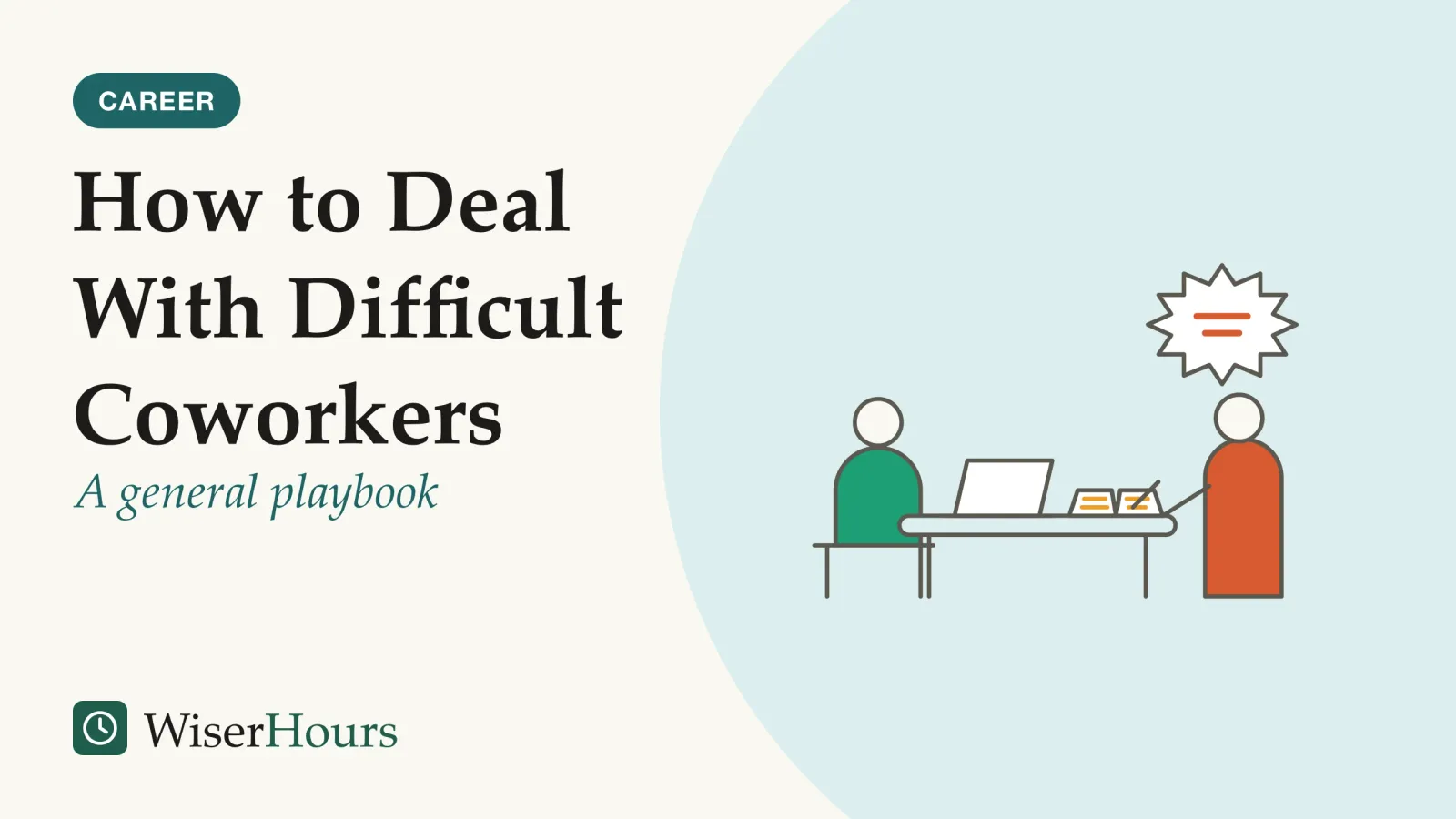
Many people who clash with a colleague say nothing about it. In the CIPD’s 2024 Good Work Index, a survey of more than 5,000 UK workers, a quarter had experienced conflict or abuse at work in the previous year, and almost half of those said they just let it go. Fewer than one in five started an informal conversation with the person involved.1
How to deal with difficult coworkers comes down to treating the behavior as a problem to manage, and knowing where ordinary friction ends and bullying, harassment or discrimination begin, because past that line company policy and the law take over. The playbook, in order:
- Name the act
- Check your own part
- Keep dated notes
- Talk privately and plainly
- Set limits on what you will accept
- Work around them where the work allows
- Escalate with evidence
This general method draws on reading and managing emotions at work; particular patterns, such as credit-taking, need more specific tactics.
Saying nothing is common, and it seldom ends the problem
In UK survey data, staying quiet is the most common way people handle conflict at work, but silence rarely ends it. In the CIPD’s 2020 conflict survey, lack of respect was by far the most common behavior in people’s most serious conflict at work, reported by about two-thirds of them, and stress, lower motivation and anxiety were the most common effects.2 The CIPD is the UK-based professional body for HR and people development, and both of its surveys are built on self-reportself-report: A measure in which people describe their own behavior, feelings or circumstances, usually by answering a questionnaire. When the same person supplies both of the things being compared, shared habits of answering can make the link between them look stronger than it is.Full entry in the glossary data, so they describe experience rather than prove cause.
Keeping quiet makes sense at first: each incident is small, and you may not be sure it was meant. Take a colleague who answers your questions in meetings with a sigh and “as I already said.” Once, you shrug it off. Every week, it starts to change how you prepare and whether you speak up at all.
Letting something go is a fair choice for a one-off. For a pattern, make it a deliberate decision: if you cannot say what you are letting go and why, you are probably just absorbing it.
Rudeness is ambiguous, and it is catching
Everyday rudeness at work is hard to read because its motive is unclear, and it tends to spread because people pass on what they receive. In a 1999 paper, management researchers Lynne Andersson and Christine Pearson introduced the idea of workplace incivility and argued that it can spiral into increasingly aggressive behavior.3 Incivility is commonly defined as low-intensity deviant behavior with ambiguous intent to harm: rude and discourteous, but short of aggression.4
That ambiguity is the trap. A curt reply might be contempt, or a colleague answering twelve messages between meetings. You cannot see the reason, so you supply one.
The study
Limited evidence
How rudeness passed from one person to the next in three 2016 studies
In the first of three studies by Foulk, Woolum and Erez (Journal of Applied Psychology), the results showed that rudeness could be contagious: a single rude episode could be enough, anyone could carry it, and it reached the people the carrier dealt with next. Two lab studies then looked at why: rudeness activated a network of related ideas in people’s minds, and that activation influenced their hostile behavior.5
Two of the three studies ran in a lab, so how far the effect carries through a real working week is less certain. The finding fits earlier experiments by Christine Porath and Amir Erez, in which rudeness reduced people’s performance on routine and creative tasks and made them less helpful.6
How to deal with difficult coworkers: seven moves in order
Most of these moves come from official guidance and practitioner advice; nobody has trialled the full sequence. The first three happen in your head and notebook, the next three with the other person, the last with someone who can act.
- Separate the act from the person: describe what they did, not what kind of person they are
- Talk about the act: privately, calmly and firmly, then state your limits
- Take the record further: if it keeps happening, bring dated notes to a manager, HR or a formal route
1. Name the act
Write down what the person did, in words a stranger could check. Psychologists call the pull in the other direction the fundamental attribution error: when judging other people, observers tend to over-explain behavior by personality and to underweight the situation. Its reach is debated, and it has been reported as weaker in more collectivist cultures, but the everyday version is easy to spot.7
“He’s arrogant” is a verdict. “In the last three project meetings, he interrupted me before I finished” is an observation. The second can be discussed and changed; the first can only be argued about.
2. Check your own part
Before acting, test your reading of the situation. Acas, which advises employers and workers in Great Britain, warns that what seems like bullying might not be, and suggests talking it through with someone you trust first. Its own example: a manager who points out mistakes privately and explains how to fix them is acting appropriately, even if the employee feels picked on.8 In the CIPD’s 2020 survey, the single most common cause of serious conflict was differences in personality or working style.2
Ask whether a deadline, a clumsy process or your own tone plays a part, and ask the colleague how they see it: here is why asking beats guessing what a colleague feels.
3. Keep dated notes
Start a private record now, even if you never use it. Acas’s guidance for people who suspect they are being bullied recommends this kind of diary: dates and times, what was said or done, how it affected you, saved emails or screenshots, and who saw it. Because most bullying happens with nobody watching, it adds, a missing witness is no reason to hold back a report.8 The advice comes from Great Britain, but a dated record is worth keeping wherever you work.
A useful entry is short and factual: “Tuesday stand-up: my update cut off with ‘we don’t need the details’; two people present.” Write it the same day and leave out guesses about motive; a record of acts is easier for someone else to act on than a record of opinions.
4. Talk privately and plainly
Raise it with the person directly if you feel safe doing so. Acas points out that the other person might not realize the impact of their behavior. Its advice for the conversation is to explain what they did and how it made you feel, stay calm, and be firm, not aggressive; if talking face to face feels wrong, you could put it in an email, ask a trade union representative for support, or talk to your manager instead.8

A script for the first conversation
“In stand-up this morning my update was cut off before the numbers, and it came across as dismissive. Could you let me finish, and raise any concerns afterward?”
It names one act, says how it landed and asks for one change. If the real disagreement is about priorities or quality, use a step-by-step method for settling work disagreements.
5. Set limits on what you will accept
A limit is a statement about what you will do, not a demand about who they are. “I’ll pick this up when we can talk without raised voices” or “I’ll answer that by email so we both have it in writing” puts the choice in your hands. This step rests on practitioner advice rather than research. A limit only helps if you keep to it; one you enforce once and then drop is easy to wait out.
6. Work around them where the work allows
Cut the number of places the problem can happen: move handoffs into shared documents and get decisions confirmed in writing. No study tests this either; it is ordinary damage limitation. You still owe the work your role requires, and if the difficult person is your manager, there may be little room to route around them.
7. Escalate with evidence
If the behavior continues after you have raised it, take it to someone with authority, and bring your notes. The Acas route in Great Britain (guidance updated in 2025) starts informally, with a line manager, a different manager or HR once you have checked your organization’s policy, and moves to a formal complaint, called a grievance, if the informal route fails or the matter is serious.9 Outside Great Britain, your employer’s own policy sets the route, so read it before the meeting.
Bring three things: the pattern, with dates; its effect on the work, such as missed handoffs; and what you have already tried. “I raised it with her directly, and it has happened twice since” shows you want help solving a problem.
Before you take it further
Download PDF
Where difficult ends and bullying or harassment begins
Ordinary difficult behavior becomes a bullying, harassment or discrimination matter when it abuses power, puts your health or safety at risk, or targets who you are, such as your sex, race, age or disability. Past that point your employer’s policy and employment law govern what happens, and each country draws the line in its own place.
A colleague who snaps at everyone the week before a deadline is difficult. One who mocks only your accent, or your age, in front of clients may be doing something policy and law cover; that calls for a report, not the playbook.
Researchers separate the two in similar terms: a single rude act is not bullying, whereas bullying carries clearer intent to harm, a bigger gap in power, and a target who feels unable to fight back.4 The law (as of September 2026) is less tidy, and the sharpest difference is whether one incident can count:
- Great Britain: Acas says there is no legal definition of bullying, and that a single incident can count, even an unintended one. Where bullying relates to a protected characteristic, the Equality Act 2010 can make it discrimination.10
- Australia: under the Fair Work Commission’s definition, bullying is unreasonable behavior that is repeated and puts health and safety at risk, and reasonable management action, a performance improvement plan for instance, does not count.11
- United States: under the EEOC’s test, harassment linked to a protected characteristic is unlawful if putting up with it becomes a condition of staying employed, or if it is severe or pervasive enough to make the workplace hostile or abusive to a reasonable person; isolated incidents and petty slights fall short unless extremely serious. The page carried an under-review notice in September 2026.12
- International: the ILO’s 2019 Violence and Harassment Convention, which binds only the countries that ratify it, counts a single occurrence as well as repeated behavior that aims at, results in or is likely to result in physical, psychological, sexual or economic harm.13
A global survey for the ILO and Lloyd’s Register Foundation, carried out by Gallup and published in 2022, found that over a fifth of employed people said they had faced violence or harassment on the job during their working lives, psychological forms most often.14 If what you face sits in the bottom row, skip the private talk when it feels unsafe and go straight to a manager, HR or a union representative. When the trouble runs through a whole team rather than one person, what a toxic workplace looks like is the more useful guide.
Where to turn, by urgency:
- Now: if someone threatens you or you feel physically unsafe, call your local emergency number. Do the same if you have thoughts of suicide or self-harm; for free, confidential support, the International Association for Suicide Prevention points people to Find A Helpline, a directory of verified helplines in over 150 countries.15 In Great Britain, Acas’s bullying guidance lists Samaritans for anyone struggling to cope;8 in the US, the 988 Suicide & Crisis Lifeline answers calls and texts on 988.16
- Soon: complaint and claim routes run on deadlines, and some are short. In the US, the EEOC gives 180 days to file a charge, a limit state laws may extend, and federal employees 45 days to contact an EEO counselor.12 For your own country, ask the national labor authority or equality body, a union or an employment lawyer early.
- Routine: if it is wearing you down, Acas suggests talking to your employer’s employee assistance programemployee assistance program: A confidential service an employer pays for that gives staff free assessment, short-term counseling and referral for personal or work problems. It is a route to help, not a replacement for a doctor or for fixing problems in the work itself.Full entry in the glossary, if there is one.8
How much of this playbook is tested?
Research is strongest on why rudeness matters and spreads, and weakest on the steps themselves, which rest mostly on official guidance. Difficult colleagues cannot be assigned at random, so the evidence comes from lab experiments, surveys and advisory bodies.
| What it is | What the best evidence found | Evidence |
|---|---|---|
| Answer what a curt message asks | Rudeness spread between people in a 2016 set of three studies; in earlier experiments it reduced task performance and helpfulness | Trial, limited (mostly lab experiments; read in abstract only, sample sizes unknown)56 |
| Name the act | Observers tend to over-explain others’ behavior by personality | Expert, mixed (a classic finding whose scope is disputed)7 |
| Keep notes, talk, stay firm | Recommended for suspected bullying in Great Britain’s official guidance; no study tests limit-setting itself | Expert (official guidance)8 |
| Manager or HR, then a grievance | Official guidance for Great Britain; in UK survey data, letting conflict go was the most common response | Expert (official guidance); observational (self-reported survey)91 |
The bottom line
Treat a difficult coworker as a pattern of behavior to record and address: write down what happened, check your own part, talk privately and firmly, and hold your limits. If it keeps happening, take your notes to someone with authority. If it threatens, humiliates or targets who you are, turn to your employer’s policy and your country’s law.
This article is general information, not legal advice. Rules differ by country and change over time; for your own situation, speak to a qualified lawyer or an official advice service where you live.
Frequently asked questions
Is it bullying if it only happened once?
As of 2026, the answer changes with the country. Australia's Fair Work Commission says a comment made once and not repeated is not bullying under its law. Acas, which advises on workplace rights in Great Britain, says bullying can be a one-off incident, and the ILO's 2019 Violence and Harassment Convention covers single occurrences too. A single serious act, such as a threat, is worth reporting anywhere.
Can a junior colleague bully their manager?
Yes. Acas, which advises on workplace rights in Great Britain, calls this upward bullying: continued disrespect, refusing to do tasks, spreading rumors or constantly undermining someone's authority, by one worker or a group. It notes that people in senior roles can find it hard to recognize, and suggests looking at the real reasons behind the behavior, such as a wider problem with the organization's culture.
Should I quit my job because of a difficult coworker?
That is a personal decision, and some people do leave: in the CIPD's 2024 UK survey, nearly one in ten people who had conflict at work decided to look for another job. Acas's 2025 guidance notes that in Great Britain, someone with employee status who has to leave because of severe bullying their employer did nothing about might claim constructive dismissal, and calls resigning a big step. Take advice on your country's rules first.
Sources
- How employers are tackling bullying and harassment at work. CIPD (2024). Survey report, September 2024; employee figures from the CIPD Good Work Index 2024 (UK)
- Managing conflict in the modern workplace. CIPD (2020). Research report, January 2020; employee survey by YouGov (UK)
- Tit for Tat? The Spiraling Effect of Incivility in the Workplace. Andersson, L. M. & Pearson, C. M. (1999). Academy of Management Review, 24(3), 452-471
- Workplace incivility. Wikipedia (accessed 28 September 2026)
- Catching rudeness is like catching a cold: The contagion effects of low-intensity negative behaviors. Foulk, T. A., Woolum, A. H. & Erez, A. (2016). Journal of Applied Psychology, 101(1), 50-67
- Does Rudeness Really Matter? The Effects of Rudeness on Task Performance and Helpfulness. Porath, C. L. & Erez, A. (2007). Academy of Management Journal, 50(5), 1181-1197
- Fundamental attribution error. Wikipedia (accessed 28 September 2026)
- Bullying at work: If you think you're being bullied. Acas (Advisory, Conciliation and Arbitration Service, Great Britain), last updated 16 December 2025
- How to raise a problem: Talking with your employer about a problem. Acas (Advisory, Conciliation and Arbitration Service, Great Britain), last updated 29 August 2025
- Bullying at work: What bullying is. Acas (Advisory, Conciliation and Arbitration Service, Great Britain), last updated 16 December 2025
- What is bullying at work? Fair Work Commission (Australia), checked 28 September 2026
- Harassment. U.S. Equal Employment Opportunity Commission, checked 28 September 2026 (page marked as under review)
- C190 - Violence and Harassment Convention, 2019 (No. 190). International Labour Organization (2019). NORMLEX
- Experiences of violence and harassment at work: A global first survey. International Labour Organization and Lloyd's Register Foundation (2022). Geneva: ILO; survey by Gallup
- Crisis Centres & Helplines. International Association for Suicide Prevention (IASP), accessed 28 September 2026
- 988 Suicide & Crisis Lifeline. 988 Suicide & Crisis Lifeline (US), accessed 28 September 2026
How we researched this
In September 2026 we read UK surveys by the CIPD, official guidance from Acas (Great Britain), the Fair Work Commission (Australia), the US EEOC and the ILO, and research on workplace incivility found through OpenAlex and Crossref. The research and guidance date from 1999 to 2025. Main limitation: no trial has tested the seven steps together, and three research papers were read in abstract only.
Keep reading
Work Friendships: What the Research Says About Having Friends at the Office
Work friendships go with engagement and staying, yet a study of 168 insurance staff tied more work friends to exhaustion too. What research shows.
Emotional Labor Explained: The Hidden Work of Managing Feelings on the Job
Emotional labor, coined in 1983, is managing feelings for pay. Meta-analyses link faking feelings at work to exhaustion; trying to feel them, less so.
Signs of a Toxic Workplace: A Checklist
Five research-backed signs of a toxic workplace, plus a checklist. Over 1 in 5 workers in a 2022 ILO survey reported violence or harassment at work.
Empathy at Work: What It Is and What It Isn't
Empathy at work means understanding and sharing what a colleague feels. A review of 43 definitions shows how it differs from sympathy and compassion.