10 Desk Exercises You Can Do Without Changing Clothes
10 desk exercises you can do in work clothes, from sit-to-stands to chin tucks, and what trials found about short sessions for neck and shoulder pain.
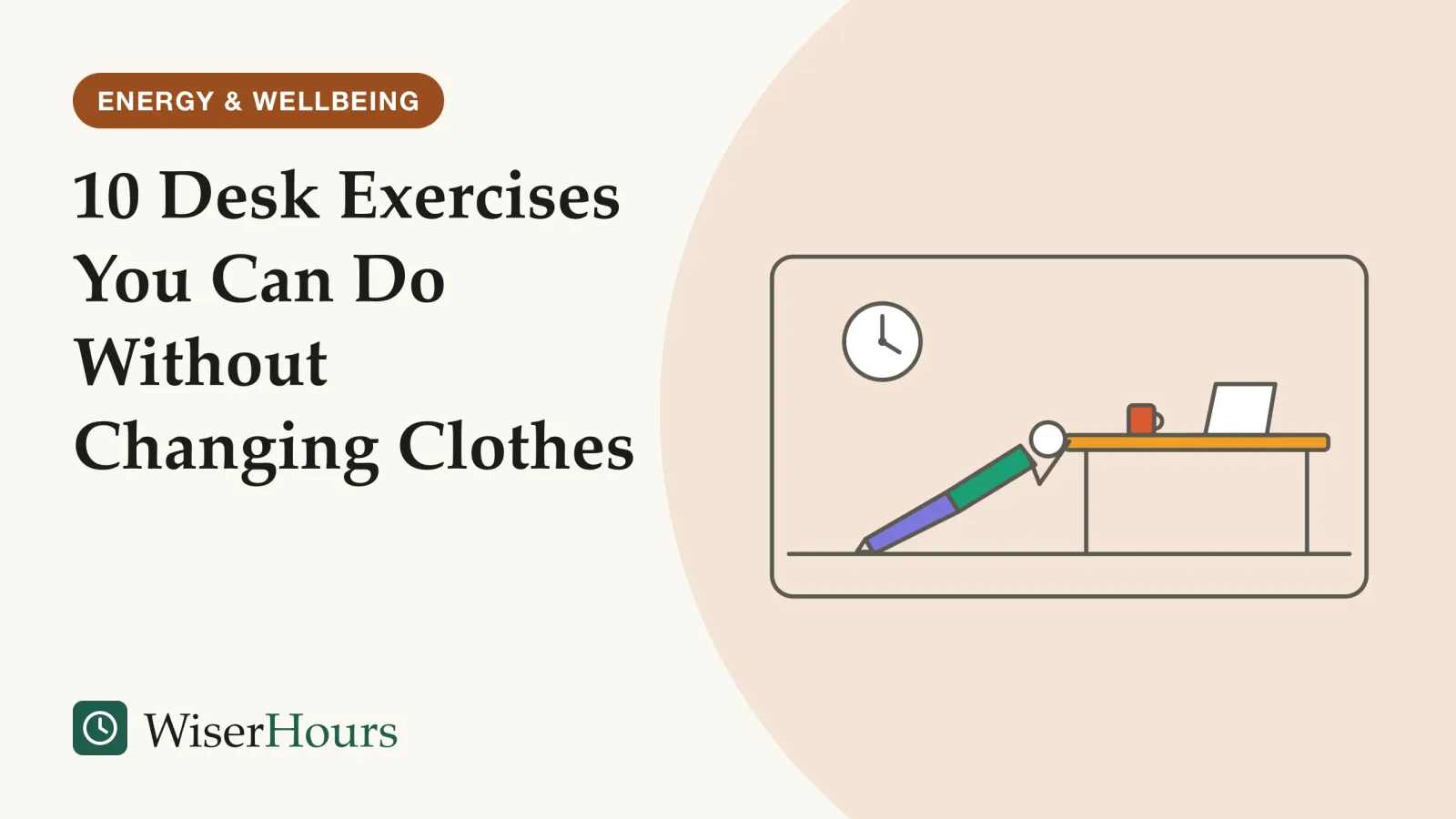
Desk exercises are short strength and stretching moves you can do beside your chair, in the clothes you came to work in, without getting out of breath. Most take a minute or two and need nothing more than a sturdy chair, a desk edge, a wall or a flight of stairs. They will not replace a workout, but they break up long sitting and can ease a stiff neck and shoulders.
The ten moves, roughly from the legs up and then the stretches:
- Chair sit-to-stands
- Calf raises
- Desk push-ups
- Wall sits
- Seated knee lifts
- Shoulder blade squeezes
- Chin tucks
- Standing hip flexor stretch
- Seated figure-4 stretch
- Stair climbs
These moves sit inside a bigger picture of how much exercise adults need each week.
Why short movement breaks at a desk are worth doing
In its 2020 activity guidelines, the World Health Organization strongly recommends that adults cut down on time spent sitting, and it adds that swapping sitting for movement of any intensity, light movement included, brings health benefits.1 The WHO’s current fact sheet puts the same message more plainly: all physical activity counts.2 For someone who sits all day, that is a low bar: a few sit-to-stands beside the chair count, and so does a walk to the far printer.
The reason short breaks might matter shows up in the lab. In a 2012 Australian crossover trialcrossover trial: A trial in which each participant receives every condition being compared, one after another in random order, often with a gap between them. Because people are compared with themselves, fewer are needed, but the design only suits effects that wear off.Full entry in the glossary led by David Dunstan, 19 middle-aged adults with overweight or obesity spent three days in a lab, in random order: one sitting still, one getting up every 20 minutes for 2 minutes of easy walking, and one doing the same at a brisker pace. After a sugary, fatty drink, the walking breaks lowered the rise in blood sugar by roughly a quarter to a third compared with sitting straight through.3
The trial was narrow. Each condition lasted a single day, blood sugar is a marker rather than a disease outcome, and the breaks came three times an hour. The guide to walking after meals covers what later short-break trials found.
Brief hard efforts in daily life point the same way, with weaker evidence. A 2022 analysis of UK Biobank data tracked about 25,000 people in middle and later life who wore activity monitors and reported no exercise in their free time. Those whose monitors picked up more short spells of vigorous daily activity, such as a hurried walk or a fast climb up the stairs, were less likely to die in the years that followed.4 It was an observational studyobservational study: A study in which researchers record what people already do or are exposed to, rather than assigning anyone to anything. It can show that two things go together, not that one causes the other, because the groups being compared may differ in other ways as well.Full entry in the glossary, so it cannot show that the bursts caused the difference; people able to rush up stairs may be healthier to begin with.
A long afternoon writing a report in one chair is close to the setting of the Australian trial, so stand and move for a couple of minutes at regular points, and count the occasional brisk flight of stairs as a bonus.
Do desk exercises work for neck and shoulder pain?
Short strength sessions at work ease neck and shoulder pain modestly, and the best tests come from Denmark. In a series of randomized trials run by Lars Andersen, Christoffer Andersen and colleagues at Denmark’s national research centre for working conditions, office workers who did short strength sessions at work reported less neck and shoulder pain than colleagues who did not.5
The study
Moderate evidence
Two minutes a day with an elastic band
Adults working at least 30 hours a week who had frequent neck and shoulder pain were randomly assigned to strength exercises with elastic tubing for 2 or 12 minutes a day, five days a week, or to weekly health information. After 10 weeks, both exercise groups reported less pain and had less muscle tenderness than the information group, and the 2-minute group improved almost as much as the 12-minute group.6
That result does not mean two minutes fixes everyone’s neck. The people in it had pain to begin with, and the exercises used a band that got harder over the weeks. It does suggest that a dose small enough to fit between emails can be worth doing.
A larger Danish trial in 2012 tested how to split the time. It gave 447 office workers one hour a week of supervised strength training with dumbbells, done as one long session, three medium ones or nine short ones, over several months. All three schedules eased neck pain compared with a group that did not train, and none of the three clearly beat the others.5 For a busy week, that means you can fit the minutes where they go.
The wider evidence agrees, with less certainty. A 2026 systematic reviewsystematic review: A review that fixes its question and its rules for including studies in advance, then searches out every study that fits and weighs them together. Some systematic reviews pool the results into a meta-analysis; others describe what the studies found without combining the numbers.Full entry in the glossary of 19 randomized trials of short workstation exercises, most of them from Denmark, found that short workplace exercise sessions eased neck and shoulder pain in people who sit for work. It rated the certainty of evidencecertainty of evidence: A rating of how confident we can be that a body of research has an effect about right, graded high, moderate, low or very low. It grades the evidence, not the stakes: low certainty means little is known, not that little is at risk.Full entry in the glossary as moderate for combined neck and shoulder pain, flagged possible publication biaspublication bias: The tendency for studies with striking or statistically significant results to be published, while quieter ones stay in the drawer. Since the missing studies are mostly the unimpressive ones, a pooled result tends to overstate the effect until it is corrected.Full entry in the glossary, and saw no clear change in sick leave in the one trial measuring it. One of its authors led several of the Danish trials.7
- Myth
- Desk exercises are too small to make any difference.
- Fact
- In workplace trials, short strength sessions eased neck and shoulder pain over several weeks, though most used dumbbells or elastic bands.
If your neck stiffens by mid-afternoon, a few minutes of shoulder work spread through the day is closer to what these trials tested than one long stretch after work, and the benefit built up over weeks.
10 desk exercises to do in work clothes
Most of the moves below follow the UK’s NHS exercise pages, and the counts are starting points to build on slowly over the weeks.8
Check the chair first
The NHS advises a solid, stable chair without wheels or arms for its chair exercises. An office chair on castors can roll away as you stand up or sit down, so use a fixed chair, or a desk or wall to hold, for the moves that need one.
1. Chair sit-to-stands
Sit on the front edge of the chair with your feet hip-width apart, lean slightly forward, and stand up using your legs rather than your arms. Lower yourself slowly. The NHS suggests 5 repetitions and notes that slower is better.9 To make it easier, push gently on your thighs or use a higher seat. To make it harder, pause just above the seat before you sit, or do 10.
2. Calf raises
Stand behind your chair or at your desk, hold on lightly, and rise onto the balls of your feet as far as is comfortable, then lower with control. Start with 5, as the NHS describes.9 For a harder version, let go of the support, or rise on one foot at a time.
3. Desk push-ups
Place your hands on the edge of a desk that will not move, step back until your body is in a straight line, and bend your elbows to bring your chest toward the desk before pushing away. The NHS describes the easier wall version: stand an arm’s length from a wall and do 3 sets of 5 to 10.9 The lower the surface, the harder the push-up, so a desk is the next step up from a wall.
4. Wall sits
Stand with your back against a wall, walk your feet forward and slide down until your knees are bent, as if sitting on an invisible stool. Keep breathing normally. Start with a short hold, and stop sooner if your knees complain. Go less deep to make it easier, or lower and longer to make it harder. Holds like this are called isometric exercise, and in a 2023 analysis pooling hundreds of trials, programs built on isometric work, wall squats among them, ranked first of all training types for lowering resting blood pressure.10 Those programs ran for weeks.
5. Seated knee lifts
Sit upright away from the back of the chair, hold the sides of the seat and lift one knee as far as is comfortable, then place the foot down with control. The NHS calls this hip marching and suggests 5 lifts with each leg.8 To make it harder, hold each lift for a couple of seconds, or straighten the leg before lowering it.
6. Shoulder blade squeezes
Sit or stand tall, draw your shoulder blades back and down as if tucking them into your back pockets, hold for a few seconds and release. Try 10. The 2012 Danish trial trained the upper back and shoulders with dumbbells, using moves such as reverse flies and shrugs.5 When the squeeze feels easy, hold a light resistance band in front of you and pull it apart as you squeeze.
7. Chin tucks
Sit upright with your shoulder blades drawn back, look straight ahead and gently draw your chin in, as if making a double chin, without tipping your head up or down. An NHS physiotherapy leaflet suggests holding for 2 seconds, repeating 10 times, little and often through the day.11 To make it easier, do it with the back of your head against a high chair back; to make it harder, hold for longer.
8. Standing hip flexor stretch
Long sitting keeps the muscles at the front of the hips short, and Harvard Health notes that this can leave them tight and stiff.12 Stand in a split stance holding your desk, one foot well in front of the other. Tuck your hips under, gently tighten the buttock of the back leg and shift your weight forward until you feel a stretch at the front of that hip. Hold for about 30 seconds and switch sides; Harvard Health suggests building to a total of about a minute on each leg for its kneeling version.12 For a gentler stretch, take a shorter step.
9. Seated figure-4 stretch
Sit with both feet on the floor, cross one ankle over the opposite knee and let the raised knee drop, then lean forward with a straight back until you feel the stretch in your buttock. Cleveland Clinic’s version holds for 30 seconds, three times on each side.13 If your ankle will not reach the knee, rest it on your shin instead. In a pencil skirt or tight trousers, this is the move to skip.
10. Stair climbs
Climb one or two flights at a brisk pace, holding the handrail, then walk down. In a small 2019 Canadian trial, inactive young adults who climbed three flights hard three times a day, three days a week, gained a modest amount of aerobic fitness after six weeks.14 It is the one move here that can make you warm, so ease the pace before an important meeting, or take a single flight at your normal speed.
A two-minute desk set
How often to move, and how to make it stick
There is no agreed number for how often to get up from your desk. The Australian lab trial used breaks every 20 minutes.3 The UK’s NHS just tells adults to break up long spells of inactivity.15 A break every half hour to an hour is a realistic target for most desk days.
The harder part is remembering, and meetings make handy cues because they already happen. When a call ends, stand up before you open the next email, do one or two moves, then sit down again. Over a day with four meetings, that is four short sets without a single calendar entry.
Short pieces also seem easier to keep up. In the 2012 Danish trial, people given three or nine shorter sessions a week were more likely to keep training regularly than those given one long session.5 A finance analyst with back-to-back calls might do sit-to-stands after the morning stand-up, chin tucks after the client call and a stair climb before lunch.
Staying active in a desk job also means walking over to colleagues, taking calls on your feet and keeping some longer sessions, such as a 20-minute workout. For the employer’s side, see what employers can do about sedentary work.
Stopping rules and medical checks
Most of these moves are light enough that healthy adults need no medical check first: the WHO judges clearance generally unnecessary before activity of light or moderate effort, no harder than a brisk walk, for anyone without a medical reason that rules it out.1 Stop and get help in these situations, most urgent first.
- Now: chest pain that feels crushing, squeezing or tight, that travels into the jaw, the left arm or the upper back between the shoulder blades, or that arrives together with sweating, feeling sick, dizziness or shortness of breath is an emergency. Stop and ring your local emergency number; MedlinePlus, a US National Library of Medicine site, uses 911 as its US example.16
- Stop for today: if a move causes significant pain or you feel unwell, stop and rest, as the NHS physiotherapy leaflet advises for its exercises, and leave that move out until you know why.11
- Soon: see a doctor or physiotherapist if your neck still hurts after a few weeks, or the pain arrives with pins and needles, arm weakness or pain, a cold arm or dizziness, as the UK charity Arthritis UK advises.17
- Before you start: the UK’s NHS suggests a word with a GP beforehand if you have hardly exercised in a long time, or have a medical condition or concern; elsewhere, your own doctor or nurse can advise.15 A heart or joint problem counts; with high blood pressure, ask before long wall sits.
- In pregnancy: the UK’s NHS suggests talking to your midwife about what is safe for you, not starting a new vigorous activity, and stopping if you feel uncomfortable, too hot or unwell, so keep stair climbs gentle.18
The bottom line
Short desk exercises are worth doing because they break up sitting, and short strength work at the desk has eased neck and shoulder pain in workplace trials. Start tomorrow with one pair: after your first meeting ends, do five slow sit-to-stands and ten chin tucks, then add a move each week.
This article is general information, not medical advice. If you're worried about your health, talk to a doctor or another qualified professional.
Frequently asked questions
Can desk exercises replace a proper workout?
Not on their own. Desk moves break up sitting and train a few muscles lightly, but the WHO's 2020 guidelines still ask adults for regular moderate or vigorous aerobic activity each week plus strength work on two days. Treat desk exercises as the floor of an active day and keep walks, sport or full workouts for the weekly total.
Should I do desk exercises if my neck already hurts?
Many people with everyday neck and shoulder pain can, and the 2011 Danish trial enrolled only people with frequent pain. Move gently and stop if a move makes the pain sharper. Arthritis UK advises seeing a doctor or physiotherapist if neck pain has not improved after a few weeks, or comes with pins and needles, arm weakness or dizziness.
Do I need equipment for desk exercises?
No. All ten moves here use a chair, a desk, a wall or stairs. The Danish trials that eased neck and shoulder pain did use dumbbells or elastic bands, so a band kept in a drawer is a cheap way to make the shoulder exercises harder once the bodyweight versions feel easy.
Sources
- World Health Organization 2020 guidelines on physical activity and sedentary behaviour. Bull, F. C., Al-Ansari, S. S., Biddle, S. et al. (2020). British Journal of Sports Medicine, 54(24), 1451-1462
- Physical activity (fact sheet). World Health Organization, fact sheet of 4 November 2026
- Breaking up prolonged sitting reduces postprandial glucose and insulin responses. Dunstan, D. W., Kingwell, B. A., Larsen, R. et al. (2012). Diabetes Care, 35(5), 976-983
- Association of wearable device-measured vigorous intermittent lifestyle physical activity with mortality. Stamatakis, E., Ahmadi, M. N., Gill, J. M. R. et al. (2022). Nature Medicine, 28(12), 2521-2529
- Influence of frequency and duration of strength training for effective management of neck and shoulder pain: a randomised controlled trial. Andersen, C. H., Andersen, L. L., Gram, B. et al. (2012). British Journal of Sports Medicine, 46(14), 1004-1010
- Effectiveness of small daily amounts of progressive resistance training for frequent neck/shoulder pain: randomised controlled trial. Andersen, L. L., Saervoll, C. A., Mortensen, O. S. et al. (2011). Pain, 152(2), 440-446
- Effectiveness of micro-exercises for managing neck/shoulder pain in sedentary workers: a systematic review and meta-analysis. Yaghoubitajani, Z., Gheitasi, M., Bayattork, M., Seeberg, K. G. V. & Andersen, L. L. (2026). Scientific Reports, 16, 27291
- Sitting exercises. NHS (UK), page last reviewed 18 January 2024
- Strength exercises. NHS (UK), page last reviewed 28 February 2024
- Exercise training and resting blood pressure: a large-scale pairwise and network meta-analysis of randomised controlled trials. Edwards, J. J., Deenmamode, A. H. P., Griffiths, M. et al. (2023). British Journal of Sports Medicine, 57(20), 1317-1326
- Neck mobility exercises (patient advice sheet). Musculoskeletal Physiotherapy OCATS, Warrington, patient leaflet hosted on an NHS website (UK), accessed November 2026
- Do you spend most of your day sitting? These hip flexor stretches are for you. Harvard Health Publishing (US), 18 December 2024
- Piriformis syndrome stretches and exercises. Cleveland Clinic (US), 1 July 2022
- Do stair climbing exercise “snacks” improve cardiorespiratory fitness? Jenkins, E. M., Nairn, L. N., Skelly, L. E., Little, J. P. & Gibala, M. J. (2019). Applied Physiology, Nutrition, and Metabolism, 44(6), 681-684
- Physical activity guidelines for adults aged 19 to 64. NHS (UK), page last reviewed 22 May 2024
- Chest pain. MedlinePlus, US National Library of Medicine, reviewed 28 April 2026
- Neck pain (information leaflet). Arthritis UK (formerly Versus Arthritis), accessed November 2026
- Exercise in pregnancy. NHS (UK), page last reviewed 24 September 2026
How we researched this
Sources were found in Europe PMC and on WHO, NHS, MedlinePlus and hospital websites in November 2026. They span 2011 to 2026: the WHO 2020 guidelines, randomized trials of workplace strength training from Denmark, a 2026 systematic review, small lab trials and one large observational study. Two trials and one review were read as abstracts only. Most trials used weights or bands, so the no-equipment moves rest on thinner evidence.
Keep reading
Walking After Meals: What Research Shows About a Short Stroll
Walking after meals for 10 to 20 minutes eased the rise in blood sugar in small trials. What research shows on timing, pace, digestion and weight.
Do You Need 10,000 Steps a Day? Where the Number Came From
The 10,000-step goal began as a 1965 Japanese pedometer's name. A 2025 review of 57 studies found the steepest gains up to about 5,000 to 7,000 steps.
The 20-Minute Workout: What You Can Realistically Get Done
A 20 minute workout counts: four vigorous sessions a week meet the WHO aerobic minimum. What trials show, three sample sessions and how to progress safely.
Vitamin B12 and Energy: Who Benefits and Who's Wasting Money
Vitamin B12 and energy: B12 ends tiredness caused by a deficiency but adds none at normal levels. Who is at risk, the signs, and whether shots are worth it.