How Much Exercise Do You Need? The Official Guidelines Explained
The WHO advises adults to aim for 150-300 minutes a week of moderate activity, plus strength work twice. What counts, how to split it, and why some beats none.

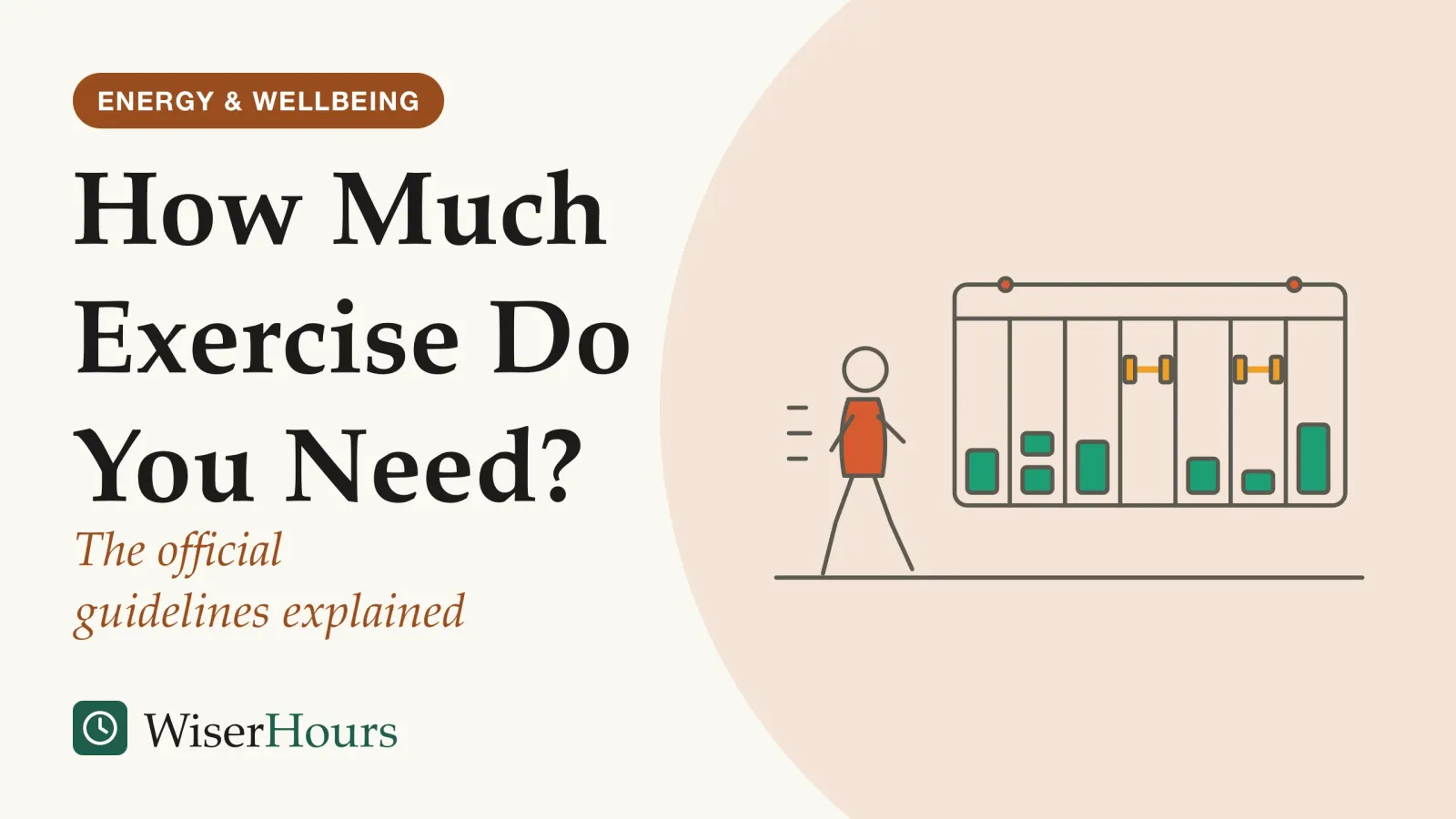
Half an hour of brisk walking on five weekdays already meets the aerobic minimum in the world’s main exercise guideline, and it can be done in short pieces. For adults, the official reply to “how much exercise do you need?” comes in weekly minutes rather than a daily rule. The World Health Organization (WHO) advised in 2020 that adults, including older adults, get 150 to 300 minutes a week of moderate-intensity aerobic activity, or 75 to 150 minutes of vigorous activity, do muscle-strengthening activities on 2 or more days, and sit less.1
Those figures mark the level for substantial health benefits: less still helps, and more helps a little further. The lower figure is about 20 minutes of brisk walking a day, or 30 minutes on five days, and a 10-minute walk counts toward it.2 How activity fits alongside rest and meals is covered in the wider guides on sleep, food, movement and energy.
How much exercise do you need in a week, by the WHO’s count
The WHO’s 2020 guidelines give adults three things to aim for: a weekly range of aerobic activity, muscle-strengthening on at least two days, and less time sitting. They cover adults living with chronic conditions or a disability too, adjusted to what each person can do. The range is the part people misread. The WHO’s 2010 guidelines set only a minimum; the 2020 version adds an upper figure because health gains continue beyond the minimum, though each extra hour is linked with less. The panel rated the core aerobic and strength advice strong, on evidence of moderate certainty, and the claim that going beyond the range brings extra benefit only a conditional one, because the evidence could not show where returns start to shrink.2
The study
Moderate evidence
How the WHO built its 2020 physical activity guidelines
An international guideline panel took the systematic reviews behind recent national guidelines, updated them with reviews and pooled cohort studies published up to September 2019, and graded the certainty of the evidence using GRADE. The adult targets rest mainly on cohort studies that tracked people’s activity and later health, and the panel rated that evidence moderate, not high, certainty. The Public Health Agency of Canada and the Government of Norway funded the work, and the paper describing it declares no competing interests.2
Those studies link regular activity with lower rates of early death, heart disease, several cancers and type 2 diabetes, and with better mental health, thinking and sleep. They show associations across large groups, not a promise for any one person. Many adults are not there yet: the WHO estimates that nearly a third of adults worldwide fell short of the minimum in 2022, and it expects its next guidelines around 2030.3
The range gives you a floor to reach and room to grow. Someone who walks briskly to and from the train each workday may already sit at the floor without ever going to a gym. So count what you already do before adding anything new.
Moderate or vigorous? Use the talk test
Moderate activity is effort at which you can keep up a chat, though singing is out of reach; vigorous activity is effort at which you struggle to talk without pausing for breath. The UK Chief Medical Officers’ 2019 guidelines offer this “talk test” as the everyday way to tell the two apart.4
The scientific yardstick is the MET, short for metabolic equivalent: one MET is the energy you use sitting quietly, and the WHO defines each intensity as a multiple of it.1
The 2018 US guidelines supply those examples, and a rule of thumb for mixing the two: a minute of vigorous activity counts about the same as two minutes of moderate. They also note that METs describe the activity, not you, so for older adults and people who have been very inactive, effort relative to your own fitness is the better guide.5
- Myth
- Exercise only counts if it leaves you out of breath and sweating.
- Fact
- Moderate activity, the kind where you can still hold a conversation, counts toward the guidelines. Vigorous effort gets you there in about half the time.
Two friends on the same route, one chatting freely and one managing only short sentences, are working at different intensities.
Every bout counts, however short
Activity of any length now counts toward the weekly total. The WHO’s 2020 guidelines dropped the old rule that it had to come in bouts of at least ten minutes, because newer evidence linked health benefits to the total volume of activity, whatever the bout length.2
The US guidelines made the same change in 2018 and give climbing a few flights of stairs as a brief episode that counts.5 The UK guidelines agree that short bouts add up over the day and week, suggest being active every day, and call walking or cycling for daily travel often the easiest way in.4
The guidelines report that benefits tracked total volume but do not spell out why. In practice that means a brisk walk after lunch, taking the stairs rather than the elevator, a longer walk on the weekend. Spread over a week, pieces like these can reach the floor without a formal workout. Whether cramming the whole week into one or two days works as well is a question for another article.
One week that meets the WHO guidelines
A 15-minute brisk walk to and from work on five days, a longer walk or bike ride on the weekend, and two short sessions of bodyweight exercises such as push-ups, or lifting and carrying, for the strength part. Use the talk test to check the walks are brisk enough.
If your day allows only ten minutes, those minutes are part of the total.
Some activity beats none, and the first minutes count most
Doing less than the guideline is still worth it, and the biggest differences in health risk lie between people who do nothing and people who do a little. A team led by Leandro Garcia found that pattern when, in 2023, it combined 94 large cohort studies in one meta-analysismeta-analysis: A study that combines the results of earlier studies on the same question into one overall estimate. Pooling makes the estimate more precise, but it cannot repair the studies it pools: a meta-analysis of surveys is still survey evidence.Full entry in the glossary; the studies recorded people’s activity outside work and then tracked early deaths, heart disease and cancer. Differences in risk were largest between no activity and the equivalent of the recommended minimum, smaller above it, and small and uncertain beyond about twice that. The authors estimated that about 1 in 10 early deaths could have been avoided if everyone had done even half the minimum, but that estimate assumes the link is causal. Studies that watch people cannot prove it: activity was self-reported, and illness can cut activity before it is diagnosed, a bias the authors tried to limit.6
Half the minimum is about 75 minutes a week at moderate effort, or around 10 minutes a day. That is the size of the first step the evidence favors: small enough to fit into a lunch break, and on the steep part of the curve.
The UK guidelines draw the same curve: there is no minimum below which activity does nothing, and each extra minute brings the most to people doing the least.4 Research on daily steps finds a similar bend, with risk falling most steeply over the first few thousand daily steps, though steps and weekly minutes are different yardsticks.
For a busy person, the first goal can be a regular short walk you keep, raised gradually. For the separate question of whether workouts make you feel less tired, see what trials show about exercise and energy.
Strength and balance, especially after 65
Muscle-strengthening is the second part of the guideline: the WHO advises adults to work all the major muscle groups, meaning legs, back, abdomen, chest, shoulders and arms, at moderate or greater intensity on at least two days a week. For adults aged 65 and over it adds varied activity that emphasizes balance and strength on three or more days, to help people stay capable and avoid falls, with examples such as walking sideways, standing on one foot during an arm exercise, and dancing.1
Strength work does not need a gym. The UK guidelines list bodyweight exercises, free weights, resistance machines and elastic bands alongside everyday tasks such as climbing stairs and lifting and carrying children.4 The WHO’s panel found no evidence that doing more strength work than the guideline brings further gains, so two sessions a week covers what the evidence supports.2
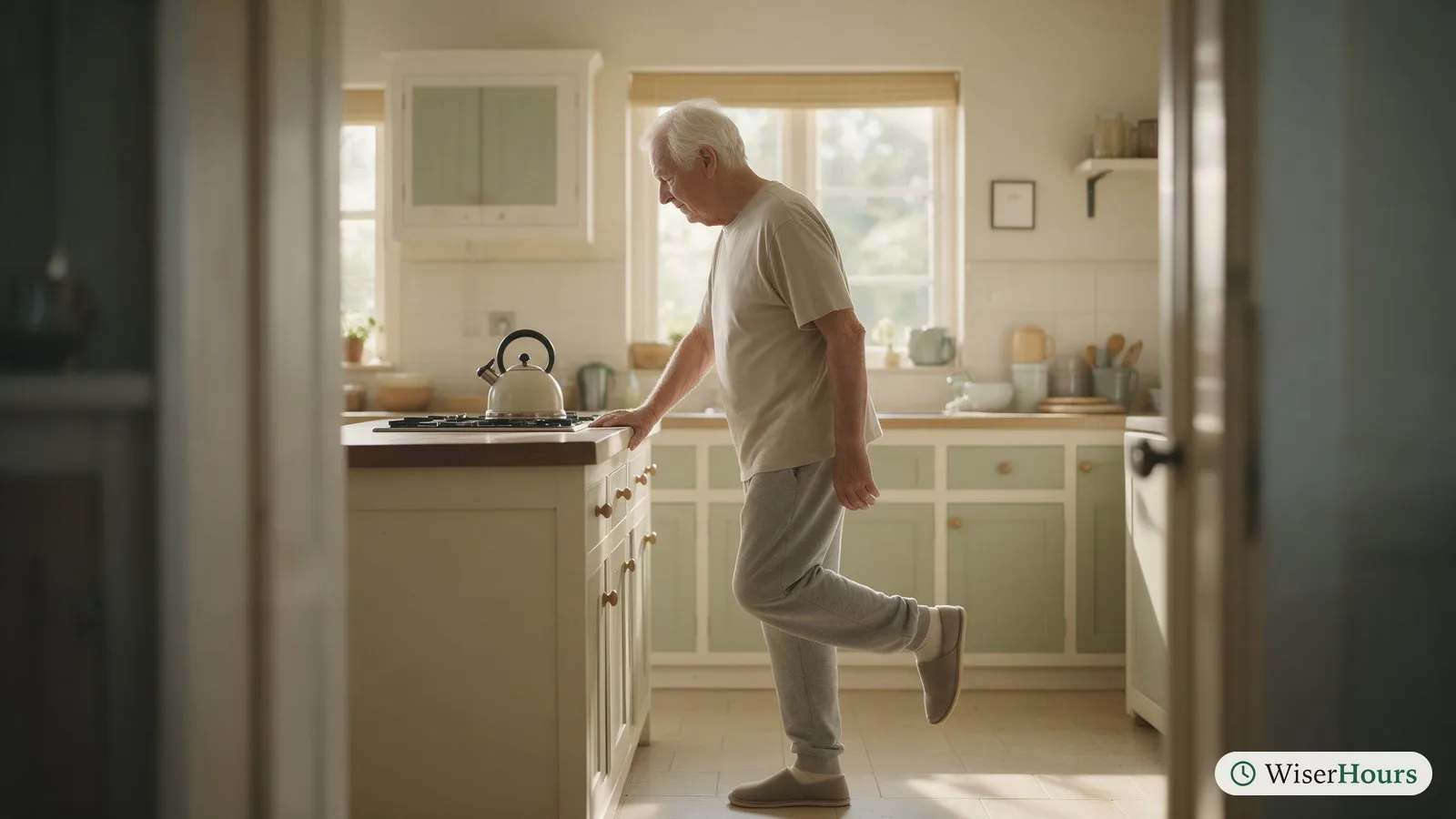
A 70-year-old who walks daily but never lifts anything heavier than a kettle covers the aerobic part only. Standing on one leg beside a kitchen counter is a small start on the rest.
Sitting less: a guideline without a number
The WHO advises every adult to limit time spent sitting and to swap some of it for movement at any intensity, light included, but sets no limit in hours, because its panel found the evidence too thin to pick a threshold. Sedentary behaviorsedentary behavior: Time spent awake sitting, reclining or lying down while using very little energy, such as desk work, driving or watching screens. It is measured separately from exercise, so a person can be both physically active and highly sedentary.Full entry in the glossary means waking time spent sitting, reclining or lying while using very little energy: most desk work, driving and watching television. In the studies the WHO reviewed, the risks linked with long hours of sitting varied with how active people were, so it adds that people who sit a lot should aim for more than the minimum aerobic activity.2
Canada’s 2020 guidelines go further and set a figure: no more than 8 hours of sedentary time a day, including limited recreational screen time, with long periods of sitting broken up as often as possible and several hours of light activity, including standing.7
A desk worker who meets the weekly target through evening runs can still spend most of the day seated. The guidelines treat these as two separate habits, so break up long sitting stretches too, for example by standing for phone calls or walking over to a colleague instead of messaging.
UK, US, Canadian and Australian guidelines compared with the WHO
The national guidelines of the UK, the US, Canada and Australia set essentially the same targets as the WHO: a weekly minimum of moderate activity or its vigorous equivalent, muscle-strengthening at least twice a week, and less sitting. The differences lie in wording and extras, not in the core amounts.
| Guideline | Aerobic activity per week | Strength | Sitting |
|---|---|---|---|
| WHO, 2020 (worldwide) | 150-300 min moderate or 75-150 min vigorous, or a mix; more for extra benefits | All major muscle groups, 2+ days; older adults add balance work on 3+ days | Limit it; no hour limit set1 |
| United States, 2018 | 150-300 min moderate or 75-150 min vigorous, preferably spread through the week | 2+ days; older adults add balance training | Move more and sit less5 |
| United Kingdom, 2019 (updated 2026) | At least 150 min moderate or 75 min vigorous, or shorter very vigorous activity; be active daily | 2+ days; older adults add balance and flexibility | Minimize it and break it up4 |
| Canada, 2020 (adults 18-64) | At least 150 min moderate to vigorous | Twice a week | 8 hours or less, with recreational screen time capped at 3 hours7 |
| Australia (adults 18-64) | 2.5-5 hours moderate or 1.25-2.5 hours vigorous, or a mix | 2+ days | Sit less and break up sitting8 |
Two differences stand out. The UK also counts short bursts of very vigorous effort such as sprinting or stair climbing.4 Canada sets figures for sitting and sleep that the WHO leaves open.7 Readers in other countries should check their own health ministry’s guideline: many draw on the same evidence, but details such as sitting limits and age bands vary.
Who should see a doctor before becoming more active
Most healthy adults do not need a medical check before starting light or moderate activity up to the level of brisk walking, and should start small and build up gradually, the WHO says.1 A doctor’s advice matters if you live with a heart condition or other chronic illness, are pregnant, or notice symptoms such as chest pain or pressure, dizziness or joint pain. Heart attacks during activity are rare, the US guidelines add, but the risk rises when a usually inactive adult suddenly does vigorous activity, such as shoveling heavy snow.5
- Now: sudden crushing, squeezing or tight chest pain, pain that spreads to the jaw, left arm or between the shoulder blades, or chest pain that comes with sweating, nausea, dizziness or breathlessness needs emergency help. Call your local emergency number (911 in the US, for example), MedlinePlus advises.9
- Soon: the US guidelines advise checking in with a health care provider when new symptoms appear as you increase your activity, and say people with chronic conditions or symptoms should be under a provider’s care.5
- Routine, before you start: with a long-term condition such as high blood pressure or type 2 diabetes, the WHO suggests asking a health professional or physical activity specialist which types and amounts of activity suit you. In pregnancy, it advises regular moderate activity for women without contraindications, says a health-care provider should explain the warning signs for stopping, and advises avoiding contact sports and, after the first trimester, exercises lying on your back.1 Canada’s guidelines point people with a medical condition or disability, or who are pregnant, to the Get Active Questionnaire or a health professional.7
The bottom line
The official answer is a weekly range: 150 to 300 minutes at moderate effort or half that at vigorous effort, strength work on two days, balance work too after 65, and less sitting. Brisk walking in short pieces counts, and the biggest health differences lie between doing nothing and doing something. If a heart condition, pregnancy or new symptoms apply to you, talk to a doctor before you step up.
This article is general information, not medical advice. If you're worried about your health, talk to a doctor or another qualified professional.
Frequently asked questions
Do chores, gardening or a bike commute count as exercise?
Yes, if the effort is at least moderate. The evidence review behind the WHO's 2020 guidelines concluded that physical activity at work, at home, in leisure time and while traveling all counts toward the recommended amounts. Brisk walking to the station, cycling to work or heavy gardening can therefore fill part of your weekly total.
Can you do too much exercise?
For risk of death, no upper limit has been found: the 2018 Physical Activity Guidelines for Americans report no evidence of increased risk even at 3 to 5 times the recommended amount. The practical limits are injury, which rises with the gap between your usual and your new level, and rare heart events, most likely when an inactive adult suddenly does vigorous activity. Build up gradually.
Do the guidelines apply to people with a disability or a long-term condition?
Largely, yes. The WHO's 2020 guidelines include adults living with disability and with conditions such as type 2 diabetes, high blood pressure or cancer survivorship. When the targets are out of reach, they advise being active according to your abilities, starting small, and asking a health professional or physical activity specialist which types and amounts suit you.
Sources
- WHO guidelines on physical activity and sedentary behaviour. World Health Organization (2020), Geneva
- World Health Organization 2020 guidelines on physical activity and sedentary behaviour. Bull, F. C., Al-Ansari, S. S., Biddle, S. et al. (2020). British Journal of Sports Medicine, 54(24), 1451-1462
- Physical activity. World Health Organization fact sheet, 26 June 2024
- UK Chief Medical Officers' physical activity guidelines. UK Chief Medical Officers (2019; HTML edition updated 10 July 2026). Department of Health and Social Care, UK
- Physical Activity Guidelines for Americans, 2nd edition. US Department of Health and Human Services (2018), Washington, DC
- Non-occupational physical activity and risk of cardiovascular disease, cancer and mortality outcomes: a dose-response meta-analysis of large prospective studies. Garcia, L., Pearce, M., Abbas, A. et al. (2023). British Journal of Sports Medicine, 57(15), 979-989
- Canadian 24-Hour Movement Guidelines for Adults aged 18-64 years. Canadian Society for Exercise Physiology (2020), Canada
- Physical activity guidelines for adults. NSW Government, Australia (summary of the Australian Government guidelines), accessed 28 September 2026
- Chest pain. MedlinePlus Medical Encyclopedia, US National Library of Medicine (review date 28 April 2026)
How we researched this
Each source was read in full (September 2026): the WHO's 2020 guidelines and the paper describing them, the WHO physical activity fact sheet, the national guidelines of Canada, Australia, the US and the UK, whose report was updated in July 2026, and a 2023 dose-response meta-analysis. Sources span 2018 to 2026. The evidence behind the targets is mostly observational, and the Australian guidelines were read through a state government summary.
Keep reading
Zone 2 Training Explained: Sorting the Trend From the Evidence
Zone 2 training is easy, conversational cardio. A 2025 review found no good evidence it beats harder exercise for mitochondria or fat-burning capacity.
Does Exercise Give You More Energy? What the Research Says
Does exercise give you energy? Randomized trials say yes on average, by a modest amount that builds over 6 weeks or more, with one key exception.
Personal Energy Audit: Track What Drains and Restores You for One Week
A personal energy audit: rate your energy 3 or 4 times a day for 7 days, note what you were doing, then sort drains from restorers. With a log and an example.
Healthy Snacks for Work: What to Keep in Your Drawer
Healthy snacks for work in 3 lists (drawer, fridge, bag) built on protein, fibre and healthy fat, with portion sizes and notes for allergies and diabetes.