Where Does Your Energy Come From? The Biology in Plain English
Where does energy come from? Sunlight stored in food, which your cells burn with oxygen to make ATP. The 3 energy systems, and why you can still feel tired.

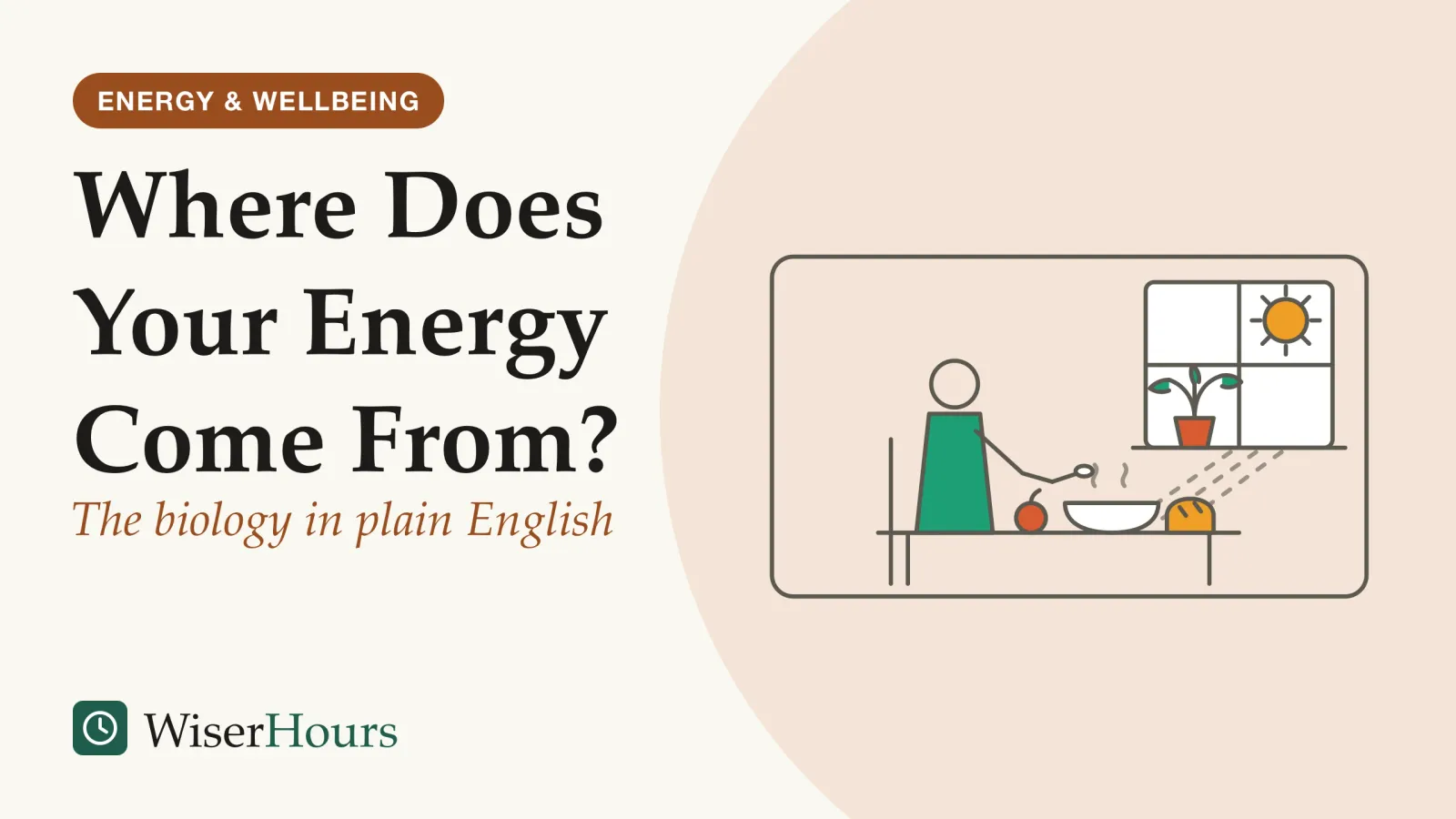
Your body’s energy starts as sunlight. Traced back through any meal, the answer to where does energy come from has four steps: plants store sunlight in sugar, you eat the plants or animals that ate them, digestion breaks the food into small fuels, and your cells burn those fuels with oxygen to make ATP, the molecule that powers almost everything a cell does.
Most of that last step happens in the mitochondria. According to the OpenStax Anatomy and Physiology textbook, about 95 percent of the ATP for resting or moderate muscle work comes from aerobic respiration, the oxygen-using process inside them.1 That chemistry runs whether you feel lively or flat. How energetic you feel on a given afternoon depends on other things, chiefly sleep, your body clock, mood and fitness, so they are usually the first things worth looking at when you feel drained. For tiredness that has lasted weeks, the guide to what keeps you tired for weeks and which signs need a doctor is the better starting point.
Where does energy come from? It starts with sunlight
Almost all the energy in your food began as sunlight, according to OpenStax’s Biology textbook. Photosynthesis is the only biological process that captures the sun’s energy and stores it in chemical bonds, as sugar, which living things then use to power their metabolism. Animals cannot do this, so they borrow the plants’ work: the textbook traces a wolf’s energy back through a deer and the plants the deer ate to sunlight and, before that, to nuclear reactions in the sun.2
A cheese sandwich follows the same route. The wheat in the bread grew in sunlight, and the cheese came from the milk of a cow that turned sunlit grass into fat and protein. Every calorie on the label is energy a plant captured first, and your body’s job is to release it, store it or send it where it is needed. When a product promises energy, ask which kind it means: calories, which every food carries, or a stimulant such as caffeine, which changes how awake you feel.
Where does the body get its energy from? Three fuels from digestion
The body gets its energy by breaking food into three kinds of small fuel, the OpenStax Anatomy and Physiology textbook explains: carbohydrates into simple sugars such as glucose, fats into fatty acids, and proteins into amino acids. Glucose is the fuel cells use most often to make ATP, and glucose you do not need straight away is stored as glycogen in the liver and muscles or turned into fat.3
None of this is perfectly efficient. The same chapter puts the share of released energy captured as ATP at about 40 percent; the rest is given off as heat, which the body’s tissues and fluids absorb.3 A bowl of rice and lentils cooked in olive oil shows all three paths at once: the rice is mostly starch that becomes glucose, the oil becomes fatty acids, and the lentils supply amino acids along with more starch.
For everyday energy, carbohydrate and fat do most of the work. Amino acids are mainly building material for new proteins.
What is ATP and why does it matter?
ATP, short for adenosine triphosphate, is the molecule cells spend to do work, and OpenStax calls it the energy currency of the cell. Its energy sits mainly in the bond to its last phosphate group, and breaking that bond powers the cell’s molecular machinery, including the building and repair of tissue.3
The body keeps very little ATP in stock: muscle holds only enough for a few seconds of contraction.1 So it recycles the molecule constantly. An adult turns over roughly their own body weight in ATP each day, rebuilding each molecule from its spent form a thousand times or more.4
A tank you fill at breakfast is the wrong picture. A closer one is a production line that never stops, rebuilding ATP every second from food, stored fuel and oxygen. That is why stored glycogen and fat can carry a healthy person through a missed meal, while oxygen has to keep arriving without a break.
Do mitochondria produce energy?
Mitochondria convert energy from food into ATP; they do not create it. In the last stage of aerobic respiration, OpenStax’s Biology textbook explains, a chain of proteins in the mitochondrion’s inner membrane passes electrons from food to oxygen, which picks up hydrogen to form water, and that flow drives most ATP production.5
Oxygen is the final link in that chain, so the supply has to be steady. Burning one glucose molecule with oxygen yields far more ATP than burning it without: current estimates are around 30 molecules, although many textbooks still print a higher theoretical figure.6 Without oxygen, the same glucose nets only 2.1
That is where oxygen and tiredness meet. In anemia the blood carries less oxygen than it should.7 The UK’s NHS lists a lack of energy with palpitations, shortness of breath and pale skin as signs that can point to iron deficiency anemia, a pattern to get checked by a doctor, who may arrange blood tests.8
Mitochondria and training
Mitochondria adapt to regular exercise, but the popular claim that slow cardio is the best way to build them holds up poorly, as the review of zone 2 training and what it does for fitness sets out.
Three energy systems: a sprint, a walk and a long day
Muscles refill their ATP in three overlapping ways, as OpenStax’s Anatomy and Physiology textbook describes. Creatine phosphate covers roughly the first 15 seconds of hard effort, glycolysis without oxygen carries a burst for up to about a minute, and aerobic respiration in the mitochondria powers everything longer and gentler.1
- First secondsCreatine phosphate hands its phosphate back to spent ATP
- Up to ~15 sThe creatine phosphate reserve runs low
- Up to ~1 minGlycolysis splits glucose without oxygen, leaving lactic acid
- BeyondAerobic respiration in the mitochondria carries steady effort
A sprint for the bus shows the first two systems. The opening strides run on creatine phosphate; if the bus pulls away and you keep going, glycolysis takes over and your legs start to feel heavy, since the lactic acid it leaves may add to muscle fatigue.1 You keep puffing after you stop because the body needs extra oxygen to rebuild its reserves.
A brisk walk to work and a long day at a desk both run on the third system, which has plenty of fuel. For a healthy person who feels drained by mid-afternoon, a shortage of ATP in the muscles is an unlikely explanation. The more useful questions are about sleep, mood and how active you have been.
Does fat or sugar give you more energy?
Gram for gram, fat holds more than twice the energy of sugar. The general Atwater factors described by the UN Food and Agriculture Organization give fat 9 kilocalories per gram, and carbohydrate and protein 4 each.9 Sugar is the faster fuel, though, and “more energy” on a label means more calories rather than more alertness.
Fat is also the body’s big reserve, which a 2018 review of fat burning during exercise describes as an almost endless supply for long efforts. Which fuel you use depends on how hard you work: at easy and moderate efforts fat supplies most of the energy, and as effort rises carbohydrate takes over, past what the review calls the crossover point.10
A slow walk with a friend leans on fat; a hard hill climb leans on glucose and glycogen. Neither changes how alert you feel at your desk, and the evidence that sugar works as a pick-me-up is poor, as the guide to food choices that keep you alert through the workday explains.
Why do I feel tired if I eat enough calories?
Feeling tired while eating enough usually has a cause other than missing fuel. The UK’s NHS names too little or poor-quality sleep, stress, depression, a poor diet combined with inactivity, and life challenges such as bereavement or a new baby as common reasons for tiredness, alongside medical conditions.8
Sleep pressure is built in. The US National Institute of Neurological Disorders and Stroke explains that adenosine, a chemical released by cells, helps make you sleepy, that the drive to sleep grows with every hour you are awake, and that caffeine works by blocking adenosine.11
The body clock adds a second layer. A master clock in the brain, set mainly by light and dark, signals for more melatonin in the evening, and shift work and travel across time zones knock it out of step, according to the US National Institute of General Medical Sciences.12 Mood is especially sensitive to sleep: a 1996 meta-analysismeta-analysis: A study that combines the results of earlier studies on the same question into one overall estimate. Pooling makes the estimate more precise, but it cannot repair the studies it pools: a meta-analysis of surveys is still survey evidence.Full entry in the glossary of 19 studies of sleep deprivation found that lost sleep affected mood more than thinking or motor performance.13
Fitness is the fourth input. A 2022 review of 81 randomized trials found that people assigned to regular exercise programs rated their energy higher and their fatigue lower than comparison groups, by small to moderate amounts.14 How quickly that builds, and when activity backfires, is covered in what regular workouts do for energy and fatigue.
A nurse finishing a run of night shifts may eat three full meals a day and still feel hollow. The fuel is there, but the sleep drive and the body clock are pulling against the hours being worked. More food will not settle that; protected sleep and steady light cues can help, and some of it has to wait until the rota changes.
Why “boosting metabolism” claims mislead
Metabolism is the sum of the chemistry on this page, and most of its energy goes on simply keeping you alive. A joint report by the FAO, the World Health Organization and the United Nations University puts basal metabolism at 45 to 70 percent of daily energy use, set mainly by age, sex, body size and body composition.15
The study
Moderate evidence
Does metabolism slow in middle age? Daily energy use from 8 days to 95 years (Science, 2021)
Herman Pontzer and an international team pooled measurements of daily energy expenditure from 6,421 people in 29 countries, aged 8 days to 95 years, taken with the doubly labeled water method. Once body size was allowed for, total and basal expenditure held steady from age 20 to 60, then fell by about 0.7 percent a year. The work was funded by the US National Science Foundation.16
The middle-age slowdown many people blame for weight gain did not show up in these averages. Individuals still vary, and the study measured calories burned, which says nothing about how lively anyone felt.
Products sold as metabolism boosters rest on thin evidence. A 2012 Cochrane review of green tea preparations, in trials of at least 12 weeks in adults with overweight or obesity, found only a small weight loss that was not statistically significant and, in the authors’ view, unlikely to matter clinically.17 Extracts carry their own cautions. The US National Center for Complementary and Integrative Health reports rare cases of liver injury, mostly from green tea extract tablets or capsules, and interactions with some medicines, so anyone who takes medicine or is pregnant should check with a doctor or pharmacist first. It also notes that in the US the FDA does not approve dietary supplements before they are sold; rules differ elsewhere.18
An overactive thyroid shows why a faster metabolism and more energy are separate things. In this condition the gland makes too much of the hormones that control how every cell uses energy, and MedlinePlus, from the US National Library of Medicine, lists fatigue and sleep problems among its common symptoms.19
- Myth
- A faster metabolism would give you more energy.
- Fact
- Burning fuel faster is a different thing from feeling lively, and MedlinePlus lists fatigue among the common symptoms of an overactive thyroid.
None of these trials measured tiredness, so a booster has no evidence behind it as a fix for feeling flat. Regular sleep, daylight and movement are better-supported places to start.
Tiredness with warning signs: who to see, and how fast
Tiredness with warning signs needs medical help, and the signs decide how fast. These tiers follow the UK’s NHS and MedlinePlus, from the US National Library of Medicine; services differ by country, so use the equivalents where you live.
- Now. Call your local emergency number for a life-threatening emergency such as signs of a heart attack or stroke (999 is the UK number, for example).20 Suicidal thoughts or urges to hurt yourself need a crisis line or emergency services straight away; in the US, call or text 988, open day and night.21 MedlinePlus also lists signs that mean contacting a provider at once: fatigue along with feeling confused or dizzy, vision that turns blurry, very little or no urine, or new swelling with weight gain.22
- Soon. The NHS advises a GP visit when unexplained tiredness has gone on for some weeks, when it disrupts daily life or arrives with weight loss or a change in mood, or when someone has noticed you gasping or choking during sleep.8
- Routine. Raise it at a regular check-up if a medicine or other substance you use may cause tiredness or drowsiness, or if you wake often in the night; keep taking prescribed medicines unless your doctor advises otherwise.22
The bottom line
Your energy is sunlight stored in food and turned into ATP by mitochondria using oxygen, a production line that keeps running whether you feel lively or not. When you feel drained despite eating well, work on what sets the feeling: keep a regular sleep window, get daylight during the day, move most days, and book a doctor’s appointment if the tiredness lasts more than a few weeks or comes with the warning signs above.
This article is general information, not medical advice. If you're worried about your health, talk to a doctor or another qualified professional.
Frequently asked questions
Are the calories on a food label the energy my body gets?
Roughly. Label calories are commonly worked out with the Atwater factors (rules vary by country), which the UN Food and Agriculture Organization describes as already corrected for losses in digestion, absorption and urine. Even so, the body does not capture all of that energy as ATP: the OpenStax Anatomy and Physiology textbook puts the share at about 40 percent, with the rest given off as heat that the body's tissues absorb.
Why do I keep breathing hard after I stop sprinting?
A hard sprint makes ATP faster than oxygen can arrive, which leaves what the OpenStax Anatomy and Physiology textbook calls an oxygen debt. Extra oxygen is then needed to rebuild ATP and creatine phosphate and to clear lactic acid, partly in the liver, so your breathing stays fast for a while after the effort ends.
Can the body run on protein for energy?
It can, but protein is mainly building material. OpenStax's Anatomy and Physiology textbook says amino acids can be used to build new proteins or broken down to make ATP, and that during chronic starvation the use of amino acids for energy can lead to a wasting away of the body as more protein is broken down.
Sources
- 10.3 Muscle Fiber Contraction and Relaxation. Betts, J. G., Young, K. A., Wise, J. A., et al. (2022). Anatomy and Physiology 2e. OpenStax, Rice University
- 8.1 Overview of Photosynthesis. Clark, M. A., Douglas, M. & Choi, J. (2018). Biology 2e. OpenStax, Rice University
- 24.1 Overview of Metabolic Reactions. Betts, J. G., Young, K. A., Wise, J. A., et al. (2022). Anatomy and Physiology 2e. OpenStax, Rice University
- Adenosine triphosphate. Wikipedia, accessed October 2026
- 7.4 Oxidative Phosphorylation. Clark, M. A., Douglas, M. & Choi, J. (2018). Biology 2e. OpenStax, Rice University
- Cellular respiration. Wikipedia, accessed October 2026
- Anemia. Wikipedia, accessed October 2026
- Tiredness and fatigue. NHS (UK), page last reviewed 2 June 2023
- Food energy: methods of analysis and conversion factors. Chapter 3: Calculation of the energy content of foods. Food and Agriculture Organization of the United Nations (2003). FAO Food and Nutrition Paper 77
- Understanding the factors that effect maximal fat oxidation. Purdom, T., Kravitz, L., Dokladny, K. & Mermier, C. (2018). Journal of the International Society of Sports Nutrition, 15, 3
- Brain Basics: Understanding Sleep. National Institute of Neurological Disorders and Stroke, US National Institutes of Health
- Circadian Rhythms. National Institute of General Medical Sciences, US National Institutes of Health (updated May 2025)
- Effects of sleep deprivation on performance: a meta-analysis. Pilcher, J. J. & Huffcutt, A. I. (1996). Sleep, 19(4), 318-326
- The Effect of Chronic Exercise on Energy and Fatigue States: A Systematic Review and Meta-Analysis of Randomized Trials. Wender, C. L. A., Manninen, M. & O'Connor, P. J. (2022). Frontiers in Psychology, 13, 907637
- Human energy requirements: report of a joint FAO/WHO/UNU expert consultation. Chapter 2: Principles and definitions. FAO, WHO and United Nations University (2004). FAO Food and Nutrition Technical Report Series 1
- Daily energy expenditure through the human life course. Pontzer, H., Yamada, Y., Sagayama, H., et al. (2021). Science, 373(6556), 808-812
- Green tea for weight loss and weight maintenance in overweight or obese adults. Jurgens, T. M., Whelan, A. M., Killian, L., et al. (2012). Cochrane Database of Systematic Reviews, CD008650
- Green Tea. National Center for Complementary and Integrative Health, US National Institutes of Health (last updated February 2025)
- Hyperthyroidism. MedlinePlus Medical Encyclopedia, US National Library of Medicine (review date 21 July 2024)
- When to call 999. NHS (UK), page last reviewed 3 February 2023
- 988 Suicide & Crisis Lifeline. 988 Suicide & Crisis Lifeline (US)
- Fatigue. MedlinePlus Medical Encyclopedia, US National Library of Medicine (review date 19 May 2025)
How we researched this
We built the biology from open textbooks (OpenStax Biology 2e and Anatomy and Physiology 2e), Wikipedia and UN FAO reports, and the practical sections from NIH and NHS pages, systematic reviews and one large 2021 cohort study, searched in October 2026. Sources date from 1996 to 2025. Main limitation: textbook figures such as the ATP yield per glucose are rounded teaching values, and two sources differ on them.
Keep reading
Personal Energy Audit: Track What Drains and Restores You for One Week
A personal energy audit: rate your energy 3 or 4 times a day for 7 days, note what you were doing, then sort drains from restorers. With a log and an example.
Why Am I Always Tired? Common Causes and When to See a Doctor
Why am I always tired? In a review of 26 primary-care studies, depression was found in about 1 in 5 tired patients, serious physical disease in about 4 in 100.
Vitamin B12 and Energy: Who Benefits and Who's Wasting Money
Vitamin B12 and energy: B12 ends tiredness caused by a deficiency but adds none at normal levels. Who is at risk, the signs, and whether shots are worth it.
Zone 2 Training Explained: Sorting the Trend From the Evidence
Zone 2 training is easy, conversational cardio. A 2025 review found no good evidence it beats harder exercise for mitochondria or fat-burning capacity.