Employer Match Explained: How Workplace Retirement Contributions Work
How an employer match works: a rate and a cap (50 cents per dollar on the first 6% of pay is one common US formula), vesting, true-ups and the UK minimum.

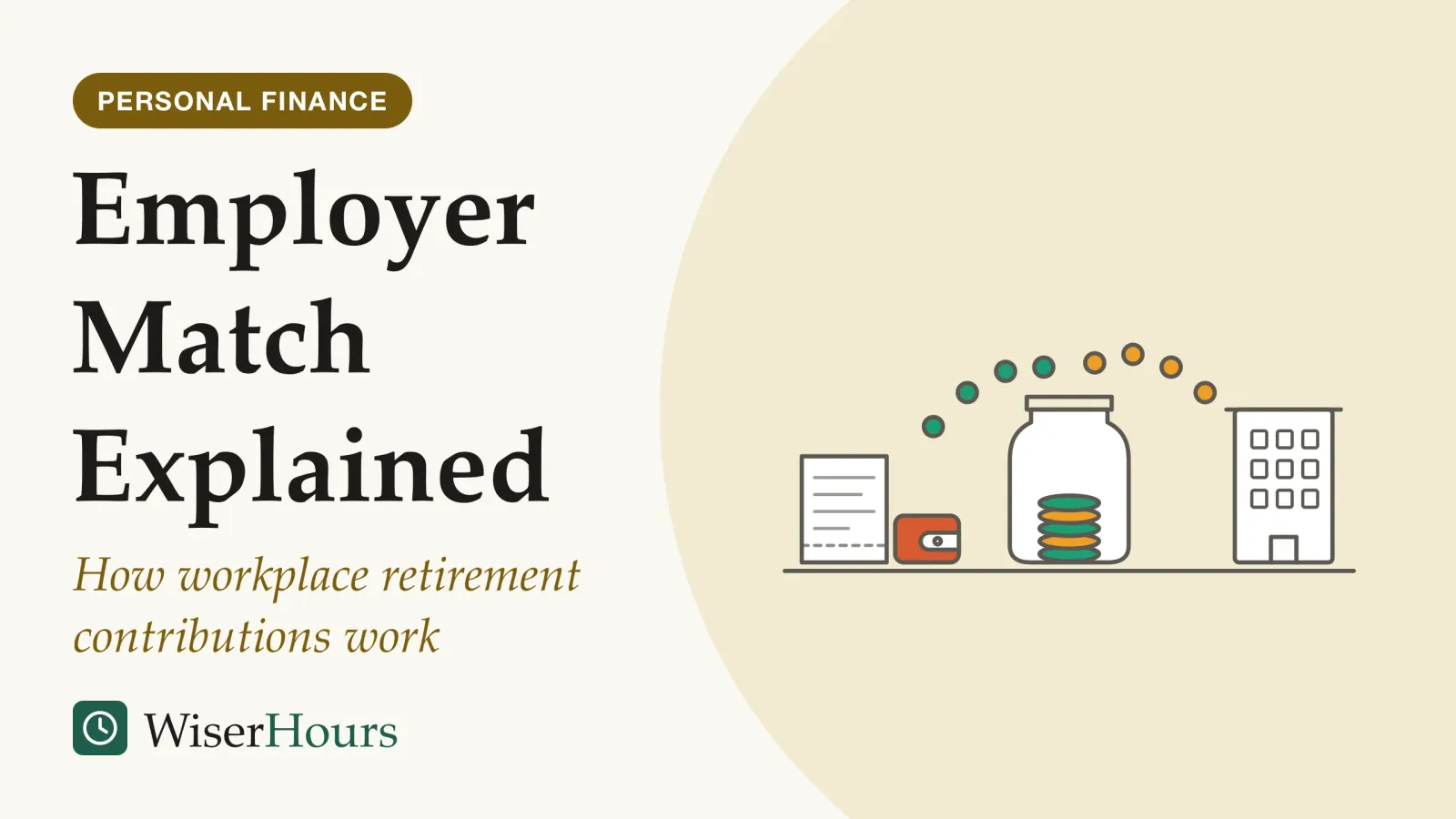
Two colleagues with the same salary and the same employer match can get very different amounts from it, because a match pays only on what each person contributes. An employer match is money your employer adds to your workplace retirement account when you contribute: a set share of each dollar you put in, up to a cap tied to your pay. Contribute less than the cap and you receive less than the full match.
In Vanguard’s 2026 report on the US plans it administers, the most common formula added 50 cents for every dollar on the first 6 percent of pay, worth up to 3 percent of salary, although only 12 percent of its plans with a match used that exact formula.1 The report is company research from a firm that sells plan services, drawn from its own clients and not peer-reviewed, so treat it as a picture of one large provider’s plans rather than of every employer.
Definition
An employer match is a contribution your employer makes to your workplace retirement plan in proportion to what you contribute, up to a limit the plan sets. The wording is ours, based on the US IRS description of matching contributions.2
Three plan rules decide how much of the match reaches you and stays yours: the contribution level at which it stops growing, the date it vests, and whether the plan makes up the difference at year end if you hit the annual limit early. In the UK the law sets a minimum employer contribution instead. How large a retirement pot needs to be is a separate question, covered in our guide to the savings target known as an FI number; more on pensions and retirement sits under financial independence and retirement.
How an employer match works: a rate and a cap
Every employer match formula has two parts: a rate, meaning the share of each dollar you contribute that the employer adds, and a cap, meaning the share of your pay beyond which it adds nothing more.
Multiply the two and you get the most the match can be worth, as a share of pay. That is why formulas that sound different can promise the same amount. Vanguard’s report points out that the common formula above and a dollar per dollar on the first 3 percent of pay promise the same maximum; the difference is that the common one pays it only if you contribute twice as much. Formulas also vary widely. Vanguard administered more than a hundred distinct ones in 2025: about a quarter of its plans used tiers, such as a richer rate on the first slice of pay and a lower one on the next, and a few set a dollar cap on the match.1
Here is the common single-tier formula applied to an invented salary.
| Your contribution, on a salary of $50,000 | The employer adds (50 cents per dollar on the first 6% of pay) | Total going in each year |
|---|---|---|
| 2% of pay ($1,000) | $500 | $1,500 1 |
| 6% of pay ($3,000) | $1,500, the full match | $4,500 1 |
| 8% of pay ($4,000) | $1,500 | $5,500 1 |
The salary is invented, in 2026 US dollars before tax, and the arithmetic is ours; it shows how the formula behaves, not a contribution level for anyone. The row to notice is the last one: past the cap, your own saving keeps growing but the employer’s share does not.
- Below the cap: each dollar you contribute, up to 6% of pay, brings 50 cents from the employer
- At the cap: contributing 6% of pay brings the whole match, worth 3% of pay
- Above the cap: your own contributions keep growing; the match stays at 3% of pay
The contribution level where the match stops growing, often called the match threshold, is the number worth finding in your own plan, because it tells you exactly how much of the benefit your current rate collects. Whether contributing up to it fits your budget is a separate, personal question that depends on your debts, cash reserves and other goals.
Why so many workers leave part of the match unclaimed
Missing part of the match is common even among people with every reason to take it. Economists James Choi, David Laibson and Brigitte Madrian, in a study published in 2011, examined workers at seven US companies who could take money out of their 401(k) at any time without penalty, and found that many still contributed below the match threshold.3
The study
Limited evidence
Penalty-free savers who still skipped the match: payroll records from seven US firms
Among match-eligible workers over 59½, who could withdraw their savings at any time without penalty, 36 percent at the average company contributed below the match threshold. The match they gave up averaged 1.6 percent of annual pay, or $507 in 1998 dollars. At one company, a mailed survey that spelled out the forgone match to a randomly chosen group was followed by a rise in contributions too small to tell apart from no effect.3
The researchers picked this group because the usual reasons for holding back, such as needing the cash, early-withdrawal penalties or an unvested match, did not apply to them.3 The caveat is that they were older workers at seven firms in 1998, so the study shows that the gap happens, not how common it is today.
Why would anyone leave money unclaimed? In the authors’ survey, which had a low response rate, workers below the threshold were more prone to put things off and knew less about finance and about their own plan, and the authors ruled out the direct cost of the paperwork as the main reason.3
A match can change behavior, though. In a randomized field experimentfield experiment: An experiment run in a real setting, such as a workplace, shop or website, with people going about their ordinary lives, usually with random assignment. It shows how an effect plays out in practice, though often for one setting and one group at a time.Full entry in the glossary with thousands of tax-preparation clients in mostly low- and middle-income St. Louis neighborhoods, published in 2006, a 50 percent match on retirement account deposits raised take-up from 3 percent to 14 percent.4 Those clients were deciding at tax time, not choosing at their desks, and the effect within workplace plans looks smaller: a 2007 observational studyobservational study: A study in which researchers record what people already do or are exposed to, rather than assigning anyone to anything. It can show that two things go together, not that one causes the other, because the groups being compared may differ in other ways as well.Full entry in the glossary of older US households by Gary Engelhardt and Anil Kumar linked richer matches to modestly higher participation and concluded that matching is a weak tool for raising saving overall.5
In everyday terms, the gap often looks like this: someone means to raise their contribution after a pay rise, never logs in to the benefits site and never notices. Because a mailed survey spelling out the lost match made no clear difference to contributions in the Choi study, a good intention may not be enough. One option that does not depend on memory, though no study here tested it, is to look at the contribution rate on your pay stub whenever your pay or your plan changes.
Vesting: when the employer’s money becomes yours (US)
Vesting is the point at which employer contributions become yours to keep. The IRS’s vesting guidance, reviewed in April 2026, says your own contributions are always fully vested, while the match follows your plan’s schedule, which can run from immediate ownership to full ownership only after several years of service.6
The IRS illustrates two kinds of schedule. Under cliff vesting you own none of the match until three years of service and all of it after that; under graded vesting your share rises each year from the second year until you own all of it in the sixth. Unvested money can be forfeited when you leave.6 Plans count a year of service in their own way, so check how yours does.
Schedules differ widely in practice. Nearly half of the plans in Vanguard’s report vested the match immediately in 2025, while about a fifth used a five- or six-year graded schedule.1
In the UK, the GOV.UK workplace pensions guide, checked in September 2026, says a workplace pension still belongs to you if you change jobs, and the money stays invested until the scheme’s pension age.7 In other countries, the national pension authority publishes the local rules.
Take an invented worker on a three-year cliff who leaves after two and a half years. She keeps everything she paid in, with any investment gains or losses on it, but none of the match. Six more months would have made the whole match hers. When a job move is on your mind, knowing your vesting date before you choose a leaving date costs nothing.
Payday matching, limits and the year-end true-up (US)
A US plan can calculate the match each payday or over the whole year, and IRS guidance for providers of pre-approved 403(b) plan documents, reviewed in September 2026, says the document must name that period and flag when a year-end true-up may be needed.8 The choice matters if you reach the yearly limit on what you can defer from pay before December.
The limits below are the IRS’s figures for 2026. The match does not count toward your own deferral limit, only toward the overall one.
| US 401(k) limit, 2026 (IRS) | Amount | What it covers |
|---|---|---|
| Your elective deferrals | $24,500 | What you contribute from pay, generally across all your plans 9 |
| Catch-up contributions, if the plan allows | $8,000 extra from age 50; $11,250 at ages 60 to 63 | Extra deferrals on top of the regular limit 9 |
| Total added to your accounts with one employer | $72,000 before catch-up contributions, or 100% of pay if lower | Your deferrals plus the match and other employer contributions 9 |
Picture an invented high earner who contributes a large share of each paycheck and reaches the deferral limit in September. Her deferrals stop for the rest of the year. If her plan matches per paycheck, so does the match, and she ends the year with less than a colleague on the same salary who spread the same total over twelve months.
A true-up is the fix. In plain terms, a plan that calculates the match over the whole year but pays it in each payday compares, at year end, what you were owed with what arrived, and pays the difference.
Before your contributions hit the limit early
Find out whether your plan calculates the match per paycheck or per year, and whether it pays a true-up. Without either, the match continues only while your contributions do.
In the UK, the law sets a minimum rather than a match
UK law does not require employers to match what you pay in, but automatic enrolment law sets a floor. For the 2026/27 tax year, The Pensions Regulator says minimum contributions total 8 percent of qualifying earnings, of which at least 3 percent has to come from the employer; the band of earnings counted runs from £6,240 to £50,270 a year.10
In most automatic enrolment schemes only pay inside that band counts, which shrinks the real amount. On an invented salary of £30,000 in 2026/27, the employer minimum applies only to the part above the lower limit, which comes to about £713 a year rather than 3 percent of the whole salary. GOV.UK’s worked example shows the employee’s share arriving partly as tax relief, and notes that in some schemes the employer has the option to pay more than the legal minimum.11
That extra is where a UK version of the match appears. Three questions for HR or your pension provider will tell you whether your employer offers one: does the employer pay above the minimum, does the extra depend on how much you pay in, and which earnings is it calculated on? In other countries, the national pension regulator sets out what employers must pay.
Questions to answer from your plan documents
The facts that decide what a match is worth to you sit in your own plan’s paperwork. UK readers can ask their pension provider or employer about their scheme’s terms. For US readers, the IRS points to HR, the Summary Plan Description and the annual benefit statement.6
Find these in your plan documents
When a match decision needs outside help
Most match questions are about facts, and the plan can answer them; a few decisions depend on your whole financial picture. Take them in order of urgency.
- Now, if money seems to be missing. If your statement does not show contributions taken from your pay, or matches you were promised, US readers can put a question about their retirement plan to the Labor Department’s Employee Benefits Security Administration online or by phone.12 For the UK, GOV.UK directs concerns about how an employer handles automatic enrolment to The Pensions Regulator, and MoneyHelper may also help.13 Elsewhere, contact your national pension regulator.
- Before a big decision, such as leaving a job with an unvested match or making a large change to what you contribute, a regulated financial adviser can weigh your whole situation; find out at the start how the adviser earns their money. US readers can look up a professional’s background, including any customer disputes and disciplinary events, in BrokerCheck, which FINRA offers free.14 UK readers can confirm that a firm holds the permissions it needs through the FCA’s Firm Checker or its Financial Services Register.15 Elsewhere, ask your national financial regulator how to check an adviser.
- Routinely, for questions about your options: GOV.UK names MoneyHelper, and Pension Wise for defined contribution schemes, as free, impartial sources of information for UK savers.13 In the US, your plan administrator or HR can explain your plan’s terms. Elsewhere, ask your national pension authority.
The bottom line
A match is worth only the part you collect and keep. Before anything else, look up three things in your plan documents: where the match stops growing, when it vests, and whether a true-up covers you if your contributions finish early. How much to contribute is a separate, personal choice, and a regulated adviser can help when your situation is complicated.
This article is general education, not financial advice. For decisions about your own money, speak to a qualified, regulated adviser.
Frequently asked questions
Can my employer stop or change the match?
Sometimes. The IRS explains, on a page reviewed in January 2026, that a US employer's matching contributions can be discretionary, paid in some years and not in others, or mandatory, as in safe harbor 401(k) and SIMPLE plans. Your plan document and Summary Plan Description set out your plan's terms, so check them again whenever your employer announces benefit changes.
Does the employer match count toward the 401(k) contribution limit?
Not toward your own limit. In the US, the 2026 cap of $24,500 applies to the elective deferrals you make from pay, according to the IRS. Matching contributions count instead toward a separate overall limit on everything added to your account in a year, which is $72,000 in 2026, before catch-up contributions.
Do UK employers have to pay in if I earn too little to be enrolled automatically?
It depends on your earnings. GOV.UK says that if you join a workplace pension voluntarily, your employer must pay the minimum contribution if you earn more than £520 a month (or £120 a week), the 2026/27 thresholds, and does not have to pay anything at or below those amounts. You can still join and pay in yourself.
Sources
- How America Saves 2026 (25th edition). Vanguard (2026), June 2026; data on more than 1,300 US plans it recordkeeps, as of December 31, 2025 (company research, not peer-reviewed); accessed 2026-09-24
- Retirement topics - Contributions. Internal Revenue Service (US), page last reviewed or updated January 29, 2026; accessed and checked current 2026-09-24
- $100 Bills on the Sidewalk: Suboptimal Investment in 401(k) Plans. Choi, J. J., Laibson, D. & Madrian, B. C. (2011). The Review of Economics and Statistics, 93(3), 748-763 (author manuscript in PubMed Central)
- Saving Incentives for Low- and Middle-Income Families: Evidence from a Field Experiment with H&R Block. Duflo, E., Gale, W., Liebman, J., Orszag, P. & Saez, E. (2005). NBER Working Paper 11680; published in The Quarterly Journal of Economics, 121(4), 1311-1346, 2006
- Employer Matching and 401(k) Saving: Evidence from the Health and Retirement Study. Engelhardt, G. V. & Kumar, A. (2006). NBER Working Paper 12447; published in the Journal of Public Economics, 91(10), 1920-1943, 2007
- Retirement topics - Vesting. Internal Revenue Service (US), page last reviewed or updated April 8, 2026; accessed 2026-09-24
- Workplace pensions: Changing jobs and taking leave. GOV.UK (UK government); accessed and checked current 2026-09-24
- Q&As for 2nd cycle pre-approved 403(b) plan providers. Internal Revenue Service (US), page last reviewed or updated September 4, 2026; accessed 2026-09-24
- Retirement topics - 401(k) and profit-sharing plan contribution limits. Internal Revenue Service (US), page last reviewed or updated April 8, 2026; accessed 2026-09-24
- Making contributions to your pension scheme. The Pensions Regulator (UK), 2026/27 figures; accessed 2026-09-24
- Workplace pensions: What you, your employer and the government pay. GOV.UK (UK government); accessed and checked current 2026-09-24
- Ask EBSA. Employee Benefits Security Administration, US Department of Labor; accessed 2026-09-24
- Workplace pensions: Get help. GOV.UK (UK government); accessed 2026-09-24
- About BrokerCheck. Financial Industry Regulatory Authority (FINRA, US); accessed 2026-09-24
- How to check a firm or individual is authorised. Financial Conduct Authority (UK), first published 20 March 2023, last updated 22 September 2026; accessed 2026-09-24
How we researched this
Sources were read in September 2026: the full 2011 Choi, Laibson and Madrian study, the working-paper version of a 2006 randomized trial of saving matches, the abstract and conclusions of a 2007 observational study, Vanguard's How America Saves 2026, and current IRS, US Labor Department, GOV.UK, Pensions Regulator, FINRA and FCA pages. Main limitation: the key study used 1998 records from seven US employers, and a search turned up no systematic review of how matches change saving.
Keep reading
Annuities: An Honest Look at How They Work, What They Cost, and the Trade-Offs
How annuities work: when income starts, who bears market risk, where fees hide, and why the UK saw 1 annuity sale per 4 plans entering drawdown in 2025/26.

How to Calculate Your FI Number: The 25x Rule and Its Limits
An FI number is often estimated as the yearly spending gap times 25. Where that comes from, and why US estimates for a 40-year retirement point nearer 30.
What Is Financial Independence? A Definition Beyond "Never Working Again"
Does financial independence mean never working again? A plain definition, why it comes in degrees, and why the 4% rule is a US rule of thumb, not a promise.