How to Set Goals You'll Actually Achieve
How to set goals in 5 steps. In a 2017 meta-analysis of 384 randomized tests, difficult goals had larger effects than easy or moderate ones.


One of the most quoted statistics about goals comes from a study that never took place. In the popular story, the 3 percent of Yale’s class of 1953 who had specific long-term goals at graduation later held 97 percent of the class’s wealth. Yale University Library says no such study occurred: the class secretary had never heard of it, and a search of university records found nothing. The library traced the story to a 1991 Success magazine article whose author relied on the motivational speaker Zig Ziglar, who in turn had no concrete source.1
The real research on goals is less dramatic and more useful. The short answer to how to set goals you will reach: choose one goal you want, make it specific and hard, decide when you will act and how you will handle obstacles, and keep a record of your progress. The five steps, with the best-tested at the top:
- Choose a goal you want, and make it specific and hard
- Plan when and where you’ll act, and what you’ll do about obstacles
- Keep a record of your progress, and let someone see it
- Set a learning goal while the skill is still new
- Break a distant goal into nearer targets
Setting a goal helps, by a small and reliable amount
A 2017 meta-analysis of 384 randomized tests with 16,523 participants found that setting a goal changed behavior by a small but reliable amount, and that difficult goals had a medium effect where easy or moderate ones had a small one. The review, by Tracy Epton, Sinead Currie and Christopher Armitage, pooled experiments on tasks ranging from puzzles and sport to study habits and health.2
The study
Moderate evidence
What 384 randomized tests say about setting a goal: Epton, Currie and Armitage, 2017
The researchers pooled randomized experiments that isolated the effect of setting a goal, most often compared with a vague instruction to do your best. Goal setting had a small positive effect overall, a standardized difference of 0.34, which held when extreme values were adjusted and when only adequately powered studies were kept. Comparing across tests, effects were larger when goals were difficult, set publicly or set for a group, and when the goal matched the thing being measured.2
In plain terms, a goal gives a nudge rather than a transformation. Nearly none of the tests described how people were randomized, a test for small-study bias was positive, and the typical test measured results within about two weeks, so the review says little about goals pursued over months.2
The result fits an older body of workplace research. In a 2002 review of 35 years of their own and others’ studies, Edwin Locke and Gary Latham, the organizational researchers who developed goal-setting theory, reported that specific, difficult goals consistently led to higher performance than urging people to do their best, with effect sizes of 0.42 to 0.80 in earlier meta-analyses. Their explanation is that “do your best” has no external reference point, so people define it loosely and accept many levels of performance as good enough.3
How to set goals: the five steps in detail
Setting goals well takes five habits, and the evidence behind them thins out down the list. The first three rest on meta-analyses of randomized experiments; the last two rest mainly on laboratory studies described by the founders of goal-setting theory, and the fifth has conflicting results.
1. Choose a goal you want, and make it specific and hard
Write the goal as a result you can check, set above what you would reach by default: “pass the project management certification exam by 30 April” rather than “study for the certification.” The goals with the larger effect in the 2017 meta-analysis were the ones its authors coded as difficult, meaning beyond what people would typically achieve.2
Choose something you actually care about. Locke and Latham describe commitment as the condition under which goals work best, especially hard ones, and name two things that build it: believing the goal matters and believing you can reach it.3 The experimental record is less tidy: in the 2017 meta-analysis, tests that added a technique to raise commitment had smaller effects than goal setting alone, though only one of them paired it with a hard goal.2
The familiar SMART checklist (specific, measurable, achievable, realistic, time-bound) overlaps with this advice but is not the same thing. A 2023 narrative review of physical activity goals, led by Christian Swann of Southern Cross University, argued that the acronym is not based on scientific theory, is not consistent with the empirical evidence and has redundant criteria.4 Whether a goal names a result (“pass the exam”) or a behavior (“study for an hour a day”) made no clear difference in the 2017 meta-analysis, although no study had compared the two directly.2
2. Plan when and where you’ll act, and what you’ll do about obstacles
A goal says what you want; an if-then plan says when you will act on it: “If it is 7 a.m. on a weekday, then I do one practice section before opening email.” A 2025 meta-analysis of 642 experimental tests by Paschal Sheeran, Olivia Listrom and Peter Gollwitzer found that such plans helped people act on their goals, with larger effects when the plan took the if-then form, when people were highly motivated to reach the goal, and when they rehearsed the plan. The average effect was small, and smaller still after correcting for publication bias; comparing across studies, plans that people wrote down had smaller effects than plans they did not.5 The same plans can name a distraction and your response to it, as the guide to if-then plans for holding your focus shows.
Thinking about obstacles before you plan has been tested as a package. In mental contrasting with implementation intentions, known as WOOP (wish, outcome, obstacle, plan), you picture the outcome you want, then the obstacle most likely to stop you, then make an if-then plan for it. A 2021 meta-analysis of 21 field studies with 15,907 participants found a small-to-medium effect on reaching goals, which shrank after correcting for likely publication bias; sessions run with an experimenter showed larger effects than written materials.6
The goal, with its plans underneath
Write the goal in one line, then make two plans and say each to yourself once. To start: “If it is 7 a.m. on a weekday, then I sit at the kitchen table and do one practice section.” For the likeliest obstacle: “If an early meeting takes that slot, then I do the section at lunch instead.”
3. Keep a record of your progress, and let someone see it
Tracking progress is one of the best-tested habits in this guide. A 2016 meta-analysis of 138 randomized studies with 19,951 participants, led by Benjamin Harkin at the University of Sheffield, found that prompting people to monitor their progress helped them reach their goals, and the effect was larger when progress was physically recorded and when it was reported to someone else or made public. Most of the studies concerned health goals such as weight, physical activity and blood sugar, so for work and study goals the finding is borrowed.7
Pick one number that shows progress, write it down at the same time each week, and share it with one person. The same weekly log sits at the center of a job search run as a weekly plan. Locke and Latham count feedback on progress as essential to how goals work, since people cannot adjust effort or strategy without it.3 Yet in the 2017 meta-analysis, adding feedback did not change the effect of goal setting across 154 tests, and the 25 tests pairing a goal with feedback, a small sample, showed no clear difference from control groups.2
4. Set a learning goal while the skill is still new
When a task is new or complex for you, a hard performance target can backfire, and a goal to learn may work better. Locke and Latham describe how a performance goal can make people so anxious to succeed that they try strategies haphazardly and fail to learn what works, and cite a 1996 experiment in which a specific, difficult learning goal, such as discovering a set number of strategies, produced higher performance on a complex task than urging people to do their best.3
They add that goal effects in general are smaller on complex tasks than on simple ones, and that once people know the right strategies, a specific, hard performance goal makes them more likely to use them.3 The 2017 meta-analysis, though, found no difference in effects by task complexity.2 A learning goal for a new reporting tool might be “try three ways of building the monthly report and note which is fastest”; once you know, switch to “build it in under an hour.”
5. Break a distant goal into nearer targets
For a goal months away, set checkpoints along the way, but know the evidence is thin. Locke and Latham describe a business-game experiment in which adding near-term goals to a distant one raised players’ confidence and profits compared with the distant goal alone or a do-your-best instruction.3 In the 2017 meta-analysis, though, near and distant goals had similar effects.2 The practical case rests on feedback: a monthly checkpoint tells you sooner whether your approach is working, which Locke and Latham tie to near-term goals on fast-changing tasks.3
- The goal: one result you care about, specific and harder than you would reach by default
- The likeliest obstacle: an if-then plan decided in advance: if this happens, then I will do that
- The record: progress written down each week, where someone else can see it
- Nearer targets: checkpoints on the way to a distant goal; the evidence for them is thin
Put together, the five steps fit on one page, and the checklist below is that page.
One goal, on one page
Writing goals down and going public: what holds up
Writing a goal down has little direct evidence behind it as a habit on its own, while sharing goals and progress with other people has more, with one exception from experiments on identity goals. The Yale study that made written goals famous does not exist, according to Yale University Library.1
- Myth
- People who write their goals down are far more successful, as the Yale study of 1953 graduates showed.
- Fact
- Yale's library says no such study took place, and in a 2017 meta-analysis of randomized tests, goals written by participants showed no clear difference from goals spoken or written by someone else.
Writing is still a sensible way to make a goal specific and to keep the record in step 3. What it lacks is evidence that the act of writing, by itself, does much: the 2017 meta-analysis found no clear difference between goals participants wrote down and goals someone else spoke or wrote.2
Going public has stronger support. In the 2017 meta-analysis, tests with goals set publicly showed larger effects than tests with private ones, and group goals larger effects than individual ones.2 In the 2016 monitoring meta-analysis, progress reported to others or made public had larger effects than progress kept private.7
The exception comes from four experiments reported in 2009 by Peter Gollwitzer and colleagues on identity goals, such as becoming a lawyer. When other people took notice of someone’s intention to act toward such a goal, the person acted on it less intensively; one experiment found this only among people strongly committed to the identity, and another suggested that being noticed gave a premature sense of already having it.8 One way to reconcile the findings is to share what you did this week rather than who you are becoming.
Further reading
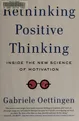
Rethinking Positive Thinking: Inside the New Science of Motivation
The researcher behind WOOP explains why picturing the obstacle before you plan helps, the method in step 2 of this guide.
Succeed: How We Can Reach Our Goals
A social psychologist's plain guide to specific, hard goals, if-then plans and learning goals, the core steps of this article.

As an Amazon Associate WiserHours earns from qualifying purchases.
When goals backfire
Hard, narrow goals have side effects, and management researchers disagree about how much weight to give them. In a 2009 critique titled “Goals Gone Wild,” Lisa Ordóñez, Maurice Schweitzer, Adam Galinsky and Max Bazerman argued that the benefits of goal setting have been overstated and listed its side effects: a narrow focus that neglects everything outside the goal, riskier choices, unethical behavior and reduced intrinsic motivation.9
Some of their evidence is experimental. In one study they cite, people with a specific, challenging goal were more likely to overstate their performance than people without one, especially when they fell just short. Other examples are company cases, such as Sears’s auto repair centers in the early 1990s, where hourly sales goals were followed by staff overcharging customers and doing unnecessary repairs.9
Locke and Latham replied the same year that the critique drew its central theme from anecdotes rather than research, and that almost all the pitfalls it named had already been published by them.10 Neither side argues that goals are harmless. In practice, name what a hard target could crowd out, such as quality, safety or honesty, and treat a near miss as information rather than something to hide.
Goal-setting advice, sorted by the strength of its evidence
The strongest evidence on goal setting supports specific, difficult goals, if-then plans and progress monitoring, each backed by a meta-analysis of randomized experiments. Advice on learning goals and near-term targets rests on fewer studies, and the evidence on going public and writing goals down is mixed or indirect.
| What it is | What the best evidence found | Evidence |
|---|---|---|
| A specific, difficult goal | Small, reliable effect on behavior; difficult goals had larger effects than easy or moderate ones | Meta-analysis, moderate2 |
| Specific, hard goals instead of “do your best” | Higher performance in earlier meta-analyses, mostly of lab and work tasks | Review of meta-analyses, moderate3 |
| If-then plans | Helped people act on their goals across 642 tests; small after correcting for publication bias | Meta-analysis, moderate5 |
| Picturing obstacles first (WOOP) | Small-to-medium effect, smaller after correcting for publication bias | Meta-analysis, limited6 |
| Monitoring progress | Helped people reach goals, more when recorded or shared; mostly health goals | Meta-analysis, moderate for goals in general (borrowed for work goals)7 |
| Going public | Public and group goals showed larger effects; noticed identity intentions were acted on less | Meta-analysis and four experiments, mixed28 |
| A learning goal for a new, complex task | Beat “do your best” on a complex task | Lab experiments, limited3 |
| Near-term targets | Helped in one business game; no clear difference in the 2017 meta-analysis | Mixed32 |
| Writing the goal down | No clear difference between goals written by participants and goals spoken or written by others | Meta-analysis subgroup comparison, limited2 |
The bottom line
Choose one goal you care about and set it high enough that you would not reach it by default, then decide when you will work on it and what you will do when something gets in the way. Record your progress each week where someone else can see it. Expect a steady nudge rather than a transformation: in the best evidence, goals improve behavior by a small, reliable amount, and hard goals by more.
Frequently asked questions
Can a goal be too hard?
Yes, at some point. Edwin Locke and Gary Latham's 2002 review reports that performance rose with goal difficulty until people reached the limits of their ability or their commitment to a very hard goal lapsed. The 2017 meta-analysis by Epton and colleagues could not test near-impossible goals, because only 10 of its tests used them, and its authors advise keeping goals within reach for the person setting them.
Do goals work better if you set them yourself?
Not in the experiments pooled in 2017. The 2017 meta-analysis by Tracy Epton and colleagues found no clear difference between goals set by the participant, goals set by someone else and goals set together. The authors note this runs against theories that stress autonomy, and suggest that people setting their own goals in these studies may have picked goals of lower quality, with little training in how to do it.
Do group goals work better than individual goals?
In the 2017 meta-analysis by Epton and colleagues, tests of group goals showed larger effects than tests of individual goals, though only 48 of the 384 tests used group goals. The authors read this, along with the larger effects of goals set publicly, as a sign that an actual or implied audience strengthens goal setting. Studies run in workplaces and schools also showed larger effects than those run in universities.
Is there a Harvard study showing that people with written goals earn more?
We could not find one. A version of the story set at Harvard circulates alongside the Yale one, but our searches of journal databases and the web in September 2026 turned up no published paper, dataset or named researcher behind it. It follows the same pattern as the Yale version, which Yale University Library says never took place: a small share of graduates with written goals later outearning everyone else.
Sources
- Where can I find information on Yale's 1953 goal study? Yale University Library, Ask Yale Library FAQ, last updated 28 September 2020
- Unique effects of setting goals on behavior change: Systematic review and meta-analysis. Epton, T., Currie, S. & Armitage, C. J. (2017). Journal of Consulting and Clinical Psychology, 85(12)
- Building a practically useful theory of goal setting and task motivation: A 35-year odyssey. Locke, E. A. & Latham, G. P. (2002). American Psychologist, 57(9)
- The (over)use of SMART goals for physical activity promotion: A narrative review and critique. Swann, C., Jackman, P. C., Lawrence, A., et al. (2023). Health Psychology Review, 17(2)
- The when and how of planning: Meta-analysis of the scope and components of implementation intentions in 642 tests. Sheeran, P., Listrom, O. & Gollwitzer, P. M. (2025). European Review of Social Psychology, 36(1)
- A meta-analysis of the effects of mental contrasting with implementation intentions on goal attainment. Wang, G., Wang, Y. & Gai, X. (2021). Frontiers in Psychology, 12
- Does monitoring goal progress promote goal attainment? A meta-analysis of the experimental evidence. Harkin, B., Webb, T. L., Chang, B. P. I., et al. (2016). Psychological Bulletin, 142(2)
- When intentions go public: Does social reality widen the intention-behavior gap? Gollwitzer, P. M., Sheeran, P., Michalski, V. & Seifert, A. E. (2009). Psychological Science, 20(5)
- Goals gone wild: The systematic side effects of overprescribing goal setting. Ordóñez, L. D., Schweitzer, M. E., Galinsky, A. D. & Bazerman, M. H. (2009). Academy of Management Perspectives, 23(1)
- Has goal setting gone wild, or have its attackers abandoned good scholarship? Locke, E. A. & Latham, G. P. (2009). Academy of Management Perspectives, 23(1)
How we researched this
We searched PubMed, Crossref, OpenAlex and the web in September 2026 for meta-analyses and randomized experiments on setting and pursuing personal goals, read full texts where they were openly available and abstracts otherwise, and checked every DOI for corrections and retractions. Sources date from 2002 to 2025. Main limitation: most experiments used university students on short tasks followed for weeks, not months.
Keep reading

SMART Goals Explained With 20 Examples
SMART goals explained letter by letter, with 20 examples, where the 1981 acronym came from, and why goal research says aim higher than realistic.

How to Make a Vision Board That's More Than Decoration
No trial has tested vision boards, but studies of the picturing behind them suggest showing the steps, not just the prize. Build a better board in 5 steps.

New Year's Resolutions: Why They Fail and How to Fix Them
The claim that 80% of New Year's resolutions fail by February traces to no study. What follow-ups of real resolvers found, and what helps.

OKRs for Your Personal Life: A Practical Guide
Personal OKRs in 5 steps, each checked against goal research. A 2024 review mapped 47 OKR studies, mostly in companies; none we found tested personal use.