Box Breathing: How to Do It and When It Helps
Box breathing paces you in four equal counts. A 2026 review of 8 trials found short-term calm; no trial shows it beats other slow breathing.
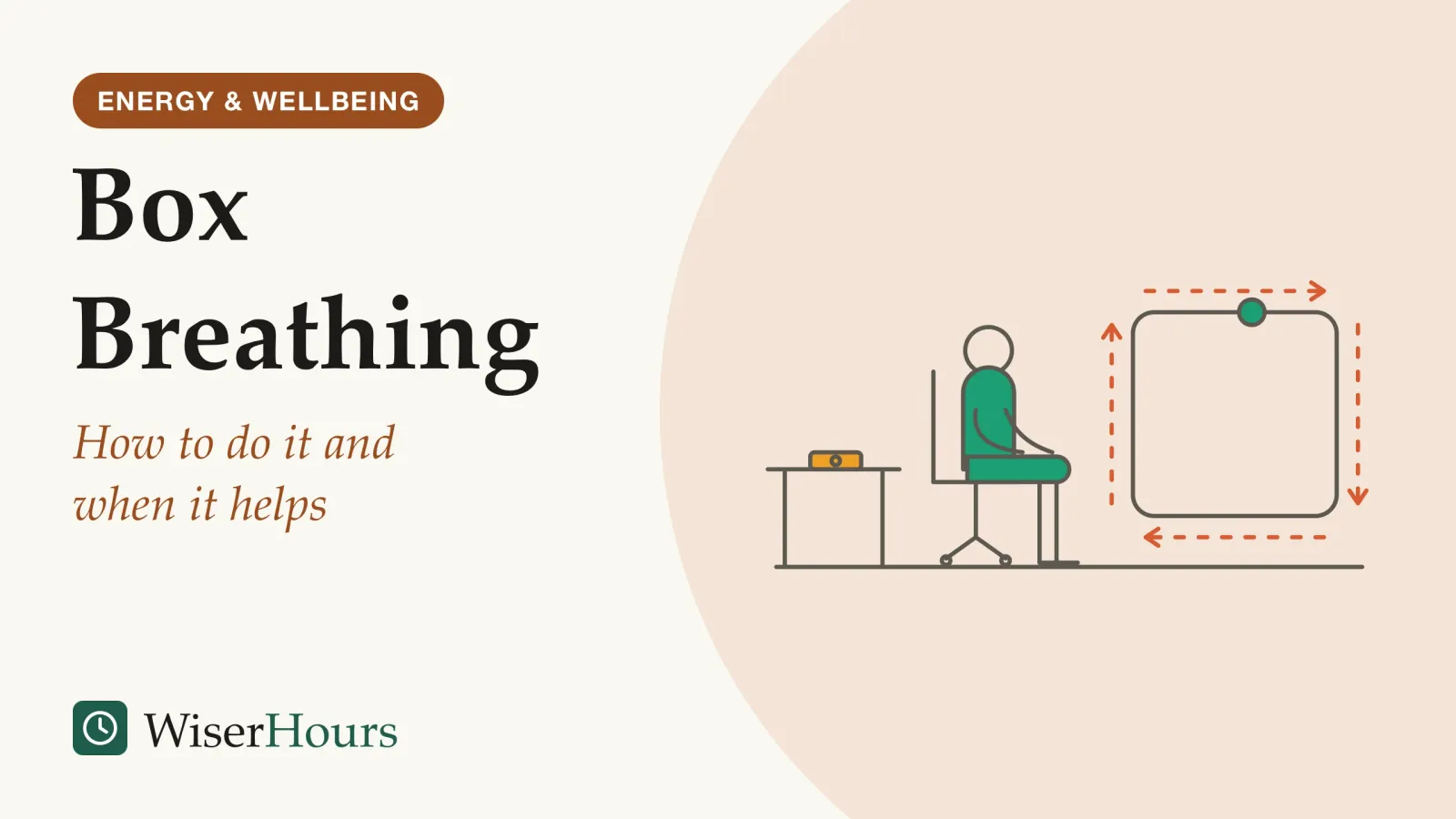
Breathe in for a count of 4, hold for 4, breathe out for 4, hold for 4, and repeat for a few minutes: that is box breathing, named for the square its four equal phases trace. In a month-long Stanford trial of daily practice, people felt calmer after each session yet did no better than the same short dose of mindfulness meditationmindfulness: Paying attention to what is happening in the present moment, including thoughts and sensations, on purpose and without judging it. The word covers both a state of mind and the courses that train it, and most research tests the courses.Full entry in the glossary.1 A systematic reviewsystematic review: A review that fixes its question and its rules for including studies in advance, then searches out every study that fits and weighs them together. Some systematic reviews pool the results into a meta-analysis; others describe what the studies found without combining the numbers.Full entry in the glossary published in 2026 found only 8 randomized trials that tested box breathing itself; several showed short-term benefits for stress, anxiety or mood, but effects on heart rate and breathing were inconsistent and long-term data were scarce.2
The method takes five steps:
- Sit or lie down and set a timer
- Choose a count you can keep without straining
- Breathe in, hold, breathe out, hold, for the same count
- Keep going for a few minutes, then breathe normally
- Stop if you feel dizzy, short of breath or panicky
What box breathing is, and why the holds slow you down
Box breathing, also called tactical or combat breathing, is a paced pattern in which the in-breath, a pause, the out-breath and a second pause all last the same time. A 2021 German lab study led by Stefan Röttger, read as an abstract only, notes that military and police personnel use tactical breathing to stay calm and keep performing in danger, but that evidence for it is limited.3
The pauses do the slowing. At 4 seconds a phase, you breathe fewer than 4 times a minute, well under the 10 a minute that a 2018 systematic review by Andrea Zaccaro and colleagues used to define slow breathing. Across the studies of healthy people it gathered, slower breathing went with a larger natural rise and fall of heart rate with each breath, and with feeling more relaxed and less anxious. None of those studies was a randomized controlled trial, so the review shows links, not proof.4
A 2022 meta-analysis of more than 200 studies, read as an abstract only, found the same signal in heart rate variability tied to the vagus nerve, a marker of the body’s calming branch: it was higher during slow breathing, right after a session and after programs of several sessions.5
- Myth
- Box breathing is a special military method that resets your nervous system.
- Fact
- It is one form of slow breathing. A handful of small trials show short-term calm, and none shows it is better overall than other slow patterns.
In practice, four rounds of the square take about a minute, the time a video call can take to connect. Because the holds set the pace, one that feels like a strain means the count is too long for you today.
How to do box breathing, step by step
Box breathing needs only a place to sit, a timer and a count you can keep. The steps below follow the instructions in a 2023 Stanford trial and a 2026 Texas State University trial, and describe a habit tested in healthy adults, not a treatment. Check the conditions listed further down before you start.
1. Sit or lie down and set a timer
Sit in a chair or lie down, and set a timer; the Stanford participants set theirs for 5 minutes. An on-screen pacer that shows when to breathe in, hold and breathe out, like the one the Texas State volunteers followed, works too.
2. Choose a count you can keep without straining
The classic count is 4 seconds per phase, the pattern used in the Texas State trial.6 The Stanford team instead sized the count to each person, from a few seconds up to about ten, and told everyone to shorten all four phases if they ever had to strain.1 If 4 feels tight, start at 3. Neither trial compared counts, so a longer count has no known advantage.
3. Breathe in, hold, breathe out, hold, for the same count
Breathe in gently, through the nose if you can, and hold with the lungs comfortably full. Breathe out slowly, then pause with the lungs empty before the next breath.
- Breathe in: slowly, through the nose if you can; recent trials used a count of about 4 seconds
- Hold: for the same count, with the lungs comfortably full
- Breathe out: slowly, for the same count
- Hold: for the same count before the next breath; if any side feels like a strain, shorten all four equally
4. Keep going for a few minutes, then breathe normally
Let the timer run, then let your breathing find its own pace. The trials below all tested short sessions, so a few minutes before a meeting is closer to the evidence than a long sitting.
5. Stop if you feel dizzy, short of breath or panicky
The breaths should feel slow and easy, not deep and forced. Breathing too fast or too deep lowers carbon dioxide in the blood, and MedlinePlus lists feeling lightheaded, dizzy or unable to catch your breath among the symptoms that follow. If any of these appear, stop, breathe normally, and use a shorter count next time; if they continue or get worse, MedlinePlus advises contacting a provider.7
Before your first round
To try a round here, use the pacer below: it counts each side for you and moves only after you press Start.
Box breathing pacer
4 seconds is the classic count. If 4 feels tight, pick 3; a longer count has no known advantage.
4 seconds a side
Breathe in 4 · Hold 4 · Breathe out 4 · Hold 4
4 rounds of 16 seconds: 1:04 in all.
Stop and breathe normally if you feel dizzy, short of breath or panicky. Use a shorter count next time.
Ask a clinician before breath holds if you have a heart or seizure condition, glaucoma, panic disorder or another serious mental health condition, or are pregnant (see conditions that call for a clinician first). This is a breathing exercise, not a treatment: use it alongside any care you receive, never in place of it. If you are struggling to breathe, this is not the moment for an exercise; see when breathing trouble needs medical help.
What the trials found: calmer in the moment, no edge over mindfulness
In the two most detailed trials, anxiety was lower, or did not rise, after a session of box breathing, but the practice did not beat mindfulness meditation at Stanford, and neither trial found a change in heart rate variability. The Stanford study, led by Melis Yilmaz Balban, compared a month of daily practice with meditation.
The study
Limited evidence
Stanford, 2023: four five-minute practices for a month, and no clear win for the square
People assigned to box breathing felt less anxious and in a better mood after each daily session, as did those assigned to mindfulness meditation or to two other breathing patterns. The breathing groups together did not reduce anxiety more than mindfulness, and box breathing did not differ clearly from it on positive mood; only cyclic sighing, a pattern with long out-breaths, beat mindfulness there. No group showed a change in heart rate variability measured during sleep.1
The mindfulness group also sat for five minutes a day, eyes closed, focused on a spot between the eyebrows, so the trial cannot show that the square adds anything over that. The groups were also small, the trial was registered only after it had run, and the wrist straps were donated by their maker, WHOOP, which took no part in the analysis; Andrew Huberman, the study’s lead contact, became an adviser to WHOOP after the data were collected.1
A 2026 trial at Texas State University, run by Matthew McAllister and colleagues with partial funding from the US Justice Department’s community policing office, tested a single short session before a stressor: young adults recruited on campus gave a job-interview speech to recorded judges. Heart rate and anxiety climbed in those who breathed normally, but not in those who first did box breathing or took periodic long out-breaths. Heart rate variability did not change in any group, and cortisol did not differ between groups, which the authors put down to a speech task too short to raise it.6
Before a difficult call with a client, a few rounds of the square may keep your pulse and nerves from climbing. What the evidence does not promise is a calmer baseline weeks later.
Does the square pattern beat other ways of slowing down?
No trial has shown that box breathing works better overall than other slow-breathing patterns. The few small comparisons point one way: slowing down seems to matter more than the exact shape of each breath.
In the 2021 German lab study, healthy volunteers did a demanding attention task under time pressure and noise, using tactical breathing (counts not given in the abstract) in one condition and a long out-breath in the other. They felt no different with either; tactical breathing left them less physically aroused, and the long out-breath gave better performance.3 The Texas State team found similar effects for box breathing and periodic long out-breaths; comparing other box-breathing variants, it suggested the exact in-to-out ratio may matter less than slowing the overall breathing rate.6
Evidence for breathing exercises as a whole is modest and favors slow ones. Guy Fincham and colleagues pooled a dozen randomized trials in a 2023 meta-analysis: breathwork went with somewhat lower self-rated stress than comparison conditions, and in subgroup analyses split by pace, slow techniques kept that link while fast ones did not. Most of the trials had some risk of biasrisk of bias: A rating of how much room a study's design, conduct and reporting leave for its result to be systematically wrong. It judges the method, not the motives of the researchers, and a high rating means the result may be off, not that it is.Full entry in the glossary, Fincham is a trained breath teacher, and the team asks clinicians to judge case by case whether breathing exercises might aggravate a patient’s mental or physical health problems.8 So the square is one reasonable way to follow the slow-breathing step among everyday habits that lower stress, not the only one; the mindfulness and breathing guides cover others.
| What readers ask | What the trials found | Strength of evidence |
|---|---|---|
| Does box breathing ease stress or anxiety? | Short-term benefits in several trials; effects on heart rate and breathing inconsistent | Systematic review, limited (abstract read; few, varied trials)2 |
| Does it beat mindfulness meditation? | No clear difference on mood or anxiety over a month | Trial, limited (one small remote trial)1 |
| Does one session help before a stressor? | Heart rate and anxiety did not rise as they did with normal breathing | Trial, limited (66 young adults, one lab session)6 |
| Does it beat a long out-breath? | No difference in how people felt; each did better on a different measure | Trial, limited (30 healthy volunteers, lab; abstract read)3 |
Choose the slow pattern you will keep doing.
When box breathing may not suit you, even if you are healthy
Box breathing does not suit every moment or person: in one trial the holds added strain after hard exercise, and in daily life its average benefit was small.
In a 2025 Turkish crossover trialcrossover trial: A trial in which each participant receives every condition being compared, one after another in random order, often with a gap between them. Because people are compared with themselves, fewer are needed, but the design only suits effects that wear off.Full entry in the glossary, active university students tried three ways of breathing after intense cycling; box breathing left heart rates higher than breathing at six breaths a minute, and effort felt harder than with either alternative. The authors suggest the holds added strain while the body was still working hard, and favor the even pace for recovery.9 A 2026 US trial of 62 cadets, read as an abstract only, points the other way on one measure: after a maximal exercise test, box breathing sped the recovery of heart rate variability compared with ordinary breathing, while heart rate recovery did not differ.10 With one trial each way, an even slow rhythm is the gentler choice between hard intervals at the gym or after a sprint for the train.
Results also varied from person to person. In a 2026 German study, physicians in training ran their own month-long experiments, alternating weeks with and without a short daily breathing exercise they had chosen. For box breathing the average change in daily stress was close to zero: a handful met the authors’ bar for a meaningful drop, while about a third had higher stress in the weeks they used it, mostly within the range of chance. Participants chose their exercise and knew which weeks were which.11
The UK’s NHS offers a breathing exercise for stress with no holds: breathe in gently, perhaps counting to 5, breathe out to the same count, and repeat for at least 5 minutes.12 If the square feels tense, try that for a week instead and notice which one you reach for.
Conditions that call for a clinician’s advice first
People with a heart condition, seizures, glaucoma, a serious mental health condition or a pregnancy should ask a clinician before trying breath holds, because the key trial of box breathing left these groups out. The Stanford trial excluded people with moderate to severe psychiatric or medical conditions that taking part could worsen, such as heart disease, glaucoma, a history of seizures, pregnancy, psychosis, suicidal thoughts, bipolar disorder or substance use disorders. Panic disorder needs its own mention: the same authors note that breathlessness is felt as a threat and that people with high anxiety or panic disorder tolerate it less well, so for them the empty-lung pause may feel alarming rather than calming.1
Lung or heart treatment already under way
If you are treated for a long-term lung or heart problem, MedlinePlus advises following your provider’s directions for it.13 Ask before adding breath holds if any condition above applies to you, and use breathing exercises alongside any treatment, never in place of it.
When breathing trouble needs medical help
Sudden or severe difficulty breathing is an emergency, not a moment for a breathing exercise. The advice below, sorted by urgency, comes from the NHS, MedlinePlus and the NIMH (the US National Institute of Mental Health).
- Straight away: in the UK, the NHS says to call 999 or go to A&E for severe difficulty breathing, a chest that feels tight or heavy, or pain that spreads to your arms, back, neck or jaw.14 In the US, MedlinePlus advises calling 911 or going to the emergency room when breathing difficulty comes on suddenly or seriously interferes with breathing and talking.13 For thoughts of suicide or emotional distress, US readers can call or text 988, and should use 911 when someone’s life is in immediate danger, according to the NIMH.15 In the UK, the NHS says to dial 999 or go to A&E if a life is at risk, or to call 111 and choose the mental health option for urgent help; Samaritans take free calls on 116 123.16 Elsewhere, use your local emergency number.
- Soon: in the UK, contact NHS 111 if you are more short of breath than usual or have palpitations.14
- At a routine visit: if you live with anxiety or panic, ask your clinician whether breath holds suit you.
The bottom line
Four equal counts, a few minutes and a timer make box breathing a free, portable way to slow down. The evidence, a review of 8 trials and a few small experiments in healthy adults, supports it for short-term calm around a stressful moment, not as a lasting fix or as better than other slow breathing. Keep the count easy, stop if you feel dizzy or panicky, and ask a clinician before the holds if you have a heart, lung or serious mental health condition, panic disorder, or a pregnancy.
This article is general information, not medical advice. If you're worried about your health, talk to a doctor or another qualified professional.
Frequently asked questions
Why is box breathing also called tactical breathing?
Because soldiers and police officers use it. A 2021 German lab study describes tactical breathing as a technique soldiers and law enforcement officers use to reduce stress and keep performing in dangerous situations, and notes that evidence for it was limited. Recent papers describe the equal-count square under names such as box, square, tactical or combat breathing, though some tactical versions use shorter pauses.
Can you do box breathing with your eyes open, at a desk?
Yes. In a 2026 Texas State University trial, volunteers followed an on-screen timer that told them when to breathe in, hold and breathe out, and in a 2026 study of physicians in Germany, people followed a video of a moving dot. The 2023 Stanford instructions let people sit in a chair or lie down, whichever they preferred.
How quickly can box breathing take effect?
Within a single session, in the trials that measured it. In the 2026 Texas State trial, a few minutes of box breathing before a stressful speech kept heart rate and anxiety from rising the way they did in young adults who breathed normally. Whether weeks of daily practice add a lasting change is less clear; neither that trial nor the 2023 Stanford trial found a change in heart rate variability.
Is box breathing suitable for children or teenagers?
Nobody has tested it well enough to say. The trials in this article that set an age limit enrolled only adults, and the others studied university students, cadets or healthy volunteers, so none shows how children or teenagers respond to breath holds. If you want to teach a child a calming breathing exercise, ask their doctor first, especially if they have asthma or another breathing condition.
Sources
- Brief structured respiration practices enhance mood and reduce physiological arousal. Balban, M. Y., Neri, E., Kogon, M. M. et al. (2023). Cell Reports Medicine, 4(1)
- Systematic Review of Randomised Controlled Trials Evaluating Box Breathing for Stress, Autonomic, and Clinical Outcomes. Dujawara, A., Ali, K. & Kumari, S. (2026). Applied Psychophysiology and Biofeedback, online ahead of print
- The Effectiveness of Combat Tactical Breathing as Compared with Prolonged Exhalation. Röttger, S., Theobald, D. A., Abendroth, J. & Jacobsen, T. (2021). Applied Psychophysiology and Biofeedback, 46(1)
- How Breath-Control Can Change Your Life: A Systematic Review on Psycho-Physiological Correlates of Slow Breathing. Zaccaro, A., Piarulli, A., Laurino, M. et al. (2018). Frontiers in Human Neuroscience, 12
- Effects of voluntary slow breathing on heart rate and heart rate variability: A systematic review and a meta-analysis. Laborde, S., Allen, M. S., Borges, U. et al. (2022). Neuroscience & Biobehavioral Reviews, 138
- Box breathing and prolonged exhalation reduces markers of physiological stress reactivity in response to a virtual trier social stress test. McAllister, M. J., Martaindale, M. H., Sutton, N. & Andersen, J. P. (2026). Comprehensive Psychoneuroendocrinology, 27
- Hyperventilation. MedlinePlus Medical Encyclopedia, US National Library of Medicine (review date 23 July 2024)
- Effect of breathwork on stress and mental health: A meta-analysis of randomised-controlled trials. Fincham, G. W., Strauss, C., Montero-Marin, J. & Cavanagh, K. (2023). Scientific Reports, 13
- Box breathing or six breaths per minute: Which strategy improves athletes post-HIIT cardiovascular recovery? Kasap, M. & Aydin, G. R. (2025). PLOS One, 20(11)
- Effectiveness of Structured Breathwork Interventions on Heart Rate Variability and Heart Rate Recovery Following Maximal Exertion in Tactical Athletes. Jones, M. E., Smith, G., Acevedo, A. & Melton, B. (2026). Medicine & Science in Sports & Exercise, 58(7)
- Evaluation of two easy-to-implement digital breathing interventions in the context of daily stress levels in a series of N-of-1 trials: results from the Anti-Stress Intervention Among Physicians (ASIP) study. Vetter, V. M., Kurth, T. & Konigorski, S. (2026). npj Digital Medicine, 9
- Breathing exercises for stress. NHS (UK), page last reviewed 12 June 2026
- Breathing difficulty. MedlinePlus Medical Encyclopedia, US National Library of Medicine (review date 1 April 2025)
- Shortness of breath. NHS (UK), page last reviewed 30 January 2024
- Help for Mental Illnesses. National Institute of Mental Health, US National Institutes of Health (last reviewed April 2026)
- Where to get urgent help for mental health. NHS (UK), page last reviewed 26 April 2023
How we researched this
Searches of Europe PMC, PubMed, Crossref and ClinicalTrials.gov in September 2026 looked for randomized trials and systematic reviews of box, square or tactical breathing and for reviews of slow breathing and breathwork; NHS, NIMH and MedlinePlus pages supplied the safety advice. The sources span 2018 to 2026; four could be read only as abstracts, the rest in full. Main limitation: few trials test box breathing itself, and they are small and mostly in young, healthy adults.
Keep reading
Meditation Apps: What the Research Says About Whether They Work
Mindfulness apps eased depression and anxiety symptoms a little in trials of up to 8 weeks; in one usage study, about 1 in 20 users still opened one at 30 days.
Gratitude Journaling: What the Research Shows and How to Do It Well
Gratitude journaling is linked to a small lift in well-being, not a cure. What 4 meta-analyses found, why weekly may beat daily, and how to keep one well.
How Long Should You Meditate? What Research Suggests for Beginners
Trials comparing 10 minutes of daily meditation with 20 or 30 found no clear difference. What the research suggests for beginners, and where it runs out.
Types of Meditation Compared: How to Choose One That Suits You
Most types of meditation fall into 3 families. What each one trains, what the trials show, who should go carefully, and a two-week way to test one.