The Physiological Sigh: What the Research Found
The physiological sigh is two breaths in and one long breath out. Done 5 minutes a day it lifted mood in one trial; the one-sigh quick fix is untested.

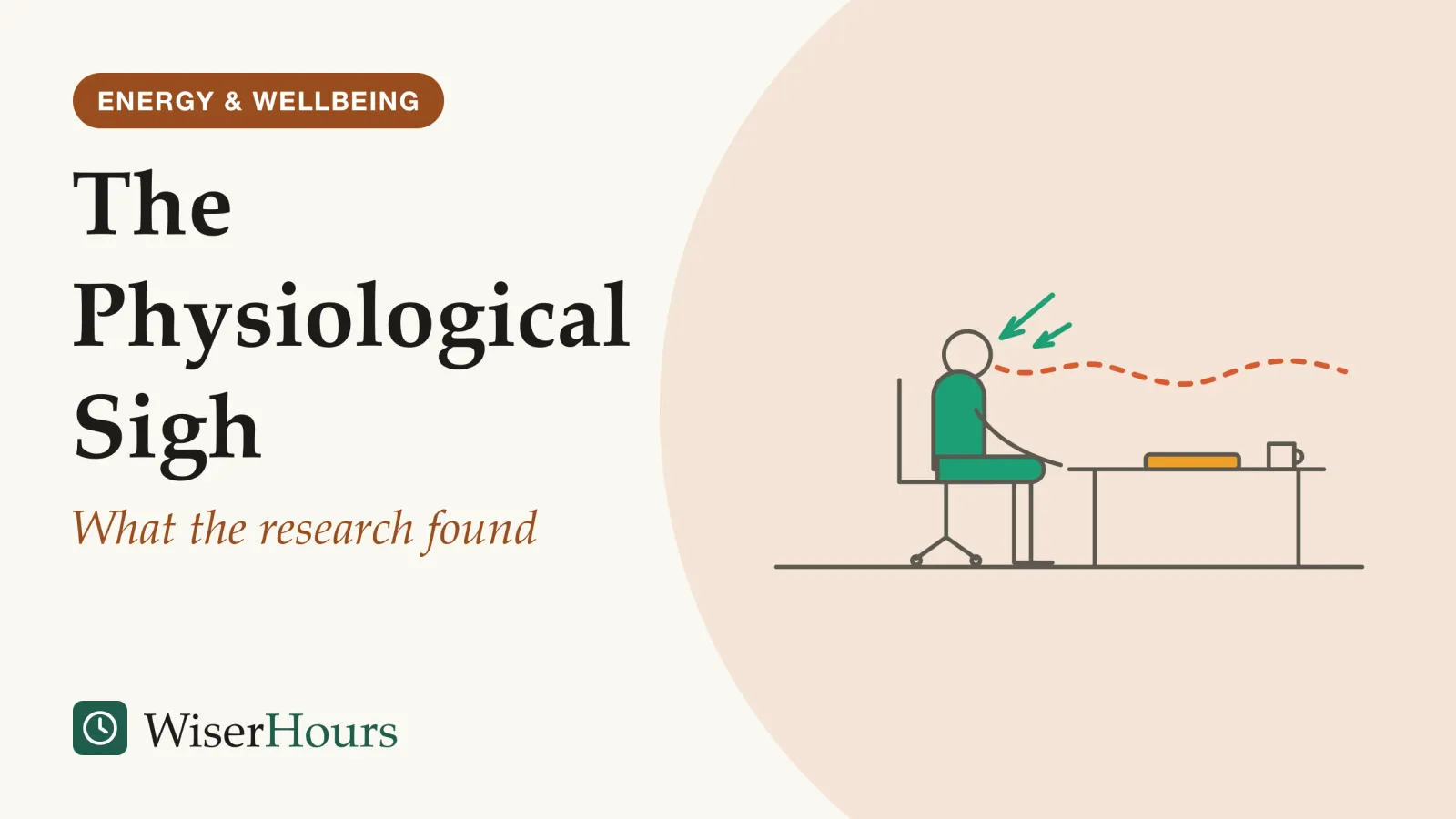
To do a physiological sigh, breathe in through your nose, add a second, shorter sip of air on top, then breathe out slowly through your mouth until your lungs feel empty. Repeated for a few minutes, the pattern is called cyclic sighing, and in a 2023 Stanford trial daily breathwork lifted mood slightly more than mindfulness, cyclic sighing most.1 That trial tested a daily habit in healthy adults; the popular promise that one sigh calms you within seconds has not been tested in a trial.
The routine the Stanford volunteers followed:
- Sit or lie somewhere comfortable and start a timer
- Breathe in slowly through the nose
- Top up with a second, shorter breath in
- Let it all out slowly through the mouth
- Repeat until the timer ends, then breathe normally
Getting the proportions of the sigh right
A physiological sigh needs no equipment, only the right proportions: a full breath in, a smaller top-up, and a long, slow breath out that empties the lungs. In the 2023 Stanford trial, run by Melis Yilmaz Balban and colleagues, volunteers repeated that cycle for 5 minutes a day.1
The second breath in is meant to be smaller and quicker than the first, and the instructions said so: people were told it is normal for the top-up to be briefer. Both breaths in ideally went through the nose and the breath out through the mouth, but breathing entirely through the nose was allowed.1 The breath out is the part to slow down, because the long exhale is what sets this pattern apart from an ordinary deep breath.
The breaths should stay easy. Overbreathing drives down blood levels of carbon dioxide, and the US National Library of Medicine’s MedlinePlus encyclopedia links that to feeling lightheaded or dizzy and to numbness or tingling around the mouth or in the arms.2 If you notice any of them, stop and breathe normally; next time, make each sigh gentler and leave a few ordinary breaths between them.
After a tense call, try three or four slow sighs; if the out-breath turns into a forced push, they are too big.
Why do we sigh naturally?
Everyone sighs without trying. Your brainstem slips in a sigh every few minutes, an extra-deep breath built on top of an ordinary one, and its main known job is mechanical: it reinflates tiny air sacs in the lungs that have partly collapsed. A 2022 review of sigh physiology by Liza Severs, Elke Vlemincx and Jan-Marino Ramirez describes the sigh as more than twice the volume of a normal breath.3
The control circuit was traced in mice. In a 2016 Nature paper, Peng Li and colleagues at Stanford and UCLA found that a small group of neurons in the breathing center of the mouse brainstem turns a normal breath into a sigh when it receives either of two signaling peptides. Blocking both signals abolished sighing, and destroying the receiving neurons stopped sighs while leaving other breathing intact, at least at first. The authors note that humans sigh several times an hour and that sighing rises under low oxygen, stress and some psychiatric conditions.4
- Ordinary breaths: small and even, every few seconds
- A spontaneous sigh: a second breath stacked on the first, roughly twice the volume of a normal breath
- The gap between sighs: a few minutes; the brainstem adds sighs on its own, and more of them under stress or low oxygen
Sighs also track feelings. In lab studies reviewed in 2022 by the same group, people and rats sighed more when a cue signaled that a stressor would not come or had ended, and the authors propose that a sigh helps the body shift from one state to the next.5 They label that idea a hypothesis: most findings on the psychology of sighs are preliminary.
A deep sigh after a hard meeting is ordinary physiology and nothing to worry about. The mouse circuit and the lab studies of spontaneous sighs say little about a sigh made on purpose.
What the Stanford trial of cyclic sighing measured
The Stanford trial, published in Cell Reports Medicine in 2023, compared four 5-minute daily practices for a month in adults recruited mostly from a Stanford psychology class: cyclic sighing, mindfulness meditationmindfulness: Paying attention to what is happening in the present moment, including thoughts and sensations, on purpose and without judging it. The word covers both a state of mind and the courses that train it, and most research tests the courses.Full entry in the glossary, box breathing and a fast-breathing pattern with breath holds. Every group felt less anxious after its sessions, on average; cyclic sighing stood out only on positive mood and on breathing rate.1
The study
Limited evidence
Sighing or meditating, five minutes a day: Balban and colleagues' 2023 remote trial
On a positive-mood scale that runs from 10 to 50, the average rise per session was about 1.9 points after cyclic sighing and 1.2 after mindfulness meditation. Taken together, the three breathing groups gained more than the mindfulness group, the trial’s main comparison; compared one by one, only cyclic sighing differed clearly from mindfulness, and its edge grew with more days of practice. Anxiety fell by about the same amount with breathing and with meditation. Over the month, the breathing rate recorded by a wrist strap fell more in the cyclic sighing group, while neither heart rate variability nor resting heart rate shifted in any group.1
That gap is under one point on a scale with a 40-point range, small enough that one person might not notice it on a given day, and it was measured minutes after a session by people who knew which practice they were doing. The trial lasted four weeks with no follow-up, and the authors write that the groups were too small to compare the breathing patterns with each other.1
The trial began as an exploratory study and was registered only after it ran; participants practiced at home, unsupervised, and the breathing groups completed about 20 of the 28 days on average. People with moderate to severe medical or psychiatric conditions were excluded. WHOOP donated the wrist straps and, according to the authors, took no part in the design or analysis; the paper’s lead contact, Andrew Huberman, took an advisory role with WHOOP in June 2022.1
For a healthy adult, the trial supports cyclic sighing as a reasonable 5-minute daily habit that may lift your mood a little. It does not show that sighing beats meditation for anxiety, sleep or heart health.
Does the physiological sigh work in seconds?
No one has yet tested a single deliberate sigh in a trial as a quick calming tool, so the “one sigh to calm down fast” claim rests on extrapolation from the natural sigh and from multi-minute practice. The closest studies point in different directions.
The 2022 review of the psychology of sighs flags the gap directly. In lab studies, an instructed deep breath did not produce the physiological relief seen after spontaneous sighs, and the authors caution that if deliberate sighing ever became excessive it could do more harm than good; they call for research on exactly this.5
Short practice has mixed support. In a preregistered pilot by a German university team, read as an abstract only, 47 students in moments of acute stress in daily life were assigned to one minute of cyclic sighing, one minute of box breathing or no exercise; both exercises were associated with bigger falls in anxiety five minutes later than no exercise, and both were followed by slower reaction times on an attention test.6 In a US pilot trial in an orthopedic clinic’s waiting room, also read as an abstract only, 4 minutes of cyclic sighing eased pain more than a matched control activity, but anxiety did not differ between the groups.7
The body’s first response may even run the other way. In a 2026 US lab study of 250 healthy students, a quick, deep breath in through the mouth, taken on cue at a fixed pace, was followed by higher heart rate and blood pressure, a pattern the authors read as activation of the body’s arousal system.8 Those breaths had no top-up and no long breath out, but they show that a big breath is not automatically a calming one.
Expectation may explain some of the effect. A study of 3,277 app users, about two-thirds of them in the US, partly funded by Samsung Research, randomly assigned people to slow breathing with a brief hold and long breaths out or to a matched video in which they only opened and closed a hand. Both groups reported more positive emotions and a greater sense of coping than at baseline, with no clear gap between the groups, and its authors suggest that a video that makes you slow down and distracts you from a busy day may be enough.9
How many physiological sighs should you do?
The only dose tested for weeks is 5 minutes a day of repeated sighs, and the Stanford team found that the mood benefit grew the more days people practiced.1 One minute had support in the small German pilot.6 No study has compared one, two or ten sighs, so any fixed number you read online is a guess.
A sensible middle path is to treat the 5-minute version as the practice and a few sighs as a pause. A nurse on a long shift might keep the full round for a break and use two or three sighs before a difficult conversation with a family. Start with a minute or two, keep the breaths gentle, and lengthen the session only if it stays comfortable.
A two-week try-out
Keep the notes to a word or two after each session.
Cyclic sighing and box breathing: what differs
Cyclic sighing puts the weight on a long breath out and has no breath holds; box breathing uses four equal counts, two of them holds. In the Stanford trial, only cyclic sighing beat mindfulness on positive mood, but the groups were too small to compare it reliably with box breathing.1
Both belong to the wider family of slow breathing practices, which the guides to mindfulness and breathing cover from several angles. A 2023 meta-analysismeta-analysis: A study that combines the results of earlier studies on the same question into one overall estimate. Pooling makes the estimate more precise, but it cannot repair the studies it pools: a meta-analysis of surveys is still survey evidence.Full entry in the glossary of 12 randomized trials, which predates the Stanford paper, linked breathwork to a small-to-medium drop in self-rated stress and asked for better-designed trials to avoid hype.10 Choose the pattern you will keep doing; the evidence does not crown either one. Popular claims that sighing “resets” the body draw on ideas explored in what nervous system regulation means.
| Question | What the evidence found | Strength |
|---|---|---|
| Does daily cyclic sighing lift mood? | Slightly more than mindfulness after each session, over a month | Trial, limited (108 adults, self-rated)1 |
| Does it ease anxiety more than meditation? | No clear difference | Trial, limited (same trial)1 |
| Does a minute of it help in a stressful moment? | Larger drop in anxiety than no exercise | Pilot, limited (47 students, abstract read)6 |
| Does one deliberate sigh calm you within seconds? | Not tested; instructed deep breaths lacked the relief seen after natural sighs | Gap (review of lab studies)5 |
Heart, lung and panic conditions: ask before you start
Ask a clinician before practicing if you are pregnant or live with a heart condition, a lung condition such as asthma or COPD, panic disorder or another serious mental health condition. The Stanford trial left out people with heart disease, seizures, glaucoma, pregnancy, psychosis or bipolar disorder, among others, so its results cannot speak for them.1
In lab studies, people with panic disorder sighed more often than others at rest, and frequent sighing in that group has been linked to low carbon dioxide; ambulatory studies have not confirmed the extra sighing. If you already sigh a lot when anxious, the 2022 review of sigh psychology cautions that deliberate deep breaths might push sighing toward excess, so a therapist’s view helps.5 MedlinePlus also lists lung disease such as asthma and COPD, heart problems and pregnancy among the medical causes of fast breathing, which is why new breathlessness needs a check before a breathing exercise.2
Stop and breathe normally
If a sigh leaves you lightheaded or tingly, stop and let your breathing settle on its own. MedlinePlus advises contacting a provider if overbreathing continues or gets worse.2
If sighing feels uncomfortable, the UK’s NHS offers a gentler exercise for stress, anxiety and panic: breathe in through the nose and out through the mouth, gently, perhaps counting to 5 each way, for at least 5 minutes.11
When breathlessness needs urgent care
Sudden or severe breathlessness is a medical problem, and no sigh fixes it. MedlinePlus advises calling your local emergency number when trouble breathing starts suddenly or makes it hard to talk; 911 in the US is one example.12
- Now: call your local emergency number, or 999 or A&E in the UK, for the signs the NHS lists: severe difficulty breathing, tightness or heaviness in the chest, pain that spreads to the arms, back, neck or jaw, pale, blue or grey lips or skin, and sudden confusion.13 For thoughts of suicide, contact your local emergency number or a crisis line; in the US, the NIMH lists 988 by call or text, and 911 when a life is in danger.14 In the UK, the NHS points to Samaritans on 116 123, and to 999 when a life is at risk.15
- Soon: feeling more breathless than usual, or noticing palpitations, is a reason to contact NHS 111 in the UK; elsewhere, your own doctor or urgent-care service fills that role.13
- Routine: book a GP (family doctor) appointment, the NHS says, if breathlessness worsens during normal activities or when lying down, or comes with swollen ankles.13
The bottom line
Cyclic sighing has one small, month-long trial behind it as a daily habit, and nothing yet behind the claim that a single sigh calms you in seconds. To try it, give it 5 minutes a day for a couple of weeks with gentle breaths, and notice how your mood feels afterward. Stop if you get dizzy or tingly, and check with a clinician before starting if you are pregnant or live with a heart, lung or panic condition.
This article is general information, not medical advice. If you're worried about your health, talk to a doctor or another qualified professional.
Frequently asked questions
Is cyclic sighing the same as the physiological sigh?
Mostly, yes. Physiologists use sigh for the extra-deep breath the brainstem makes on its own every few minutes. Cyclic sighing, the name used in the 2023 Stanford trial, is a deliberate copy of that shape repeated for several minutes: a breath in, a short top-up and a long breath out. The trial tested the repeated version, not a single sigh.
Does the physiological sigh help you sleep?
The only month-long trial found no sign that it does. In the 2023 Stanford study, sleep length, sleep efficiency and a sleep score from a wrist strap did not change in any group, and neither did self-rated daytime sleepiness. The trial did not test sighing at bedtime, so that use remains untested rather than disproved.
Can a physiological sigh stop a panic attack?
No trial has tested it in people with panic disorder, and the Stanford trial excluded people with moderate to severe psychiatric conditions. Lab studies reviewed in 2022 found that people with panic disorder sigh more than others at rest, though studies in daily life did not confirm it. The NHS suggests a gentle, even breathing exercise for stress, anxiety and panic; a doctor or therapist can say what fits you.
Should I breathe in through my nose or my mouth?
In the Stanford trial, both breaths in went through the nose and the breath out through the mouth, though breathing entirely through the nose was allowed. The trial did not compare the two, so pick whichever lets the breath out stay slow and comfortable.
Sources
- Brief structured respiration practices enhance mood and reduce physiological arousal. Balban, M. Y., Neri, E., Kogon, M. M. et al. (2023). Cell Reports Medicine, 4(1)
- Hyperventilation. MedlinePlus Medical Encyclopedia, US National Library of Medicine (review date 23 July 2024)
- The psychophysiology of the sigh: I: The sigh from the physiological perspective. Severs, L. J., Vlemincx, E. & Ramirez, J.-M. (2022). Biological Psychology, 170
- The peptidergic control circuit for sighing. Li, P., Janczewski, W. A., Yackle, K. et al. (2016). Nature, 530(7590), 293-297
- The psychophysiology of the sigh: II: The sigh from the psychological perspective. Vlemincx, E., Severs, L. & Ramirez, J.-M. (2022). Biological Psychology, 173
- Simply breathing anxiety away? A pilot, just-in-time ecological momentary intervention study of one-minute cyclic sighing versus box breathing as tools for acute anxiety reduction and attention promotion in real life. Riedl, E. M., Bracklo, T., Wimmer, K. et al. (2026). Anxiety, Stress, & Coping, 39(5), 608-622
- Cyclic sighing in the clinic waiting room may decrease pain: results from a pilot randomized controlled trial. Hanley, A. W., Davis, A., Worts, P. & Pratscher, S. (2025). Journal of Behavioral Medicine, 48(2), 385-393
- Dissecting Cardiovascular Responses to a Fixed-Interval Volitional Sighing Protocol Using a Mixed Modeling Approach. Muzumdar, N., Sun, K., Zhang, S. et al. (2026). Psychophysiology, 63(1)
- Stress reduction experiments in daily life: Scaling from the lab to the world. Newman, D. B., Gordon, A. M., O'Bryan, J. & Mendes, W. B. (2024). Journal of Experimental Psychology: General, 153(4), 1076-1092
- Effect of breathwork on stress and mental health: A meta-analysis of randomised-controlled trials. Fincham, G. W., Strauss, C., Montero-Marin, J. & Cavanagh, K. (2023). Scientific Reports, 13
- Breathing exercises for stress. NHS (UK), page last reviewed 12 June 2026
- Breathing difficulty. MedlinePlus Medical Encyclopedia, US National Library of Medicine (review date 1 April 2025)
- Shortness of breath. NHS (UK), page last reviewed 30 January 2024
- Help for Mental Illnesses. National Institute of Mental Health, US National Institutes of Health (last reviewed April 2026)
- Where to get urgent help for mental health. NHS (UK), page last reviewed 26 April 2023
How we researched this
Searches of Europe PMC, PubMed and Crossref in October 2026 for the physiological sigh, cyclic sighing and sigh physiology, plus NHS and MedlinePlus pages for safety advice. Sources span 2016 to 2026; three were read as abstracts only, the rest in full. Main limitation: deliberate sighing has one month-long trial in mostly young, healthy adults and a handful of small or indirect studies.
Keep reading
"Nervous System Regulation": What the Phrase Means and What It Doesn't
Nervous system regulation explained: what the autonomic system does, what 'dysregulated' and 'vagal tone' mean, and 4 calming habits with evidence.
Box Breathing: How to Do It and When It Helps
Box breathing paces you in four equal counts. A 2026 review of 8 trials found short-term calm; no trial shows it beats other slow breathing.
Unsent Letters: Writing to Process Conflict and Loss
Unsent letters give what you never said a place to go. How to write one, what to do with it afterwards, and what a review of 146 trials found.
Silent Retreats: Benefits, Risks, and Who Should Think Twice
A silent retreat can ease stress, but it carries real risks. What happens, what 21 studies found, and who should see a clinician before booking.