How Long Should You Meditate? What Research Suggests for Beginners
Trials comparing 10 minutes of daily meditation with 20 or 30 found no clear difference. What the research suggests for beginners, and where it runs out.

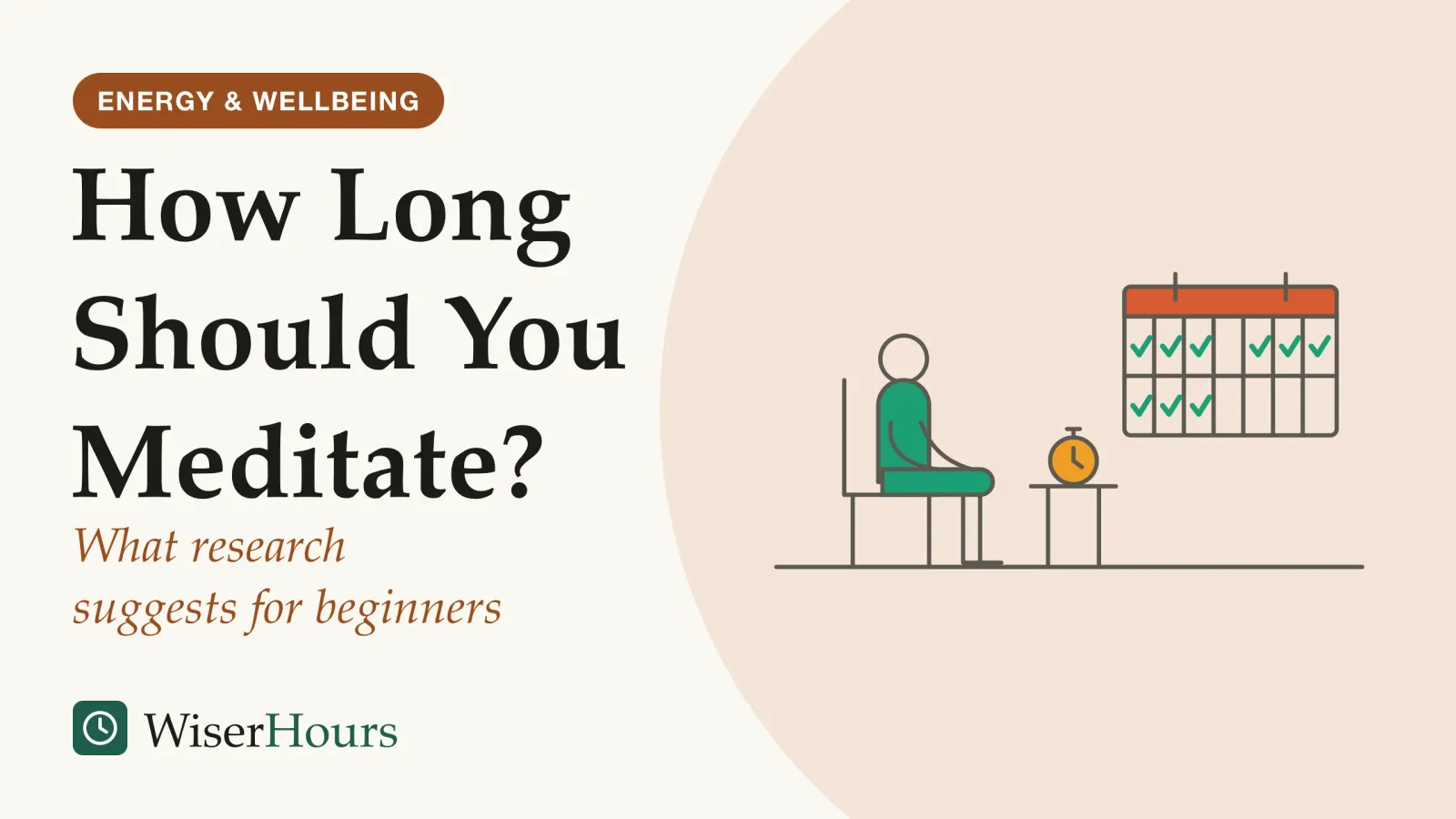
Ten minutes of daily meditation did about as much good as thirty in one of the few experiments that has put the question to a direct test. Adults in a 2023 online trial run from the University of St Andrews were randomly assigned to a short or a long daily practice for two weeks, and both groups ended up in much the same place.1
So how long should you meditate when you are starting out? Research has not found an ideal length: the few experiments that compared session lengths found no clear winner.2 So for a healthy adult starting out, a short daily session of around 10 minutes is a sensible start, and practicing on most days may matter more than stretching any one sitting. In a 2017 review of studies of the standard eight-week mindfulness courses, people who practiced more at home improved slightly more, but the link was small and correlational, so it cannot tell you the right daily amount.3
How long should you meditate? The courses ask for more than most people do
The best-studied mindfulness courses ask for about 45 minutes of practice at home, six days a week, far more than most beginners imagine. Mindfulness-Based Stress Reduction (MBSR) and Mindfulness-Based Cognitive Therapy (MBCT), both eight-week group courses, set that as formal home practice, as a 2017 systematic reviewsystematic review: A review that fixes its question and its rules for including studies in advance, then searches out every study that fits and weighs them together. Some systematic reviews pool the results into a meta-analysis; others describe what the studies found without combining the numbers.Full entry in the glossary by Christine Parsons and colleagues describes them.3 If you are new to the practice itself, start with what mindfulness is, and what the trials say it does.
That figure is a design choice, not a tested minimum: MBSR was built to be long enough for people to learn the skill and keep it up on their own. A 2009 review by James Carmody and Ruth Baer found that MBSR programs with fewer class hours did not show clearly smaller effects on psychological distress, though the authors note that the standard format still has the most evidence behind it. We read only that review’s abstract, and it looked at class time, not home practice.4
The study
Limited evidence
Assigned about 45 minutes a day, course participants reported about 30 (Parsons and colleagues, 2017)
Participants reported doing about 64% of the home practice they were assigned, roughly 30 minutes a day, six days a week. In the studies that tested it, people who practiced more had slightly better outcomes: a small correlation of 0.26. Many of the included trials were at risk of bias, and lower amounts of practice were less likely to be reported.3
Two lessons follow. Even people on a structured course, with weekly classes, fell well short of the assigned time. And a correlationcorrelation: A measure of how closely two things move together, running from minus one, where one rises as the other falls, through zero, meaning no link, to plus one. It says how strong the relationship is, not what causes it, and it is not a percentage.Full entry in the glossary cannot separate cause from effect: people who were already feeling better may simply have practiced more. Only a trial that randomly assigns different amounts of practice can settle which way it runs.
Picture someone who signs up for an eight-week course while holding down a demanding job. The long recordings shrink to half-length sessions on weekdays, and Saturday gets skipped. By the review’s standard, that person is typical, not failing.
For a beginner, the lesson is that the course prescription tells you what the best-tested programs used, not what a beginner practicing alone needs.
Further reading
Mindfulness: An Eight-Week Plan for Finding Peace in a Frantic World
An eight-week program adapted from MBCT by one of its developers, for readers who want a structured daily practice to follow.
As an Amazon Associate WiserHours earns from qualifying purchases.
Ten minutes did about as well as twenty or thirty
When researchers have randomly assigned people to shorter or longer sessions, the shorter ones have held up. In the St Andrews randomized trialrandomized controlled trial: A study that assigns participants to the treatment or the comparison group at random, so the groups start out alike and a difference in what happens next can be put down to the treatment. Random assignment makes the two groups comparable; it does not make the people in the trial representative of anyone else.Full entry in the glossary by Guy Fincham and colleagues, published in 2023, adults who meditated for about 10 minutes a day for two weeks improved about as much as those who meditated for about 30.1
The people who finished, most of them university-educated, used guided recordings drawn largely from the Oxford Mindfulness Centre’s MBCT course, either sitting or moving. In this trial, the short sessions were not practiced noticeably more often, which the authors say cuts against the common belief that a shorter practice is easier to keep up. With no group that skipped meditation, part of the improvement may come from simply setting time aside, or from scores drifting back toward average. Roughly two in five of those who signed up dropped out, and nobody was asked about unpleasant effects.1
Two single-session experiments point the same way. At Yale, a guided meditation of 10 minutes raised how mindful people felt about as much as one twice as long, in an online experiment with US adults, though neither length reduced anxiety more than a control recording about sequoia trees.5 In a 2026 trial led by Sarah Strohmaier, a 5-minute practice and a 20-minute one both raised how mindful people felt compared with a control activity; the longer one did better on one measure, decentering, and which length suited people best depended partly on traits such as agreeableness. We read only the abstract.6
Why would length matter so little? Nobody knows yet. The Yale authors suggest that the two lengths they tested may simply sit close together on the dose-response curve, and that differences may only show up over many sessions rather than one.5
In everyday terms, the gap between getting off the train and reaching your desk is about the size of session these trials tested, and it held its own against sessions two or three times longer.
How often you practice may matter more than how long
Practicing on more days was more strongly linked to benefit than practicing for longer each time, in a 2025 study by Nicholas Bowles and Nicholas Van Dam at the University of Melbourne. They followed more than 1,000 meditators, who averaged about six years of practice, as they practiced on their own for two months; frequency predicted three of four outcomes more strongly than session length. The same data tied noticeable change within a month to roughly 35 to 80 minutes of practice a day, far more than the trials above used. Because this was an observational studyobservational study: A study in which researchers record what people already do or are exposed to, rather than assigning anyone to anything. It can show that two things go together, not that one causes the other, because the groups being compared may differ in other ways as well.Full entry in the glossary and nobody was assigned an amount, people who felt better may simply have meditated more, a limit the authors state themselves.7
Why might repetition count? The Yale group offers one hypothesis: mindfulness is taught as a skill that must be practiced over and over before it sticks, much like learning an instrument.5 If you are building the routine from scratch, it helps to know how habits form through repetition.
- Short, most days: in a 2025 study that followed meditators for two months, how often people practiced predicted benefit more strongly than how long each session lasted
- Long, now and then: the same total time in one sitting; that study found session length the weaker predictor, and it could not show cause and effect
- How much in total: still open: few trials have randomly assigned people to different daily amounts; the longest so far, four weeks and not yet peer reviewed, found no advantage for longer sessions
Take two people who each meditate for about an hour a week. One sits for a short session on six mornings; the other does a single hour on Sunday. On the Melbourne data, the first pattern is the one linked to more benefit, though no trial has put the two head to head.
What to take from this, as a suggestion for healthy adults rather than a tested rule: if your week has room for an hour of practice, spreading it across most days fits the evidence better than saving it for one sitting. Read the Melbourne estimate of daily minutes as a description of what went with change in that study, not as a target for a beginner.
A starting routine for your first four weeks
These steps are general habits for healthy adults, drawn from the studies above; they are suggestions, not a program with tested results. The best-supported point comes first: short sessions held up as well as longer ones in the trials that compared them.
1. Start with about 10 minutes you can repeat
Pick a length you could manage on a bad day. On the trials described above, you give up nothing measurable by starting short, and if even 10 minutes feels long at first, shorter still is a reasonable place to begin.
2. Hang it on a routine you already keep
The NHS advice is to choose a regular slot, such as the trip to work or a lunchtime walk, in which you decide to stay aware of the sensations the world around you creates.8 The same idea works for a seated practice: after the first coffee, before opening email, or on the bus home.
3. Count the days, not the minutes
Keep a simple tally of the days you practiced, and lengthen sessions only if you want to, adding time gradually once the short one feels settled. Frequency was the stronger predictor of benefit in the Melbourne study, which also linked more total practice with more change, but no trial has shown when a beginner should step up, or that doing so helps.7
Who these studies left out
If that describes you, read the last section before you start. Otherwise, here is the routine in five lines.
Your first four weeks
Each row below shows how firm the ground is under that routine.
| Question | What the best evidence found | Evidence |
|---|---|---|
| Does a longer daily session beat a shorter one? | About 10 minutes a day matched about 30 over two weeks; no group skipped meditation | Trial, limited (one online trial)1 |
| Does a longer single sitting beat a shorter one? | 10 and 20 minutes raised how mindful people felt by similar amounts | Trial, limited (one online experiment)5 |
| Does more home practice go with better results in courses? | A small correlation, with practice self-reported | Meta-analysis, limited (self-reported, correlational)3 |
| Does practicing more often beat practicing longer? | Frequency predicted most outcomes more strongly than session length | Observational, limited (no random assignment)7 |
| Is there a proven ideal length for beginners? | No. A four-week trial in 716 beginners, not yet peer reviewed, found no gain from 10, 20 or 30 minutes a day over 4 | Trial, limited (a preprint, not yet peer reviewed)9 |
What the research does not settle
Whether longer daily practice brings more benefit for a beginner is still an open question, and a 2025 trial protocol from the Melbourne team sets out why. By its count, only four experiments had manipulated session length to test mental health or well-being, most found no dose effect, and each compared just two lengths, none longer than half an hour, over two weeks at most. Pooled studies disagree too, and the authors argue that a real effect could have been missed because the experiments were short and the doses close together.2
Their own trial has since reported, in a June 2026 preprint that has not yet been peer reviewed; we read only its abstract. It randomly assigned 716 healthy adults new to meditation to between 4 and 30 minutes a day for four weeks. Scores improved in every group, with no evidence that longer sessions helped more, and unlike in the St Andrews trial, fewer people kept up the longer ones: about 7 in 10 in the 10-minute group completed two-thirds of their sessions, against about half in the 30-minute group.9
Until that trial is peer reviewed and repeated, treat any precise number, from an app, a course or a book, as a sensible guess rather than a finding. If an app tells you exactly how many minutes to sit, ask which trial compared that length with a shorter one; the few that did, none longer than four weeks, mostly found no advantage for sitting longer.
Getting help: what needs a doctor, and how soon
Anyone in crisis needs urgent help rather than a meditation session, and anyone with a current mental health condition should raise meditation with a clinician before starting. This guidance comes from the NHS, the NCCIH and the US National Institute of Mental Health (NIMH), sorted by us into three levels of urgency.
- Straight away: the National Institute of Mental Health points anyone in the US who is suicidal or in emotional distress to the 988 Suicide & Crisis Lifeline, by call or text, and, when a life is in immediate danger, to 911 or the nearest emergency room.10 The NHS in the UK advises phoning 999 or going to A&E if a life is in danger, or if you do not think you can keep yourself or others safe, and it gives Samaritans’ free number, 116 123.11 Anywhere else, ring the emergency number where you are.
- Promptly: if practice leaves you unsettled or low and the feeling does not pass, stop pushing through and see a doctor. In England, when mental health help is needed urgently, the NHS gives two routes: NHS 111, choosing the mental health option, or an urgent GP appointment.11
- Before you start: if you live with a mental health condition now, including one that followed trauma, such as post-traumatic stress disorder, talk to a clinician first. The NCCIH warns against meditating instead of conventional care or as a reason to delay seeing a health care provider. It also suggests letting your providers know about every complementary approach you are using, and finding out what training and experience an instructor has.12
The bottom line
Nobody has found the right meditation length, and the few experiments that compared lengths found short sessions held up as well as long ones. If you are a healthy adult starting out, begin with about 10 minutes you can repeat, pin it to a daily routine you already have, and count the days rather than the minutes. Lengthen it only if you want to, and if practice leaves you feeling worse, stop and talk to a doctor.
This article is general information, not medical advice. If you're worried about your health, talk to a doctor or another qualified professional.
Frequently asked questions
Is 5 minutes of meditation enough to do anything?
For one sitting, possibly. In a 2026 trial led by Sarah Strohmaier, a 5-minute practice and a 20-minute practice both raised state mindfulness, how mindful people felt in the moment, compared with a control activity; we read only the abstract. Whether a few minutes a day adds up to lasting change over weeks has barely been tested, and very short practices deserve a look of their own.
How long before meditation starts to make a difference?
There is no fixed timeline. In the 2023 St Andrews trial, well-being scores rose after two weeks of daily practice, but there was no group that skipped meditation, so the change cannot be credited to it with confidence. In a 2025 Melbourne study of everyday meditators, noticeable change within a month was linked to far more daily practice than any of the trials here assigned.
Can you meditate for too long?
Longer is not automatically better. No trial in this article assigned beginners more than about 30 minutes a day, and the Yale authors raise the untested possibility that benefits level off or even fall at higher amounts. The NHS notes that mindfulness does not suit everyone and can leave some people feeling worse, so if longer sessions leave you unsettled, shorten them and talk to a doctor if it persists.
Does the type of meditation change how long you should sit?
Not in the one trial that tested both. In the 2023 St Andrews study, sitting meditation and mindful movement produced similar changes at both lengths. People assigned to movement practices were more likely to drop out, an unexpected result the authors say should be read with caution, and the sample was mostly university-educated.
Sources
- Effects of Mindfulness Meditation Duration and Type on Well-being: an Online Dose-Ranging Randomized Controlled Trial. Fincham, G. W., Mavor, K. & Dritschel, B. (2023). Mindfulness, 14(5)
- Examining the Dose-Response Effects of Mindfulness Meditation Interventions on Well-Being: Protocol for a Randomized Controlled Trial. Bowles, N. I., Burger, A., Davies, J. N. et al. (2025). JMIR Research Protocols, 14
- Home practice in Mindfulness-Based Cognitive Therapy and Mindfulness-Based Stress Reduction: A systematic review and meta-analysis of participants' mindfulness practice and its association with outcomes. Parsons, C. E., Crane, C., Parsons, L. J., Fjorback, L. O. & Kuyken, W. (2017). Behaviour Research and Therapy, 95
- How long does a mindfulness-based stress reduction program need to be? A review of class contact hours and effect sizes for psychological distress. Carmody, J. & Baer, R. A. (2009). Journal of Clinical Psychology, 65(6)
- The effect of ten versus twenty minutes of mindfulness meditation on state mindfulness and affect. Palmer, R., Roos, C., Vafaie, N. & Kober, H. (2023). Scientific Reports, 13
- Evaluating the Effectiveness of Mindfulness Practice Doses in the General Population Through Personalization—A Randomized Controlled Experiment. Strohmaier, S., Jones, F. W. & Medvedev, O. N. (2026). Mindfulness, 17(3)
- Dose-response effects of reported meditation practice on mental-health and wellbeing: A prospective longitudinal study. Bowles, N. I. & Van Dam, N. T. (2025). Applied Psychology: Health and Well-Being, 17(4)
- Mindfulness. NHS (UK), page last reviewed 17 August 2026
- A randomized controlled trial exploring dose-response effects of mindfulness meditation practice on wellbeing. Bowles, N. I., Van Dam, N. T., Davies, J. N. & Galante, J. (2026). PsyArXiv preprint, not peer reviewed
- Help for Mental Illnesses. National Institute of Mental Health, US National Institutes of Health (last reviewed April 2026)
- Where to get urgent help for mental health. NHS (UK), page last reviewed 26 April 2023
- Meditation and Mindfulness: Effectiveness and Safety. National Center for Complementary and Integrative Health, US National Institutes of Health (last updated June 2022)
How we researched this
We used PubMed, Europe PMC, Crossref, ClinicalTrials.gov and PsyArXiv, plus NHS, NIMH and NCCIH pages, to find experiments that compared meditation session lengths, reviews of home practice and dose, and studies of practice frequency, searching in September 2026. The sources run from 2009 to 2026; most were read in full, three only as abstracts. Main limitation: few experiments have assigned people to different amounts of practice, and the only one longer than two weeks is so far a preprint.
Keep reading
Meditation Apps: What the Research Says About Whether They Work
Mindfulness apps eased depression and anxiety symptoms a little in trials of up to 8 weeks; in one usage study, about 1 in 20 users still opened one at 30 days.
Box Breathing: How to Do It and When It Helps
Box breathing paces you in four equal counts. A 2026 review of 8 trials found short-term calm; no trial shows it beats other slow breathing.
Gratitude Journaling: What the Research Shows and How to Do It Well
Gratitude journaling is linked to a small lift in well-being, not a cure. What 4 meta-analyses found, why weekly may beat daily, and how to keep one well.
Types of Meditation Compared: How to Choose One That Suits You
Most types of meditation fall into 3 families. What each one trains, what the trials show, who should go carefully, and a two-week way to test one.