Peer Mentoring: Learning From People at Your Own Level
Peer mentoring explained: what colleagues at your level offer that a senior mentor can't, 3 kinds of peer, and how to set up a pair or circle in 6 steps.

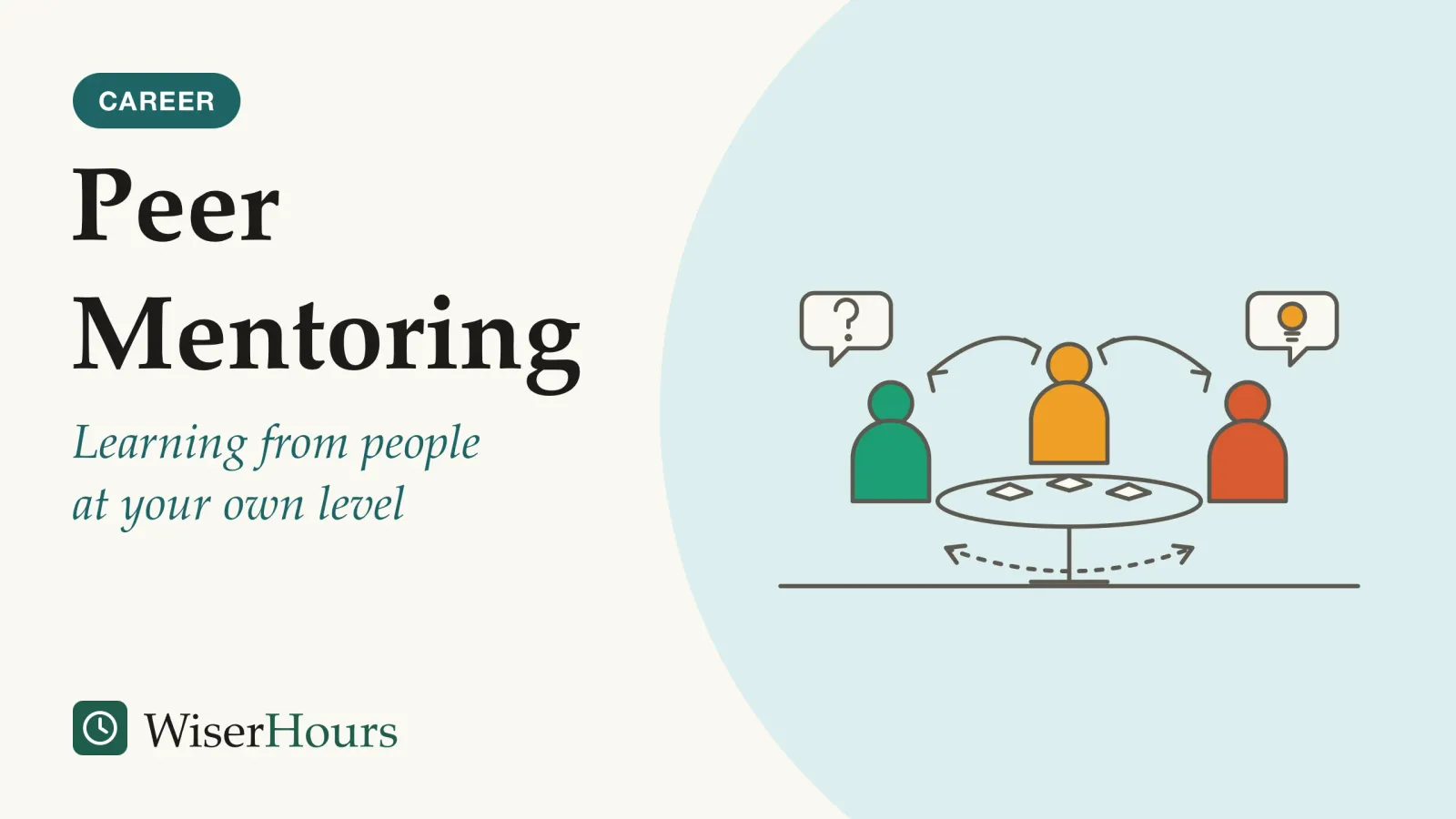
Colleagues at your own level can give you some of the help a mentor gives, and they get help back in the same conversation. When Kathy Kram and Lynn Isabella interviewed managers and professionals at one US manufacturing company for a 1985 study, the peers people named as important to their growth shared information, gave feedback, helped plan careers and offered emotional support, and the help ran in both directions. Their list of what peers provided left out the help that rests on rank, such as sponsorship.1
That two-way help is peer mentoring. It works best alongside a senior mentor, and setting it up takes six steps:
- Choose one or two peers who face similar problems
- Agree on a shared goal
- Set a rhythm and an end date
- Trade one real problem each session
- Ask for candid feedback and give it back
- Review it, and keep someone senior in the mix
Peer mentoring is one strand of networking, the deliberate building of work relationships, and it is the strand that runs between equals.
What is peer mentoring?
Peer mentoring is a working relationship between colleagues at a similar level in which each helps the other learn and develop. In Kram and Isabella’s 1985 study, peers usually shared either their age or their rank, and the feature that set them apart from mentors was mutuality: both people gave help and both received it.1
Definition
Peer mentoring is a two-way developmental relationship between colleagues at a similar level, in which each person both gives and receives help.
The term is used loosely. In schools, universities and health programs, a “peer mentor” is often someone who has already lived through an experience guiding someone who is new to it, such as an experienced student helping a newcomer.2 Some mentoring research also treats “step-ahead” mentors as a separate type from peers.3 This guide is about two or more colleagues on roughly the same rung, trading help.
Conventional mentors in the study were much older and several levels higher, and their help flowed one way. Kram and Isabella also noted that a hierarchy contains more peers than bosses or mentors, so most people have far more potential peer mentors than senior ones.1
Two project coordinators who joined a hospital’s operations team in the same year might meet every other Friday. One is good at budgets, the other at calming difficult department heads, and each brings a question the other can answer. If you already turn to a colleague when something at work puzzles you, you have the start of peer mentoring; making it deliberate is mostly a matter of agreeing to it.
What are the benefits of peer mentoring at work?
Peers give two kinds of help, according to Kram and Isabella: career help, made up of information sharing, career strategizing and job-related feedback, and personal help, made up of confirmation, emotional support, personal feedback and friendship. Some of it resembles what mentors give, but peers give it as equals.1
Equality matters because rank changes what people say. The authors reasoned that without a difference in level it is easier to communicate openly, support each other and work together. The closer peer relationships in the study also carried personal feedback on each person’s leadership style, how they came across and how they balanced work and family.1 A junior analyst may hesitate to tell a director that she froze in a client meeting. Telling a colleague who froze in a similar meeting last month costs her far less, and the colleague can say what helped.
The study
Limited evidence
Kram and Isabella (1985): 25 pairs of peers in one US company
The researchers asked 15 managers and professionals, spread across early, middle and late career, to name up to two colleagues who supported their growth, then interviewed both people in each pair: 25 pairs in all. Peers provided some of the same kinds of help as mentors, but the study’s list of peer help left out sponsorship, exposure, protection and challenging assignments. Help flowed both ways, and some peer relationships had lasted 20 or 30 years, against the three to six years the authors give as typical for a mentoring relationship.1
This exploratory interview study in one company described relationships without measuring their effects, so it shows what peers can offer and not how much difference that makes. Later work is mostly in medicine. One systematic reviewsystematic review: A review that fixes its question and its rules for including studies in advance, then searches out every study that fits and weighs them together. Some systematic reviews pool the results into a meta-analysis; others describe what the studies found without combining the numbers.Full entry in the glossary, published in 2020, gathered nine studies of peer mentoring among medical residents in Canada, the UK, the US, the Netherlands and Kenya. Residents in those studies reported support from peers, more motivation to build academic and career skills, and more satisfaction with their training, though the reviewers note that none of the nine included a control groupcontrol group: The group in a study that does not get the treatment being tested, so its results show what would have happened anyway. It may get nothing, usual care, a placebo, a place on a waiting list or a different activity, and which one it gets shapes what the comparison can show.Full entry in the glossary.4
Bring a peer the questions you would hesitate to ask your manager: how you came across in a meeting, whether a plan looks naive, how they handle a demanding client.
Three kinds of peer, from information-sharer to confidant
Kram and Isabella arranged peer relationships along a line, from information peers through collegial peers to special peers. At each step, trust and self-disclosure rise and the range of help widens.1
Information peers mainly swap news about the work and the organization. Trust and self-disclosure are low, and the study suggests people keep many of them. Collegial peers add career strategizing, job-related feedback and friendship; the career histories suggested people had two to four, often with someone they had once shared a department with. Special peers are the closest kind, offering candid personal feedback, emotional support and confirmation. They were rare, one to three per person or none at all, and usually took several years to develop.1
- Information peer: swaps information about the work and the organization; low trust and self-disclosure; people tend to have many
- Collegial peer: adds career strategizing, job-related feedback and friendship; moderate trust; people may have two to four
- Special peer: the closest kind: candid personal feedback, emotional support and confirmation; rare, and usually several years in the making
Most work relationships stay at the information end, and they are useful there: they keep you informed at little cost. Peer mentoring usually means moving one or two of them toward the collegial end, where people trade honest feedback and career advice.
A software tester who trades news about release dates with a tester in another squad has an information peer. When the two start asking each other how to handle an overbearing lead, or whether a team-lead opening is worth applying for, the relationship has moved toward the collegial kind.
What is the difference between peer mentoring and mentoring?
Traditional mentoring is a one-way relationship in which an older, more senior person guides a junior one; peer mentoring is a two-way exchange between people at a similar level. Kram and Isabella found the clearest differences in the kind of help each provides and the quality of the exchange. Senior mentors bring career help that depends on rank: sponsorship, exposure and visibility, protection, and challenging assignments. None of these appeared in the list of what peers provided.1
A 2001 study of 142 protégés in informal mentoring relationships, by Ellen Ensher and colleagues, points the same way: protégés said traditional mentors gave significantly more vocational support and role modeling than peer or step-ahead mentors, and they were more satisfied with them. We could read only that paper’s abstract.3
Kram and Isabella suggested that even people with mentors may find times when consulting a peer makes more sense, and that while conventional mentors seemed most important early in a career, peers seemed important at every stage.1 Use a peer for the everyday problem and the honest read, and a senior person for openings that only rank can create. Finding that person has its own step-by-step guide to finding a mentor.
Pairs, circles and cross-team swaps
Peer mentoring comes in three common formats: a one-to-one pair, a small group or circle working toward a shared goal, and a swap between peers in different teams or organizations. In the 2020 review of programs for medical residents, pairs usually decided for themselves when and how often to meet, while groups usually met monthly with a faculty facilitator.4
A pair suits candor. Two people who trust each other can discuss a failed presentation or a career doubt they would not raise in a group.
A circle suits a shared project. In a 2012 program at Mayo Clinic in the US, junior women faculty formed peer groups of three to five, each with a more senior facilitator, and spent a year working toward a common goal of getting manuscripts, such as clinical review articles, ready for journals. By the end, the groups had submitted nine manuscripts to journals, and participants rated their satisfaction with academic achievement, and several academic skills, higher than at the start.5 The program had 19 participants and no comparison group, so the ratings may also reflect a year of practice. Its design is a hybrid: peers did the work together, and someone senior kept them on course.
A cross-team swap suits blind spots. Higgins and Kram’s 2001 paper argues that the people who help you develop give less overlapping information when they come from different settings, such as another employer, a school or a professional association, than when they all sit in one workplace.6 The logic matches why acquaintances outside your circle bring news your close colleagues lack. A marketing analyst and a finance analyst who explain their teams’ reports to each other monthly each learn how the other side reads the numbers.
How do you set up a peer mentoring group?
Setting up peer mentoring takes a shared goal, an agreed rhythm and length, and a habit of bringing real problems. The steps below draw on how studied programs worked; none has been tested against an alternative.
- 1Shared goal
- 2Agreed rhythm
- 3One problem each
- 4Candid feedback
- 5Review
1. Choose one or two peers who face similar problems
Look for colleagues at a similar stage. Kram and Isabella found that what people brought to peer relationships changed with career stage, from learning the ropes early on to passing on wisdom in mid-career.1 For a circle, three to five is a workable size.
2. Agree on a shared goal
Name what the arrangement is for. The Mayo Clinic groups wrote a project charter and a 12-month timeline at the start.5 A goal for a pair can be as plain as “each of us leads one meeting with a senior stakeholder before March”.
3. Set a rhythm and an end date
No study fixes the right rhythm. The Mayo Clinic groups were encouraged to meet weekly and in practice met anywhere from every week to every four to six weeks.5 Monthly is a reasonable default, with a review date six or twelve months out, so stopping is easy if the match does not work.
4. Trade one real problem each session
Give each person time for one live problem: a decision to make, a draft to critique, a conflict to think through. Make sure each person both gives and receives help; a pair might split an hour in half.
5. Ask for candid feedback and give it back
Ask a specific question (“Did I sound defensive when the client pushed back?”) and agree that what is said stays between you. When you give feedback, describe what you saw and its effect, a pattern that the SBI model for constructive feedback sets out step by step.
6. Review it, and keep someone senior in the mix
At the end date, say what helped and what did not, then renew, change the format or stop. Keep at least one senior adviser alongside your peers, for the reasons below.
Starting a peer mentoring pair or circle
Where peer mentoring falls short
Peers have three main limits: they cannot sponsor you, they may share your blind spots, and rivalry can keep the relationship shallow. Each has a workaround, and the evidence behind peer mentoring is itself thin.
Sponsorship needs rank. Higgins and Kram, drawing on earlier work, describe sponsors as people who give a lot of career help and little personal support.6 Sponsorship was absent from Kram and Isabella’s list of what peers provided.1 A peer cannot put your name forward to a promotion panel they do not sit on.
Blind spots can be shared. Two juniors in the same team may both misread what leaders value, because they learned it from the same people. The fix is the cross-team swap described above: a peer from another team or employer.
Rivalry can block trust. Kram and Isabella speculated that people who feel they are competing with peers for jobs or resources may hold back from the closer kinds of peer relationship.1 If you and a colleague are up for the same promotion, choose someone else as your peer mentor for now.
| What it is | What the best evidence found | Evidence |
|---|---|---|
| Peers as a source of mentoring help | Peers gave career and personal help, both ways; not sponsorship | Interview study, 25 pairs in one US company, limited1 |
| Peers compared with traditional mentors | Traditional mentors gave more vocational support and role modeling | Study of 142 protégés, abstract read, limited3 |
| Peer mentoring for medical residents | Residents reported support, motivation and satisfaction with training | Systematic review of 9 studies, none controlled, limited4 |
| Facilitated peer groups | Manuscripts submitted; self-rated satisfaction and several skills higher after a year | Before-and-after study, 19 participants in one US clinic, limited5 |
| Peers from different settings | Less overlapping information than developers from one workplace | Theory paper, expert opinion6 |
Treat a peer arrangement as a low-cost experiment with a review date. If after a few months nobody has learned anything, change the format or the people.
The bottom line
A peer can critique your draft, tell you how you came across and stand by you in a bad week, and you do the same in return. What a peer cannot do is sponsor you. Pick one or two peers, agree on a goal, a rhythm and an end date, and keep at least one senior person in your network for the doors a peer cannot open.
Frequently asked questions
Can a peer mentor work at a different company?
Yes. Higgins and Kram's 2001 paper on developmental networks argues that developers drawn from different settings, such as another employer, a school or a professional association, give you less overlapping information than people from one workplace. Kram and Isabella's 1985 study looked only at peers inside one company, so the case for outside peers rests mainly on that theory.
Can peer mentoring happen online?
It can. A 2020 systematic review of peer mentoring among medical residents included a group peer e-mentoring program for radiology residents in Kenya, and a 2012 US program let its peer groups meet face to face, off campus or virtually. No study we found compares online with in-person peer mentoring, so pick the format the group will keep up.
Is a work friend the same as a peer mentor?
They overlap. In Kram and Isabella's 1985 study, friendship was one of the things peers provided, and the closest peer relationships combined it with candid personal feedback and emotional support. A friendship becomes peer mentoring when both people deliberately help each other learn and develop at work.
Sources
- Mentoring alternatives: The role of peer relationships in career development. Kram, K. E. & Isabella, L. A. (1985). Academy of Management Journal, 28(1), 110-132
- Peer mentoring. Wikipedia (accessed November 2026)
- Comparison of traditional, step-ahead, and peer mentoring on protégés' support, satisfaction, and perceptions of career success: A social exchange perspective. Ensher, E. A., Thomas, C. & Murphy, S. E. (2001). Journal of Business and Psychology, 15(3), 419-438
- Peer mentoring in medical residency education: A systematic review. Pethrick, H., Nowell, L., Oddone Paolucci, E., Lorenzetti, L., Jacobsen, M. and colleagues (2020). Canadian Medical Education Journal, 11(6), e128-e137
- The positive impact of a facilitated peer mentoring program on academic skills of women faculty. Varkey, P., Jatoi, A., Williams, A., Mayer, A., Ko, M. and colleagues (2012). BMC Medical Education, 12, 14
- Reconceptualizing mentoring at work: A developmental network perspective. Higgins, M. C. & Kram, K. E. (2001). Academy of Management Review, 26(2), 264-288
How we researched this
Papers on peer and developmental relationships were traced through OpenAlex, Crossref, Europe PMC and web searches during November 2026, with preference for the original researchers' work from 1985 to 2020. Kram and Isabella's 1985 study, Higgins and Kram's 2001 paper, a 2020 systematic review of peer mentoring among medical residents and a 2012 program evaluation were read in full; a 2001 comparison study was read in abstract form only. Almost all of this research uses interviews and surveys with no comparison group, which limits what it can show.
Keep reading
How to Find a Mentor: A Step-by-Step Guide
How to find a mentor in 5 steps: know what you need, look where you already work, let it grow, use programs well and build several advisers.
Informational Interviews: How to Ask for One and What to Ask
How to ask for an informational interview, with 3 request templates, 10 questions grouped by purpose, and how to run 20-30 minutes and follow up.
Is LinkedIn Premium Worth It? A Neutral Look at the Paid Features
Is LinkedIn Premium worth it? Four paid plans compared with the free account, using LinkedIn's own pages, with a verdict for 4 kinds of user.
Dunbar's Number: How Many Relationships Can You Really Maintain?
Dunbar's number says we keep up about 150 relationships. A 2021 reanalysis says the data can't fix any number. What it means for your network.