How to Give Constructive Feedback Using the SBI Model (With Examples)
The SBI feedback model in 3 steps (situation, behavior, impact), with examples for praise and correction, and the next step it leaves out.

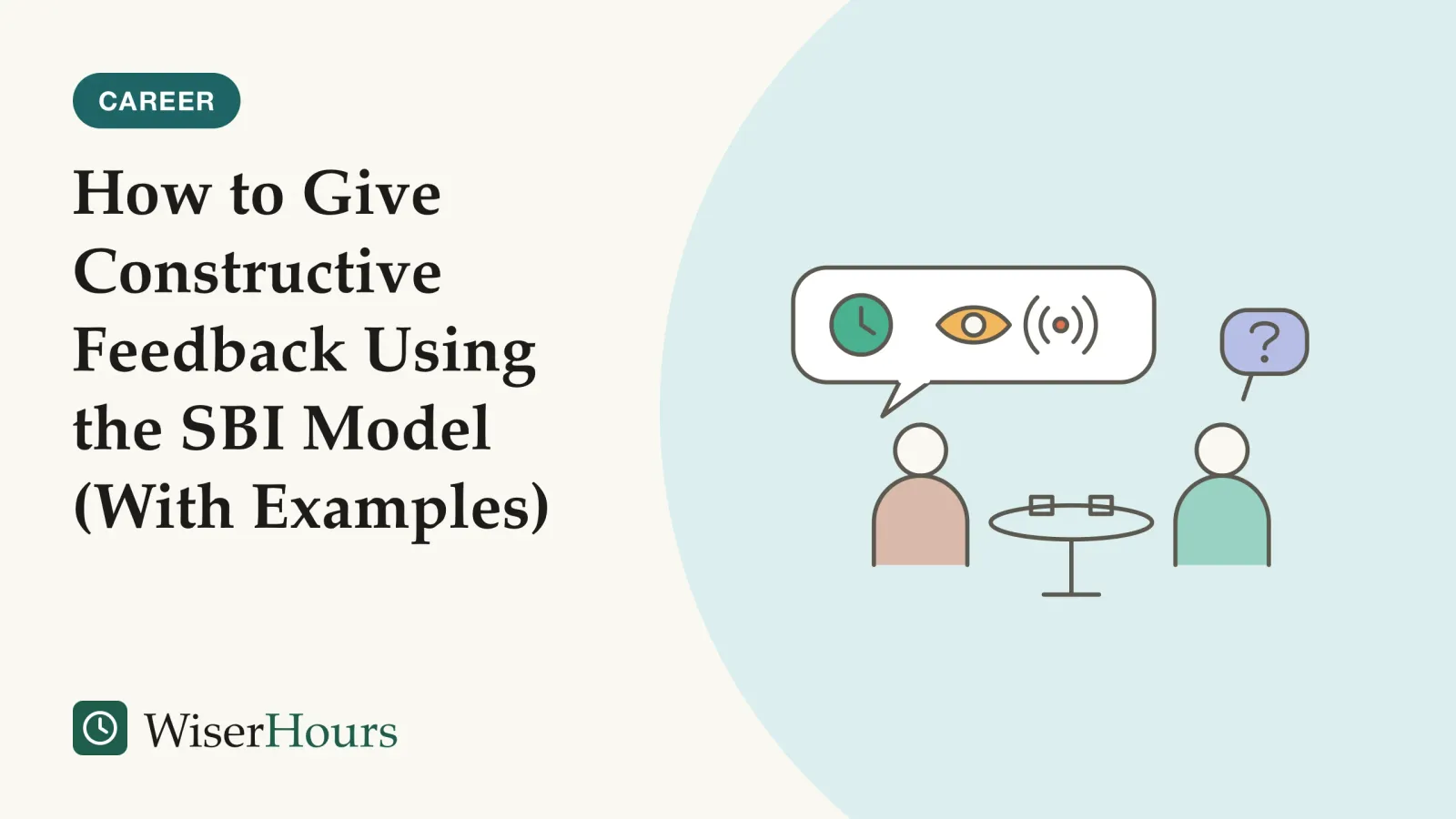
Useful feedback describes an event the other person can recognize, not a verdict on who they are. The SBI feedback model builds that into three steps: describe the situation, then the specific behavior you saw, then its impact.1 It comes from the Center for Creative Leadership (CCL), a nonprofit leadership-development organization headquartered in Greensboro, North Carolina, with offices in Europe, the Middle East and Asia.2 A complete SBI conversation has five parts, and the last two are ones the three letters do not cover:
- Name the situation.
- Describe the behavior, not the person.
- Say what the impact was.
- Ask what they intended.
- Agree on the next step.
No independent study has tested SBI against other ways of giving feedback, but its central rule, describe the act rather than judge the person, matches what a 1996 review of feedback research by Avraham Kluger and Angelo DeNisi linked to more effective feedback.3 Giving feedback is one of the communication skills that matter most at work; this guide takes the SBI model apart and shows it working for praise and for correction.
What goes into each step of the SBI feedback model
The SBI feedback model asks for three pieces of description in a fixed order: when and where something happened, what the person observably did, and what effect it had. CCL’s guidance says to keep the behavior step to facts, with no opinions or judgments, and to use the same steps for praise as for criticism.1
Each step removes a guess the listener would otherwise have to make. The situation anchors the comment to a moment they can remember; CCL suggests a time and place, such as a named meeting this morning, because something loose like “last week” invites confusion. The behavior step describes what a camera could have recorded: CCL contrasts saying that someone interrupted you while you were presenting the budget with simply calling them rude. The impact step says what the behavior did, and CCL suggests plain feeling words for it, such as proud when the effect was good and worried when it was not.1
- 1Situationone moment: when and where
- 2Behaviorwhat a camera would have caught
- 3Impactwhat it did to you, the work or others
Picture a team lead who needs to tell a new support analyst that a shift handover went badly. “Your handover was sloppy” gives him nothing to fix and something to defend. “In Wednesday night’s handover note, the two escalated tickets weren’t listed, and the night team spent their first hour finding them again” gives him a moment, a fact and a consequence. He can check all three.
Is there proof that the model itself works? Not independent proof. CCL says its own research found that SBI lowers anxiety about giving feedback and defensiveness in the person hearing it, but it does not publish that research on the page.1 Our searches turned up classroom descriptions and conference posters, not a controlled comparison. Treat SBI as a well-built practitioner tool whose parts rest on wider research, and test each part before you speak: could the other person picture the moment, could a bystander confirm the behavior, and does the impact say why it matters?
Five moves for an SBI conversation
The five moves below turn SBI and the two pieces it leaves out into one short conversation. The first three follow CCL’s model, the fourth follows its SBII extension, and the fifth follows the wider feedback research covered later in this guide. CCL warns that the model may feel awkward or formal at first and says managers find it helpful once they have practiced.4
1. Name the situation
Pick one moment and say when and where it was: “In this morning’s client call.” One incident is easier to discuss than a pattern, and it keeps you honest about whether you actually saw it. If no specific moment comes to mind, hold the feedback until one does.
2. Describe the behavior, not the person
Say what the person did or said, in words a bystander would agree with: “You told the client the fix would ship Friday.” Leave out adjectives about character (careless, brilliant, difficult) and guesses about motive. Motive belongs to the fourth move, as a question.
3. Say what the impact was
Say what the behavior did to you, the work or other people: “Engineering hasn’t scoped it yet, so I’m worried we’ll have to walk that date back.” Speak for yourself and keep your tone plain; an assertive tone states the effect directly without an attack.
4. Ask what they intended
Then stop and ask: “What was your thinking there?” Hear the answer out before replying, and check you have understood it in the way active listening describes. Often the reason changes the fix: the client may have pressed hard, or the date may have come from someone else.
5. Agree on the next step
Finish with what happens now, decided together: “Could you email the client today to say we’ll confirm the date Monday, and bring me in when dates come up?” For praise, the next step is simply to keep doing it, and saying so makes that explicit.
Five checks for your SBI feedback
SBI feedback examples for praise and for correction
SBI works the same way for praise as for correction: one moment, one action, one effect. The difference is the last move, which for praise is “keep doing this” and for correction is a change you agree on together.
Praise is easy to leave vague. “Great presentation” feels generous but tells the person nothing about what to repeat. An SBI version: “In this afternoon’s budget meeting, you opened with the one decision you needed and kept the detail for questions. The committee approved it without a second round, and I could see the chair relax.” The praise is about an act rather than a trait, which fits Kluger and DeNisi’s finding that feedback pulling attention toward the self, praise included, tended to be less effective.3
A correction runs through all five moves. “In Thursday’s release notes, the price change wasn’t mentioned. Two customers called support confused, and I spent the morning on those calls. What happened on your side?” After listening: “Could we add pricing to the release checklist, and could you send me the draft a day early?”
Two related cases get their own treatment elsewhere on the site. Wrapping a correction in unrelated praise, the familiar feedback sandwich, has its own research, and feedback to your own manager uses the same moves but carries different risks. When a disagreement is mutual and heated, steps for resolving conflict at work fit better than a feedback script.
Read your version aloud before you use it. If it names a time, an action and an effect, and nothing in it describes the person’s character, it is ready.
Why a description lands better than a verdict
Feedback aimed at the task tends to work better than feedback aimed at the person, and feedback of any kind does not reliably help. Both conclusions come from Kluger and DeNisi’s 1996 meta-analysismeta-analysis: A study that combines the results of earlier studies on the same question into one overall estimate. Pooling makes the estimate more precise, but it cannot repair the studies it pools: a meta-analysis of surveys is still survey evidence.Full entry in the glossary in Psychological Bulletin, which pooled decades of feedback experiments.3
The study
Moderate evidence
Kluger and DeNisi, 1996: the feedback that backfired
Across 131 papers yielding 607 measured effects, Avraham Kluger and Angelo DeNisi found a positive average effect of feedback on performance. Yet over a third of those effects were negative: people performed worse after the feedback. Comments that drew attention to the self, including praise and messages that threatened self-esteem, went with weaker effects, and those that supplied the correct solution with stronger ones.3
Kluger and DeNisi’s account centers on attention. Their results suggest feedback loses power as it moves attention away from the task and toward the self: someone busy working out what a comment says about them has less attention for the work itself.3 The caveat: the comparisons between kinds of feedback were made across studies, mostly lab tasks, so they show what went with better results rather than proving cause. The same study informs our guide to what to cover in one-on-one meetings, where much everyday feedback happens.
Wording matters inside the impact step, too. In a 2018 study run at an Australian university, 253 students rated opening lines for conflicts at work, with friends and with partners, and statements that used “I” and acknowledged the other person’s view were judged least likely to make the listener defensive.5 These were ratings of written scenarios, not real conversations, but they fit SBI: “I was worried we’d miss the deadline” reports your reaction, while “you put the deadline at risk” assigns blame.
Compare “you’re not a team player” with “in Monday’s planning meeting you took on the dashboard, and on Thursday it hadn’t been started, so sales presented without it.” The first invites a denial. The second invites an explanation. If a draft contains “you are,” “you always” or “you never,” rewrite it as one event.
What SBI leaves out: intent and a next step
The SBI feedback model ends at impact, so it tells someone what happened and why it mattered, but not what to do next. CCL’s own extension, SBII, adds a fourth step, a question about intent, and says that asking turns a one-way message into a two-way conversation.1
The only way to know what someone intended is to ask them — and the only way to let a person know their impact is to tell them.
Intent matters because people fill gaps with stories. CCL points out that when someone lets us down, we tend to make unflattering assumptions about why and then act on them.1 Back to the support analyst: suppose the two tickets were missing because the ticketing system had shown them as closed. A question such as “What happened with those two tickets?” brings that out, and the fix becomes a check of the system’s filters, not a talk about carelessness.
Even SBII leaves the next step unspoken, and that is the part wider research points to. In Kluger and DeNisi’s review, feedback that showed the correct way to do the task went with stronger effects.3 A 2020 meta-analysis of classroom feedback by Benedikt Wisniewski, Klaus Zierer and John Hattie, drawing on 435 studies, concluded that feedback is more effective the more information it contains.6 That evidence comes from schools and universities rather than offices, but the direction matches: a comment that says what good looks like gives the listener more to work with than one that only says what went wrong.
- Situation: when and where it happened
- Behavior: what you saw or heard, without judgment
- Impact: what it did to you, the work or others
- Intent: ask what they meant, then listen (SBII)
- Next step: what to keep, change or try, agreed together (not part of SBI or SBII)
Short bracket (teal dot): the three SBI steps. Long bracket (purple dot): SBII, which adds the question about intent. Curved arrow: asking turns a one-way message into a conversation. Dashed tile: an agreed next step, which neither version spells out.
There is a limit to how much direction helps. In a 2004 US experiment by Jodi Goodman and colleagues, more specific feedback improved performance during practice, but the benefit did not last once the task changed, and it reduced how much people explored (its sample goes undescribed in the abstract, which was all we could access).7 So match the next step to the situation. For a one-off correction, name the fix. For someone learning a skill, describe the impact precisely and ask them to propose the next step.
How much evidence stands behind each part
The evidence behind SBI is indirect: its creator’s own materials describe the model, and wider feedback research supports most of its parts. The table sorts each piece by the kind of evidence behind it.
| What it is | What the best evidence found | Evidence |
|---|---|---|
| SBI as a whole | CCL reports that it lowers anxiety and defensiveness; the research is not published on the page and no independent test was found | Expert opinion from the model’s owner, limited1 |
| Describe behavior, not the person | Feedback drawing attention to the self went with weaker effects | Meta-analysis, mostly lab studies, moderate3 |
| State the impact with “I” and their view | Such openings were rated least likely to provoke defensiveness | One study of rated scenarios, students at an Australian university, limited5 |
| Add a next step | Feedback carrying more information, such as the correct answer and how to get there, was linked to larger effects | Meta-analysis in education, moderate6 |
| Keep direction proportionate | Very specific feedback helped practice but reduced exploration | One experiment, abstract only, limited7 |
Use the table to decide where effort pays off. The two parts with the most support, describing the act and adding a next step, are the ones to get right every time; the advice on wording is sensible and fits the research, but it rests on thinner evidence.
The bottom line
The SBI feedback model is a sound habit rather than a tested method: name one moment, describe what the person did, and say what it affected. Then do the two things the three letters leave out: ask what they intended, and agree on what happens next, the step wider feedback research backs most directly.
Frequently asked questions
How soon after the event should you give SBI feedback?
Soon, and regularly. The Center for Creative Leadership advises giving feedback on a regular basis rather than saving it for the performance review, and calls feedback given in the moment on everyday behavior some of the most valuable. Timing also keeps the situation step precise: this morning's meeting is easy to picture, while an incident from months ago invites an argument about what happened.
Is SBI feedback better given in writing or face to face?
The research does not settle it. A 2020 meta-analysis of feedback in education found that the channel, written or spoken, made no significant difference to how well feedback worked. A live conversation makes it easier to ask about intent and agree on a next step, so it suits correction; a short written note works well for praise.
Does the SBI model work in every culture?
Nobody seems to have tested it. The model was developed by a US-based organization, and we found no study that tested it on its own, in the US or elsewhere. The situation and behavior steps are factual, so they need little adapting. How openly to state feelings in the impact step is a judgment to make with colleagues who know the local norms.
How does SBII differ from the original SBI model?
SBII adds a fourth step, intent. After the situation, behavior and impact, you ask what the person was trying to do, then listen. The Center for Creative Leadership presents it as a way to turn one-way feedback into a two-way conversation and to check your assumptions about why someone acted as they did.
Sources
- Use Situation-Behavior-Impact (SBI) To Understand Intent. Center for Creative Leadership (2025, August 19). The model's owner; not peer-reviewed
- About the Center for Creative Leadership. Center for Creative Leadership (accessed September 2026)
- The effects of feedback interventions on performance: A historical review, a meta-analysis, and a preliminary feedback intervention theory. Kluger, A. N. & DeNisi, A. (1996). Psychological Bulletin, 119(2), 254-284
- Improve Talent Development With Our SBI Feedback Model. Center for Creative Leadership (2025, February 24). The model's owner; not peer-reviewed
- I understand you feel that way, but I feel this way: the benefits of I-language and communicating perspective during conflict. Rogers, S. L., Howieson, J. & Neame, C. (2018). PeerJ, 6, e4831
- The Power of Feedback Revisited: A Meta-Analysis of Educational Feedback Research. Wisniewski, B., Zierer, K. & Hattie, J. (2020). Frontiers in Psychology, 10, 3087
- Feedback specificity, exploration, and learning. Goodman, J. S., Wood, R. E. & Hendrickx, M. (2004). Journal of Applied Psychology, 89(2), 248-262
How we researched this
Searches of Crossref, Europe PMC, OpenAlex and PubMed, run in September 2026, sought studies of the Situation-Behavior-Impact model and reviews of when feedback helps; we also read the Center for Creative Leadership's own descriptions of SBI and SBII. We found no controlled study of SBI itself, so the article relies on wider feedback research published between 1996 and 2020. Main limitation: most of that research used lab tasks or students, and one study could be checked against its abstract alone.
Keep reading
Active Listening Explained: What It Is and How to Practice It
Active listening, from its 1957 origin to the experiments: what it is, what feeling heard does for a speaker, and five steps to practice it at work.
How to Write a Professional Email: Structure, Length, and Tone
How to write a professional email: the request first, only the detail the reader needs, a courteous tone, and what a review of 62 work-email papers found.
What Are Communication Skills? A Plain-English Guide to the Core Set
Communication skills explained: the core six, the two tests they are judged on, and why email senders in a 2005 study expected 78 percent accuracy but got 56.