Scrum vs. Kanban: Which One Fits Your Team?
Scrum runs in sprints of up to 1 month; Kanban caps work in progress instead. Which fits support, product and mixed teams, and what the evidence shows.

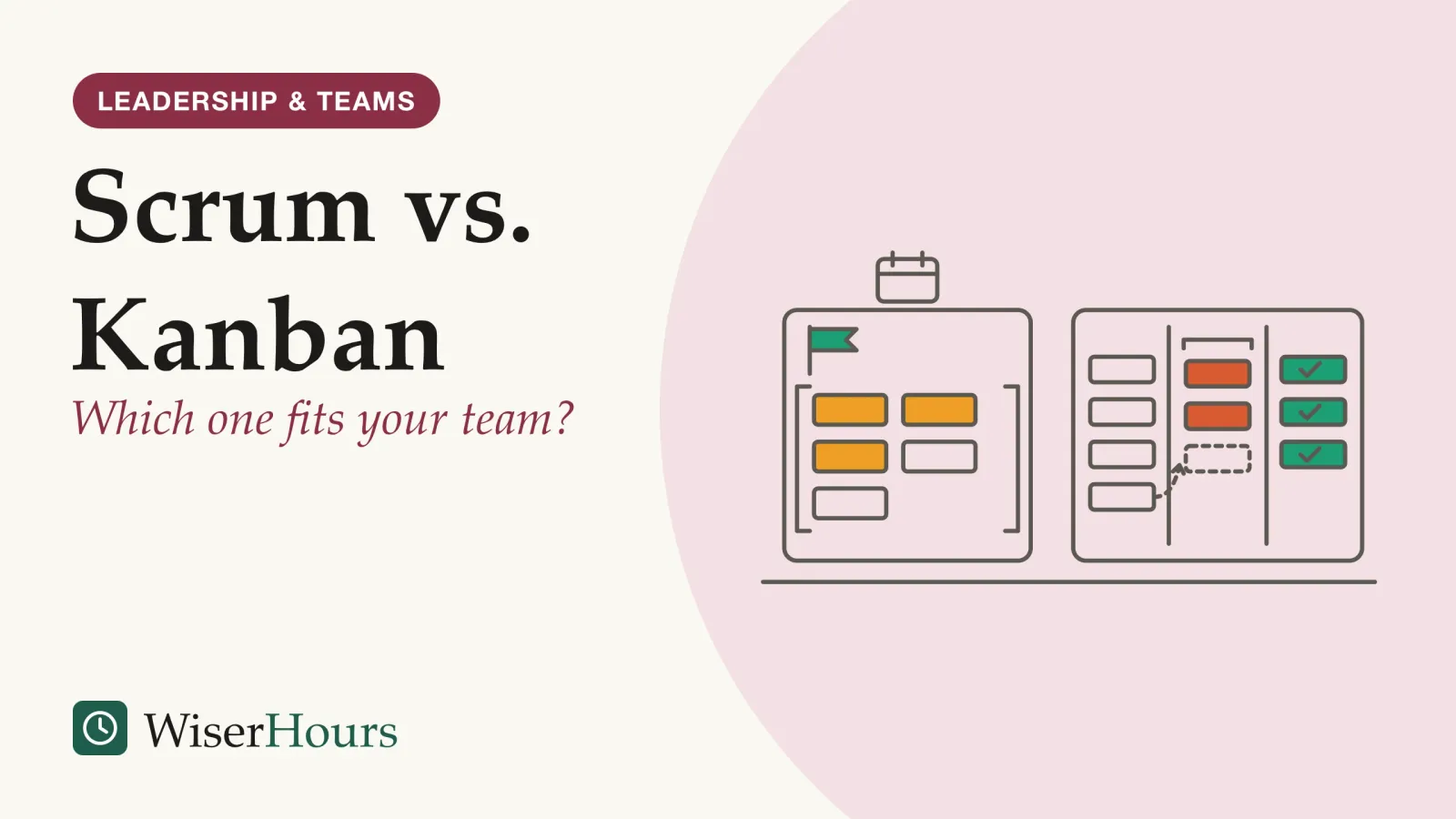
Scrum vs Kanban comes down to one design choice: what a team puts a limit on. ScrumScrum: A framework in which a small team works in fixed cycles called sprints, each lasting a month or less, with set events such as sprint planning and a short daily check-in. Its rules are written down in the Scrum Guide.Full entry in the glossary limits time, planning each fixed sprint of one month or less around a single goal.1 kanbankanban: A way of managing work on a board of columns, such as to do, doing and done, where new work is pulled in only when there is room and the number of tasks in progress is kept to a set limit. It comes from Toyota's factory system.Full entry in the glossary limits quantity, capping how many items are in progress and starting new work only when there is room.2 When researchers in Turkey gathered the studies that compared or combined the two for their 2022 systematic reviewsystematic review: A review that fixes its question and its rules for including studies in advance, then searches out every study that fits and weighs them together. Some systematic reviews pool the results into a meta-analysis; others describe what the studies found without combining the numbers.Full entry in the glossary, most of the studies that described a team changing method showed it moving away from pure Scrum, usually to a mix that replaced sprints with continuous flow and most often kept Scrum’s product owner and daily meeting.3
Neither method wins everywhere. Kanban tends to suit work that arrives unpredictably, such as a support queue; Scrum tends to suit a team building something new for stakeholders; and a team that does both usually needs parts of each. Both belong to the adaptive family among the ways of running a project. Below, the two are set side by side, followed by a verdict for each kind of team and then the evidence behind those verdicts.
Scrum vs Kanban: a time box or a cap on work in progress
Scrum and Kanban both make work visible and both improve through regular inspection, but they control the amount of work differently. Scrum, as its 2020 guide sets it out, runs sprints of one month or less and protects each sprint’s goal; the Kanban Guide by Daniel Vacanti and John Coleman caps how much work may be in progress and lets items enter whenever there is capacity.12
The two limits answer the same problem, too much work started at once, in different ways. A sprint answers it by batching: the team commits to a set of items for a few weeks, and anything new waits until the following sprint is planned unless it serves the goal. A cap answers it by pacing: nothing waits for a date, but nothing new starts until something finishes.
Picture an urgent request from sales that lands in the middle of a sprint. In Scrum, the guide allows no change that would endanger the sprint goal, so a request that would endanger it usually waits for a later sprint (the rules for how agile teams trade new work against old are a separate subject).1 In Kanban, the request joins the queue and starts as soon as someone finishes an item, perhaps that afternoon. Scrum protects focus; Kanban protects responsiveness.
| Scrum (2020 Scrum Guide) | Kanban (Kanban Guide) | |
|---|---|---|
| Rhythm and limit | Fixed-length sprints of one month or less, back to back; no changes that would endanger the sprint goal | Continuous flow; an explicit cap on the number of items started but not finished12 |
| Roles and meetings | Product Owner, Scrum Master and Developers; sprint planning, daily scrum, sprint review and retrospective | No roles; no required meetings, and changes to the workflow need not wait for one12 |
| Forecasting and measures | Past performance, upcoming capacity and the Definition of Done; burn-downs and cumulative flow listed as options | A service level expectation from past cycle times, such as 85% of items in 8 days or less (the guide’s example); four required flow measures12 |
The table hides a practical difference in how much each method decides for you. Scrum arrives with roles, events and a goal already specified, which gives a team that is new to planning together a ready structure. Kanban decides very little, so the team has to agree its own meetings and responsibilities, and the 2022 review notes that this works best in teams that are motivated from within.3
- Myth
- Scrum teams can release only at the end of a sprint.
- Fact
- Under the 2020 Scrum Guide, an increment may reach stakeholders before the sprint ends, and the sprint review is never a gate to releasing value.
So the first question is not which method is better but which limit your work needs. If your problem is too many half-finished tasks, a cap on work in progress targets it directly. If your problem is drifting priorities and no shared direction, a sprint goal targets that.
Which one fits your team? A verdict for three situations
Match the method to how work arrives. Kanban fits interrupt-driven work, Scrum fits product work that benefits from a shared goal and a regular review with stakeholders, and mixed work needs a deliberate combination. These verdicts rest on the two guides and on evidence that is mostly case studies, so test them against your own work rather than taking them on trust.
If most of it did, a sprint plan will keep breaking. If very little did, Scrum’s structure costs you less.
- Work arrives unplanned (support, maintenance, operations): start with Kanban: cap work in progress and pull new work when there is room
- The team builds toward goals that stakeholders review: start with Scrum: one sprint goal and a review every sprint
- The team does both: combine them on purpose, and say which parts you kept
Interrupt-driven support work: choose Kanban
Service desks, maintenance and operations teams receive work they cannot schedule, so a sprint plan agreed on Monday can be overturned by an outage on Wednesday. In the 2022 review, fixed sprints coping badly with frequent, unexpected change was the reason teams gave most often for leaving Scrum, and several studies called Scrum unsuitable for maintenance work.3
Kanban fits because it never asks the team to promise a batch. Instead, it gives requesters a service level expectation, a forecast of how long most items take, built from the team’s past cycle times. That is a promise a support team can keep: not when a particular ticket will be done, but how long most tickets take. In practice, set a cap on work in progress, check the age of every open item, and write down what counts as a genuine emergency, because the Kanban Guide asks that any exception to the cap be made explicit.2
Product teams building something new: choose Scrum
A team building a new product or feature for customers or stakeholders gains from a shared goal and a fixed point to show work and change course. Scrum supplies both: one sprint goal that keeps the team pulling in the same direction, and a sprint review each sprint where the team and its stakeholders inspect the result and decide what to adjust.1
The 2022 review found single studies reporting Scrum as better suited to new product development under high uncertainty, to work with firm deadlines and to larger teams. One study it included described a Kanban team struggling with a lack of control, of deadlines and of a sense of progress, problems the authors suggest Scrum’s sprints answer.3 For a team like this, keep sprints short and open each one with a sprint planning meeting built around the goal.
Mixed work: combine them on purpose
Many teams build a product and keep it running at the same time, and for them the evidence points to a mix. In the 2022 review, combined models mostly used flow instead of sprints, often kept the product owner and a daily meeting, and tended to hold their meetings on a calendar schedule rather than only when needed.3
Two ways to combine them
Keep Scrum and add a cap on work in progress and the flow measures, holding back part of each sprint’s capacity for the interruptions your records say will come. Or run Kanban and add a regular review with stakeholders and a goal for the period. Both are our suggestions, not rules in either guide.
Either way, name what you run honestly: the Scrum Guide says a team that keeps only parts of Scrum is no longer doing Scrum, and saying so stops anyone expecting sprint commitments the team no longer makes.1
Scrum asks a team to reorganize; Kanban starts from what it does now
The methods differ most in how a team adopts them. Scrum arrives as a complete framework with defined roles and events, while the Kanban method, in principles the 2022 review quotes from David Anderson’s 2010 book, asks a team to start with what it does now and initially respect current processes, roles, responsibilities and job titles.3
That difference sets the cost of starting. The authors of the 2022 review describe Scrum as having an entry threshold that teams must be helped across, because its changes arrive all at once, and several of the studies they gathered reported Kanban as easier to move to and use.3 An IT operations team that already has a ticket queue can start Kanban this week by putting its current steps on a board and capping work in progress. Turning the same team into a Scrum team means naming a product owner, choosing a sprint length and writing a goal that a queue of unrelated tickets may not have.
Scrum is still the more common choice. In Digital.ai’s 2023 State of Agile survey, 63 percent of respondents who used agile methods at team level said they followed Scrum.4 Digital.ai sells agile planning software, and its report has had no peer review. The 788 respondents, nearly half of them in North America, answered the company’s own questionnaire, and the report does not describe a random sample. The figure tells you what is popular, not what works.
The practical lesson: choose a method because it fits your work, not because it is the default. In the published studies, the most common method is also the one teams are most often described as leaving, as the research below shows.
Teams that switch mostly leave Scrum, but the studies are thin
Direct comparisons of Scrum and Kanban are few, and most are case studiescase study: A detailed look at one organization, group, project or event, often with interviews and documents. It can show how something happened in context, but with no comparison group it cannot show that a change caused the result or that it would work elsewhere.Full entry in the glossary of software teams. The fullest summary is the 2022 systematic review by Necmettin Ozkan and colleagues in Turkey, which gathered the peer-reviewed empirical studies, published up to March 2022, that compared the two methods or combined them.3
The study
Limited evidence
Scrum, Kanban or a mix? Ozkan et al. (2022), FedCSIS
Of 18 studies that described a team changing method, 16 started from Scrum: 11 moved to a hybrid and 5 to Kanban. Fixed sprints coping poorly with frequent or unexpected changes was the reason cited most, by 11 studies. In the hybrids, sprints had almost disappeared in favor of continuous flow, while the product owner and the daily meeting were among the Scrum elements most often kept.3
The direction is striking, but the design is weak. The authors read their results as favoring Kanban in general, yet they point out that most organizations adopted Scrum before Kanban, so moves away from Scrum may partly reflect where teams started, and they warn that the included studies’ results depend on context and may not generalize. Their own recommendation is to treat the methods as complements to blend to fit the work, rather than rivals.3
Reviews of Kanban on its own report benefits but little rigorous testing. A 2013 systematic literature review by Muhammad Ovais Ahmad and colleagues found Kanban studies reporting shorter lead times, better quality and better communication and coordination, alongside a lack of knowledge and training, according to its abstract.5 A 2018 mapping study by Ahmad and colleagues, covering 2006 to 2016, called the research largely descriptive, with little rigorous work, which made Kanban’s true value in software engineering extremely difficult to judge.6
For a team lead, that means most benefits quoted for either method come from teams describing their own experience. Treat any claim that one method is simply better with suspicion, including claims from trainers and vendors on either side, and choose by the kind of work in front of you.
One company’s switch: faster delivery, but read the dates
The most detailed numerical comparison we found is a 2012 case study of Software Innovation, a Scandinavian document-management software company with developers mainly in Norway and India, which moved from Scrum to Kanban in 2010. Analyzing more than 12,000 work items, Dag Sjøberg of the University of Oslo and two of the company’s managers found that average lead time almost halved after the switch.7
The details matter more than the headline. The long Scrum lead times were concentrated in 2009; in 2010, teams still on Scrum had lead times at the same level as teams already on Kanban. The two company coauthors were its R&D operations manager and its chief technology officer, whose view that Scrum was too rigid and unsuitable for maintenance work prompted the switch. The authors themselves say the results should be read with caution, because Kanban followed Scrum rather than running alongside it.7 A team getting better with practice and a team benefiting from a new method can look identical on a before-and-after chart.
The lesson is to measure before you change anything. Record when each item starts and finishes for several weeks first, so you can tell a method effect from ordinary improvement. The flow measures in the comparison table above, such as cycle time and throughput, can be tracked under either method.
The bottom line
Choose by how your work arrives. If most of it arrives unplanned, start with Kanban’s cap on work in progress; if the team builds toward goals that stakeholders review, start with Scrum’s sprints; if you do both, combine them deliberately and say which parts you kept. The studies comparing the two are mostly case studies, so measure your own lead times before and after any change rather than trusting someone else’s before-and-after story.
Frequently asked questions
Is Scrumban a real method?
Scrumban is a common name for a mix of the two, not a method defined by either guide. The 2020 Scrum Guide says that implementing only parts of Scrum is possible but the result is not Scrum, while the Kanban Guide says Kanban can and should be used to augment other approaches. A mix can work well; call it what it is, so nobody expects Scrum's rules from it.
Does Kanban have a Product Owner or Scrum Master?
No. The Kanban Guide by Daniel Vacanti and John Coleman defines no roles and calls everyone who takes part Kanban system members. The 2020 Scrum Guide defines three accountabilities: a Product Owner, a Scrum Master and the Developers. Teams that combine the methods often keep a product owner, according to a 2022 review of studies that compared or combined Scrum and Kanban.
Can a Kanban team still commit to dates?
Yes, as forecasts rather than sprint commitments. The Kanban Guide asks every team to set a service level expectation from its past cycle times, such as a stated share of items finished within a set number of days. One study in a 2022 review reported a Kanban team feeling a lack of deadlines and of a sense of progress, and the review's authors suggest Scrum's sprints answer that need.
Do Scrum and Kanban work outside software?
Both guides say so. The 2020 Scrum Guide notes Scrum's use in many domains beyond software, and the Kanban Guide names finance, utilities and healthcare among the fields whose knowledge workers have benefited from Kanban. The comparative research, however, comes almost entirely from software teams, so results elsewhere are less well tested.
Sources
- The Scrum Guide: The Definitive Guide to Scrum: The Rules of the Game. Schwaber, K. & Sutherland, J. (November 2020). Scrum Guides; checked current on 2026-09-27
- The Kanban Guide. Vacanti, D. & Coleman, J. (May 2025 revision; first published 2020). Kanban Guides; checked current on 2026-09-27
- Scrum, Kanban or a Mix of Both? A Systematic Literature Review. Ozkan, N., Bal, S., Gurgen Erdogan, T. & Gök, M. Ş. (2022). Proceedings of the 17th Conference on Computer Science and Intelligence Systems (FedCSIS), ACSIS 30, 883-893
- 17th State of Agile Report. Digital.ai (2023). Company survey report, not peer-reviewed
- Kanban in software development: A systematic literature review. Ahmad, M. O., Markkula, J. & Oivo, M. (2013). 39th Euromicro Conference on Software Engineering and Advanced Applications, 9-16
- Kanban in software engineering: A systematic mapping study. Ahmad, M. O., Dennehy, D., Conboy, K. & Oivo, M. (2018). Journal of Systems and Software, 137, 96-113
- Quantifying the Effect of Using Kanban versus Scrum: A Case Study. Sjøberg, D. I. K., Johnsen, A. & Solberg, J. (2012). IEEE Software, 29(5), 47-53
How we researched this
Both guides, the 2020 Scrum Guide and the Kanban Guide (the May 2025 revision of the 2020 original), were read end to end. Systematic reviews and empirical studies comparing Scrum and Kanban were then sought in September 2026 through Crossref, Semantic Scholar, OpenAlex and publishers' sites. Sources date from 2012 to 2025. Two Kanban reviews were read in abstract only, Anderson's 2010 book is described through a later review, and almost all the evidence concerns software teams.
Keep reading
Scope Creep: Why It Happens and How to Control It
Scope creep is project work added without extra time or money. How it differs from approved change, why it happens, and a 5-step routine to control it.

Sprint Planning: How to Run It Without Wasting Half a Day
The Scrum Guide caps sprint planning at 8 hours for a one-month sprint. How to set a sprint goal, size the work and finish well inside that limit.

What Is Project Management? A Plain-English Guide for Beginners
What is project management? Plain definitions from PMI, ISO and PRINCE2, and a study of 258 projects that found costs underestimated in almost 9 in 10.