How to Manage an Underperforming Employee: A Step-by-Step Guide
How to manage an underperforming employee in 5 steps: check expectations were clear, diagnose the cause, agree a plan, review it, and know when HR takes over.
Half of US small employer firms in a 2025 Fed survey said uneven cash flow was a challenge. Why profit and cash differ, with a worked example.
Root cause analysis step by step: the tools, why five whys falls short, and the fix teams skip. In one review, 2 of 21 studies could partly show a safety gain.
A manager's guide to employee onboarding from before day one to day 90, built on research into role clarity, confidence and feeling accepted.
Of the workplace fixes in a 34-study Cochrane review, only sit-stand desks cut sitting consistently. What employers can do about sedentary work, by evidence.
The popular claim is half to twice a salary. Published case studies point lower for most jobs. How to estimate turnover costs for your own team in 5 steps.
Scope creep is project work added without extra time or money. How it differs from approved change, why it happens, and a 5-step routine to control it.
Leadership vs management: Kotter's 1990 essay split the work into 3 pairs of tasks, then warned that strong leadership with weak management can be worse.
Cost of meetings, step by step: attendees times hourly pay plus benefits times hours, plus prep and recovery. Six people for an hour: about $400 (US, 2026).
Forming, storming, norming, performing and adjourning: where Tuckman's 1965 stages of team development came from, and how to use them at work.
There is no single ideal team size: a 2023 review of 208 team results found no overall link. Here is when size matters more, when it matters less, and why.
How 6 leadership style models compare on evidence: the modern styles overlap heavily, and hands-off leadership has the clearest record of harm.
Hourly or value-based pricing? 2 questions decide it: can the work be defined before it starts, and can the client put a number on the result?
Six Sigma targets 3.4 defects per million chances, but its real content is a way to run projects. What it adds, what firm studies found, and where it fits.
How to get quiet people to speak up in meetings: 6 steps from research on why employees stay silent, from the decision rule to a private second route.
Structured interviews explained: the 15 components of structure, how much you need, how to write questions and rating scales, and US and British rules.
WHO's 2022 guidelines strongly back 2 employer steps on mental health at work, training managers and adjusting the work, and leave treatment to clinicians.
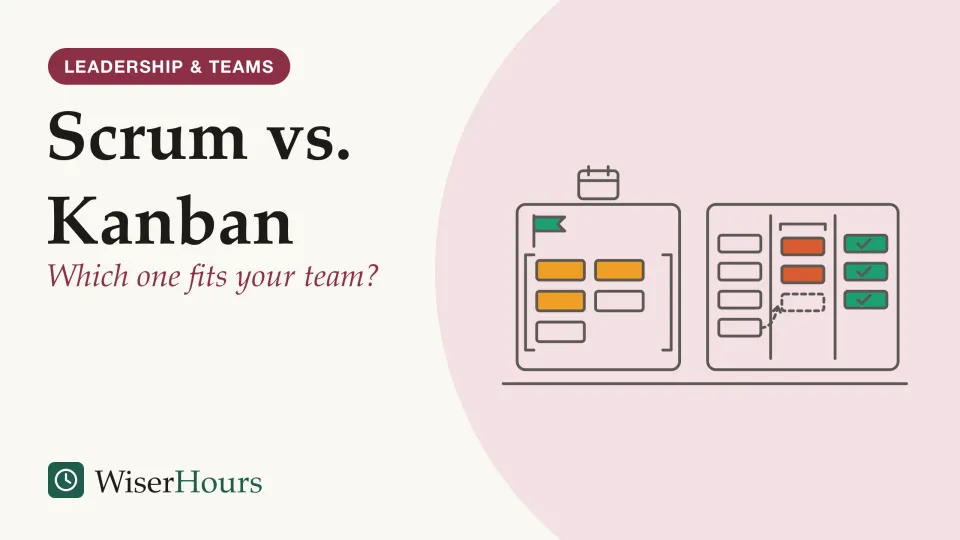
Scrum runs in sprints of up to 1 month; Kanban caps work in progress instead. Which fits support, product and mixed teams, and what the evidence shows.
A 2023 meta-analysis links room to learn and personal resilience most closely to engagement; a 2010 one ties red tape and role conflict to lower engagement.
Herzberg's 1959 theory splits work into hygiene factors and motivators. What it claims, why critics doubt the split, and what still helps managers.
Psychosocial hazards are work conditions such as overload, low control and bullying. What counts as one, and the 4-step loop safety codes use to manage them.
How to run performance reviews in 4 steps, and why a 2000 study found that ratings say more about the rater than about the person being rated.
The Scrum Guide caps sprint planning at 8 hours for a one-month sprint. How to set a sprint goal, size the work and finish well inside that limit.
A daily stand-up earns its 15 minutes when teammates plan today and raise blockers instead of reporting yesterday. Six steps from research on real teams.
A RACI matrix shows who does, owns, advises on and hears about each task. How to build one in 6 steps, with examples and what the evidence says.
Delegation is hard because work you shaped looks better to you and control feels good in itself. 5 habits drawn from the research help managers let go.
One-on-one meetings make up nearly half of all workplace meetings, yet a 2023 review found no empirical research on them as a topic.
Value stream mapping in 7 steps, worked through on an invoice-approval example, plus what reviews find and the step most published maps skip.
Should you start a business? About half of new US business locations with staff close within 5 years, but not every closure is a failure. How to weigh it.
Why does the same mistake keep happening? What process improvement means, the 4-step plan-do-study-act loop, and what makes the gains last.
Design a hiring process in 8 steps, from defining the job to onboarding, and why structured interviews top a 2022 review of how to predict job performance.
What is employee wellbeing? The physical, mental, social and financial health that work shapes, in 6 dimensions, and why NICE and NIOSH put the work first.
Researchers define employee engagement as vigor, dedication and absorption; Gallup's Q12, given to nearly 64 million employees, measures work conditions.
How to choose a co-founder in 5 steps: decide if you need one, pick for skills you lack, test the fit on real work, then put roles and equity in writing.
What is project management? Plain definitions from PMI, ISO and PRINCE2, and a study of 258 projects that found costs underestimated in almost 9 in 10.
Why meetings fail: in 92 videotaped team meetings, complaining was more strongly linked to poor outcomes than problem-solving talk was to good ones.
What makes a team effective? Decades of research point less to star talent than to how a team is set up and works together. Here is the evidence.
What is leadership? Nearly every definition centers on influence, and a 2011 meta-analysis found behaviors tend to explain more of effectiveness than traits.