Storytelling in Presentations: A Step-by-Step Guide
Storytelling in presentations in 6 steps: build a short work story, place it beside your data, and see what research on stories does and does not show.

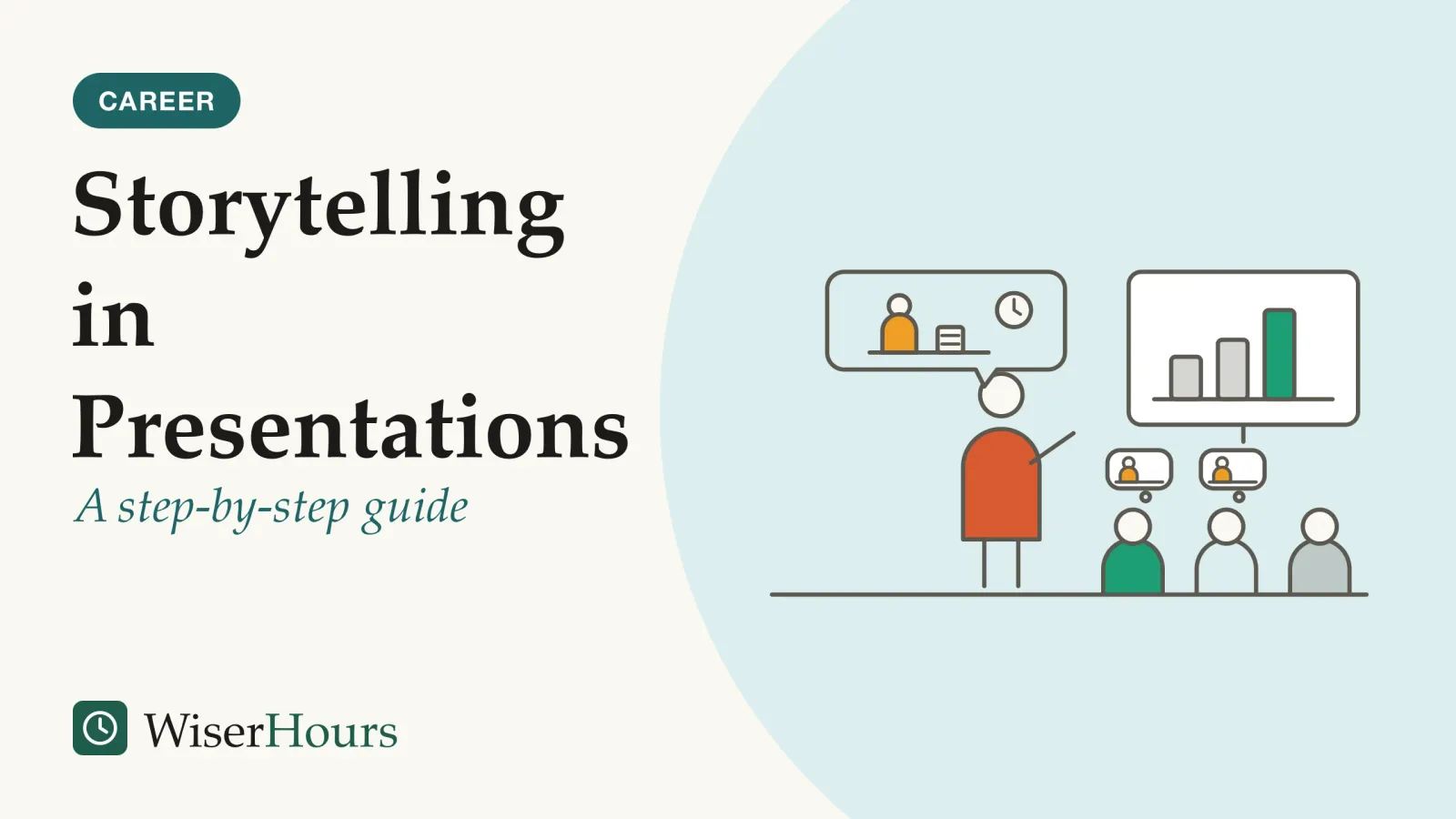
A team lead has five minutes at a planning meeting to ask for a second support hire (an illustrative case this guide returns to). She can say that response times have slipped. Or she can spend forty seconds on one Monday, when a customer waited two days for an answer about a failed payroll run.
The second version is storytelling in presentations: one real case the room can picture, told so that it carries a point your evidence supports. A story earns attention and helps a point stick, but it can also backfire. In three experiments published in 2020, with about 1,100 US adults and students, facts told inside a short story persuaded more than the same facts listed alone when the facts were weak, and less when the facts were strong.1 So what the story carries, and where it sits, decides whether it helps.
Six steps get you there, and the first and last are about the point rather than the story:
- Name the point before you pick the story
- Choose a real moment with one person in it
- Give it a problem, a turn and a result
- Add details people can picture
- Put the number next to the story
- Say the point out loud afterward
A story will not settle your nerves (the beginner’s plan for public speaking handles that), and it will not rescue a crowded screen, which is a job for slide design for non-designers. What it can do is give the room a reason to care about the evidence you show.
What storytelling in presentations means at work
A story in a work presentation is a short account of something that happened to a particular person over time, in which one event led to the next. Communication researcher Michael Dahlstrom, in a 2014 review in PNAS, names those three features (characters, events in time, and cause and effect) as the standard definition of narrative.2
The difference from a fact is the direction of reasoning. A statistic states a general truth and leaves the audience to apply it to cases. A story gives one specific case and lets the audience infer the general truth behind it, and because its meaning comes from the chain of events, it is hard to cut into pieces without losing the point.2
In the team lead’s pitch, “response times have slipped” is the general truth, and the payroll Monday is the case. Told well, the case makes the room do the generalizing: people conclude for themselves that customers are waiting too long.
That is also the risk. If the audience infers a general truth from your one case, the case has to be typical. Pick a story you would be comfortable defending as representative, not the most dramatic one you know.
Why a story pulls listeners in and lowers their guard
Stories persuade partly by absorbing people, a state psychologists Melanie Green and Timothy Brock called transportation in a 2000 paper: attention, mental images and feelings all focused on the events of the story. In their experiments, the more absorbed readers became, the more their beliefs moved toward the story’s.3
The study
Moderate evidence
Green & Brock (2000): absorbed readers spot fewer false notes
In the first three experiments, students read “Murder at the Mall”, a true account of a child killed at a shopping mall. The more transported readers were, the more their beliefs matched the story and the more they liked its main characters. Highly transported readers also circled fewer “false notes”, passages that did not ring true to them. In the fourth, with a different story, instructions that steered readers toward surface features of the text lowered transportation and the story-consistent beliefs with it. Labeling a story as fact or as fiction made little difference.3
Most of this evidence links absorption to beliefs rather than proving it causes them, and the participants were students reading on paper. Transportation has since been described for spoken stories too, not just written and filmed ones, according to a 2024 review by Green and Markus Appel.4
A 2014 meta-analysismeta-analysis: A study that combines the results of earlier studies on the same question into one overall estimate. Pooling makes the estimate more precise, but it cannot repair the studies it pools: a meta-analysis of surveys is still survey evidence.Full entry in the glossary of 76 articles by Tom van Laer and colleagues linked transportation to fewer critical thoughts and more story-consistent attitudes. It also found three things a storyteller controls that went with deeper absorption: a character the audience can identify, a plot they can picture and events that feel lifelike.5 Those three are steps 2 to 4 below.
In a meeting, transportation is the moment laptops close and people stop glancing at their phones. It is also the moment nobody asks whether the payroll customer was typical, because the story has done the arguing for them. Absorbed audiences tend to check less, which is why the steps below keep the story and the evidence side by side.
Building the story, from first sentence to final chart
A good work story is short, true and specific, and it sits beside your evidence rather than replacing it. The steps apply the research in this guide, but the order is our suggestion, not a tested formula.
- The point, written first: one sentence the story has to prove
- One person: a real, typical case the room can picture
- A problem, a turn, a result: what went wrong, what changed, how it ended
- Details people can see: a time, a place, an object
- The number beside the story: the data sit next to it, not buried inside it
- The point, said out loud: so nobody draws a different lesson
Schematic, not data: the order is this guide's suggestion, not a tested formula.
1. Name the point before you pick the story
Write the one sentence the story has to prove, such as “our onboarding loses people in the first week.” Since the audience will generalize from your case, a story chosen first and justified later can end up proving something slightly different.

2. Choose a real moment with one person in it
Pick one identifiable person, whether a customer, a colleague or a past version of yourself, in one moment. A clearly drawn character went with deeper absorption in the 2014 meta-analysis.5 Choose a typical case, not the worst one, and ask permission or remove identifying details when the person is real.
3. Give it a problem, a turn and a result
Keep the shape simple: what the person wanted, what got in the way, what changed and how it ended. Leave out the backstory that does not bear on the turn. In a work talk, that fits in under a minute.
4. Add details people can picture
A plot people can imagine and events that feel lifelike were both linked to deeper transportation.5 One or two concrete details do the work: the invoice sat in a shared inbox for nine days; the new hire spent her first morning without a laptop. Skip the details that only you find interesting.
5. Put the number next to the story
End the story, then show the figure it stands for: “That customer was one of the orders delayed last quarter.” In the 2020 experiments, strong facts persuaded best when they were not buried inside a story.1 The memory research further down gives a second reason to keep the two close.
The support-hire pitch, told in full
The team lead tells the payroll story in four sentences, stops, and puts one chart on screen: response times over the last six months. She says, “That customer was not unusual. This is the trend,” and lets the chart make the case.
6. Say the point out loud afterward
Close the story with the sentence you wrote in step 1. Different listeners can draw different lessons from the same case, so name the one you meant, then move to your next point.
Story check for your next talk
Download PDF
Where a story helps a talk and where it hurts
A story helps most where the audience would otherwise argue and least where your evidence could win on its own. In Rebecca Krause and Derek Rucker’s 2020 experiments, a story reduced how closely people processed the facts inside it: that hid the flaws in weak facts and blunted the force of strong ones. The products were invented (a cell phone and a flu medicine), the stories were short and written, and the authors note that their audiences were not strongly opposed to the message, so a room that rejects your premise may behave differently.1
In an everyday pitch, if the team lead has six months of slower replies across every ticket, her data are strong, and they deserve the screen to themselves once the story ends. If all she has is three complaints from one bad week, a vivid story would make that look like more than it is.
That bottom-right cell is the uncomfortable one. Dahlstrom points out that a story never has to justify its claims, because the story itself seems to demonstrate them, and he argues that this power raises ethical questions for communicators who use it.2 If your numbers are thin, say so; a story that makes them feel stronger than they are borrows trust you may need later.
How much a story can move a room
Stories change minds, but by modest amounts. A 2016 meta-analysis by Kurt Braddock and James Dillard reported positive links between exposure to a narrative and beliefs, attitudes, intentions and behaviors that matched it; the correlations are small by common benchmarks, and we could read only the abstract.6
The more useful question for a presenter is whether a story beats the same information told plainly. A 2025 meta-analysis led by Bardia Rahmani pooled 77 randomized experiments of narrative radio, television and film and found sizable effects compared with no message or an unrelated one. In the smaller set of head-to-head tests against non-narrative messages with the same information, though, it found no clear difference.7 The authors suggest the main advantage of stories may be drawing and holding an audience.
Two further studies suggest why many good talks use both. A 2015 meta-analysis of 15 studies, mostly on health messages, found statistical evidence moved beliefs and attitudes more, while narrative evidence moved intentions more.8 And in five experiments published in 2019, with students and online panel workers, people who read a narrative argument rated its author as warmer, while a statistical argument made its author seem more competent.9
Picture a product manager pitching a new feature to leadership. A two-minute account of one customer’s workaround makes the room warm to the idea and to her; the usage figures make the case look rigorous.
None of these studies tested a live talk to colleagues, so treat the pattern as a well-grounded guide rather than a rule.
Are stories 22 times more memorable?
The popular line that stories are 22 times more memorable than facts has no traceable study behind it. The source most often named is a Stanford leadership-lab page built around a video talk by marketing professor Jennifer Aaker: it states the figure and lists general readings further down, but ties none of them to the number.10 The line is also credited to psychologist Jerome Bruner, whose 1986 book is on that reading list; we found no source that locates it in his work.
- Myth
- Stories are 22 times more memorable than facts.
- Fact
- No study behind the figure has been found. A 2021 meta-analysis found people recall and understand stories better than essays by a medium margin, nowhere near 22-fold.
The real advantage is smaller but solid. A 2021 meta-analysis by Raymond Mar and colleagues, covering experiments with more than 33,000 participants, found that people understood and recalled narrative texts better than expository ones, a medium-sized advantage. The authors found signs of publication biaspublication bias: The tendency for studies with striking or statistically significant results to be published, while quieter ones stay in the drawer. Since the missing studies are mostly the unimpressive ones, a pooled result tends to overstate the effect until it is corrected.Full entry in the glossary, and only eight of the studies had people listen rather than read.11
Timing matters too. In preregisteredpreregistration: Filing a study's hypotheses and analysis plan publicly before the data are collected or examined. It stops a planned test from being rewritten once the results are in, so a reader can tell a real confirmation from a hunt through the data.Full entry in the glossary online experiments on product reviews, published in 2024, Thomas Graeber and colleagues found that a story’s effect on beliefs faded by about a third over a day, while a statistic’s faded by nearly three quarters. Adding descriptive detail, even detail with no information in it, to a statistic also slowed the fading.12 A day later the story was still doing most of its work, and the bare number only about a quarter of its own.
That matters because work decisions rarely happen in the room. The budget call comes a week after your talk.
Story research at a glance: solid, modest and missing
Transportation and the modest persuasive effect of stories rest on meta-analyses; the story-versus-plain-message comparison and the weak-versus-strong-facts pattern rest on fewer studies, and nothing here was tested in real workplace talks.
| What it is | What the best evidence found | Evidence |
|---|---|---|
| Absorption in a story | Linked to story-consistent beliefs and fewer doubts; reducing it weakened the effect | Trial, moderate (students, written stories)3 |
| What makes a story absorbing | Identifiable characters, an imaginable plot and lifelike events | Meta-analysis of correlations, moderate5 |
| Exposure to a story | Small positive links with matching beliefs, attitudes, intentions and behaviors | Meta-analysis, moderate (abstract read)6 |
| Stories versus the same facts told plainly | No clear difference in head-to-head tests | Meta-analysis, limited (few comparisons)7 |
| Stories around weak or strong facts | Helped weak facts, hurt strong facts | Trial, limited (three lab and online experiments)1 |
| Memory for stories versus essays | Better recall and comprehension, a medium advantage | Meta-analysis, moderate (mostly reading)11 |
| Stories versus statistics a day later | Stories’ effect on beliefs faded less | Trial, limited (online experiments)12 |
| “22 times more memorable” | No study found behind the figure | Gap10 |
The firmest rows say stories absorb listeners and are remembered better than plain exposition; the thinner ones concern beating data outright.
The bottom line
Use a story to make the room care about a problem your evidence shows. Choose one real, typical case, tell it in under a minute, then put your number beside it and say the point out loud. When the data are strong, let them stand in plain view.
Frequently asked questions
Does a hypothetical or made-up story work as well as a true one?
It can absorb an audience as well, but it cannot stand in for evidence. In Green and Brock's 2000 experiments, labeling the same story as fact or as fiction made little difference to how absorbed readers became or to their beliefs. At work, though, a colleague who later learns a story was invented may discount the rest of the talk, so say plainly when an example is illustrative.
Do stories help in technical or data-heavy talks?
They can, especially for listeners outside your specialty. Michael Dahlstrom's 2014 review in PNAS argues that narratives help non-experts understand and engage with science. In Graeber and colleagues' 2024 experiments, even adding descriptive detail to a statistic helped it stick a day later. Keep the data on screen and use a short case to show why it matters.
Will a story win over a skeptical or hostile audience?
Sometimes, but expect less. A 2020 meta-analysis by Ratcliff and Sun, summarized in Green and Appel's 2024 review, found that narratives provoked slightly less resistance than non-narrative messages, even when the intent to persuade was obvious. Krause and Rucker note that their 2020 experiments used audiences who were not strongly opposed, so a room that rejects your premise may still argue with the story.
Sources
- Strategic Storytelling: When Narratives Help Versus Hurt the Persuasive Power of Facts. Krause, R. J. & Rucker, D. D. (2020). Personality and Social Psychology Bulletin, 46(2), 216-227
- Using narratives and storytelling to communicate science with nonexpert audiences. Dahlstrom, M. F. (2014). Proceedings of the National Academy of Sciences, 111(Suppl. 4), 13614-13620
- The role of transportation in the persuasiveness of public narratives. Green, M. C. & Brock, T. C. (2000). Journal of Personality and Social Psychology, 79(5), 701-721
- Narrative transportation: How stories shape how we see ourselves and the world. Green, M. C. & Appel, M. (2024). Advances in Experimental Social Psychology, 70, 1-82
- The Extended Transportation-Imagery Model: A Meta-Analysis of the Antecedents and Consequences of Consumers' Narrative Transportation. van Laer, T., de Ruyter, K., Visconti, L. M. & Wetzels, M. (2014). Journal of Consumer Research, 40(5), 797-817
- Meta-analytic evidence for the persuasive effect of narratives on beliefs, attitudes, intentions, and behaviors. Braddock, K. & Dillard, J. P. (2016). Communication Monographs, 83(4), 446-467
- The persuasive effects of narrative entertainment: a meta-analysis of recent experiments. Rahmani, B., Montano, B., Groves, D. W. & Green, D. P. (2025). Behavioural Public Policy, advance online publication, 1-23
- The Differential Impact of Statistical and Narrative Evidence on Beliefs, Attitude, and Intention: A Meta-Analysis. Zebregs, S., van den Putte, B., Neijens, P. & de Graaf, A. (2015). Health Communication, 30(3), 282-289
- Narrative warmth and quantitative competence: Message type affects impressions of a speaker. Clark, J. L., Green, M. C. & Simons, J. J. P. (2019). PLOS ONE, 14(12), e0226713
- Harnessing the Power of Stories. Stanford VMware Women's Leadership Innovation Lab, video and key takeaways featuring Jennifer Aaker (accessed 24 September 2026)
- Memory and comprehension of narrative versus expository texts: A meta-analysis. Mar, R. A., Li, J., Nguyen, A. T. P. & Ta, C. P. (2021). Psychonomic Bulletin & Review, 28(3), 732-749
- Stories, Statistics, and Memory. Graeber, T., Roth, C. & Zimmermann, F. (2024). The Quarterly Journal of Economics, 139(4), 2181-2225
How we researched this
The search, run in Crossref, Europe PMC and a general search engine over September 2026, sought experiments and pooled analyses of how stories persuade, absorb and are remembered, favored the most recent reviews, and traced the '22 times more memorable' claim to its earliest findable source. Sources date from 2000 to 2025. The chief limitation: most studies used written or filmed stories with students or online panels; we found no trials of stories in real workplace presentations, and one meta-analysis was read at abstract level only.
Keep reading
How to Open a Presentation: 10 Ways to Start Strong
How to start a presentation: the 3 jobs of the first minute, 10 openings with short examples for meetings, conferences and toasts, and 4 starts to avoid.
Impromptu Speaking: Frameworks for Thinking on Your Feet
Impromptu speaking without rambling: 6 frameworks matched to real moments, a short spoken example of each, ways to buy time and a weekly practice drill.
Canva for Presentations: Strengths, Limits, and When to Use It
Canva for presentations: what it does well, where it falls short (offline, data, PowerPoint export), when to use it, and 7 steps to present without surprises.
Body Language for Presenters: What to Do With Your Hands
Gestures gave listeners a moderate boost in understanding in a 2019 meta-analysis of 83 samples. Where to rest your hands, what to show and what to skip.