How to Open a Presentation: 10 Ways to Start Strong
How to start a presentation: the 3 jobs of the first minute, 10 openings with short examples for meetings, conferences and toasts, and 4 starts to avoid.

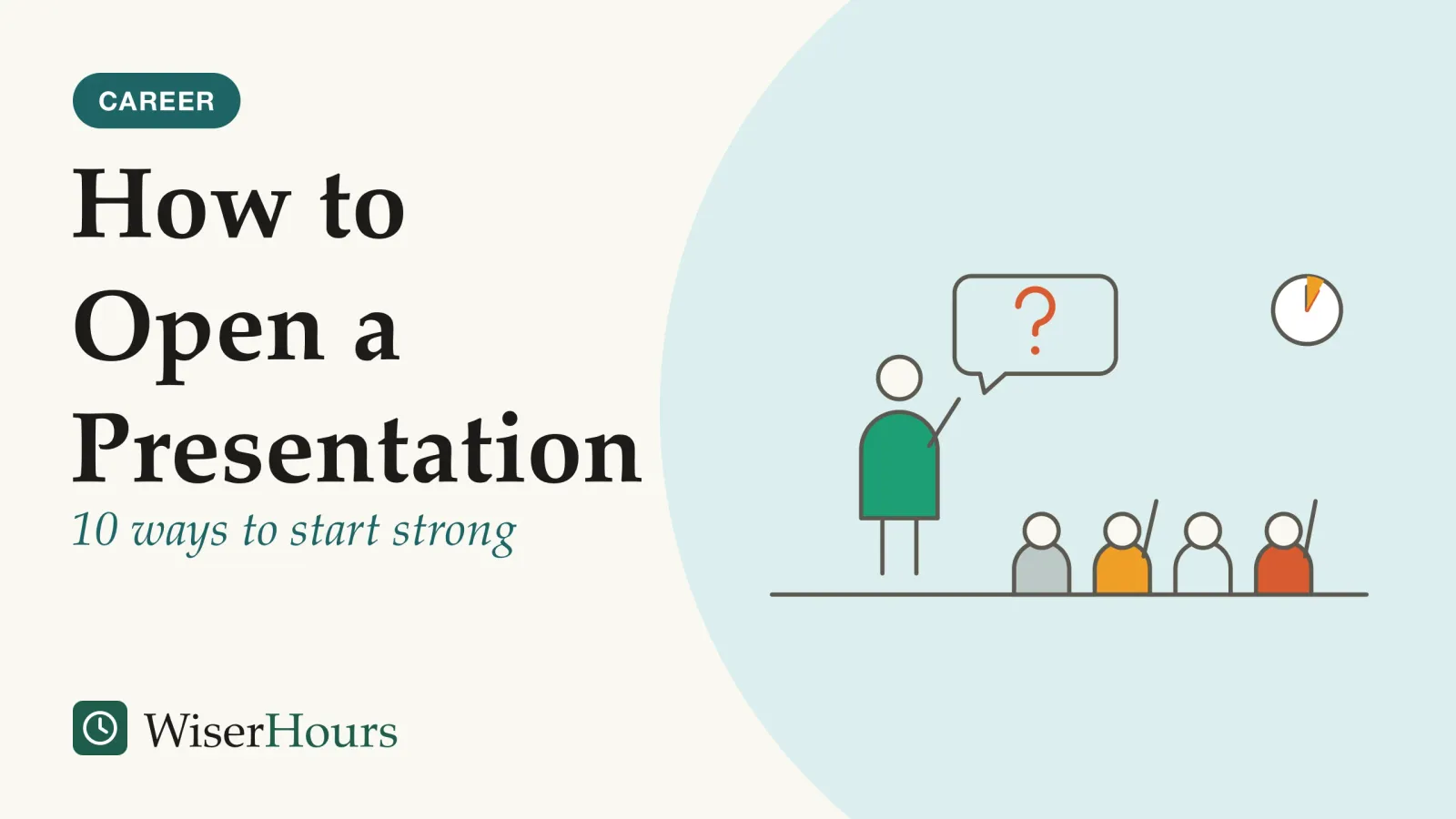
Thanks to the organizer, a name and job title, a check that the slides work, then the agenda: many talks spend their first minute on housekeeping. By the time the speaker reaches the point, the audience may already have decided how closely to listen.
How to start a presentation well comes down to three jobs in the first minute: earn the room’s attention, say what the talk is for, and tell people what they will get from it. Any of these ten openings can do the first job, as long as the next two sentences do the other two:
- Ask a question the room can answer
- Share one striking fact you have checked
- Tell a very short story
- Name the problem the room already has
- Promise what they will leave with
- Lead with your conclusion
- Show something
- Borrow a line from someone else
- Speak to the audience or the occasion
- Make a brief personal connection
Prefer to watch? The video covers the same ground as this article.
For the wider basics, including nerves and practice, start with public speaking basics for beginners, and browse the rest of the public speaking and presentations guides.
Why the first minute of a talk carries extra weight
An audience forms its view of a speaker quickly and then listens through it. Stand Up, Speak Out, an open public speaking textbook first released in 2011, warns that if you do not win attention at the outset, it only gets harder as you go on.1
Research on first impressions shows how fast that view forms. In a 1993 US study of 13 graduate teaching fellows at a private university, strangers’ ratings of just 30 seconds of silent classroom video closely tracked the ratings the teachers’ own students gave at the end of the semester.2 The judges saw only nonverbal behaviornonverbal communication: Communication without words, through facial expression, tone of voice, gesture, posture and eye contact. The popular claim that nearly all of a message's meaning is nonverbal is a misreading of two small experiments on judging feelings.Full entry in the glossary, and the teachers who came across as confident, active and warm tended to be the ones students rated highly.
The sample was tiny, and the clips came from the start, middle and end of each class, so the study shows that impressions form fast, not that openings matter more than middles.2 Later experiments add a limit. In two 2016 studies using scripted lessons, funded by the US Department of Education, both first impressions and lesson quality were linked to college students’ ratings of the instructor, but lesson quality mattered most for what they learned.3
Still, your opening is the first slice anyone sees. A speaker who begins by shuffling notes and asking whether the screen is visible shows the room someone who is not ready, before a word of content. Walk up, pause, and start with a sentence you know by heart, so the first slice shows someone settled and sure of the point.
Memory adds a second reason. In list-learning experiments, people recall the first few items better than those in the middle, a pattern psychologists call the primacy effect.4 A talk is not a word list, but a point said early gets that head start, so put your main point in the first minute instead of holding it back until the last slide.
Three jobs that decide how to start a presentation
The first minute has three jobs: earn attention, say what the talk is for, and tell people what they will get. The University of North Carolina’s Writing Center frames them as a hook, a reason the topic matters, and your main point stated right away along with how you will support it.5
- Earn attention: give the room a reason to look up
- Set the purpose: say what the talk is for, in one sentence
- Say what they will get: the payoff, and a short preview of how you will get there
Schematic, not data: our summary of a speaking textbook's and a writing center's advice, not a tested model.
Take a monthly operations review. “Good morning, I’m going to talk about returns” does none of the three jobs. “Returns cost us more last quarter than our biggest new contract brought in. In ten minutes I’ll show you where they come from and the two changes I want us to try” does all three.
The opening should also be short. Stand Up, Speak Out suggests the whole introduction take 10 to 15 percent of the talk, which for a five-minute update is well under a minute.1 Write your opening, then check it against the three jobs; if one is missing, add a sentence rather than a slide.
Ten ways to open, with an example of each
Stand Up, Speak Out lists eleven common attention-getters, drawn from a 1946 analysis of how speakers begin, and warns that each must suit the audience, the purpose, the topic and the occasion.1 The ten openings below build on that list. Only the question opening draws on a body of experiments we could find; the others come from teaching experience. The examples are illustrations, not real cases.
1. Ask a question the room can answer
A question works best when people try to answer it: a show of hands, a guess written on a card, a quick poll. “Before I show you the survey, guess: which task do new hires find hardest in their first week?” Save rhetorical questions for when you want people to reflect, not answer.
The study
Moderate evidence
Guess first, then learn: the prequestion experiments Pan and Carpenter reviewed in 2023
Psychologists Steven Pan, of the National University of Singapore, and Shana Carpenter, of Oregon State University, reviewed experiments in which people answered questions before they read a text, watched a video or sat through a lecture. Across these studies, mostly with students, trying to answer first often improved memory for the content the questions targeted, even when many first answers were wrong. Benefits for untested content were far less common, and results varied with the procedure. In one classroom study with a randomized design, students did better on final exam questions about content pretested at the start of lectures, even though they were never told the right answers.6
The review is a narrative reviewnarrative review: A review in which an expert summarizes a body of research in prose, choosing which studies to discuss. It can be a good map of a field, but without a stated search and pooling method it is easier for selection and opinion to shape the conclusions than in a systematic review.Full entry in the glossary rather than a pooled analysis, and most studies used students in labs or classrooms, so treat it as a strong hint rather than proof for boardrooms. For speakers, an opening question helps most when your talk goes on to answer it, because the benefit clusters on the content the question points to.6
2. Share one striking fact you have checked
A surprising fact makes people look up, and the textbook adds a duty: confirm it is true and relevant, not just shocking.1 “Last year our team answered more customer emails than the rest of the company combined” works if you can show the source on your next slide.
3. Tell a very short story
An anecdote is a brief account of a real event, and the textbook’s warning is about length: a common mistake is a story that runs too long.1 Aim for four or five sentences. The guide to storytelling in presentations shows how to build one around a single person and a single moment.
4. Name the problem the room already has
Explaining why a topic matters to these listeners is one of the jobs the UNC Writing Center sets for an introduction.5 Start from something the audience has lived through: “Every one of us has lost an afternoon to the expense system.” Stated plainly, a shared problem earns attention.
5. Promise what they will leave with
The textbook urges speakers to tell listeners directly how they can use what they are about to hear, rather than hoping they make the connection.1 “By the end of this session, you’ll have a one-page checklist for your next project kickoff.” Then keep the promise, or the room will notice.
6. Lead with your conclusion
Bottom line up front, a convention written into US Army correspondence rules, puts the main point first and the context after, so busy readers can decide faster.7 Spoken, it sounds like “I’m asking for approval to hire two engineers this quarter, and the reasons follow.” This suits decision meetings and senior audiences, and it is the one opening that can double as the purpose statement.
7. Show something
Holding up an object gives people something concrete to look at. At work, that might be the old and the new version of a form, or a 20-second live demo of the tool you want funded. Rehearse it; a demonstration that fails in the first minute is hard to recover from.
8. Borrow a line from someone else
A quotation lends your topic a second voice. Pick a line from your field or your organization’s own history rather than a famous name from a quote website, and check the original source before you use it. Choose a line whose meaning does not rest on wordplay, which may not survive translation for an international audience.
9. Speak to the audience or the occasion
Naming what the room shares, such as a profession, a project or an event, is a standard opening, and the textbook notes that many toasts begin with the occasion itself: “Today we are here to honor X.” For a toast, keep it brief and about the person being honored, and skip inside jokes the rest of the room cannot share.1
10. Make a brief personal connection
A short personal reference can show why you, specifically, are speaking on this topic. The textbook’s warnings apply: the topic is the point of the opening, not you, and avoid material that could choke you up in front of the room.1 One sentence often does it: “I ran this process for three years before I tried to fix it.”
Matching the opening to the room
The right opening depends on what the audience came for: a decision, an idea or a celebration. The table sums up the fits suggested by the textbook’s four tests (audience, purpose, topic and occasion); the pairings are our reading of that advice, not tested rules.
| Setting | Openings that usually fit | Use with care |
|---|---|---|
| Decision meeting or update | Lead with your conclusion; name the problem; promise the payoff | Long stories; jokes1 |
| Conference or lecture | A question they answer; a checked fact; a short story; a demonstration | A long personal history1 |
| Toast or celebration | The occasion; a brief story about the person | Inside jokes; anything about you1 |
Openings to avoid, and what to say instead
Four common starts spend the first minute without doing any of its jobs: apologizing, introducing yourself at length, testing the equipment in front of everyone, and reading out an agenda before giving a reason to listen.
Apologies come first because they are so tempting. The textbook advises against apologizing for nerves: audiences often do not notice them unless you point them out.1 “Sorry, I didn’t have much time to prepare” lowers expectations you then have to climb back over. A long self-introduction turns the opening toward you, too. If someone has already introduced you, skip it; if not, one sentence on why you are the one speaking is enough.
Equipment checks belong before the audience arrives. The textbook recommends arriving early to test the equipment and having a backup plan ready in case something breaks. “Can everyone hear me? Is this on?” tells the room you are not ready.1
An agenda-only start states the topic and nothing else. The textbook calls a plain reference to the subject clear but perhaps the least interesting way to begin.1 Keep the agenda, but let it follow the hook as your preview. And if your first words tend to be “So, um, okay,” see why speakers say um, and how to say it less.
Choosing and rehearsing your first minute
Choose the opening last and rehearse it most. Once you know the one point your talk makes, pick the opening that leads to it most directly, then link it to your topic in the next sentence, a step the textbook calls the link to topic.1
The colleague test
Say your first three sentences to a colleague, then ask two questions: what is this talk about, and what will you get from it? If they cannot answer both, one of the three jobs is missing.
Then run the whole first minute against this list.
Your first-minute check
Download PDF
Where the research on openings stops
Most opening advice comes from teaching experience, not experiments. Research backs two background points: impressions form fast, and questions asked before content help people learn it. No study we could locate compares opening types in real workplace talks.
One popular argument for a flashy opening does not survive checking.
- Myth
- Audiences now have an 8-second attention span, shorter than a goldfish's, so you must hook them instantly.
- Fact
- A 2017 BBC investigation traced the figure to a website whose listed sources had no record of it. A psychologist the BBC interviewed said attention depends on the task.
The goldfish line traces to a 2015 Microsoft Canada report that credited the numbers to another website, and when the BBC’s More or Less team checked, the sources that website listed had no research behind them.8 The full story is in the guide to whether attention spans are really shrinking. A speaker does not need a stunt in the first eight seconds, only a first minute that gives people a reason to keep listening.
| What it is | What the best evidence found | Evidence |
|---|---|---|
| Impressions of a speaker form fast | Strangers’ ratings of brief silent clips tracked students’ end-of-semester ratings of teachers | Observational, limited (13 teachers, one US university)2 |
| An 8-second attention span | No research found behind the figure | Gap8 |
| Asking questions before content | Often better memory for the questioned content; general benefits rarer | Review of experiments, moderate (mostly students)6 |
| Ten types of opening, and what to avoid | Standard advice in a speaking textbook and a writing center; no trials compare openings | Expert opinion1 |
Which opening wins in your room is a judgment call, so try it on a colleague first.
The bottom line
Make the first minute earn attention, say what the talk is for and tell people what they will get. Pick the opening that suits the room, cut the apology, the long biography, the microphone check and the bare agenda, and rehearse those first three sentences more than any others.
Frequently asked questions
How much of my talking time should the introduction take?
About 10 to 15 percent of it. The open textbook Stand Up, Speak Out puts a speech introduction at 10 to 15 percent of the total, which it works out as no more than about 45 seconds for a five-minute talk and about a minute and a half for a ten-minute one. For a short update, that can mean two or three sentences.
Should I open a presentation with a joke?
Only if you have tested it on people like your audience. Stand Up, Speak Out calls humor a double-edged sword and advises trying any joke on a sample of listeners first, because humor that falls flat or offends turns a room against you. Jokes also depend on shared references, which differ between countries and languages, so international audiences raise the risk.
Should I thank the organizers before I start?
A short thank-you is fine, and in some workplaces and cultures it is expected. Keep it to one sentence, then move straight to your opening. The UNC Writing Center advises telling listeners your main point right away, so a long round of thanks spends time your opening needs.
Sources
- Stand Up, Speak Out: The Practice and Ethics of Public Speaking, v. 1.0 (chapters 3, 9, 15 and 18). Saylor Academy edition of a 2011 open textbook (CC BY-NC-SA) whose author and publisher asked not to be credited; adapted in 2016 by University of Minnesota Libraries Publishing
- Half a minute: Predicting teacher evaluations from thin slices of nonverbal behavior and physical attractiveness. Ambady, N. & Rosenthal, R. (1993). Journal of Personality and Social Psychology, 64(3), 431-441
- No second chance to make a first impression: The thin-slice effect on instructor ratings and learning outcomes in higher education. Samudra, P. G., Min, I., Cortina, K. S. & Miller, K. F. (2016). Journal of Educational Measurement, 53(3), 313-331
- Serial-position effect. Wikipedia (accessed 28 September 2026)
- Speeches. The Writing Center, University of North Carolina at Chapel Hill (accessed 28 September 2026)
- Prequestioning and Pretesting Effects: a Review of Empirical Research, Theoretical Perspectives, and Implications for Educational Practice. Pan, S. C. & Carpenter, S. K. (2023). Educational Psychology Review, 35, article 97
- BLUF (communication). Wikipedia (accessed 28 September 2026)
- Busting the attention span myth. Maybin, S. (10 March 2017). BBC News, More or Less, BBC World Service
How we researched this
Advice on openings came from an open speaking textbook (Saylor Academy edition) and a university writing center (full texts, September 2026); claims about attention and first impressions were checked against 1993 and 2016 studies, a 2023 review of prequestion research and a BBC investigation. Sources date from 1993 to 2023. The main gap: no study has yet tested opening types against each other in real workplace talks, so most advice here is expert opinion.
Keep reading
Storytelling in Presentations: A Step-by-Step Guide
Storytelling in presentations in 6 steps: build a short work story, place it beside your data, and see what research on stories does and does not show.
Impromptu Speaking: Frameworks for Thinking on Your Feet
Impromptu speaking without rambling: 6 frameworks matched to real moments, a short spoken example of each, ways to buy time and a weekly practice drill.
Canva for Presentations: Strengths, Limits, and When to Use It
Canva for presentations: what it does well, where it falls short (offline, data, PowerPoint export), when to use it, and 7 steps to present without surprises.
Body Language for Presenters: What to Do With Your Hands
Gestures gave listeners a moderate boost in understanding in a 2019 meta-analysis of 83 samples. Where to rest your hands, what to show and what to skip.