The Values Card Sort: A Simple Tool Borrowed From Therapy
A values card sort is a free deck of 83 value cards from the University of New Mexico: sort them into piles, keep five, rank them and talk them through.

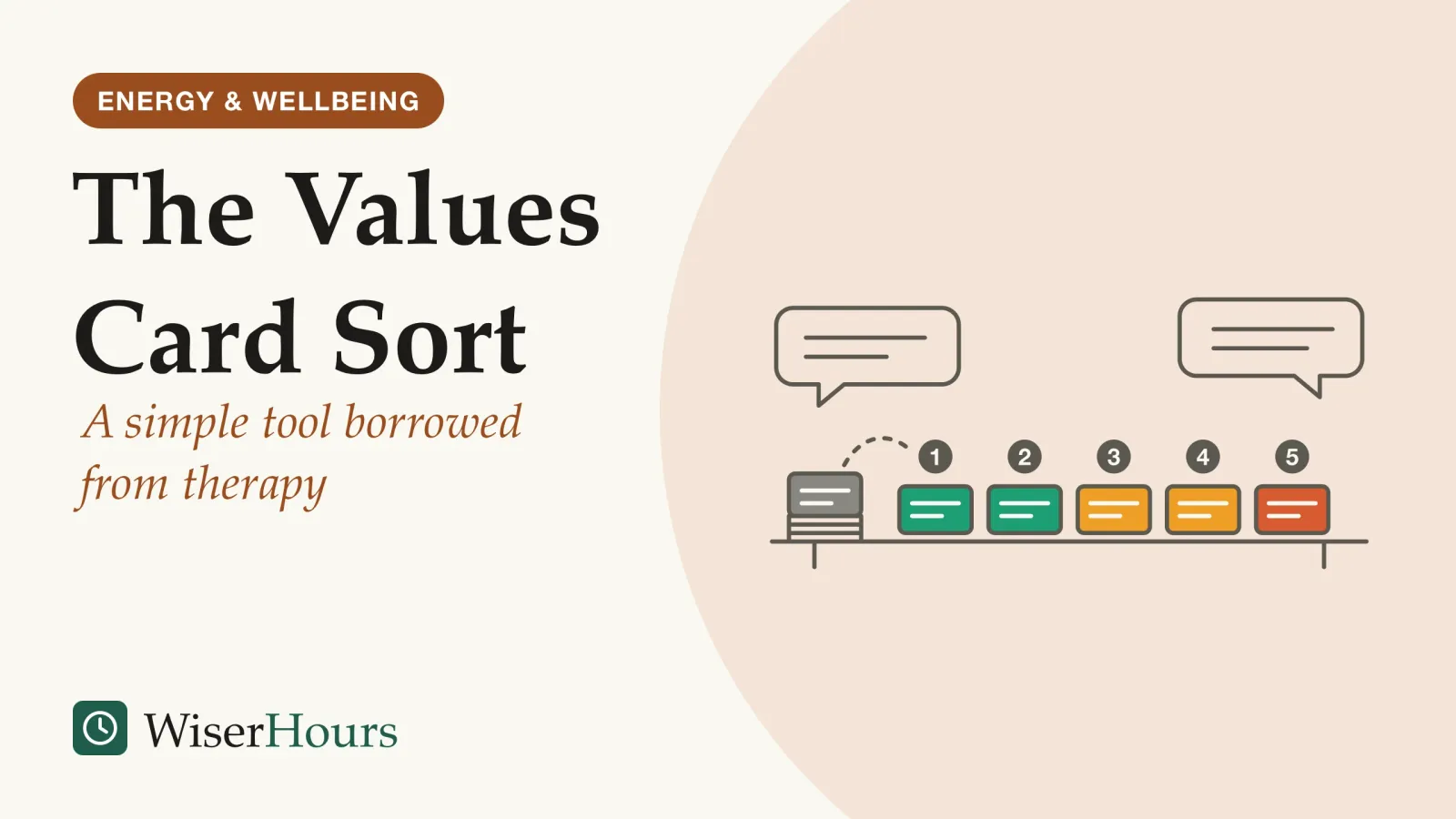
A counselor who wants to know what a client cares about can skip the questionnaire and hand over a deck of cards. In a values card sort, each card names one value with a one-line definition, and you sort the deck by how much each matters to you. The best-known deck, the Personal Values Card Sort, was written in 2001 by William Miller, Janet C’de Baca, Daniel Matthews and Paula Wilbourne at the University of New Mexico, and its 83 value cards are in the public domain, free to copy and adapt.1
To do a values card sort on your own:
- Print or write the cards
- Sort them into three piles
- Cut the top pile to five
- Rank your top five
- Talk them through with someone
The sort has no right answer and no score. It gives you words for what matters to you and something to talk about, and it does not replace therapy. For the wider question of what you are aiming at in life, start with what a sense of purpose is and how psychologists study it.
What is a values card sort, and where does it come from?
A values card sort turns the vague question “what matters to me?” into a task for your hands: putting cards in piles. The University of New Mexico deck has 83 values, from ACCEPTANCE (“to be accepted as I am”) to WORLD PEACE, plus three header cards for the piles (very important to me, important to me, not important to me) and blank cards for values the deck leaves out.1
Ranking values is older than the cards. In 1973 the social psychologist Milton Rokeach published the Rokeach Value Survey, which asks people to put 18 end states, such as freedom and wisdom, and 18 ways of behaving, such as honesty and courage, in order of importance as guiding principles in their lives.2
- Myth
- A card sort reveals your true values, like a test.
- Fact
- It has no score or right answer; it gives you words to start a conversation.
Cards add one thing a list lacks: you can move them. A card that sat in the top pile for a minute slides down when a stronger card turns up, and the growing pile shows you where the trade-offs are. The authors updated the deck in 2011 to 100 cards and up to five piles, and their notes for users say the sorting can help on its own but its value often lies in the interview that follows.3 Expect your first sort, then, to be a draft you will argue with.
- 1973, a ranked list: the Rokeach Value Survey asks people to put 18 end states and 18 ways of behaving in order of importance
- 2001, a deck of cards: the University of New Mexico Personal Values Card Sort: 83 value cards, three pile headers, free to copy and adapt
- 2011, a bigger deck: the same authors update it to 100 cards and up to five piles, and say the conversation afterward is often where the value lies
- In therapy: card sorts are used in motivational interviewing and, in other decks, in acceptance and commitment therapy
What is the values card sort used for in therapy?
In therapy, a values card sort helps a counselor learn what a client cares about and helps the client hear it said aloud. William Miller, the deck’s lead author, developed motivational interviewing (MI) with Stephen Rollnick, a counseling style that helps people explore and resolve mixed feelings about changing a behavior.4
The deck’s 2011 notes describe the MI way of using it. After the sort, the counselor asks open questions about the top values, such as what a value means to the person and how they have shown it in daily life, and listens reflectively to the answers.3 The tension that surfaces can be between a value and a habit. A man who ranks HEALTH and FAMILY near the top and still smokes has heard nothing new, but he has now stated his own reasons for change, and a counselor can build on them.
Acceptance and commitment therapy (ACT) puts values at its center for a different reason. It aims to build psychological flexibility, which one 2019 study describes as engaging with personal values even when difficult thoughts and feelings are present, so clarifying values counts as a core skill, and that 2019 study tested a new values card sort built for the purpose.5
A therapist brings two things the cards cannot: someone listening for what you mean, and training in what to do with it. If sorting brings up grief, guilt or a problem that feels too big to handle alone, take that as a reason to talk to a counselor or your doctor.
How do you do a values card sort?
You do a values card sort by printing the cards, sorting them quickly into three piles, cutting the top pile to five, ranking those five and talking them through. The steps follow the University of New Mexico deck and its 2011 notes; the cut to exactly five and the conversation with a friend are our suggestions.
1. Print or write the cards
Is there a free values card sort? Yes: the 2001 deck is a free PDF on a University of New Mexico website, and its footer says it may be copied, adapted and used without permission.1 The 2011 version is laid out for printable business-card sheets.3 Print on thick paper and cut along the lines, or copy the values you want onto index cards or sticky notes.
2. Sort them into three piles
Lay the three header cards in a row, shuffle the deck and place each card under a header on your first reaction. Speed helps here, because a fast sort catches what you feel before you start editing for how it looks. Write any missing value on a blank card and sort it with the rest.
Expect the “very important” pile to be the biggest. Most of the cards name things that sound good, so a crowded top pile tells you little until you cut it.
3. Cut the top pile to five
The 2011 notes ask people to pick the 5 to 10 values that matter most.3 Five is harder and more useful, because five values fit in your head when a decision is in front of you. Start by stacking cards that mean the same thing to you and keeping the word you would use yourself. Then go through what is left and move a card down to “important” whenever you can say how your life would carry on well enough without it. Nothing gets thrown away.
Nine cards down to five, one example
A top pile might hold FAMILY, HEALTH, FITNESS, INDEPENDENCE, KNOWLEDGE, ADVENTURE, EXCITEMENT, HONESTY and FUN. HEALTH (“to be physically well and healthy”) and FITNESS (“to be physically fit and strong”) stack into one card, and so do ADVENTURE and EXCITEMENT. That leaves seven. FUN goes down if a dull month would still feel like your life, and KNOWLEDGE goes down if you can picture a good year without a course or a book in it. Five remain.
4. Rank your top five
Put the five in order, from 1 for the value most central to you down to 5, as the 2011 instructions describe; each card carries a serial number so the order is easy to record.3 Photograph the row or write the five names and the date in a notebook. A ranking you can find again in six months is the one you can check against how you spent them.
5. Talk them through with someone
Pick a listener who will ask questions and keep their opinions to themselves. Give them the questions from the 2011 notes: what each value means to you, why you chose it, and how it shows up in your days.3 One of them asks you to look ahead.
In what ways could you be even more true to this value?
The listener’s job is to say back what they heard, so you hear it too. Saying “achievement” aloud and then explaining it as “people knowing I can be counted on” may show you that DEPENDABILITY was the card you meant.
Your values card sort
For the next stage, turning a ranked list into choices and goals, follow our step-by-step exercise for identifying your core values.
Further reading
Motivational Interviewing: Helping People Change and Grow
By the two founders of motivational interviewing, the counseling style behind the values card sort, on how talking through values helps people change.

As an Amazon Associate WiserHours earns from qualifying purchases.
How can couples, teams and teenagers use a card sort?
Couples, teams and teenagers can all use the same deck, with changes to who sees the results and which cards are in it. We found no study testing these versions, so treat what follows as our suggestions.
Couples
Couples can sort separately, then lay their top fives side by side. Talk about the overlap first, since shared values are the easy part, then pick one difference and ask about it with the questions from step 5. Two people who both rank FAMILY may mean Sunday lunch with parents and a quiet evening alone together; the card sort gives you the moment to find out.
Teams
Team members can sort privately and share only what each person chooses to. A team can also write its own short deck about how it works, borrowing cards such as ACCURACY, COOPERATION and CREATIVITY from the original, and sort that together.1 Keep the results out of appraisals and hiring: a sort done under that pressure is likely to show what people think the manager wants.
Teenagers
For teenagers, use fewer cards in plain words. Pick 30 or 40 cards that fit their age; some, such as SEXUALITY (“to have an active and satisfying sex life”), will not suit a classroom, and the public-domain terms let you remove them.1 The adult’s role is the listener in step 5, and the teenager decides whether the results leave the room.
Do values cards work across cultures?
The ideas on the cards travel well, but the words may not. Shalom Schwartz’s 2012 overview of his theory of basic values identifies ten values recognized across cultures, arranged in a circular structure that appears culturally universal, based on findings from 82 countries.6
The same overview finds substantial differences in the value priorities of individuals, while the average priorities of most societal groups follow a similar order.6 Your ranking can differ from your neighbor’s and still use the same vocabulary. The vocabulary of this deck, though, was written in American English at a US university. Its GOD’S WILL card reads “to seek and obey the will of God”, which fits some faiths and leaves out others; FAMILY is defined as “to have a happy, loving family”, with no mention of duties to parents or wider relatives, which weigh heavily for many people.1
Rewrite any card you have to explain twice. Translate the deck into the language you think in, swap in local words for respect, honor or duty, and drop cards that make no sense where you live; the deck’s own terms allow it.1
Does a values card sort change anything?
The values card sort itself has barely been studied: the two randomized tests we found are unpublished university theses, and neither found a clear difference from a comparison session. Its closest well-studied cousin, values affirmation, has helped in some trials and failed in a large replication.
Values affirmation means writing about your values. Geoffrey Cohen of Stanford and David Sherman, in a 2014 Annual Review of Psychology article, describe its most studied form: people review a list of values, choose one or a few that matter most, and write a brief essay about why.7 The review reports better results in education, health and relationships in some studies, sometimes lasting months or years, and stresses that the benefit depends on conditions: there must be a threat holding a person back and resources for improvement once it lifts.7
Replicationreplication: Running a study again with fresh data and the same method, to see whether the original result comes back. A finding that fails to replicate is not automatically wrong, but it stops being something you can lean on.Full entry in the glossary has been uneven. When a US team repeated a successful classroom study with more than 1,200 seventh graders in one Midwestern school district, using the same procedures, it found no evidence that the essays helped, and the estimates were precise enough to rule out all but very small benefits.8 The authors call the method potentially fragile in schools when used widely.
In a 2012 doctoral study at the New Mexico veterans’ health system in the US, one session of a values card sort before a stop-smoking group did no better than one education session on cigarettes smoked; smoking fell in both groups.9
The study
Limited evidence
A card-sort session compared with a control sort, 2019
Students were randomly assigned to a values card sort, the same sort plus a rubber band given to them as a reminder of their values, or a control card sort. A week later, the groups showed no significant difference in connection with their values, negative feelings or quality of life. The author suggests the card sort may suit people with clinical problems better than students without them, which this study did not test.5
One session and one week is a short test, and in our reading students with no pressing reason to change make a hard audience. Still, nothing here suggests that sorting cards alone shifts how you feel or act.
| What it is | What the best evidence found | Evidence |
|---|---|---|
| Card-sort session with a control comparison | No difference after one week in students | One small trial, unpublished, limited5 |
| Card-sort session before a stop-smoking group | No difference from an education session; smoking fell in both | One trial, unpublished dissertation, limited9 |
| Writing about your values (affirmation) | Benefits in some education, health and relationship studies | Narrative review, mixed7 |
| Large repeat of a classroom affirmation study | No evidence of an effect | One large trial, moderate8 |
| Ten values recognized across cultures | Similar structure in findings from 82 countries | Cross-cultural surveys, strong6 |
Someone who sorts the deck on a Sunday and puts HEALTH first has not started exercising by Monday. The sort has done its job if it gets them talking about why HEALTH came first and what stands in the way; changing the habit needs a plan of its own.
The bottom line
The cards give you words for what you value, and the talk afterward is where those words get tested. Print the University of New Mexico deck this week, sort it on first reaction, cut the top pile to five, and ask someone to spend half an hour asking you what each of those five means.
This article is general information, not medical advice. If you're worried about your health, talk to a doctor or another qualified professional.
Frequently asked questions
How long does a values card sort take?
Most people can sort and rank the cards in one sitting of under an hour, and the conversation afterward can take as long again. That is our estimate, not a tested figure: the University of New Mexico notes give no time limit. Sort quickly on a first pass, and leave the ranking for a second look a day or two later if the top five feel uncertain.
Should a values card sort use three piles or five?
Either works. The 2001 University of New Mexico deck comes with three header cards, from very important to me down to not important to me, and the authors' 2011 update says the usual procedure uses three to five piles, with five headers from not important to most important. Three piles are quicker; in our view, five help when the top pile keeps growing past ten cards.
Can you do a values card sort online?
Yes. Several free online versions exist, and a list of values typed into a spreadsheet can be reordered row by row. In our view, printed cards are easier to move around and compare than a list on a screen, so print the deck if you can.
Sources
- Personal Values Card Sort. Miller, W. R., C'de Baca, J., Matthews, D. B. & Wilbourne, P. L. (2001). University of New Mexico (public domain)
- Rokeach Value Survey. Wikipedia (accessed 2026-11-07), citing Rokeach, M. (1973). The Nature of Human Values. Free Press
- Personal Values Card Sort (2011 update). Miller, W. R., C'de Baca, J., Matthews, D. B. & Wilbourne, P. L. (2011). University of New Mexico (public domain); copy hosted by TrueSport
- Motivational interviewing. Wikipedia (accessed 2026-11-07)
- A Preliminary Investigation of a Values Intervention and a Values Reminder on Clinically Relevant Outcomes. Clark, B. (2019). Master's thesis, Southern Illinois University Carbondale
- An Overview of the Schwartz Theory of Basic Values. Schwartz, S. H. (2012). Online Readings in Psychology and Culture, 2(1)
- The Psychology of Change: Self-Affirmation and Social Psychological Intervention. Cohen, G. L. & Sherman, D. K. (2014). Annual Review of Psychology, 65
- New Evidence on Self-Affirmation Effects and Theorized Sources of Heterogeneity from Large-Scale Replications. Hanselman, P., Rozek, C. S., Grigg, J. & Borman, G. D. (2017). Journal of Educational Psychology, 109(3)
- Values-Based Motivational Interviewing: Effectiveness for Smoking Cessation Among New Mexico Veterans. Sanders, L. (2012). Doctoral dissertation, University of New Mexico
How we researched this
In November 2026 we read the University of New Mexico card sort and its 2011 update, searched Google Scholar, PubMed and university repositories for tests of values card sorts and values affirmation, and used Wikipedia for background on Rokeach and motivational interviewing. Sources date from 2001 to 2019; three were read as abstracts only. Main limitation: the card sort itself has been tested only in two unpublished studies.
Keep reading

How to Identify Your Core Values: A Step-by-Step Exercise
Identify your core values in 6 steps: mine your hard choices, name and rank your values, write your reasons, and turn each value into a goal.
How to Find Your Purpose: A Practical, Low-Pressure Guide
How to find your purpose in 5 low-pressure steps: notice what absorbs you, check your values, run small experiments, contribute and review over months.

Character Strengths: Using the VIA Survey to Do More of What Fits You
The free VIA character strengths survey ranks 24 strengths in 10-15 minutes. How to read your results, what trials found, and how it differs from Gallup's.
The Midlife Crisis: Myth, Reality, and the Happiness U-Curve
About 1 in 4 US adults in one study said they had had a midlife crisis. What the happiness U-curve shows, and why studies of the same people disagree.