The Mental Load Explained: The Invisible Work of Running a Household
The mental load is the planning behind housework. Research splits it into 4 stages; women tend to do more of 2, and time-use surveys barely see it.

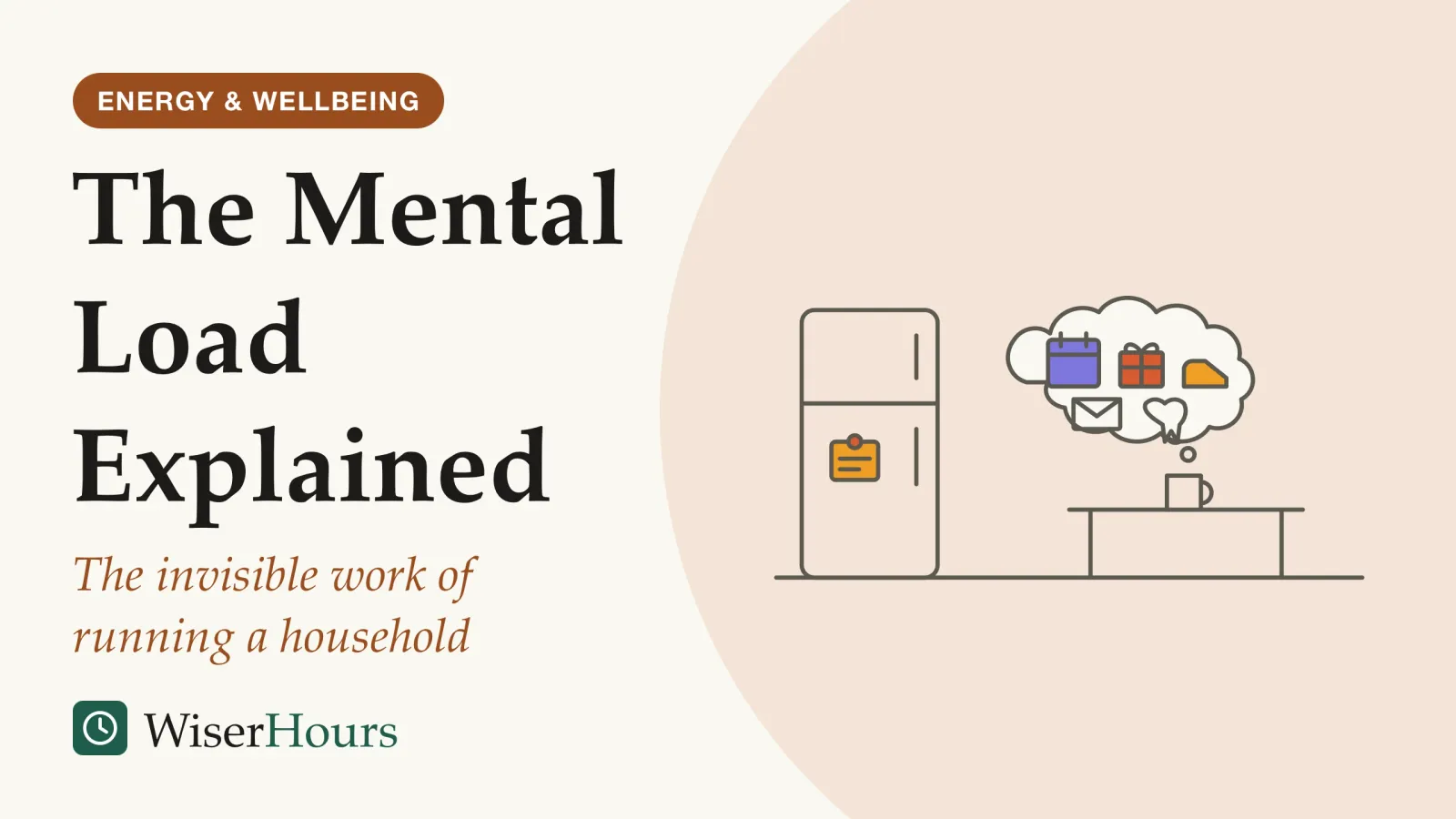
A couple can split the chores down the middle and still leave one person doing most of the thinking. That thinking is the mental load: noticing that something will be needed, working out the options, deciding, and checking that it happened, along with the worry that comes with it. In a 2019 interview study of American couples, Allison Daminger split this thinking work into four stages and found that women did more of two of them, anticipating needs and monitoring progress, while decisions were shared about equally.1
That split explains a familiar complaint better than any tally of chores: one partner does half the tasks on the list, and the other one still holds the list. The mental load is one strand of the wider question of work-life balance.
The mental load defined: planning with worry attached
In a 2022 paper in Community, Work & Family, Liz Dean, Brendan Churchill and Leah Ruppanner describe the mental load as cognitive labor combined with emotional labor, and argue that it is the combination that turns mental work into a load. They give it three features: it is invisible, happening internally while producing a range of unpaid physical work; it has no boundaries, coming along to work, into leisure and even into sleep; and it never ends, because it is tied to caring for loved ones, which is constant.2
Definition
A 2023 systematic reviewsystematic review: A review that fixes its question and its rules for including studies in advance, then searches out every study that fits and weighs them together. Some systematic reviews pool the results into a meta-analysis; others describe what the studies found without combining the numbers.Full entry in the glossary of 31 articles, by Natalia Reich-Stiebert and colleagues in Germany, lands close by. It calls the work mental labor: managerial thinking done for the family rather than for oneself, aimed at something in the future and unseen as part of housework. The main responsibility for it often lies with one person, the authors add, though it can be shared.3
As an illustration, take a child’s birthday party. The visible work is an afternoon of cake and wrapping paper. The mental load started weeks earlier: remembering the date, choosing whom to invite, and wondering whether the quiet child in class will feel left out.
The lesson for any household talking about fairness: count the remembering and the worrying as work, not personality.
Four stages behind every household task
Allison Daminger’s 2019 study in the American Sociological Review breaks household thinking work into four stages: anticipating a need, identifying options for meeting it, deciding among them, and monitoring whether it worked. She calls this cognitive labor and argues it is a separate dimension of housework, not one more physical chore.1
The study
Limited evidence
The interviews that named the four stages
Women did more cognitive labor overall, and more of the anticipating and monitoring in particular. Men and women took part in decisions, the stage arguably most closely tied to power and influence, roughly equally. Because the work is taxing and often invisible both to the person doing it and to their partner, it was a frequent source of conflict.1
It explains why a couple can decide things together and still disagree about who does more. Deciding is the visible, shared moment; the noticing comes before and the follow-up after. The caveat is the sample: a small group of well-educated American parents, interviewed rather than measured, so the study names the stages but cannot say how common the pattern is.3
Consider a child’s winter coat, as an illustration. Anticipating is noticing in October that last year’s coat is short in the sleeves. Identifying is finding a few that fit the budget. Deciding is choosing one. Monitoring is checking that it arrived, fits and comes home from school. The shop trip is the only part anyone sees.
- Anticipate: notice that something will be needed; in Daminger’s interviews, women did more of this
- Identify options: find the possible ways to meet the need
- Decide: choose among the options; shared roughly equally in the study, and often followed by the one visible step, the task itself
- Monitor: check that it happened and worked; women did more of this too, and the need then comes round again
So “just ask me and I’ll do it” means the asker has already done stage one.
Making the mental load visible: map one routine
The simplest way to make the mental load visible is to write it down, one routine at a time, stage by stage. The 2023 review found that no complete scale for mental labor exists yet, and its authors suggest one would help couples grasp and assess the work, and raise awareness of it among the people who do most of it.3
Here is a school trip broken into the four stages, with the question each raises.
| Stage | What it looks like for a school trip | Question to ask |
|---|---|---|
| Anticipate | Knowing the trip is coming and that it needs a form and a packed lunch | Who first knew it was happening?1 |
| Identify options | Finding out what the lunch can include and how to pay | Who found out what the choices were?1 |
| Decide | Choosing the lunch and signing the form | Who made the call, and was it shared?1 |
| Monitor | Checking the form went back and the lunch went in the bag | Who checked it all happened?1 |
Map one routine this week
Pick one job that repeats, such as packed lunches, birthdays or school forms. Each partner writes down, alone, who did each of the four stages the last time it came round. Then compare the two lists and look for stages one of you did not know existed. The exercise borrows Daminger’s stages; nobody has tested it as an intervention.
To do it on one phone or laptop, use the mapper below: each of you answers alone, then the two lists appear side by side.
Four-stage routine mapper
Each of you marks who did each stage the last time the routine came round. The first person’s answers are hidden before the second person starts, then both lists appear side by side.
First person: who did each stage last time?
Answer alone. “Me” means you; “My partner” means the other person.
Your two lists side by side
No answers yet.
Anticipate Who first knew it was happening?
- First person said
- —
- Second person said
- —
—
Identify options Who found out what the choices were?
- First person said
- —
- Second person said
- —
—
Decide Who made the call, and was it shared?
- First person said
- —
- Second person said
- —
—
Monitor Who checked it all happened?
- First person said
- —
- Second person said
- —
—
No score and no verdict: it only shows where your answers differ, as a place to start talking. The exercise borrows Daminger’s stages; nobody has tested it as an intervention. Nothing is saved or sent, and Clear everything wipes it from the page.
Writing the lists separately matters because partners often see the split differently. A stage that always lands on one person is where to start talking.
Why housework statistics miss most of it
Time-use surveys, the main official source on housework, record what people do hour by hour, not what they keep in mind. The US Bureau of Labor Statistics’ American Time Use Survey records only the main activity at each moment, apart from looking after children under 13. The survey does count household management, such as filling out paperwork or planning a party, but only when it is the main thing someone is doing.4 Planning rarely works that way: it happens on the commute or in the shower, on top of another activity, so the diary records the commute and loses the plan.
What the surveys can see still shows a gap, each country measured by its own survey.
| Country and survey | What was measured | Women | Men |
|---|---|---|---|
| US, American Time Use Survey 2025 | Did any household activities on an average day | 87% | 75%5 |
| US, American Time Use Survey 2025 | Hours of household activities, on days they did any | 2.8 hours | 2.1 hours5 |
| UK, ONS time-use study, autumn 2023 | Unpaid work per day, including housework, care and volunteering | 3 h 37 min | 2 h 43 min6 |
The UK statistics office notes that the gap in unpaid work has narrowed since 2020.6 Those gaps cover the doing. The 2023 review found three studies that recorded time spent on the thinking: they put mental labor at about two to three hours a week, with women spending more of it in the two that compared the sexes. That sounds modest in hours, but the review also notes that such work spills into paid work and leisure time.3 A diary that records only the main activity is likely to miss time spent that way.
The practical reading: treat housework statistics as a floor, and an even split of chores as no proof of an even split of thinking.
Who carries it, and why partners see it differently
Across the studies in the 2023 systematic review, most found that women carry the larger share of household thinking work, especially decisions about children. Most samples were middle-class men and women in couples in the US and Europe, so the pattern is best established there.3
A 2024 study by Elizabeth Aviv and colleagues put figures on one piece of it. More than 300 mothers of toddlers, taking part in a national study run from the University of Southern California, rated who was responsible for planning, and who for doing, 30 common household tasks. On average, the mothers said they were responsible for about 73 percent of the planning but about 64 percent of the physical work: the thinking was more lopsided than the chores. These were the mothers’ own reports from a well-off, mostly white sample, with no partner’s view, and the task list came from the Fair Play card deck created by one of the co-authors.7
Partners often see the split differently. Two studies in the review found that men reported sharing mental labor equally, while women reported doing it themselves.3 That is what you would expect of work that, in Daminger’s words, is often invisible to both the person doing it and their partner.1
A second study by Daminger, published in 2020, suggests why the imbalance can persist even in couples who believe in equality. In interviews with college-educated couples, partners explained unequal outcomes as the incidental result of necessary compromises, made through a process they saw as gender-neutral and judged only by the present moment. That story helped them avoid conflict, but it may also keep things as they are.8
The load is also hard to pay someone else to carry. In survey data from 10 European countries collected between 2002 and 2013, about 3 percent of couples or fewer outsourced tasks such as organizing joint social activities, paying the bills or deciding on purchases, while outsourcing was more common for some physical tasks, such as vacuuming.9 A cleaner can take over the floors; nobody else notices that the school form is due.
If the answer is “weeks”, the job is yours, whoever does the physical part.
What carrying the load costs, and what it doesn’t
What the mental load costs depends on which part you carry. In a 2023 set of survey studies, Julie Holliday Wayne and colleagues found that the planning and thinking parts went with some benefits, while the worrying part went with more family-to-work conflict, sleep problems and exhaustion, and lower life and family satisfaction.10
Their final survey asked 448 employed adults, recruited online, about three parts of what the authors call invisible family load. Planning and delegating was linked to more enrichment flowing from family life into work, and remembering and anticipating to higher family satisfaction and job performance. Worry about meeting the family’s needs was linked only to worse outcomes. It was a one-off survey, so it shows associations rather than causes, and the authors call for long-term studies to test which way the effects run.10
The European data point in the same direction for the costs. Among employed people living with a different-sex partner in those 10 countries, a woman who did all of the thinking-heavy household tasks had a predicted 15 percent chance of arriving at work too tired to function well, several times a month or more, because of household work. If she shared those tasks equally, the figure was 9 percent. Men’s figure stayed at 6 to 7 percent whatever their share.9 Put plainly, the model predicts about 6 more women in every 100 arriving at work worn out that often when they do all of the thinking rather than half. Modest for any one person, the numbers still suggest the load follows women into their jobs in a way it does not for men.
The 2024 study of mothers of toddlers found a similar pattern for mental health. Mothers who said they did a larger share of the planning also reported more depressive symptoms, stress and burnout, while their share of the physical chores showed no clear link to those measures. It was a one-off survey of the mothers’ own reports, so it cannot show which came first.7
Focus research describes something similar at work: unfinished tasks leave attention residue that lowers performance on the next one. Applying it to household planning is our comparison, not something these studies tested.
The practical lesson, again our reading rather than a tested method: sharing the load means handing over whole jobs, including the worrying, not single tasks. A partner who takes over the dentist entirely, from noticing a check-up is due to confirming the next appointment, removes more load than one who makes the call when reminded.
When the strain needs more than a fairer split
Exhaustion, low mood or stress that will not lift deserves a professional’s view. The routes come from the US National Institute of Mental Health (NIMH) and the UK’s NHS; the tiers are our grouping.
- Now: for thoughts of suicide or self-harm in the US, call or text 988, the Suicide and Crisis Lifeline; in a life-threatening situation, call 911 or go to the nearest emergency room.11 In the UK, call 999 or go to A&E if a life is at risk or you do not feel you can keep yourself safe; Samaritans listens free on 116 123.12 Elsewhere, call your local emergency number.
- Soon, within days or weeks: the NHS suggests a GP when you are struggling to cope with stress or what you are trying yourself is not helping; in England, NHS 111 handles urgent help that is not an emergency.13 Elsewhere, see a family doctor.
- Routine: NIMH suggests raising mental health concerns with a primary care provider, for example at a regular check-up.11
The bottom line
Every household job has a thinking half, and it is the half nobody watches: noticing, researching, deciding and following up, with the worry that goes with it. The research is young and mostly drawn from well-off couples in the US and Europe, but it points one way: women tend to carry more of the noticing and checking, and housework statistics barely register it. The most useful move is to count the thinking alongside the doing, and to hand over whole jobs rather than single tasks.
This article is general information, not medical advice. If you're worried about your health, talk to a doctor or another qualified professional.
Frequently asked questions
Is mental load a scientific term?
Partly. A 2023 systematic review in Sex Roles found the work described under several names, including mental labor, cognitive labor and invisible labor. Some writers use mental load; the review's authors prefer mental labor for the work itself and treat the strain it puts on working memory, which they call cognitive load, as a consequence of that work.
Is the mental load the same as emotional labor?
Not quite. Liz Dean and colleagues argued in 2022 that the mental load combines cognitive labor with emotional labor, and that the combination is what makes it a load. The 2023 systematic review in Sex Roles instead keeps emotion work separate from mental labor, so studies do not always measure the same thing.
Do men carry a mental load too?
Yes. In the 2023 survey study by Julie Holliday Wayne and colleagues, men reported all three parts of what the authors call invisible family load, managerial, cognitive and emotional, though at lower levels than women. In a 2024 study of mothers of toddlers, partners were mainly responsible for the planning of one task out of 30: taking out the garbage.
What about same-sex couples and single parents?
The evidence is thin. The 2023 systematic review found that most studies sampled middle-class men and women in couples in the US and Europe, and a 2024 European analysis left out same-sex couples because there were too few in its data. A single parent carries every stage alone by definition, which none of the studies reviewed here measured directly.
Sources
- The Cognitive Dimension of Household Labor. Daminger, A. (2019). American Sociological Review, 84(4), 609-633
- The mental load: building a deeper theoretical understanding of how cognitive and emotional labor overload women and mothers. Dean, L., Churchill, B. & Ruppanner, L. (2022). Community, Work & Family, 25(1), 13-29
- Gendered Mental Labor: A Systematic Literature Review on the Cognitive Dimension of Unpaid Work Within the Household and Childcare. Reich-Stiebert, N., Froehlich, L. & Voltmer, J.-B. (2023). Sex Roles, 88(11-12), 475-494
- American Time Use Survey: Technical Note. US Bureau of Labor Statistics (2026), accompanying the 2025 results
- American Time Use Survey: 2025 Results. US Bureau of Labor Statistics, news release of 25 June 2026
- Time use in the UK: 23 September to 1 October 2023. Office for National Statistics (UK), statistical bulletin, 9 November 2023
- Cognitive household labor: gender disparities and consequences for maternal mental health and wellbeing. Aviv, E., Waizman, Y., Kim, E., Liu, J., Rodsky, E. & Saxbe, D. (2025). Archives of Women's Mental Health, 28(1), 5-14 (online 2024)
- De-gendered Processes, Gendered Outcomes: How Egalitarian Couples Make Sense of Non-egalitarian Household Practices. Daminger, A. (2020). American Sociological Review, 85(5), 806-829
- The gendered division of cognitive household labor, mental load, and family–work conflict in European countries. Haupt, A. & Gelbgiser, D. (2024). European Societies, 26(3), 828-854
- Who's Remembering to Buy the Eggs? The Meaning, Measurement, and Implications of Invisible Family Load. Wayne, J. H., Mills, M. J., Wang, Y.-R., Matthews, R. A. & Whitman, M. V. (2023). Journal of Business and Psychology, 38(6), 1159-1184
- Help for Mental Illnesses. National Institute of Mental Health, US National Institutes of Health (last reviewed April 2026)
- Where to get urgent help for mental health. NHS (UK), page last reviewed 26 April 2023
- Stress. NHS (UK), page last reviewed 6 March 2026
How we researched this
Sources come from Crossref, Europe PMC and PubMed searches run in September 2026 on the mental load and cognitive household labor (definitions, reviews, quantitative studies), plus official US and UK time-use statistics and NIMH and NHS help pages; they date from 2019 to 2026. The 2023 systematic review, three studies and the official pages were read in full; for Daminger's two papers and the 2022 theory paper by Dean and colleagues, only the abstracts were available. Main limitation: most studies are small or one-off surveys of well-off couples.
Keep reading
How to Stop Thinking About Work in the Evening
How to stop thinking about work: why stewing, more than problem-solving, is linked to fatigue, five evening habits, and what a 2021 review of 30 studies found.
Workaholism Explained: How It Differs From Working Hard
Workaholism is working excessively and compulsively, not just long hours. How the 7-item Bergen scale measures it and how it differs from engagement.
Long Working Hours and Health: What Large Studies Found
Working 55+ hours a week is linked to more stroke and heart disease in WHO/ILO reviews. What the estimates mean, what critics dispute, and what helps.
What Is Work-Life Balance? A Definition That Survives Real Life
What is work-life balance? A 2018 review found 233 definitions. The one that holds up is fit with what you value, not an equal split of hours.