What Is Work-Life Balance? A Definition That Survives Real Life
What is work-life balance? A 2018 review found 233 definitions. The one that holds up is fit with what you value, not an equal split of hours.

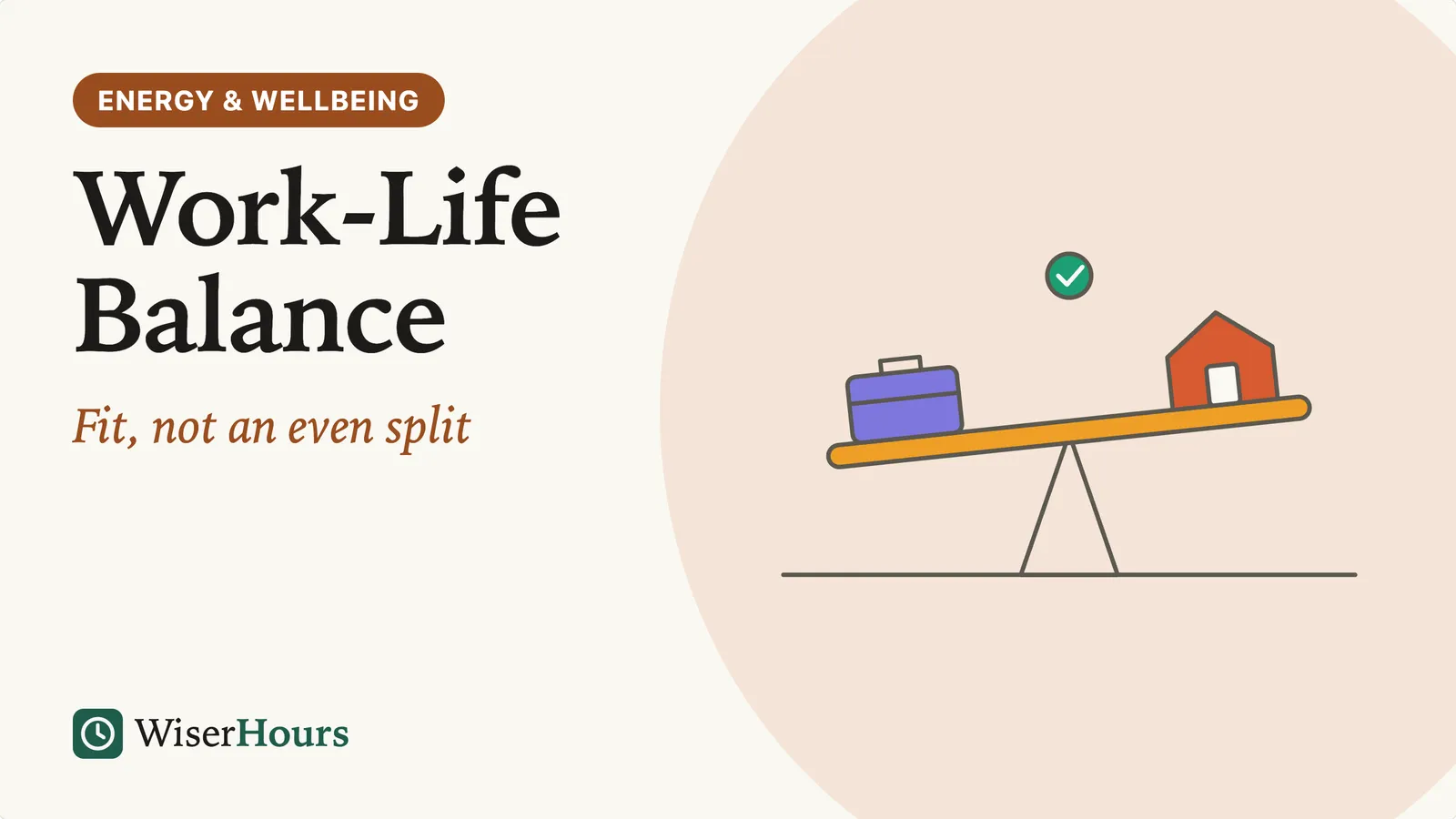
Researchers have defined work-life balance in so many ways that the definitions became a research topic of their own. In a 2018 review of 290 research papers, Wendy Casper and four colleagues counted 233 definitions of balance and proposed one built on a personal judgment of fit.1 By that standard, work-life balance is how well your job and the rest of your life fit together, judged against what matters to you, not an equal split of hours.
The definition you carry around decides what you try to fix. If balance means equal hours, every heavy month at work counts as failure. If it means fit, the question is sharper: does each part of your life get the attention its importance to you deserves right now?
Work-life balance defined: fit with your priorities, not equal hours
Work-life balance, in the definition Casper and her co-authors proposed in the Journal of Applied Psychology in 2018, is a person’s own evaluation of how well their work and nonwork roles combine: whether their feelings, involvement and effectiveness in each role match the value they place on it.1
Definition
Work-life balance is your own judgment of how well work and the rest of life combine: whether the feelings, attention and effectiveness you bring to each role match how much that role matters to you.1
The word “balance” suggests a scale with equal weights, and early research took that literally. In 2003 Jeffrey Greenhaus and colleagues defined balance as being equally engaged in, and equally satisfied with, work and family. When they tested the idea on professionals in public accounting, the evenly split were not the best off: among those who put a lot of time into work and family combined, people who gave more time to family had a higher quality of life than the evenly balanced, who in turn did better than those tilted toward work.2 It was a study of one profession, so it shows a link rather than a cause, but it challenged the equal-split idea.
People do not value their roles equally, and what they value changes. A split that suits a new parent will not suit someone finishing a qualification, and neither will suit the same person five years later. That is why several recent definitions, including the 2018 review’s, describe fit with your own priorities.1
As an illustration, two colleagues work the same long weeks. One is chasing a promotion she wants and has agreed with her partner that the next few months will tilt toward work; she feels fine. The other promised himself he would coach his daughter’s team and keeps missing practice; he feels torn. Same hours, different balance, because the hours sit differently against what each of them values.
The main families of definition compare like this.
| Definition | Balance means | Where it falls short |
|---|---|---|
| Equality | Equal engagement in, and satisfaction with, work and family | In one study of accountants, a tilt toward family went with a better quality of life than an even split2 |
| Low conflict | Satisfaction and good functioning at work and home with a minimum of role conflict | Treats balance as low conflict, which the 2018 review counts as a separate thing31 |
| Fit with values | Effectiveness and satisfaction in each role consistent with your life priorities | Harder to measure; the 2018 review found no scale yet built for the 2011 version1 |
- Myth
- Work-life balance means splitting your time equally between work and the rest of life.
- Fact
- Leading recent research definitions do not require equality. A 2018 review proposed judging balance by fit with what you value, and in a 2003 study of accountants a tilt toward family went with a higher quality of life than an even split.
So ask whether the split matches what you value now, not how many hours each role gets.
Rank your roles, then check your week
List the three or four roles that matter most to you right now, such as your job, family, friends or health, and rank them. Then ask of each: does it get the attention and energy its rank deserves? The gap between the ranking and your real week is the imbalance worth working on. This follows the fit definition from Casper and colleagues; it is a reflection exercise, not a tested intervention.
Where work ends and home begins
Sue Campbell Clark’s work/family border theory, published in Human Relations in 2000, describes people as daily border-crossers between two domains, work and home, each with its own purposes and culture. Balance depends partly on the borders between them: where they sit and how easily one domain gets into the other.3
Clark named three kinds of border. Physical ones, such as office walls, set where work happens; temporal ones, such as set hours, set when; psychological ones are the rules people make about which thoughts, feelings and behavior belong in each place. She called the ease with which one domain enters the other permeability, and gave a familiar example: a home office has a door, but if the family is used to walking in and chatting, the border barely holds.3
Blurring is not always bad: Clark noted that an idea from one domain can spark creativity in the other. She also argued that no single arrangement is right: although blending work and home sounds like the most balanced option, happy, productive people, and people who describe their lives as less than ideal, can be found everywhere between strict separation and full blending.3
- Keeping work and home apart: roles stay clear, but each crossing is a bigger switch; people often ease it with a rite of passage, such as a walk or a change of clothes
- Blending work and home: switching is easy, but roles blur, so boundaries are harder to keep; people often manage with boundary work, such as agreed signals for when you are off
- A range, not a right answer: happy, productive people can be found at every point between the two ends
Blake Ashforth and colleagues made the trade-off explicit in a 2000 paper. They placed roles on a continuum from segmentation, where work and home are kept apart, to integration, where they blend. Segmentation keeps the roles clear but makes each crossing a bigger switch, which people often ease with rites of passage. Integration makes switching easy but blurs the roles, so creating and keeping boundaries gets harder, a challenge people often meet with boundary work.4
As an illustration, a separator never opens work email after leaving the office and pays with a jolt on Monday morning. A blender answers a message during dinner and pays when the evening never quite starts. Neither is wrong. The lesson is to know which way you lean and to budget for its cost: separators can use a routine that marks the switch, such as a walk after work, and blenders from signals that tell other people when they are off, such as a status message or a closed door.
Conflict and enrichment: traffic in both directions
Work-family conflict, as Jeffrey Greenhaus and Nicholas Beutell defined it in 1985, happens when pressures from work and family are incompatible, so that taking part in one makes the other harder. It runs in both directions: work can interfere with family life, and family life with work.5
Greenhaus and Beutell distinguished three forms of conflict, based on time, on strain and on behavior.5 As an illustration: a late meeting collides with school pickup. Exhaustion from a hard day turns into a short temper at dinner. The brisk, directive style that works in a project review lands badly at home.
The opposite traffic has a name too. Greenhaus and Gary Powell defined work-family enrichment in 2006 as the extent to which experience in one role improves quality of life in the other.6 Planning skills from work can run a household, and patience learned with a toddler can calm a tense meeting. The Casper review treats conflict and enrichment as related to balance but separate from it, so low conflict and a balanced life are not the same thing.1
A 2011 meta-analysis by Fabienne Amstad and colleagues found that both directions went with worse outcomes at work, at home and in general wellbeing, but each was tied most strongly to the domain it came from: work intruding on home was linked more to job outcomes, and home intruding on work more to family outcomes. Most of the studies were one-off surveys, so this shows associations, not causes.7
One practical reading, our suggestion rather than a tested one, is to ask which way the traffic runs, then look for the fix where the intrusion starts. As an illustration, if late messages keep eating your evenings, a calmer bedtime routine eases the evening but leaves the source untouched; the lever more likely sits at work, in meeting times, deadlines or what your manager expects after hours. If a family commitment keeps derailing your mornings, the change more likely belongs at home.
Is conflict between work and home bad for mental health?
Work-family conflict is linked to poorer mental health later on, according to a 2026 PLOS Medicine review of 52 long-term studies with more than 112,000 people. Work intruding on home went with more depressive symptoms, burnout and general distress at follow-up, even after allowing for people’s mental health at the start; home intruding on work went with more depressive symptoms and burnout.8
The links were small: across a workforce they add up, but in one person they are easy to miss or to blame on something else. All the studies were observational, so the authors say a causal relationship cannot be fully established; they note that earlier evidence left open whether conflict harms mental health or the reverse.8 Picture the reverse: someone already feeling low may find the same late meeting harder to absorb, and report more conflict.
What to watch for is persistence. A tense week that ends when the project ends is ordinary; strain from juggling roles that keeps coming back is worth taking seriously, and the last section sets out when to get help. When the pressure comes mostly from the job, the topic overlaps with what burnout is and how the WHO defines it. If the pressure shows up in your body or sleep, it helps to understand how the stress response works.
What helps: control, flexibility and a supportive boss
One of the strongest tests is a randomized trial. In STAR, a program in the information technology division of a large US company, employees were given more say over when and where they worked and supervisors were trained to support staff’s personal lives. Over six months, work-family conflict fell modestly compared with groups that carried on as usual.9
The study
Moderate evidence
More say, more support: the STAR workplace trial (Kelly and colleagues, 2014)
Researchers in the Work, Family and Health Network, funded by the US National Institutes of Health and the CDC, randomly assigned groups of employees to STAR or to usual practice. STAR employees reported more control over their schedules, more supportive supervisors and more often having enough time for family. Family-to-work conflict fell significantly; the fall in work-to-family conflict was only marginally significant. Work hours and job demands did not rise.9
The authors call the effects on conflict modest, smaller than the gains in schedule control and supervisor support that the program targeted directly. It was also one company, so the size of the benefit elsewhere is unknown.9
Having flexibility on paper appears to matter less than feeling in control of your time. A 2013 meta-analysis by Tammy Allen and colleagues found only small links between flexible work arrangements and work-family conflict, varying with the kind of flexibility.10 In a 2006 study of US professionals, Ellen Kossek and colleagues found that feeling in control of when, where and how you work was linked to less family-to-work conflict and fewer self-reported depressive symptoms, and mattered more than whether people used a telework policy.11 A 2010 Cochrane review, which called its own evidence limited, pointed the same way for health: flexibility that gave workers more control tended to go with better health, while arrangements imposed by the employer had unclear or negative effects.12
Our own reading, which none of these studies tested: if conflict is two sets of pressures that cannot both be met, a say over timing lets you move one out of the other’s way. As an illustration, a home-working day does little for a parent if the late meeting still lands on it. The common thread is control, not a particular policy, and the ideas in this guide combine into a short review of your own week.
A work-life fit review
Many people cannot choose their hours: shift workers, caregivers and people in jobs with fixed coverage have less room. For the location question, see how remote and hybrid work are defined.
If you manage people, or need to ask
Managers can take two ideas from STAR: ask your team what control over timing they need, and treat questions about family or personal life as legitimate, not as a lack of commitment. As an employee, a request framed around predictability (“I need to finish by 5:30 on Tuesdays and Thursdays”) may be easier to agree than open-ended flexibility. These are suggestions, not promises; the trial did not test how requests are worded.
When strain needs more than better boundaries
If you have thoughts of suicide or self-harm, get help now, whatever the cause. If you are struggling to cope with the stress of juggling work and home, or what you are trying on your own is not helping, book a doctor’s appointment within days or weeks. The routes come from the US National Institute of Mental Health (NIMH) and the UK’s NHS; the three tiers are our grouping.
- Now: in the US, the 988 Suicide and Crisis Lifeline takes calls and texts at any hour, free and in confidence, and NIMH advises calling 911 or going to the nearest emergency room in life-threatening situations.1314 In the UK, the NHS points to 999 or A&E when someone’s life is at risk or you do not feel able to keep yourself or someone else safe, and Samaritans listens for free on 116 123.15 In any other country, call your local emergency number.
- Soon, within days or weeks: the NHS suggests seeing a GP when you are struggling to cope with stress or your own efforts are not helping. In England, NHS 111 or an urgent GP appointment covers help that is urgent but not an emergency, and adults can refer themselves to NHS talking therapies.16 Outside the UK, a family doctor plays the GP’s part.
- Routine: NIMH’s stress fact sheet says that when you are struggling to cope, or stress or anxiety symptoms will not go away, it may be time to talk to a professional; strain that keeps coming back is worth raising at your next check-up.17 If tiredness is part of it, common reasons for always feeling tired is useful reading beforehand.
The bottom line
The useful question about work-life balance is whether each part of your life gets the attention it deserves given what you value now, not whether the hours come out even.1 Borders between work and home can be firm or loose, and each choice has a cost worth planning for. The best-tested help is more control over when and where you work, backed by a supportive manager, and in one trial its effects were real but modest.9
This article is general information, not medical advice. If you're worried about your health, talk to a doctor or another qualified professional.
Frequently asked questions
How do researchers measure work-life balance?
Mostly with questionnaires that people fill in about themselves. Casper and colleagues' 2018 review of 290 papers found that 94 percent of the ways studies measured balance relied on a single source of data, and nearly a fifth used a single question. Some studies labelled scales of work-family conflict as balance, which the authors warn makes the research harder to build on.
Does working from home improve work-life balance?
Not reliably on its own. A 2013 meta-analysis by Tammy Allen and colleagues found that links between flexible work arrangements and work-family conflict were small and depended on the type of flexibility. In a 2006 survey of 245 US professionals, blending home and work was linked to more family-to-work conflict, while feeling in control of when and where you work was linked to less.
Does work-life balance matter if you have no children?
Yes. The definition proposed in a 2018 review in the Journal of Applied Psychology covers all nonwork roles, including friend, community member and the self, not only family. The authors note that about a third of the earlier definitions they reviewed looked only at work and family.
Sources
- The jingle-jangle of work–nonwork balance: A comprehensive and meta-analytic review of its meaning and measurement. Casper, W. J., Vaziri, H., Wayne, J. H., DeHauw, S. & Greenhaus, J. H. (2018). Journal of Applied Psychology, 103(2)
- The relation between work–family balance and quality of life. Greenhaus, J. H., Collins, K. M. & Shaw, J. D. (2003). Journal of Vocational Behavior, 63(3)
- Work/Family Border Theory: A New Theory of Work/Family Balance. Clark, S. C. (2000). Human Relations, 53(6)
- All in a Day's Work: Boundaries and Micro Role Transitions. Ashforth, B. E., Kreiner, G. E. & Fugate, M. (2000). Academy of Management Review, 25(3)
- Sources of Conflict between Work and Family Roles. Greenhaus, J. H. & Beutell, N. J. (1985). Academy of Management Review, 10(1)
- When Work and Family Are Allies: A Theory of Work-Family Enrichment. Greenhaus, J. H. & Powell, G. N. (2006). Academy of Management Review, 31(1)
- A meta-analysis of work–family conflict and various outcomes with a special emphasis on cross-domain versus matching-domain relations. Amstad, F. T., Meier, L. L., Fasel, U., Elfering, A. & Semmer, N. K. (2011). Journal of Occupational Health Psychology, 16(2)
- Work-family conflict and mental health: A systematic review and meta-analysis. Liu, D., Ni, Y., Ma, T. S. W., et al. (2026). PLOS Medicine, 23(7), e1005162
- Changing Work and Work-Family Conflict: Evidence from the Work, Family, and Health Network. Kelly, E. L., Moen, P., Oakes, J. M., et al. (2014). American Sociological Review, 79(3)
- Work–Family Conflict and Flexible Work Arrangements: Deconstructing Flexibility. Allen, T. D., Johnson, R. C., Kiburz, K. M. & Shockley, K. M. (2013). Personnel Psychology, 66(2)
- Telecommuting, control, and boundary management: Correlates of policy use and practice, job control, and work–family effectiveness. Kossek, E. E., Lautsch, B. A. & Eaton, S. C. (2006). Journal of Vocational Behavior, 68(2)
- Flexible working conditions and their effects on employee health and wellbeing. Joyce, K., Pabayo, R., Critchley, J. A. & Bambra, C. (2010). Cochrane Database of Systematic Reviews, Issue 2, CD008009
- Help for Mental Illnesses. National Institute of Mental Health, US National Institutes of Health (last reviewed April 2026)
- 988 Suicide & Crisis Lifeline. 988 Suicide & Crisis Lifeline (US)
- Where to get urgent help for mental health. NHS (UK), page last reviewed 26 April 2023
- Stress. NHS (UK), page last reviewed 6 March 2026
- I'm So Stressed Out! Fact Sheet. National Institute of Mental Health, US National Institutes of Health (NIH Publication No. 20-MH-8125)
How we researched this
We searched PubMed, Crossref and publisher sites in September 2026 for definitions, theories, meta-analyses and randomized trials on work-life balance, preferring systematic reviews and trials. Sources date from 1985 to 2026. We read the key review, trial and meta-analyses in full; five sources were read as abstracts only and one theory paper only through quotations in later reviews. Main limitation: most studies are one-off, self-reported surveys, so causes are hard to pin down.
Keep reading
How to Stop Thinking About Work in the Evening
How to stop thinking about work: why stewing, more than problem-solving, is linked to fatigue, five evening habits, and what a 2021 review of 30 studies found.
Workaholism Explained: How It Differs From Working Hard
Workaholism is working excessively and compulsively, not just long hours. How the 7-item Bergen scale measures it and how it differs from engagement.
The Mental Load Explained: The Invisible Work of Running a Household
The mental load is the planning behind housework. Research splits it into 4 stages; women tend to do more of 2, and time-use surveys barely see it.
Long Working Hours and Health: What Large Studies Found
Working 55+ hours a week is linked to more stroke and heart disease in WHO/ILO reviews. What the estimates mean, what critics dispute, and what helps.