AI, Machine Learning, and Generative AI: What's the Difference?
AI holds machine learning, which holds deep learning and generative AI. How the 5 terms nest, and why predictive and generative tools need different checks.

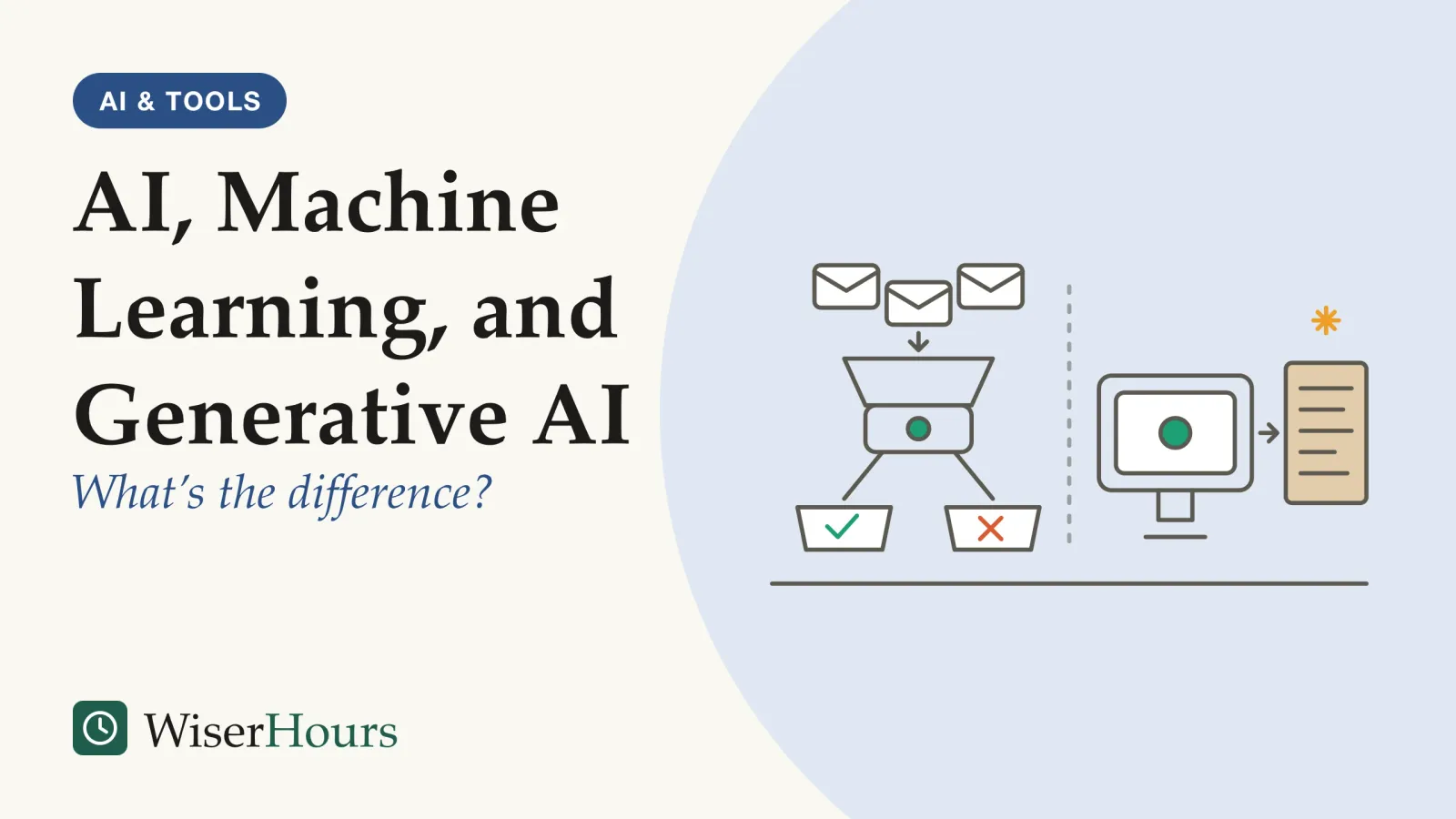
In AI vs machine learning vs generative AI, the terms nest like boxes: artificial intelligence is the whole field, machine learning is the part of it that learns from examples, deep learning is the part of machine learning built on many-layered neural networks, and generative AIgenerative AI: AI systems that produce new text, images, audio or code in response to a request, by generating output that resembles the data they were trained on. Chatbots built on large language models are the best-known kind.Full entry in the glossary is the part that produces new text, images or code.12 Large language models, the engines behind most chatbots, are generative AI for text.
For work, the more useful question is what a system hands back. A spam filter picks a label and a fraud model a score, both from a range someone fixed in advance; a chatbot writes something that did not exist a moment ago. The US National Institute of Standards and Technology (NIST) says confidently stated false content from generative AI is a natural result of how generative models are designed.3 NIST calls it confabulationhallucination: When an AI system states false or made-up content, such as an invented fact or citation, as confidently as true content. NIST calls it confabulation; it follows from how these systems generate plausible text, so answers still need checking.Full entry in the glossary, and it is why the two kinds of system need different checks.
This page stays with the vocabulary; the wider skill set is in what AI literacy means for every employee.
Prefer to watch? The video covers the same ground as this article.
AI vs machine learning vs generative AI: circles inside circles
Each term in this family names a narrower kind of the one before it. IBM’s explainer describes a series of systems from largest to smallest, each containing the next: AI is the overarching system, machine learning is a subset of AI, and deep learning is a subfield of machine learning. It also lists fraud detection, a predictive task, among the jobs enterprises give to deep learning.1 Google’s machine learning course counts generative AI as one kind of machine learning, alongside systems that predict and classify.2
Definition
Machine learning is AI that learns its rules from examples instead of being given them. Generative AI is machine learning that produces new text, images, audio or code, and large language models are its text branch.
Your own inbox shows most of the circles at once. The filter that moves junk aside is machine learning. The feature that turns a voice note into text usually runs on deep learning. The button that drafts a reply is generative AI, powered by a large language model.
- Artificial intelligence: the whole field: software that infers from its input how to predict, recommend, decide or create. Example: a rule-based expert system.
- Machine learning: AI that learns its rules from examples instead of being told them. Example: a spam filter.
- Deep learning: machine learning with many-layered neural networks. Example: speech-to-text in a video call.
- Generative AI: models that produce new text, images, audio or code. Example: an image generator.
- Large language models: generative models of text, the engine behind most chatbots. Example: an assistant drafting an email.
So when a tool is described as AI, ask what it hands back: a label (spam or not spam), a number (a fraud score) or new content (a drafted reply). Labels and numbers can be tested against past cases before you rely on them; new content has to be read each time.
- Myth
- AI means ChatGPT and other chatbots.
- Fact
- Chatbots built on large language models are one small circle inside AI. Spam filters, fraud scores and speech-to-text are AI too, and they fail in different ways.
Artificial intelligence: the whole field, including software that follows rules
Artificial intelligence is the broadest of the terms. In the revised definition the OECD’s member countries approved in 2023, an AI system is a machine-based system that infers from the input it receives how to generate outputs such as predictions, content, recommendations or decisions.4 Nothing in that sentence requires the system to learn.
The label is older than most of the tools now sold under it: John McCarthy, an assistant professor of mathematics at Dartmouth College in the US, chose “artificial intelligence” in 1955 for a summer research project held the following year.5
Some AI runs on rules that people wrote down, and the European Commission’s 2025 guidelines on the EU AI Act’s definition still count such logic- and knowledge-based systems as AI, including expert systems that encode what medical specialists know in order to suggest a diagnosis. Below them sits basic data processing: fixed, human-programmed rules, such as a database filter or an ordinary spreadsheet, which the guidelines place outside the definition of AI.6 An expense tool that flags every claim over a set limit, or a form letter that fills in each customer’s name, is ordinary software, whatever its sales page says.
A label such as “AI-powered” tells you little about how a tool works. Ask whether it learned its behavior from data or follows rules someone wrote, because written rules can be read line by line, while learned behavior has to be tested.
Machine learning: rules learned from examples
Machine learning is the part of AI that learns its behavior from data instead of following rules someone wrote. Google’s course defines it as training a piece of software, called a model, to make useful predictions or generate content from data, and splits the predictive kind into classification, which sorts an item into a category, and regression, which predicts a number such as a travel time or a house price.2
The classic workplace examples are supervised learning: the system sees many examples paired with the right answer and learns to map one to the other. The European Commission’s guidelines use an email spam filter, trained on messages people labeled “spam” or “not spam”, as their illustration, and name fraud detection trained on labeled transactions as another.6
A card payment in Nairobi, São Paulo or Seoul is scored by a fraud model against patterns learned from past transactions before the bank decides what to do. A retailer’s weekly demand forecast works the same way, with a number instead of a category.
What makes these systems checkable is that the answer comes from a fixed menu. A spam model produces a score, and someone chooses a threshold above which a message counts as spam. Google’s crash course spells out the trade-off: some legitimate emails will land in the spam folder (false positives) and some junk will reach the inbox (false negatives), and a sensible threshold depends on which mistake costs more.7
So for any predictive tool that affects your work, ask two questions. How often is it wrong on cases like yours? And when it is unsure, does it lean toward blocking too much or letting too much through?
Deep learning: many layers, less hand-built guidance
Deep learning is machine learning built on neural networks with many layers. The European Commission’s guidelines describe it as layered architectures that learn features from raw data by themselves, which removes much of the manual feature engineering older methods needed but typically requires large amounts of training data.6
IBM’s explainer makes the difference concrete with photos of pizzas, burgers and tacos. Classic machine learning relies on a human expert to decide which features, such as the bread, tell the dishes apart; a deep learning model can work that out from the raw images. IBM adds that neural networks let speech and image recognition tasks take minutes instead of the hours they take by hand.1 That is the kind of work behind features such as meeting transcription and photo search, and none of those writes anything new: they recognize and sort.
Deep does not mean generative. When a supplier stresses a model’s size or depth, bring the conversation back to what it outputs and how often that output was right in testing on material like yours.
Generative AI and large language models: systems that write, draw and code
Generative AI is the kind of machine learning that produces new content, such as text, images, audio, video or code, in response to a request. Google’s course describes generative models as learning the patterns in their training data in order to produce new data that resembles it.2
Large language models are the text branch. A large language model is trained on a vast amount of text and generates language one small piece at a time, predicting what comes next; most are built on the transformer design that emerged in 2017, and they are the basis of chatbots such as ChatGPT, Claude and Gemini.8 ChatGPT, released to the public in November 2022, popularized generative AI for general-purpose text tasks.9
In a typical week, a project manager in Manila turns meeting notes into a status update with a chatbot, a designer in Lisbon generates rough images for a pitch, and an analyst in Toronto asks for a spreadsheet formula. Each output is new, and each can look finished before anyone has checked it.
Give a language model tools that act on real systems and suppliers start calling it an agent, a step with risks of its own that are set out in what makes software an AI agent. Generative tools are judged by reading what they produce, so plan review time into any work that relies on one.
Predictive or generative: why the checks differ
Predictive and generative systems fail in different ways, so they need different checks. A predictive model picks an answer from a fixed set that can be scored against what happened. A generative model writes something new, and NIST’s 2024 generative AI profile lists confident false content among the risks that generative AI creates or makes worse. The reason is how the output is made: it approximates the statistical patterns of the training data, and the process that yields accurate, consistent answers can also yield inaccurate or self-contradicting ones, especially for open-ended requests in specialist fields, sometimes with invented reasoning or citations to back them up.3 A spam filter cannot invent a new folder. A language model can invent a source, a figure or a quotation and phrase it as fluently as a true one.
| Question | Predictive (spam filter, fraud score) | Generative (chatbot, image generator) |
|---|---|---|
| What does it return? | A category or a number | New text, images, audio or code2 |
| How does it go wrong? | False alarms and misses at a chosen threshold | Confident content that is false or unsupported73 |
| How is it checked? | Compare its answers with known outcomes on cases it has not seen | Verify the facts, sources and citations in each output103 |
Two scenes show the difference. If a spam filter misfiles a handful of messages in a month, you can count them, adjust the threshold and move on. If a chatbot’s summary of a long report gets one date wrong, nothing flags it; the only check is someone comparing the date with the report. For why chatbots make things up, see how AI hallucinations happen.

The checking also falls to different people. A predictive tool’s error rate can be measured by whoever runs it and then monitored. A generative tool’s errors turn up in each new output, so the person who uses the output has to check it.
Which kinds of AI EU businesses use
In the European Union, businesses were more likely to use AI that analyzes text or generates language, images or sound than machine learning for data analysis, according to Eurostat’s 2025 survey of enterprises with at least 10 employees, though no single type dominated.11
The study
Strong evidence
Eurostat's 2025 survey of AI use in EU enterprises
One in five EU businesses with at least 10 employees (20%) used at least one AI technology in 2025. Text analysis led, at about 12% of businesses, followed by generating images, video or sound (about 10%) and generating written or spoken language or code (about 9%). Machine learning for data analysis was reported by about 5%.12
Read those shares with two caveats. Businesses report their own use, and the survey’s categories describe tasks rather than the nesting on this page: its machine learning category, which includes deep learning, is listed separately from text generation, so the survey’s boxes cut across the circles instead of matching them. Large businesses were also far more likely than small ones to use AI at all.11
In an ordinary office, AI can arrive as a feature rather than a product, such as transcription in a meeting tool. The figures cover the EU only; readers elsewhere can check whether their national statistics office publishes a similar survey. When you list the AI your team uses, include features inside software you already have, not only tools with AI in the name.
Legal definitions draw the line in a different place
Laws define AI for their own purposes, and their lines do not match everyday usage. The European Commission’s 2025 guidelines on the EU AI Act’s definition, which are not binding, count rule-based expert systems as AI yet exclude some systems that technically use machine learning, such as simple forecasts that only predict an average. They add that most systems meeting the definition fall outside the Act’s bans, high-risk rules and transparency duties.6
The guidelines also exclude classical heuristics, such as a chess program that evaluates board positions without learning from data.6 IBM’s explainer, by contrast, gives winning a chess game as an example of the narrow AI in use today.1 The same program can be AI in conversation and outside the EU’s legal definition. Which systems the Act actually regulates is a separate question, answered by its risk categories for AI systems.
Outside the EU, legal definitions vary by country, so look up the one in the law that applies to your organization. The Commission’s guidelines add that no list settles in advance whether a system counts; each is judged on its own features, and only the EU’s Court of Justice can give a final reading.6 For a compliance decision, ask a lawyer or your compliance team. In a contract, policy or procurement form, say what you mean by AI instead of relying on the word, because a supplier, a regulator and your colleagues may each draw the line in a different place.
The bottom line
The most useful split at work is simple: does the tool pick an answer or write one? Test a predictive tool on its error rates, and check a generative tool’s output every time you use it. When a supplier says a product is AI, ask which kind it is.
This article is general information, not legal advice. Rules differ by country and change over time; for your own situation, speak to a qualified lawyer or an official advice service where you live.
Frequently asked questions
Is ChatGPT machine learning or AI?
Both. ChatGPT runs on a large language model, which is a kind of generative AI; Google's machine learning course counts generative AI as a kind of machine learning, and machine learning is part of AI. Each label is correct, but the narrowest one, large language model, says the most about how the tool works and how it tends to fail.
Is deep learning the same thing as a neural network?
Not quite. A neural network is the structure, and deep learning is the use of networks with many layers. IBM's explainer describes neural networks as layers of connected nodes and says a network with more than three layers, counting the input and output layers, can be considered a deep learning algorithm. IBM adds that deep learning can pick out the useful features in raw images or text by itself.
Are recommendation engines machine learning or generative AI?
Usually predictive machine learning. IBM gives Amazon's product suggestions, based on what a customer has viewed and bought, as an example of machine learning, and the European Commission's 2025 AI Act guidelines treat recommendations as their own kind of AI output, next to predictions, content and decisions. A recommender ranks items that already exist; it does not write new ones.
Is generative AI always built on deep learning?
Not by definition, but most of today's tools are. NIST's 2024 generative AI profile notes that not all generative AI comes from foundation models, the large models trained on broad data. Wikipedia's overview credits the recent boom in generative AI to improvements in deep neural networks, particularly large language models built on the transformer design.
Sources
- AI vs. machine learning vs. deep learning vs. neural networks: What's the difference? IBM Data and AI Team. IBM Think (accessed 28 September 2026)
- Introduction to Machine Learning: What is Machine Learning? Google for Developers, Machine Learning course (accessed 28 September 2026)
- Artificial Intelligence Risk Management Framework: Generative Artificial Intelligence Profile (NIST AI 600-1). US National Institute of Standards and Technology (July 2024)
- Updates to the OECD's definition of an AI system explained. Russell, S., Perset, K. & Grobelnik, M. OECD.AI, The AI Wonk (29 November 2023)
- Dartmouth workshop. Wikipedia (accessed 28 September 2026)
- Commission Guidelines on the definition of an artificial intelligence system established by Regulation (EU) 2024/1689 (AI Act), C(2025) 5053 final. European Commission (29 July 2025)
- Classification: Thresholds and the confusion matrix. Google for Developers, Machine Learning Crash Course (accessed 28 September 2026)
- Large language model. Wikipedia (accessed 28 September 2026)
- Generative artificial intelligence. Wikipedia (accessed 28 September 2026)
- Introduction to Machine Learning: Supervised Learning. Google for Developers, Machine Learning course (accessed 28 September 2026)
- Use of artificial intelligence in enterprises. Eurostat, Statistics Explained (data extracted December 2025)
- Artificial intelligence by size class of enterprise (dataset isoc_eb_ai). Eurostat, EU survey on ICT usage and e-commerce in enterprises, 2025 (accessed 28 September 2026)
How we researched this
We read the definitions of AI published by the OECD, NIST and the European Commission (its 2025 guidelines on the EU AI Act's definition), explainers from IBM and Google's machine learning course, and Wikipedia's overviews for dates and history, all in September 2026. Adoption figures come from Eurostat's 2025 survey of EU enterprises, the official EU statistics. Main limitation: sources draw the boundaries slightly differently, and the adoption figures cover EU businesses only.
Keep reading
What Is an AI Agent? A Plain-English Guide for Business Readers
An AI agent acts, it does not only answer. What independent tests found about finishing multi-step work, and 6 things to require before you let one act.
AI Literacy Explained: What Every Employee Needs to Understand
How EU law, the OECD and the US Labor Department define AI literacy, the 5 things every employee should understand, and what the EU asks of employers.
Workslop: When Low-Effort AI Output Creates More Work for Colleagues
Workslop is AI output that looks finished but isn't. What two US surveys found, why the MIT 95% figure is separate, and how to send it back politely.
How to Get Useful Results From Copilot in Excel
How to get useful results from Copilot in Excel: set up the data, then 5 everyday jobs, each with a worked prompt and a quick way to check the answer.