Workslop: When Low-Effort AI Output Creates More Work for Colleagues
Workslop is AI output that looks finished but isn't. What two US surveys found, why the MIT 95% figure is separate, and how to send it back politely.

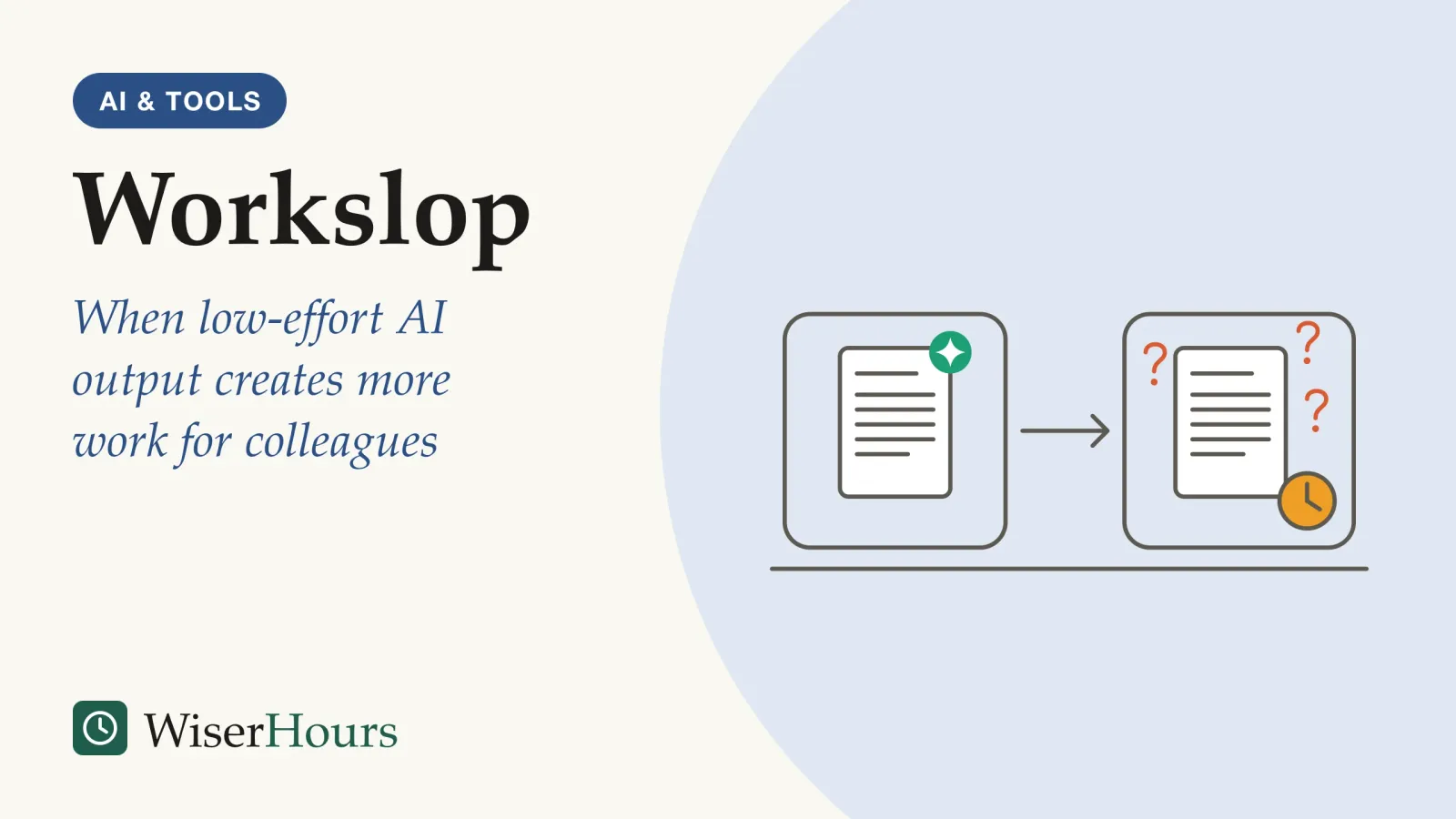
A finance employee described the problem to researchers in 2025. A colleague had handed him work made with AI, and he now had to choose: rewrite it himself, send it back for a rewrite, or accept it as good enough.1 The researchers, at BetterUp Labs and the Stanford Social Media Lab, gave that experience a name: workslop.
Workslop is AI-generated work that looks finished but lacks the substance to move a task forward, so the person who receives it has to interpret, correct or redo it. In a 2025 survey of US full-time employees by the same team, about two in five had received some in the past month.1 Three habits keep it from spreading:
- Senders read and check AI output, add the context only they have and say in one line what the AI did.
- Receivers send it back with specific questions about what is missing and when they need it.
- Teams name the tasks AI suits and agree that whoever sends the work owns the check.
What is workslop?
Workslop is AI-made work content that passes for good work but does not advance the task it was meant for. Kate Niederhoffer and colleagues at BetterUp Labs, the research arm of the coaching company BetterUp, introduced the term with Jeffrey Hancock of the Stanford Social Media Lab in a September 2025 Harvard Business Review article, as a workplace version of “AI slop”.1
Definition
Workslop is AI-generated work that looks complete and polished but lacks the substance to advance the task, so the effort of finishing it moves to whoever receives it.
The mechanism is a transfer of effort. Generative AIgenerative AI: AI systems that produce new text, images, audio or code in response to a request, by generating output that resembles the data they were trained on. Chatbots built on large language models are the best-known kind.Full entry in the glossary makes the look of finished work cheap: tidy slides, long structured reports, fluent summaries of research papers by people outside the field. Polish used to be a rough sign that someone had thought a piece through, and it no longer is. The authors argue that the receiver now carries the skipped work, decoding the content and guessing at context the sender left out, then deciding whether to fix it, return it or let it pass.1 They separate this from ordinary cognitive offloadingcognitive offloading: Using something outside your head, such as a note, a calendar alert, a search engine or a chatbot, to cut the mental work a task needs. It usually helps you do the task, though you may remember less of what you handed over.Full entry in the glossary, where you hand mental work to a machine. With workslop, the machine is the route by which work lands on another person.
A project lead asks for a one-page summary of client feedback before a meeting. She receives three pages with neat headings, generic themes such as “communication” and “timelines”, no client named and one claim she knows is wrong. The draft took the sender a few minutes; checking it against the raw feedback takes her the hour before the meeting.
Use the receiver’s side as the test. AI-assisted work that has been read, checked and fitted to the task is ordinary good work, whatever tool produced the first draft. Workslop is one of the problems that appear when people add AI to shared work without agreeing how; the case for building AI into a team’s workflow around shared tasks rests on the same point.
How common is workslop, and how firm are the figures?
In the BetterUp Labs and Stanford surveys, about two in five US full-time desk workers reported receiving workslop in the past month, mostly from peers. These are self-reports from online samples in one country, and the exact figures shift between the HBR article, BetterUp’s own summary and press write-ups.
In the HBR article, recipients estimated that about 15 percent of the content they received at work qualified, or roughly three items in a week of 20 emails, documents and decks. Most workslop passed between peers, some went up from staff to managers and some came down from managers to their teams, and professional services and technology were hit hardest.1 The table compares three write-ups of the same 2025 survey.
| Version | Sample as described | Received workslop in the past month | Time per instance |
|---|---|---|---|
| HBR article | 1,150 US full-time employees | 40%, and 41% later in the same article | 1 hour 56 minutes1 |
| BetterUp blog | 1,004 full-time US desk workers | 40% | 1 hour 51 minutes2 |
| Fortune report | Full-time employees “at 1,150 companies” | 40% | Not given3 |
The team then wrote up a September 2025 survey in full as a preprint, posted in February 2026; the preprint does not say whether its sample overlaps the one in HBR.
The study
Limited evidence
Recipients traced their workslop to about 2 colleagues each (US preprint, 2026)
In the main survey of 962 full-time US desk workers, 38% said they had received workslop in the past month, and recipients put the time spent dealing with it at about 3.4 hours a month. On average they named about 2 colleagues as senders, roughly 1 in 5 of the people they worked with closely. Just over half of all respondents said at least some of the AI-made work they shared was low-quality or low-effort.4
The figures are self-reportsself-report: A measure in which people describe their own behavior, feelings or circumstances, usually by answering a questionnaire. When the same person supplies both of the things being compared, shared habits of answering can make the link between them look stronger than it is.Full entry in the glossary from a single cross-sectionalcross-sectional: Describes a study that measures everyone in its sample at a single point in time. Because the possible cause and the outcome are recorded together, it can show that two things occur together but not which of them came first.Full entry in the glossary survey, so they show associations, and the time estimates rely on memory, a weakness the authors acknowledge. BetterUp sells coaching on AI adoption to employers.2 It paid for the survey, five of the six authors are its employees or paid consultants, the sixth works for Boston Consulting Group, and the paper is a preprintpreprint: A research paper posted publicly before it has been peer reviewed or published in a journal; in economics and finance the same stage is usually called a working paper. Its findings may change, or fail to hold up, by the time it is published.Full entry in the glossary still awaiting peer review. The authors call the sample representative, but it came from an online research panel with a quota for gender.4
The widely repeated cost of US$186 a month for each employee who receives workslop is the HBR authors’ extrapolation from respondents’ estimates of their time and salaries.1 A manager who puts that figure in a budget request is quoting recalled minutes multiplied by self-reported pay.
From recipients’ counts of who sent them workslop, the preprint’s authors conclude that it comes from a small group of people.4 Treat the numbers as a sign that the problem is common enough to plan for, and keep the cost estimates out of a business case.
Workslop and the MIT “95 percent” figure are separate studies
The claim that 95 percent of companies see no measurable return from generative AI comes from a 2025 report by MIT’s NANDA initiative on company AI pilots. It did not measure workslop. The HBR authors opened their workslop article with it as context, so the two figures often travel together.1
According to Fortune, the MIT report drew on interviews with leaders, an employee survey and a review of public AI deployments. It found that about 1 pilot in 20 reached rapid revenue growth and blamed a “learning gap” in how tools fit company workflows, more than the quality of the models.5 We could not open the report itself, so these details come from Fortune’s account of it. In a team update, give each finding its own sentence and source.
- Myth
- Research shows 95% of AI pilots fail because of workslop.
- Fact
- The 95% figure comes from an MIT report on company pilots. The workslop surveys asked workers what colleagues sent them. HBR offered workslop as one possible reason for weak returns.
When you quote either finding, quote it alone, with its source and what it measured. Workslop may help explain disappointing returns, but no study has measured how much of the gap it accounts for.
Why does AI make some people less productive?
AI shortens the time to a first draft, but checking that draft still takes time. When the checking is skipped or underestimated, total time can rise. One randomized test comes from METR, a research nonprofit: in its 2025 trial, experienced open-source developers took 19 percent longer on tasks where AI tools were allowed, while believing afterwards that the tools had sped them up.6
That trial involved 16 developers on mature code projects they knew from years of earlier work, using early-2025 tools, so it may tell us little about reports or slides. It does show how easily people misjudge their own speed.6 In February 2026, METR said developers were probably sped up more by then, while noting that its newer data could not show by how much.7 A draft that appears in seconds feels like progress, whatever the checking costs later.
The 2026 preprint asked senders why they shared low-quality AI work. Two reasons stood out: pressure, such as urgent tasks and too much to do, and a sense that they lacked the expertise and wanted AI as a thought partner. Sending workslop was more common among people who trusted AI more, felt little control over how they used it, felt their organization pushed AI use and reported lower psychological safetypsychological safety: A shared belief within a team that it is safe to take interpersonal risks, such as asking questions, admitting mistakes or raising concerns, without being punished or embarrassed. It is about candor, not about everyone being nice.Full entry in the glossary, all as associations in one survey.4
- Purposeful AI use: the sender does the thinking and checking, so what arrives can be used
- Workslop: the sender saves effort, and the receiver has to interpret, correct or redo the work
A new analyst under deadline, told that the team should use AI for everything, pastes a model’s market summary into a client deck because finishing on time feels safer than asking for help. Before using AI on a task, ask who will check the result and how long that will take. If the answer is the next person, for longer than the draft took you, do the checking yourself before you send it.
Why workslop costs the sender trust
Workslop changes how colleagues see whoever sent it. In the HBR survey, about half of recipients rated the sender as less creative, capable and reliable than before, and about a third reported being less keen to work with that person again.1
Part of that penalty attaches to AI use itself. In four preregistered experiments with about 4,400 participants, reported in PNAS in 2025, people who used AI at work expected to be judged as less competent and less motivated, and others did judge them that way.8 This article relies on that abstract alone.
A team lead who receives two unchecked AI summaries from the same colleague in a month may start rechecking everything that person sends, including the work they did with care. That leaves the sender two layers to manage. You cannot control how a colleague feels about AI in general. You can make sure that what you send is plainly checked, specific to the task and signed by you, which gives the receiver nothing to redo.
A sender’s checklist before you pass on AI output
Before forwarding AI output, make sure it answers the receiver’s real question, that you have read and checked all of it, that it carries the context only you have, and that it says what the AI did. In the 2026 preprint, recipients most often spotted workslop by wording and formatting typical of AI, by missing context or errors, and by work that did not sound like the colleague who sent it.4
Before you send AI-assisted work
The HBR authors argue that work done by a person with AI should meet the same standard as work done by a person alone, and a line such as “drafted with AI; figures checked against the March report” tells the receiver which standard you applied.1
How do you tell a colleague their work is AI slop?
Talk about the work and what it is missing, ask specific questions, and say what you need by when. Guesses about which tool produced it can stay out of the conversation. In the 2026 preprint, almost half of recipients spoke to the sender directly, and nearly four in ten did nothing and moved on.4
Accusing someone of using AI starts an argument you may lose: the authors note that people sometimes mistake human work for AI, and such false alarms may carry their own cost to trust.4
A reply you can adapt
“Thanks for turning this around quickly. Before I can use it, I need two things: which figures come from the March data, and what you recommend we do about the delay. Could you add those by Thursday? If ten minutes on a call is quicker, I’m happy to talk it through.”
The HBR authors count responding diplomatically, especially up or down a hierarchy, among workslop’s social costs.1 With a manager, turn the gap into a question about the decision: “Which of these three options do you want me to take forward, and by when?”
How can teams prevent workslop?
Teams prevent workslop by making purposeful AI use the stated default: name the tasks AI suits, expect the sender to own the check, make a short disclosure normal and make it safe to send work back. The HBR authors recommend that leaders model purposeful use, set clear guardrails and hold work done with AI to the same standard as other work, and they warn that blanket calls to use AI everywhere model poor judgment about where it fits.1
- Name the tasks. Replace “use AI for everything” with a short list of tasks where the team has seen AI help, and review it every few months.
- The sender owns the check. Whoever sends AI-assisted work has read and checked it; a receiver who finds unchecked work returns it without fixing it.
- Disclose in one line. “Drafted with AI; I checked the figures” is enough. In the PNAS experiments, people who used AI at work were judged as less competent, so pair the disclosure with what you checked.8
- Make returning work normal. In the 2026 preprint, people who sent more workslop reported lower psychological safety, so a team where asking for help is easy may see less of it.4
- Count the receiver’s time. When the team reviews how AI is going, ask how much time people spent fixing others’ AI output as well as how much they saved.
If your organization has a written AI use policy that sets out which tools and data are allowed, these norms sit inside it as team habits.
The bottom line
Workslop moves effort from the person who made a draft to the person who receives it, and the published figures, all self-reported by US desk workers, suggest it is common enough to plan for. This week, add one line to anything AI-assisted that you send, saying what the AI did and what you checked, and ask your team which tasks AI suits and who owns the check.
Frequently asked questions
Is workslop the same as AI slop?
Workslop is the workplace form of AI slop. AI slop is the name social media gave to low-quality AI posts; the BetterUp Labs and Stanford researchers who coined workslop in Harvard Business Review in 2025 used it for AI-made work that looks good but fails to advance a task, which leaves a colleague to sort it out. The difference is the receiver: workslop costs a named person time.
Is it still workslop if I edited the AI draft?
It depends on what reaches the receiver. The researchers define workslop by its effect: work that looks complete but lacks the substance to move the task forward. A draft you have read, checked and fitted to the task is ordinary AI-assisted work. Light edits that leave generic content, missing context or unchecked figures in place can still land as workslop.
How do people spot workslop?
Mostly by style and by gaps. In a 2026 preprint survey of 962 US desk workers by BetterUp Labs and Stanford researchers, recipients pointed to wording and formatting typical of AI in about a third of the incidents they described, to missing context or errors in about a quarter, and to work that did not sound like the colleague in about a fifth. The authors note that people can also mistake human work for AI.
Sources
- AI-Generated “Workslop” Is Destroying Productivity. Niederhoffer, K., Kellerman, G. R., Lee, A., Liebscher, A., Rapuano, K. & Hancock, J. T. (2025). Harvard Business Review, 22 September 2025, updated 25 September 2025
- What is AI workslop? Research on costs and solutions. Leon, M. (2025). BetterUp blog, 29 September 2025
- AI promised to revolutionize productivity. Instead, ‘workslop’ is a giant time suck and the scourge of the 21st century office, Stanford warns. MacLellan, L. (2025). Fortune, 23 September 2025
- Workslop: Examining the prevalence, antecedents and consequences of low-quality AI-generated content at work. Liebscher, A., Lee, A. Y., Rapuano, K., Kellerman, G., Niederhoffer, K. G. & Hancock, J. (2026). PsyArXiv preprint, posted 5 February 2026, not peer reviewed
- MIT report: 95% of generative AI pilots at companies are failing. Estrada, S. (2025). Fortune, 18 August 2025, reporting on MIT NANDA's The GenAI Divide: State of AI in Business 2025
- Measuring the Impact of Early-2025 AI on Experienced Open-Source Developer Productivity. Becker, J., Rush, N., Barnes, E. & Rein, D. (2025). METR, arXiv preprint 2507.09089
- We are Changing our Developer Productivity Experiment Design. Becker, J., Rush, N., Cunningham, T., Rein, D. & Mahamud, K. (2026). METR, 24 February 2026
- Evidence of a social evaluation penalty for using AI. Reif, J. A., Larrick, R. P. & Soll, J. B. (2025). Proceedings of the National Academy of Sciences, 122(19)
How we researched this
We read the 2025 Harvard Business Review article that introduced workslop in full, BetterUp's own summary, the research team's 2026 preprint and its funding statement, and news coverage from Fortune, searching the web, PsyArXiv and Crossref in October 2026 for newer data. Sources date from 2025 to 2026. Main limitation: every workslop figure is a self-report from US desk workers in surveys paid for by BetterUp, and none has been peer reviewed.
Keep reading
How to Build AI Into Your Team's Workflow, One Task at a Time
How to put AI in team workflows in 6 steps, and why, in a large trial, an AI tool for each person sped up solo work but not the work a team shares.
How to Get Useful Results From Copilot in Excel
How to get useful results from Copilot in Excel: set up the data, then 5 everyday jobs, each with a worked prompt and a quick way to check the answer.
AI Governance Explained: Who Decides What in Your Organization
AI governance decides who approves, checks and answers for AI at work. A map of 7 decisions, 3 ways to organize them, and what fits a small firm.
AI, Machine Learning, and Generative AI: What's the Difference?
AI holds machine learning, which holds deep learning and generative AI. How the 5 terms nest, and why predictive and generative tools need different checks.