Compassion Fatigue vs. Burnout: What Helping Professionals Should Know
Compassion fatigue has 2 parts in its main questionnaire: burnout and secondary traumatic stress. How they differ, what scores mean, and when to get help.

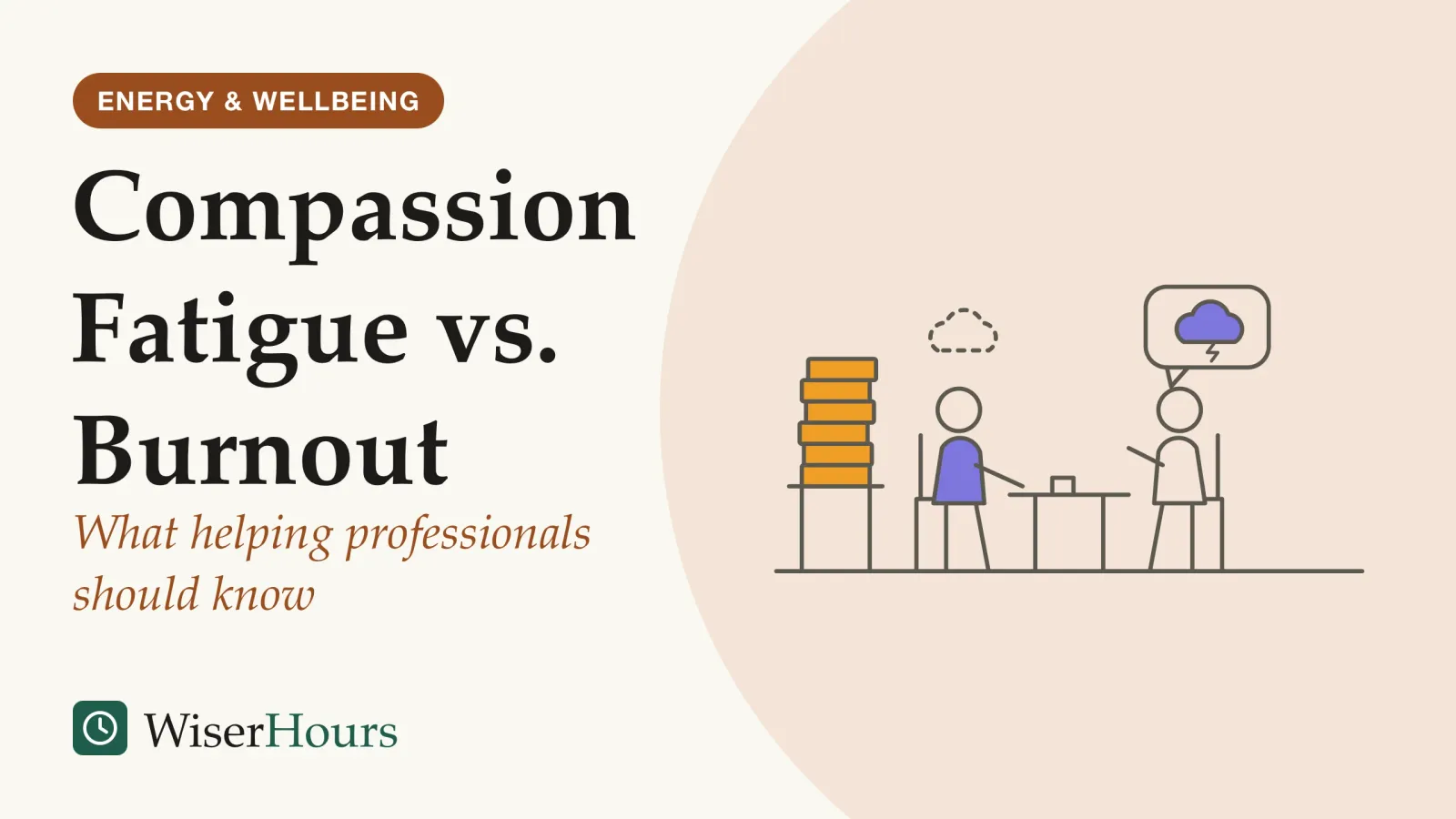
Burnout is not the opposite of compassion fatigue. In the Professional Quality of Life scale (ProQOL), the questionnaire behind most compassion fatigue research, burnout is one of the two parts of compassion fatigue; the other, secondary traumatic stress, is driven by fear rather than overload.1 Both describe the strain that helping work can leave on nurses, therapists, social workers, teachers, police officers and others who spend their days with people in pain.
For anyone in that work, the useful question is which strain is doing the damage: the amount of work, or what you see and hear. The two respond to different changes, and neither is a diagnosis; both are scores on a questionnaire about the last 30 days.1 The World Health Organization’s definition of burnout, and its overlap with depression, have their own page on what burnout means under ICD-11.
Compassion fatigue vs. burnout: one sits inside the other
In Beth Hudnall Stamm’s ProQOL, compassion fatigue is the negative side of helping work, and it has two parts. Burnout covers exhaustion, frustration and feeling bogged down by the system; secondary traumatic stress covers fear, feeling on edge and intrusive thoughts picked up from the trauma of the people you help.
The split exists because the two have different sources. In Stamm’s 2010 manual, the typical burnout pattern goes with high workloads and a system that works badly, and with a sense that nothing you do will make things better. Secondary traumatic stress comes from exposure instead: hearing or seeing what happened to someone else, then carrying it into your own sleep and your own life. A third scale, compassion satisfaction, counts the good side: the pleasure of doing the work well.1
- Professional quality of life: how a helper feels about their work, good and bad together
- Compassion satisfaction: the pleasure of doing helping work well
- Compassion fatigue: the negative side of helping work, with two parts
- Burnout: feeling worn out, overwhelmed and bogged down by the work and the system around it
- Secondary traumatic stress: fear, feeling on edge and intrusive thoughts picked up from the trauma of the people you help
| Question | Burnout | Secondary traumatic stress |
|---|---|---|
| Where it comes from | Overload: high workloads and systems that do not work | Exposure: other people’s traumatic experiences, taken in through the work1 |
| How it shows up | Worn out, overwhelmed, “nothing I can do” | On edge, preoccupied with people you helped, frightening thoughts1 |
Its developers say the ProQOL suits anyone whose paid or volunteer work can expose them to another person’s potentially traumatizing material.2
An illustrative case: two nurses on the same ward both say they are exhausted. One is buried in short staffing and paperwork; she dreads the rota but sleeps well. The other keeps replaying a child’s failed resuscitation at 3 a.m. and avoids the room where it happened. The first pattern is what the burnout scale picks up, the second what the secondary traumatic stress scale picks up, and plenty of people carry some of both.
Answer that question before choosing a fix, because the two parts point to different changes.
What helps depends on which part is loudest
Stamm’s ProQOL manual matches the response to the source. For high burnout it points to time off, a change of routine within the organization and a look at how the system works; for high secondary traumatic stress, to a different mix of cases, working alongside trusted colleagues and treatment for traumatic stress where it is needed.1
When both scores are high and satisfaction is low, the manual calls that the most distressing pattern, suggests assessment for PTSD and depression, and says a return to an unchanged job is unlikely to help.1
The responsibility is not only the helper’s. The US National Child Traumatic Stress Network (NCTSN), funded by the federal agency SAMHSA, writes for staff who work with traumatized children and calls on the individual, supervisors and the organization to act together, with psychoeducation, skills training and supervision at the core of prevention. Its list for organizations includes adequate clinical supervision, a balanced trauma caseload, physical safety for staff and flexible hours. It notes that many organizations refer staff to outside help such as employee assistance programs, and it is frank that evidence on interventions for secondary traumatic stress is limited.3
Some structured programs for individuals have trial support. A 2024 meta-analysismeta-analysis: A study that combines the results of earlier studies on the same question into one overall estimate. Pooling makes the estimate more precise, but it cannot repair the studies it pools: a meta-analysis of surveys is still survey evidence.Full entry in the glossary by Jose Mariya Lipsa and colleagues pooled 11 randomized trialsrandomized controlled trial: A study that assigns participants to the treatment or the comparison group at random, so the groups start out alike and a difference in what happens next can be put down to the treatment. Random assignment makes the two groups comparable; it does not make the people in the trial representative of anyone else.Full entry in the glossary of psychological programs for helping professionals and found that, on average, they lowered compassion fatigue scores; mindfulness, psychoeducation and resilience training were among the most common types in the wider review. Results varied so much between trials, though, that the true size of the benefit is uncertain.4
Take two child-protection social workers, again as an illustration. One is drowning in overdue cases, so her first talk with a supervisor is about which cases can move and when she can take leave. The other keeps picturing a child’s injuries from one file, so she asks for fewer of the most graphic cases for a while and for regular supervision.
Not everyone can change their caseload or take leave, so the realistic first step is often a conversation with a supervisor, occupational health or an employee assistance program.
Why the two strains usually arrive together
Burnout and secondary traumatic stress scores tend to rise and fall together. A 2014 meta-analysis led by Roman Cieslak at the University of Colorado at Colorado Springs, pooling studies of professionals who work with trauma survivors, found the two strongly linked, most of all when both were measured with compassion fatigue questionnaires.5
The study
Moderate evidence
Burnout and secondary traumatic stress, measured side by side in 8,256 workers
Across the studies, the average correlation between burnout and secondary traumatic stress was 0.69. On that measure, 1 is perfect agreement between two scores and 0 is no link at all. The figure rose to 0.74 in studies that used measures from the compassion fatigue framework, where the two scores shared about 55% of their variance, and was 0.58 with other measures.5
A helper who scores high on one scale will usually score high on the other. The authors read the stronger link inside the compassion fatigue family of questionnaires as a sign that those measures overlap, so part of the pairing likely reflects the ruler rather than the person. Correlations also cannot show which strain comes first.
A measurement study adds a second warning. When Brody Heritage and colleagues analyzed ProQOL answers from more than 1,600 Australian nurses in 2018, the compassion satisfaction scale held up, but the burnout and secondary traumatic stress scales did not show adequate measurement properties, and the authors advised caution in using them.6
Two high scores, then, need not mean two separate problems. A crisis-line volunteer who feels both worn out and jumpy after a run of hard calls fits the pattern these studies describe. Treat the pair as one picture: if you recognize one pattern in yourself or a colleague, check for the other before deciding what help fits.
Caring deeply is not a proven risk
No research shows that the most compassionate carers are the most susceptible to compassion fatigue, according to a 2017 meta-narrative review of 90 studies by Shane Sinclair and colleagues at the University of Calgary. The risk factors it found were job-related factors, fewer health care qualifications and fewer years of experience. The review also noted that the ProQOL does not assess any element of compassion, and it called the term an iconic euphemism that should be critically re-examined. What it describes instead is cumulative stress from the work that harms the physical, emotional, social and spiritual health of staff.7
Empathy may be a separate matter. The NCTSN says the risk of secondary traumatic stress appears greater in people who are highly empathetic by nature, as it does for heavy caseloads of traumatized children.3
- Myth
- Compassion fatigue means you cared too much and your compassion ran out.
- Fact
- A 2017 review of 90 studies found no research showing that the most compassionate carers are more susceptible, and the main questionnaire does not measure compassion itself.
The name suggests a tank of compassion that empties with use, and the evidence does not describe one. Consider a hospice nurse who is advised to care a little less to protect herself. If her strain comes from short staffing and from carrying patients’ distress home, caring less addresses neither problem.
Reading a compassion fatigue score without over-reading it
Nobody can say precisely how common compassion fatigue is, because studies use different questionnaires and cutoffs. A 2020 systematic review of 71 studies by Nicola Cavanagh and colleagues, also at the University of Calgary, found it reported in every group of health care practitioners studied, with prevalenceprevalence: The share of a population who have a given condition at a point in time or across a set period. Every prevalence figure depends on the case definition behind it: loosen or tighten the criteria for counting as a case and the figure moves with them.Full entry in the glossary highly variable and no consistent link to experience or specialty.8
A 2024 meta-analysis of emergency nurses by Zhiyong Xu and colleagues shows why the numbers wobble. Pooling 11 surveys from Asia, North America and Europe, it put the share scoring above the cutoff for secondary traumatic stress at about two in three. But the studies mixed two questionnaires and several cutoffs, results varied widely, the authors found signs of publication biaspublication bias: The tendency for studies with striking or statistically significant results to be published, while quieter ones stay in the drawer. Since the missing studies are mostly the unimpressive ones, a pooled result tends to overstate the effect until it is corrected.Full entry in the glossary, and all the studies they included were cross-sectionalcross-sectional: Describes a study that measures everyone in its sample at a single point in time. Because the possible cause and the outcome are recorded together, it can show that two things occur together but not which of them came first.Full entry in the glossary.9
What the ProQOL manual says about its own scores
Look first at which of the three scales is high. Stamm’s manual places the cut points near the highest and lowest quarter of scores in its reference data, warns that they tend to produce false positives, and recommends the measure only for screening. It says the ProQOL is not a diagnostic test and that it would be inappropriate to diagnose depression or any other disorder from it. It adds that a high burnout or secondary traumatic stress score, or high scores on both with low compassion satisfaction, can be an early sign of depression worth assessing properly.1
Picture a paramedic who fills in the ProQOL after a bad month and lands in the high range for secondary traumatic stress. Her score sits in roughly the top quarter of the manual’s reference data, but it describes only that month. The score is a prompt to pay attention and talk to someone, not a label.
Where the term came from, and why the questions lean toward trauma
Most accounts trace compassion fatigue in health care to a 1992 article by Joinson in the journal Nursing, which used it for emergency nurses losing what the article called the ability to nurture. A 2025 scoping review of 43 articles by Noor and colleagues found that most of the literature gives that origin, and that the trauma researcher Charles Figley later adopted the term for people who treat trauma survivors.1011
Figley’s 1995 edited book was subtitled Coping with Secondary Traumatic Stress Disorder in Those Who Treat the Traumatized, a title that already joined the two ideas.12 His Compassion Fatigue Self Test grew into the ProQOL: Stamm added compassion satisfaction in 1993, and the measure passed fully to her in the late 1990s under its current name.1
That history explains a quirk of the questionnaire. Built around trauma work, it asks about being startled and about intrusive thoughts, which fits a crisis counselor more closely than a teacher facing a hard term. Sinclair’s review makes a similar point: the concept was borrowed from crisis counseling and psychotherapy and covers only limited facets of compassion.7
Psychiatry now recognizes part of the idea. Since 2013, the DSM-5 criteria for PTSD have counted indirect exposure to the details of trauma, usually through professional duties such as those of first responders and medics, as a qualifying exposure, according to the US National Center for PTSD.13 In our reading, the fear-driven half of compassion fatigue can therefore reach a clinician’s assessment; the burnout half stays outside diagnosis.
If your work is far from crisis counseling and the fear questions do not fit, that tells you about the tool, not about whether your strain is real.
Flashbacks, a crisis or slow exhaustion: where to turn
Anyone having thoughts of suicide or self-harm should get help at once. Nightmares, flashbacks or steering clear of reminders of what happened to someone you helped are reasons to see a doctor soon, because work that involves trauma is a recognized route to PTSD. The advice below comes from NIMH in the US and the NHS in the UK; grouping it by urgency is our editorial choice.
- Now: in the US, NIMH says to call 911 or go to the nearest emergency room when a situation is life-threatening, and to call or text 988, the Suicide and Crisis Lifeline, for confidential support around the clock if you are suicidal or in emotional distress.14 In the UK, the NHS directs people to 999 or A&E when a life is at risk or you feel unable to keep yourself or another person safe; for urgent help short of an emergency, it points to 111 and its mental health option, and Samaritans take free calls on 116 123.15 Elsewhere, call your local emergency number.
- Soon, within days or weeks: the NHS counts jobs such as police officer, paramedic or healthcare worker among the experiences that can lead to PTSD, and suggests a GP appointment for anyone who thinks they have its symptoms, such as flashbacks, intrusive images or avoiding reminders; in England, adults can usually self-refer to NHS talking therapies.16 In the US, NIMH notes that a primary care provider can do an initial mental health screening and refer you on.14 It also advises talking to a health care provider if signs of depression, such as a persistently sad mood or loss of interest, do not go away.17
- At a routine appointment: exhaustion or detachment that keeps returning without fear, intrusive memories or low mood is worth mentioning to your doctor, supervisor or employee assistance program; this tier is our suggestion. Outside the UK, the equivalent of a GP is usually a family doctor.
The bottom line
Compassion fatigue is best read as a questionnaire’s name for two strains of helping work: burnout from the load, and secondary traumatic stress from the stories. Neither score is a diagnosis, and the two usually rise together, so notice which one is louder and look first at the work and the support around you. Fear, nightmares or intrusive memories that keep coming back deserve a doctor’s attention, whatever name the questionnaire gives them.
This article is general information, not medical advice. If you're worried about your health, talk to a doctor or another qualified professional.
Frequently asked questions
Is compassion fatigue the same as vicarious trauma?
Not exactly, but the difference is hard to pin down. Beth Hudnall Stamm's 2010 ProQOL manual calls compassion fatigue, secondary traumatic stress and vicarious trauma three accepted terms from three lines of research, and says attempts to separate them have largely failed to find real differences. Most studies use the terms loosely, so check how each one measured its term.
Can family caregivers get compassion fatigue?
The ProQOL was not built for them. Its developers say the questionnaire suits people exposed to others' potentially traumatizing material through paid or volunteer work, and they do not recommend it for family caregivers, pointing instead to measures designed for caregiver strain. Exhaustion from caring for a relative is real; it is simply measured with different tools.
Is compassion satisfaction the opposite of compassion fatigue?
No. In the ProQOL they are separate scales, so a person can score high on both: Stamm's manual describes helpers in war zones who find their work deeply meaningful while carrying fear from it. The developers say they have tried for years to combine the scales into a single score without success.
Sources
- The Concise ProQOL Manual, 2nd edition. Stamm, B. H. (2010). ProQOL.org, now maintained by the Center for Victims of Torture
- ProQOL: Frequently asked questions. ProQOL.org, Center for Victims of Torture (accessed 24 September 2026)
- Secondary Traumatic Stress: Introduction. National Child Traumatic Stress Network (US; funded by SAMHSA), accessed 24 September 2026
- Effectiveness of psychological interventions for compassion fatigue: a systematic review and meta-analysis. Lipsa, J. M., Rajkumar, E., Gopi, A. & Romate, J. (2024). Journal of Occupational Health, 66(1)
- A meta-analysis of the relationship between job burnout and secondary traumatic stress among workers with indirect exposure to trauma. Cieslak, R., Shoji, K., Douglas, A., et al. (2014). Psychological Services, 11(1)
- The ProQOL-21: A revised version of the Professional Quality of Life (ProQOL) scale based on Rasch analysis. Heritage, B., Rees, C. S. & Hegney, D. G. (2018). PLOS ONE, 13(2)
- Compassion fatigue: A meta-narrative review of the healthcare literature. Sinclair, S., Raffin-Bouchal, S., Venturato, L., et al. (2017). International Journal of Nursing Studies, 69
- Compassion fatigue in healthcare providers: A systematic review and meta-analysis. Cavanagh, N., Cockett, G., Heinrich, C., et al. (2020). Nursing Ethics, 27(3)
- Prevalence and associated factors of secondary traumatic stress in emergency nurses: a systematic review and meta-analysis. Xu, Z., Zhao, B., Zhang, Z., et al. (2024). European Journal of Psychotraumatology, 15(1)
- Coping with compassion fatigue. Joinson, C. (1992). Nursing, 22(4), 116, 118-120
- Compassion fatigue in helping professions: a scoping literature review. Noor, A. M., Suryana, D., Kamarudin, E. M. E., et al. (2025). BMC Psychology, 13
- Compassion Fatigue: Coping with Secondary Traumatic Stress Disorder in Those Who Treat the Traumatized. Figley, C. R. (Ed.) (1995). Brunner/Mazel; reissued by Routledge, 2013
- PTSD and DSM-5. National Center for PTSD, US Department of Veterans Affairs (accessed 24 September 2026)
- Help for Mental Illnesses. National Institute of Mental Health, National Institutes of Health (US)
- Where to get urgent help for mental health. NHS (UK), page last reviewed 26 April 2023
- PTSD (post-traumatic stress disorder). NHS (UK), page last reviewed 8 April 2026
- Depression. National Institute of Mental Health, National Institutes of Health (US; NIH Publication No. 24-MH-8079, revised 2024)
How we researched this
We searched PubMed, Europe PMC and Crossref in September 2026 for the origin of the term, the ProQOL, critical reviews and meta-analyses of prevalence, overlap and interventions, then read the ProQOL manual, two meta-analyses, a scoping review and NHS, NIMH, NCTSN and VA pages in full. Three key reviews were read as abstracts only, and the 1992 and 1995 origin works from their records. Sources date from 1992 to 2026. Main limitation: nearly all studies are one-off questionnaire surveys.
Keep reading
Parental Burnout: What Researchers Have Learned
Parental burnout has 4 signs researchers can measure. What a global study, research on risks and resources, and early treatment trials have found.
12 Early Warning Signs of Burnout You Shouldn't Ignore
12 early signs of burnout, mapped to the WHO's three dimensions and validated scales, what else each could mean, and when a doctor should look.
How to Recover From Burnout: A Realistic Step-by-Step Plan
A realistic burnout recovery plan in 6 steps: rule out other causes, cut the load, protect rest, and change the job with your manager's help.
What Is Burnout? The WHO Definition in Plain English
What is burnout? The WHO's ICD-11 calls it an occupational phenomenon with 3 dimensions, not a medical condition. What that means, and the depression debate.