Compa-Ratio and Range Penetration: The Pay Metrics HR Uses
A compa ratio of 1.0 means pay at the midpoint of its range. How compa ratio and range penetration are worked out, why they disagree and how they shape raises.

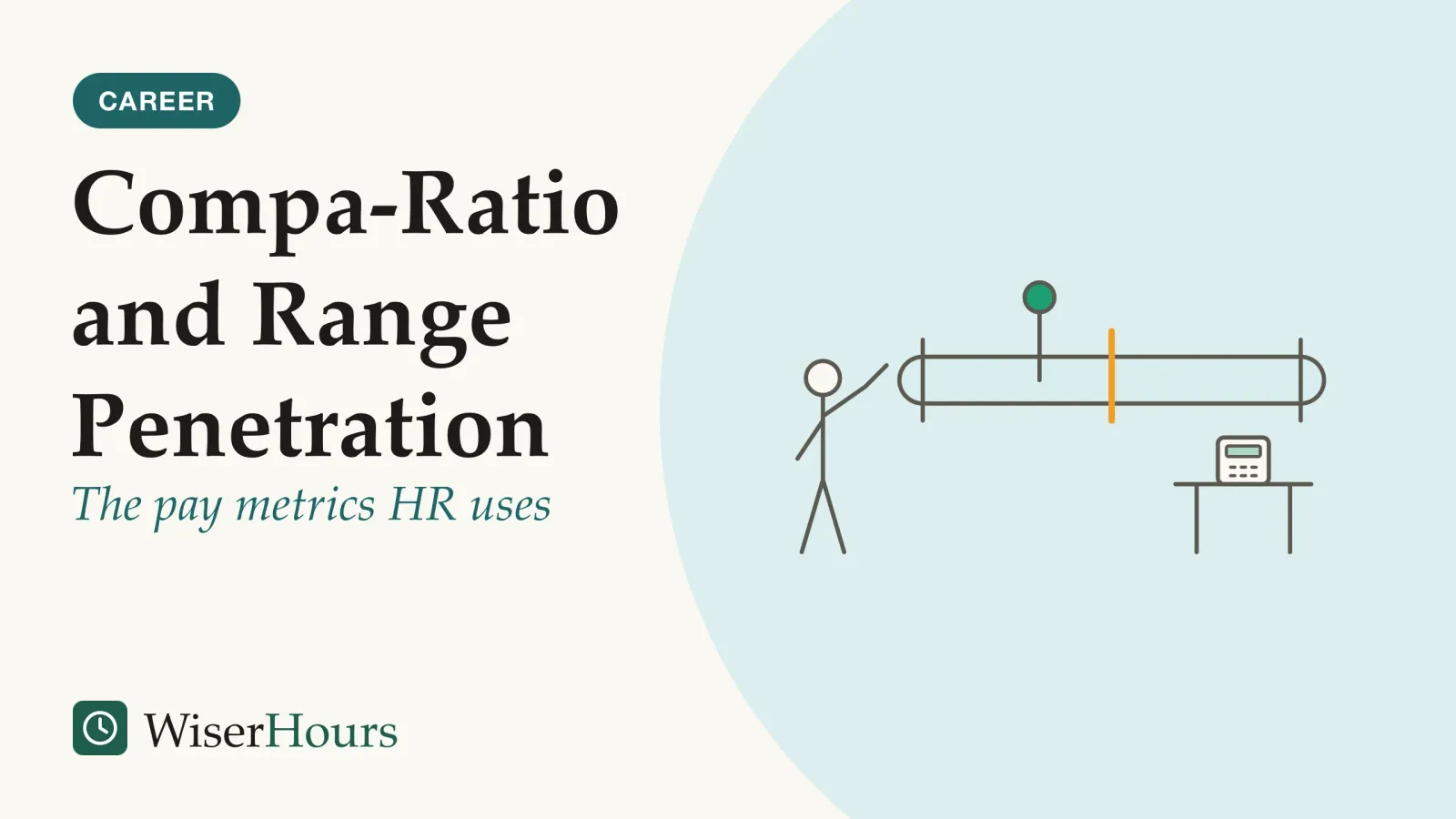
Your compa ratio is your salary divided by the midpoint of the pay range for your job, so 1.0 means you are paid exactly at the midpoint and a lower figure means pay below it. Range penetration measures something else: how far your salary has climbed from the bottom of the range toward the top. HR teams use both numbers to size raises, set pay after a promotion and check whether people doing similar work are paid alike.
The wider evidence on what drives pay and promotion puts pay alongside the other levers of a career.
Definition
A compa ratio (short for comparative ratio) is a salary divided by the midpoint of its pay range or a market reference rate. Range penetration is the salary minus the range minimum, divided by the full width of the range.
What is a compa ratio, and how do you calculate it?
A compa ratio is a salary divided by a reference rate, usually the midpoint of the job’s pay range, and it is often shown as a percentage. AIHR, an HR training company, gives the formula as actual salary divided by salary midpoint; a result below 1.0 means pay under the midpoint and above 1.0 means pay over it.1
The reference rate is less fixed than the word “midpoint” suggests. AIHR also allows a market midpoint from pay surveys or the average pay of a defined group.1 ADP, the payroll company, describes the comparison point as the medianmedian: The middle value when numbers are put in order, so half fall below it and half above. Unlike the average (mean), it is not pulled up or down by a few very large or very small values, which is why it is often used for incomes and wealth.Full entry in the glossary pay for similar positions.2
Take an analyst whose range runs from 50,000 to 70,000 a year, in any currency, so its midpoint is 60,000. Paid 54,000, she has a compa ratio of 0.90, which puts her pay a tenth below the midpoint. HR Source, an employers’ association in Illinois, works through the same kind of example in a 2024 explainer.3
Why measure against the middle of the range at all? Employers intend the midpoint to stand for the market rate for someone fully competent in the job; Kent State University’s staff pay policy in the US describes its midpoints as the university’s chosen competitive position against the outside market.4 AIHR’s compensation metrics sheet ties the minimum to someone still learning the job, the midpoint to someone who handles all of it independently and the maximum to someone highly experienced and ready for promotion.5 Whenever someone quotes your ratio, ask which reference rate sits underneath it, since an out-of-date range or a different pay survey changes the answer.
Range penetration: where you sit between minimum and maximum
Range penetration, also called position in range, measures how far a salary has moved from the range minimum toward the maximum: salary minus minimum, divided by maximum minus minimum. HR Source’s 2024 explainer uses the same formula, which puts the floor of the range at 0 percent and the ceiling at 100 percent.3
For the same analyst, pay sits a fifth of the way up the range, a range penetration of 20 percent. ADP notes that a compa ratio of 100 percent usually goes with a range penetration of 50 percent.2 That pairing holds whenever the midpoint sits exactly halfway between the minimum and the maximum.
Range penetration answers a question the compa ratio leaves open: how much room is left before the ceiling. Some employers cap base pay at the maximum; the University of Waterloo’s staff pay policy in Canada says a grade’s maximum salary is not to be exceeded.6 A range penetration near the top therefore signals little room for further base raises in the same job, and the useful conversation turns to the next grade.
Estimate your own numbers from a posted or shared range
You can estimate both numbers once you have your base salary, the minimum and maximum of your range, and the rate your employer treats as the midpoint. The sums are easy; the hard part is an accurate range, because figures you find without asking may not be the ones HR uses for you.
Where the range comes from
Some employers share ranges with staff; others publish them in job ads because the law requires it. In the EU, the 2023 Pay Transparency Directive gives job applicants a right to information on the starting pay or its range, and requires employers to make the criteria for pay and pay progression easily accessible to workers, though member states may exempt employers with fewer than 50 workers from the pay-progression part.7 In the US state of Colorado, the labor department’s 2024 guidance says job postings must include the pay or a range of possible offered rates.8 Rules differ by country and state, so look up the pay-transparency rules where you work.
A posted range is a hiring range. Colorado’s guidance says a compliant posted range spans the lowest to highest pay the employer believes it may offer for that specific job, and that the employer may end up paying more or less.8 The range HR uses for your grade may differ from what an ad shows, so a ratio worked out from a job ad is only an estimate.
Run the sums on base pay
Use base pay only, since AIHR notes that the compa ratio leaves out bonuses, equity and benefits.1
- 1Find the midpointminimum plus maximum, halved, for a symmetrical range; otherwise the rate HR names
- 2Compa ratiobase salary divided by the midpoint
- 3Range penetrationsalary minus minimum, divided by maximum minus minimum
If the two answers point in different directions, such as a ratio near 1.0 but a position low in the range, the reference rate does not sit halfway up the range, which the next section explains.
Why compa ratio and range penetration disagree
The two metrics can disagree because the compa ratio looks only at the midpoint while range penetration uses the range’s floor and width, so one salary can look close to market on one measure and low on the other.
Width is the first reason. AIHR’s guide to range penetration, by Suzanne Lucas, a former corporate HR professional, shows it by placing one salary in two ranges of different widths. Stretch the analyst’s range so it starts lower and ends higher around the same midpoint, and her compa ratio does not move, but her range penetration rises because the floor is now further below her. Lucas also points out how differently one salary can feel: fair when described as 95 percent of the midpoint, unfair when described as a third of the way into the range.9
Asymmetry is the second reason. When the reference rate is a market figure that does not sit halfway between floor and ceiling, the two measures part company even at the market rate. An employer might set a range with more room above its market rate than below it, so that someone paid exactly the market rate has a compa ratio of 1.00, “at market”, yet sits only a quarter of the way into the range. The table works through the arithmetic; the figures are illustrative, not any employer’s policy.
| Scenario | Salary and range | Compa ratio | Range penetration |
|---|---|---|---|
| The analyst | 54,000 in 50,000 to 70,000 (midpoint 60,000) | 0.90 | 20% |
| Same pay, wider range | 54,000 in 40,000 to 80,000 (midpoint 60,000) | 0.90 | 35% |
| Range set above the market rate | 54,000 in 54,000 to 78,000 (market rate 60,000) | 0.90 | 0% |
| Paid exactly the market rate | 60,000 in 54,000 to 78,000 (market rate 60,000) | 1.00 | 25% |
| After a promotion | 62,000 in 60,000 to 84,000 (midpoint 72,000) | about 0.86 | about 8% |
- Narrow range, 50,000 to 70,000: compa ratio 0.90; range penetration 20%
- Wide range, 40,000 to 80,000: compa ratio still 0.90; range penetration 35%, because the floor is further away
- Lopsided range, 54,000 to 78,000: compa ratio still 0.90 against the 60,000 market rate; range penetration 0%, because the salary sits on the floor
Ranges also move. When a range rises further than your pay does, both of your numbers fall, which Lucas notes can happen even in a year you get a raise.9 So when you hear one number, ask for the other and for the range itself.
What is a good compa ratio?
AIHR’s guide says a good compa ratio usually sits close to 1.0 and that many organizations treat roughly 0.8 to 1.2 as acceptable; ADP’s guide gives the same band.12 AIHR adds that the right ratio depends on context, including experience, performance and market conditions.1
Some pay structures build that band in. The University of Waterloo sets staff ranges with a minimum at 80 percent of the job value and a maximum at 120 percent, and starts new staff anywhere from the bottom of the range up to the job value.6
- Myth
- A compa ratio below 1.0 means you are underpaid.
- Fact
- Pay below the midpoint is expected while someone is still learning the job; it becomes a question when it lasts after the job is mastered.
AIHR notes that developing employees often sit between 0.8 and 0.9, and that ratios which stay low for too long may point to underpayment.1 An employee two years into a job, with strong reviews and a ratio that has barely moved, has a specific, checkable question to put to a manager.
How compa ratio affects your raise
Some employers set raises with a grid called a merit matrix, which weighs two things together: the performance rating and the compa ratio. In grids like the one below, a lower compa ratio earns a larger percentage increase for the same rating, so pay below the midpoint catches up faster and pay near the top grows more slowly.5
The study
Limited evidence
WorldatWork's sample merit grid (reproduced by AIHR)
The grid crosses five performance ratings with four compa-ratio bands from 0.80 to 1.20. An outstanding performer in the lowest band gets a suggested 7% to 8%; the same rating in the highest band gets 4% to 5%. An unsatisfactory rating gets nothing in any band.5
Each employer sets its own grid to fit its budget. AIHR presents this one as an illustration from WorldatWork, an association of compensation professionals, and gives no year or survey behind the percentages. For pay above the range maximum, the same sheet says it will probably be frozen until the range catches up.5
What carries over is the shape: two people with the same rating can get different raises because they sit in different places in the range. ADP’s guide describes the same logic, with large merit raises possible for people below the midpoint and smaller increments for those already paid above market.2 If your ratio is high and your raise was small, ask whether the grid capped it and whether a lump sum or a move to a higher grade is available. If you then decide to press for more, preparing a raise request starts from evidence of your results.
Promotions and fairness checks use the same numbers
A promotion moves you into a higher range, which usually resets your position: the new salary normally has to reach at least the new minimum, and the compa ratio against the higher midpoint is often lower than before. Kent State University’s policy says a promoted employee’s salary should be at least the minimum of the new range and normally no more than its maximum, and lists the current salary’s position in the new range among the factors it weighs.4
The University of Waterloo brings a promoted staff member’s pay up to the new grade’s minimum immediately if it falls below it.6 In the table above, the analyst promoted into a higher range gets a raise of about 15 percent, yet her compa ratio falls and she sits near the bottom of her new range. Under a merit grid like WorldatWork’s sample, that low position could mean larger percentage raises in the next few cycles.
HR teams also compare compa ratios across groups doing similar work. AIHR suggests reviewing ratios by tenure, gender, job family and department, and treats a pattern such as women consistently having lower ratios than men in comparable roles as a sign that pay practice needs adjusting.1 ADP cautions that compa ratios are only a starting point for pay equity and are not enough on their own to settle it.2
In the European Union, the 2023 directive also requires employers to have pay structures that ensure equal pay for equal work or work of equal value. It gives workers the right to request their own pay level and the average pay levels, broken down by sex, for people doing the same work or work of equal value. Member states were due to bring their national laws into force by 7 June 2026; the details, and whether a law is yet in force, depend on each country.7
Questions that fill the gaps in your estimate
A home-made estimate leaves three unknowns: the exact range HR uses for you, what it treats as the midpoint, and how its raise grid reads the result. Only your employer can answer those, and asking for the inputs is a narrower request than asking for more money.
Questions for your manager or HR
Start with your manager, then go to HR or the compensation team for the range data. None of these numbers promises a raise: they feed decisions that managers make within budgets, and policies differ widely between employers and countries.
If your numbers suggest that you are paid less than colleagues of another sex doing the same work or work of equal value, raise it soon rather than waiting for a routine review. Under the 2023 EU directive, workers can make the pay request through workers’ representatives or an equality body, and equal pay claims get limitation periods of at least three years once national law applies.7 Elsewhere, a trade union, your national labor inspectorate or equality body, or an employment lawyer can explain the rules and deadlines that apply to you.
The bottom line
In many companies, where your pay sits in its range shapes the size of your next raise and where a promotion lands you, and both ratios measure that position against your employer’s own yardstick. Before your next pay review, ask for your range’s minimum, midpoint and maximum and how the merit grid uses them, then work out both numbers yourself.
This article is general education, not financial advice. For decisions about your own money, speak to a qualified, regulated adviser.
This article is general information, not legal advice. Rules differ by country and change over time; for your own situation, speak to a qualified lawyer or an official advice service where you live.
Frequently asked questions
Does a compa ratio include bonuses or benefits?
Usually not. AIHR's guide for HR staff lists the narrow focus on base pay as one of the metric's limits, because it leaves out bonuses, equity, benefits and other rewards. Two people with the same compa ratio can have quite different total pay, so if your package includes a large bonus or shares, compare total pay separately from the ratio.
Can my compa ratio fall even after a raise?
Yes. When an employer moves its pay ranges up to follow the market, the midpoint rises, and a raise smaller than that move leaves your ratio lower than before. AIHR's guide to range penetration makes the same point about position in the range, and Kent State University's pay policy says revising its salary structure does not by itself raise anyone's pay.
Can I ask my employer for my compa ratio?
You can ask anywhere, but a right to an answer depends on where you work. The EU Pay Transparency Directive of 2023 lets workers in EU countries, once their national law applies, request their own pay level and average pay levels by sex for the same work or work of equal value, which is close to the ratio but not the same. Elsewhere, check your national rules and ask HR how they calculate it.
What does a red-circled or green-circled salary mean?
Both are HR terms for pay outside the range. AIHR's compensation metrics sheet calls pay below the range minimum green-circled, usually raised to the minimum at the next review, and pay above the maximum red-circled, often frozen until the range catches up. In range-penetration terms, green circles sit below 0 percent and red circles above 100 percent.
Sources
- Compa Ratio: A Clear Guide with Examples [Plus Free Calculator]. AIHR (Academy to Innovate HR), HR training company (accessed 2026-10-18)
- Compa-ratio: Definition and how-to guide. ADP, payroll and HR services company (accessed 2026-10-18)
- Compa Ratio & Position in Range. Hyer, J. L. (2024). HR Source, employers' association, Illinois, US, 29 October 2024
- Administrative policy and procedures regarding the compensation of administrative and professional salaried employees. Kent State University (US), Policy Register (accessed 2026-10-18)
- Compensation Metrics Cheat Sheet. AIHR, 2023; includes a salary increase matrix attributed to WorldatWork (accessed 2026-10-18)
- Policy 5 – Salary Administration, University Support Staff. University of Waterloo (Canada), revised 3 April 2025 (accessed 2026-10-18)
- Directive (EU) 2023/970 to strengthen the application of the principle of equal pay for equal work or work of equal value between men and women through pay transparency and enforcement mechanisms. European Parliament and Council of the European Union (2023). Official Journal of the European Union, L 132, 17 May 2023
- INFO #9A: Transparency in Pay and Job Opportunities: The Colorado Equal Pay for Equal Work Act, Part 2. Colorado Department of Labor and Employment, Division of Labor Standards and Statistics (US), last updated 29 May 2024
- What Is Salary Range Penetration? Definition, Use, and Examples. Lucas, S. AIHR (accessed 2026-10-18)
How we researched this
In October 2026 we read how compensation professionals define and use compa ratio and range penetration: guides from ADP, AIHR and HR Source, a merit matrix AIHR attributes to WorldatWork, staff pay policies at one US and one Canadian university, the EU Pay Transparency Directive and Colorado guidance on pay in job postings. Main limitation: these are practitioner and policy sources; we found no peer-reviewed research on how the metrics affect individual raises, and practice varies by employer.
Keep reading

How to Ask for a Promotion (With Scripts)
How to ask for a promotion in 6 steps, from learning who decides to agreeing a follow-up date, with short scripts for opening, making the case and hearing no.

Performance Improvement Plan (PIP): What It Means and What to Do
A performance improvement plan often runs 30 to 90 days. What a PIP contains, how to read support from a paper trail, and what to do week by week.

The Peter Principle: Do People Really Rise to Their Level of Incompetence?
The Peter principle began as a 1969 satire. A 2019 study of US sales workers found top sellers were promoted most and managed less well; here is the evidence.
Non-Promotable Tasks: What the Research Says About Office Housework
Non-promotable tasks help the organization, not the person doing them. What 10 sources show about who gets asked, who says yes and what to change.