Non-Promotable Tasks: What the Research Says About Office Housework
Non-promotable tasks help the organization, not the person doing them. What 10 sources show about who gets asked, who says yes and what to change.

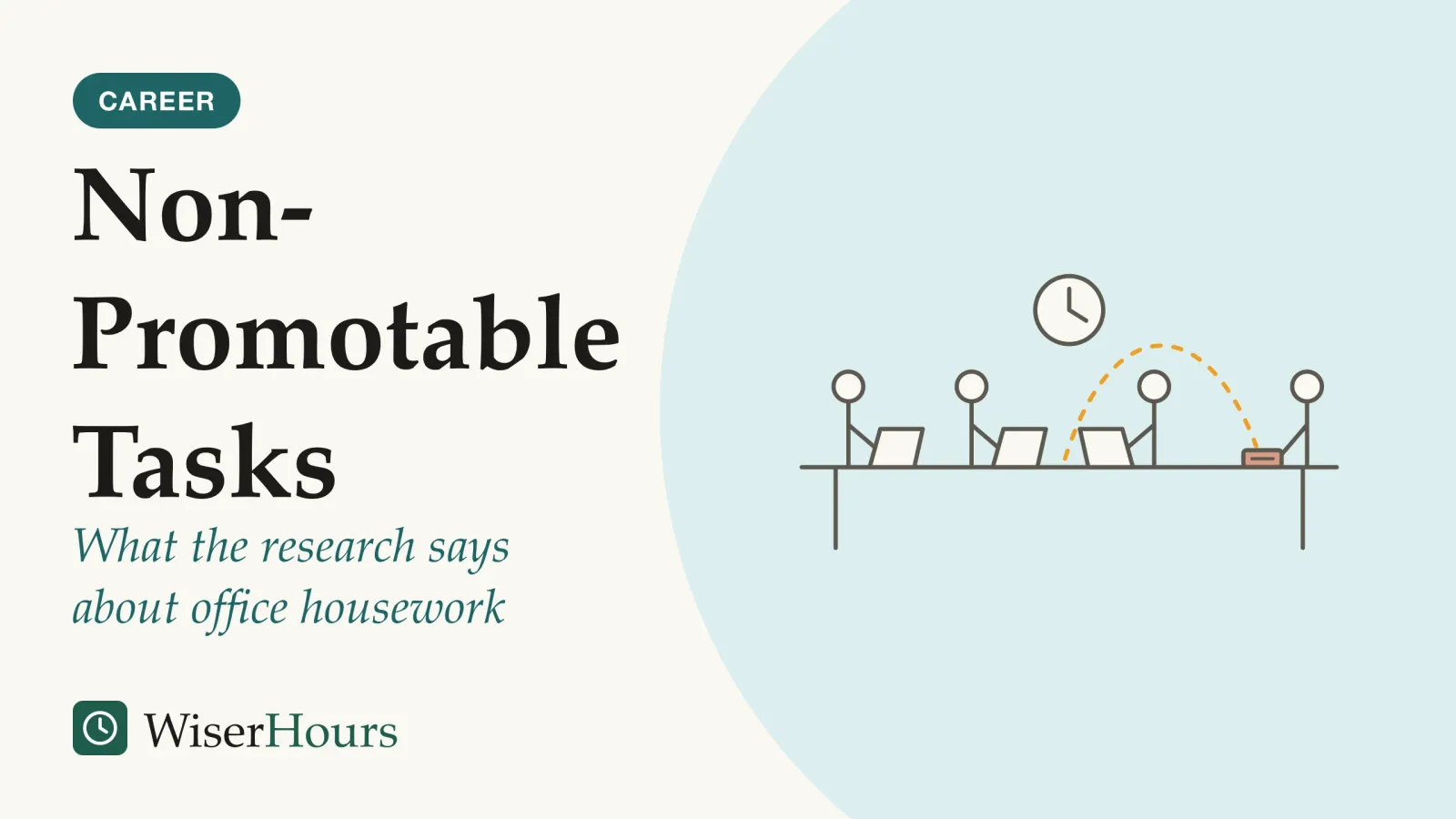
Every year, a large public university emails all of its faculty asking for volunteers to serve on faculty senate committees. In the 2012-13 round, more than 3,000 faculty got the same email and most ignored it. Women were more than twice as likely as men to say yes, so they made up about a quarter of the faculty yet over a third of the committee members.1
Non-promotable tasks, often called office housework, are work that helps an organization but does little for the career of the person doing it: meeting notes, event planning, onboarding, internal committees. Research in economics and higher education finds that women are asked to do more of this work and agree more often, partly because people expect them to. The practical answer is to spot these requests before you reply and keep your share in proportion; for managers, it is to stop asking for volunteers and rotate the work.
The wider research on what helps careers grow puts weight on skills that others can see and value. Office housework is the part of a job that seldom gets seen.
What non-promotable tasks are, and why they go uncounted
A task is non-promotable when it matters to the organization but will not help the person doing it advance. That is the definition Linda Babcock, Brenda Peyser, Lise Vesterlund and Laurie Weingart use in their 2022 book The No Club, three of whom ran the experiments described below.2
Promotion systems reward some work more than others. In industry, Babcock and her co-authors note in their 2017 paper, revenue-generating work may be seen as more promotable; in research universities, research may count for more than committee service. In a small survey of Carnegie Mellon faculty, almost 9 in 10 ranked research papers and conference talks above committee work as the best use of an assistant professor’s extra hours for promotion.1
Picture a project team of five. One person keeps the shared tracker up to date, books the rooms, writes up the notes and welcomes the new analyst. Another leads the client pitch. Both keep the project alive, but only the second shows up in the promotion case.
The label depends on the job: planning an offsite is non-promotable for a software engineer and core work for an events coordinator. And non-promotable does not mean unimportant.
Three questions for any new request
Will it count in how my performance is judged? Will the people who decide promotions see it? Is it part of my role? Two “no” answers suggest a non-promotable task. This is our suggestion, built from the definition, not a tested tool.
Who gets asked and who says yes
Women are asked to do non-promotable tasks more often than men and say yes more often when asked, according to experiments published in 2017 in the American Economic Review by Babcock, Maria Recalde, Vesterlund and Weingart. When people played the same volunteering game in groups of only women or only men, the gap between women and men disappeared, which points to expectations rather than preferences.1
The email data could not settle why women said yes more often; perhaps they simply liked committee work more. So the team built an unwanted task into a lab experimentlaboratory experiment: An experiment run under conditions the researchers set up and control, often with students doing short tasks. Control makes cause and effect easier to pin down, but the tasks are simpler than real life, so results do not always carry over to work or home.Full entry in the glossary, where everyone faced the same incentives.
The study
Moderate evidence
The button nobody wanted to press
In each of ten rounds, groups of three had two minutes to decide whether anyone would click a button. If nobody clicked, everyone earned the least; if someone did, the group did better, but the clicker earned less than the other two. In mixed groups, women clicked about 50% more often than men. In single-sex sessions, where people could see their group would be all women or all men, the gap disappeared. When a fourth player was told to ask one member to volunteer, both men and women asked women more often, and women who were asked agreed about three times in four, against about half of the men who were asked.1
The design separates preferences from expectations: the incentives were identical, and only the makeup of the group changed. The authors acknowledge the limit of scope: these were anonymous students playing for a dollar or two a round, not colleagues with reputations. A follow-up by three of the same authors, published later in 2017, found the gap again and no evidence that the threat of penalties for saying no widened it.3
After someone asks who can take notes, there is a pause. Everyone wants notes; nobody wants to write them. The experiments suggest the pause tends to end with whoever the room expects to fill it. The authors suggest that once this starts, it can feed itself, because each yes seems to confirm the expectation.1
- A task nobody wants: the group needs it done, and each person would rather someone else did it
- An expectation: in the 2017 experiments, people expected women to volunteer more than men
- More asks, more yeses: women were asked more often and, when asked, agreed more often
- The pile grows: the authors suggest the pattern can feed itself, as each yes seems to confirm the expectation
The pattern lives in the group, not in one person’s character, so the fix starts at the moment someone asks, on both sides of the question.
The same pattern in faculty service and company surveys
Outside the lab, studies of US faculty and a large survey of companies in the US and Canada find the same tilt: women report more internal service and more of the extra work that supports colleagues, which reviews seldom count. They describe who does the work, not why.
Cassandra Guarino and Victor Borden compared men and women of the same rank, race or ethnicity and field in two data sets: 2012 activity reports from a large Midwestern public university and a 2014 survey of faculty at more than 140 mostly US colleges. In both, women reported more service on average, mainly inside the university, such as department and campus committees, rather than service to communities outside it.4
A 2017 time-diary studydiary study: A study in which people record what they do or feel repeatedly, often daily or when prompted at random moments, close to when it happens; the prompted form is called experience sampling. It relies less on memory, but it is still self-report.Full entry in the glossary by KerryAnn O’Meara and colleagues adds the request side. In a small, self-selected sample of 111 faculty at US research universities who logged their work for four weeks, women received more new work requests than men.5
Company data point the same way. Women in the Workplace 2021 is company research by the consulting firm McKinsey & Company and the nonprofit LeanIn.Org, based on 423 companies in the US and Canada, which chose to take part; no peer review stands behind it. In it, senior-level women were roughly twice as likely as their male peers to spend substantial time on diversity and inclusion work outside their formal jobs, such as recruiting and supporting employee networks, yet fewer than a quarter of companies said they recognized that work to a substantial extent in performance reviews.6
A senior engineer who runs the women’s network and mentors every new hire may find that her review lists only the features she shipped. If a review form has no place for a kind of work, that work will count for little however well it is done. Before saying yes to work like this, ask your manager where it will show up in your review; if the answer is nowhere, that is part of the price.
What office housework costs the people who do it
The clearest cost is time: unless women work longer hours than men, Babcock and colleagues point out, time on less promotable tasks is time not spent on more promotable ones.1
A 2024 working paper, not yet peer-reviewed, measures the other half of the trade: who gets the visible assignments. Çağatay Bircan of the European Bank for Reconstruction and Development, with Guido Friebel and Tristan Stahl of Goethe University Frankfurt, studied personnel and project records from 2000 to 2018 at one unnamed international financial institution. Entry-level women were promoted at a markedly lower rate than men, but the gap was no longer statistically significant once the analysis accounted for credit on team results and for who was made team leader, a visible role women got less often than men with similar records.7
A 2021 peer-reviewed study by Seulki Jang, Tammy Allen and Joseph Regina, which we could read only in summary, found that women did more office housework than men, but a statistically significant link between that work and promotion only for men.8 No study we found has followed people’s non-promotable hours over years, so the size of the career cost is not known.
An invented but typical week shows how the hours pile up: four hours of onboarding, scheduling and event planning a week comes to about 190 hours over a 48-week year, roughly a month of full-time work that never appears in a promotion case.
Helping becomes a problem when it crowds out the work you are judged on.
Which requests to accept, trade or hand back
For individuals, the findings suggest two moves: recognize a non-promotable request before you answer, and keep your share in proportion rather than refusing all of it. These steps follow from the findings above; no study has put them to the test as a set.

- Buy a moment before you answer. In the experiments, the yes often came from the expectation in the room, so even a short delay turns a reflex into a choice. The wording for a delay or a refusal is covered in saying no at work while keeping the relationship intact.
- Know your current share. The No Club encourages readers to list their tasks, sort them into promotable and non-promotable, and notice how often they take the second kind on.2 Try two columns for last month: work your review measures and everything else.
- Keep the tasks that fit and trade the rest. A yes can come with a condition: notes this month if the role rotates next month, or the committee if another task comes off your plate.
- When you hand a task back, propose a system rather than a name. “Could we rotate this?” moves the job off you without passing it to the next person the room expects to agree.
- Report what you keep. Plain facts, as the guide to getting your work noticed without bragging explains, work for office housework too.
The book’s title comes from the authors’ own group of women who helped each other turn down dead-end work, and it suggests readers form one of five or six trusted peers.2
What managers and organizations can change
The biggest lever sits with whoever hands out the work. Babcock and colleagues suggest that when people’s skills are similar, organizations stop asking for volunteers and use turn-taking or random assignment instead, because the gap comes from who is asked and who feels expected to agree.1
One randomized trialrandomized controlled trial: A study that assigns participants to the treatment or the comparison group at random, so the groups start out alike and a difference in what happens next can be put down to the treatment. Random assignment makes the two groups comparable; it does not make the people in the trial representative of anyone else.Full entry in the glossary has tested an organizational fix. KerryAnn O’Meara, Audrey Jaeger, Joya Misra and colleagues, with money from the US National Science Foundation, matched 30 science and social-science departments at 16 public US colleges and universities in pairs and randomly chose which would join an 18-month program. Participating departments learned how bias shapes the division of work, built dashboards of each member’s teaching and service, and drafted action plans, drawing on options such as rotations for time-heavy roles. Afterward, their faculty were more likely than faculty in control departments to say teaching and service were shared fairly, and to report speaking up for themselves.9 The outcomes were faculty’s own reports shortly after the program, not measured workloads or promotions.
The Women in the Workplace authors argue that companies should formally recognize and reward extra work that supports colleagues, or it risks being relegated to office housework.6
For a team lead, the switch is small.
These are illustrations of the researchers’ suggestions, not tested policies. A rota is the simplest place to start: it changes who is asked without asking anyone to refuse.
How strong is the evidence on office housework?
The experiments are the firmest ground, and they measure a lab version of the problem. The workplace studies come mostly from US universities, gender is recorded as women and men throughout, and none tracks the career cost of office housework over many years.
The main lab result held up in India: in a 2026 adaptation of the game, Ritwik Banerjee and Priyoma Mustafi found the same volunteering gap among students, and a smaller gap when volunteers were publicly recognized.10
| Question | What the research found | Evidence |
|---|---|---|
| Do women volunteer more for an unwanted group task? | Yes in mixed groups; no gap in single-sex groups | Trial: lab experiments, US undergraduates, moderate1 |
| Are women asked more often? | Yes, by both men and women making the request | Trial: one lab experiment with 80 students, limited1 |
| Does the threat of penalties for refusing widen the gap? | No evidence that it did | Trial: lab follow-up, abstract read only3 |
| Do women faculty do more service? | Yes, mainly service inside the university | Observational: two mostly US data sets, self-reported4 |
| Are women faculty asked to do more? | They received more new work requests | Observational: four-week diaries, 111 faculty5 |
| Is extra inclusion work recognized at companies? | Fewer than a quarter of companies recognize it substantially | Company research, US and Canada, 20216 |
| Do promotable assignments explain promotion gaps? | Fewer team-lead roles and less team credit accounted for an entry-level gap | Observational: one firm, working paper7 |
| Can departments share work more fairly? | Faculty reported fairer workloads after the program | Trial: 30 US departments, perceptions only9 |
The weakest link is the cost to individual careers, which rests on one working paper, one study we could read only in summary, and reasoning rather than long-term measurement.
The bottom line
Women are asked to take on office housework more often and agree more often, partly because people expect them to. Know your share, trade what does not fit, and ask for a rotation when a task keeps coming back. If you hand out the work, stop asking for volunteers.
Frequently asked questions
Why don't organizations simply reward non-promotable tasks?
Partly because someone always ends up doing them. Linda Babcock and her co-authors argue in their 2017 American Economic Review paper that because these tasks get done regardless, hiring, pay and promotion decisions put more weight on the work that differs between people, such as publications or revenue. Doing office housework better therefore earns less than doing promotable work better. This is the authors' reasoning, not a tested finding.
Do men do non-promotable tasks too?
Yes. In Babcock and colleagues' 2017 experiments, men volunteered as well, and in all-male groups they volunteered about as often as women did in all-female groups. The authors also stress that saying yes is not a mistake: if nobody else will do a task the group needs, doing it can be the sensible choice. The problem the research describes is an uneven share, not the work itself.
Are some groups of women asked to do even more?
The company data suggest so. In Women in the Workplace 2021, company research by McKinsey & Company and LeanIn.Org covering firms in the US and Canada, Black women, LGBTQ+ women and women with disabilities in management roles were more likely than women overall to spend substantial time on diversity and inclusion work outside their formal jobs. It was not independently peer-reviewed.
Does the research apply outside the United States?
Only in part. The 2017 experiments used US undergraduates, the faculty studies cover mostly US universities, and the Women in the Workplace data come from companies in the US and Canada. A 2026 lab study in India found the same volunteering gap among students, and the 2024 working paper studied one international financial institution. How requests and refusals work in most other countries and cultures has barely been measured.
Sources
- Gender Differences in Accepting and Receiving Requests for Tasks with Low Promotability. Babcock, L., Recalde, M. P., Vesterlund, L. & Weingart, L. (2017). American Economic Review, 107(3), 714-747
- The No Club: Putting a Stop to Women's Dead-End Work. Babcock, L., Peyser, B., Vesterlund, L. & Weingart, L. (2022). Simon & Schuster; book by the researchers (authors' book site)
- Gender Differences in the Allocation of Low-Promotability Tasks: The Role of Backlash. Babcock, L., Recalde, M. P. & Vesterlund, L. (2017). American Economic Review, 107(5), 131-135
- Faculty Service Loads and Gender: Are Women Taking Care of the Academic Family? Guarino, C. M. & Borden, V. M. H. (2017). Research in Higher Education, 58(6), 672-694; working paper version: IZA Discussion Paper 10010, 2016
- Asked More Often: Gender Differences in Faculty Workload in Research Universities and the Work Interactions That Shape Them. O'Meara, K., Kuvaeva, A., Nyunt, G., Waugaman, C. & Jackson, R. (2017). American Educational Research Journal, 54(6), 1154-1186
- Women in the Workplace 2021. McKinsey & Company and LeanIn.Org (2021). Company research, not peer-reviewed
- Gender Promotion Gaps in Knowledge Work: The Role of Task Assignment in Teams. Bircan, Ç., Friebel, G. & Stahl, T. (2024). EBRD Working Paper No. 291, not peer-reviewed
- Office Housework, Burnout, and Promotion: Does Gender Matter? Jang, S., Allen, T. D. & Regina, J. (2021). Journal of Business and Psychology, 36(5), 793-805
- Undoing disparities in faculty workloads: A randomized trial experiment. O'Meara, K., Jaeger, A., Misra, J., Lennartz, C. & Kuvaeva, A. (2018). PLOS ONE, 13(12), e0207316
- Using Social Recognition to Address the Gender Difference in Volunteering for Low-Promotability Tasks. Banerjee, R. & Mustafi, P. (2026). Management Science, 72(5), 3997-4011; preprint arXiv:2012.13514 (2020)
How we researched this
To find lab experiments, faculty workload studies and company reports on non-promotable tasks, we checked Crossref, ERIC, RePEc, PLOS, PubMed Central, the American Economic Association site and publishers' own pages in September 2026, using full texts whenever they could be obtained. The sources run from 2017 to 2026. Main limitation: the strongest evidence comes from lab experiments with US undergraduates and most workplace data from US universities; only the abstracts of the 2017 backlash paper and the 2021 office-housework study were available, the 2026 lab study was read in its 2020 preprint, and The No Club was not read in full.
Keep reading
How to Be More Visible at Work Without Bragging
A 2003 meta-analysis of 31 studies found self-promotion did little for performance ratings or pay. What works better for visibility at work, and why.
Compa-Ratio and Range Penetration: The Pay Metrics HR Uses
A compa ratio of 1.0 means pay at the midpoint of its range. How compa ratio and range penetration are worked out, why they disagree and how they shape raises.

How to Ask for a Promotion (With Scripts)
How to ask for a promotion in 6 steps, from learning who decides to agreeing a follow-up date, with short scripts for opening, making the case and hearing no.
Performance Improvement Plan (PIP): What It Means and What to Do
A performance improvement plan often runs 30 to 90 days. What a PIP contains, how to read support from a paper trail, and what to do week by week.