Communication Styles Explained: Passive, Aggressive, Passive-Aggressive, Assertive
The 4 communication styles, where the model comes from, why your style shifts with the situation, and what style tests like DISC can and cannot tell you.

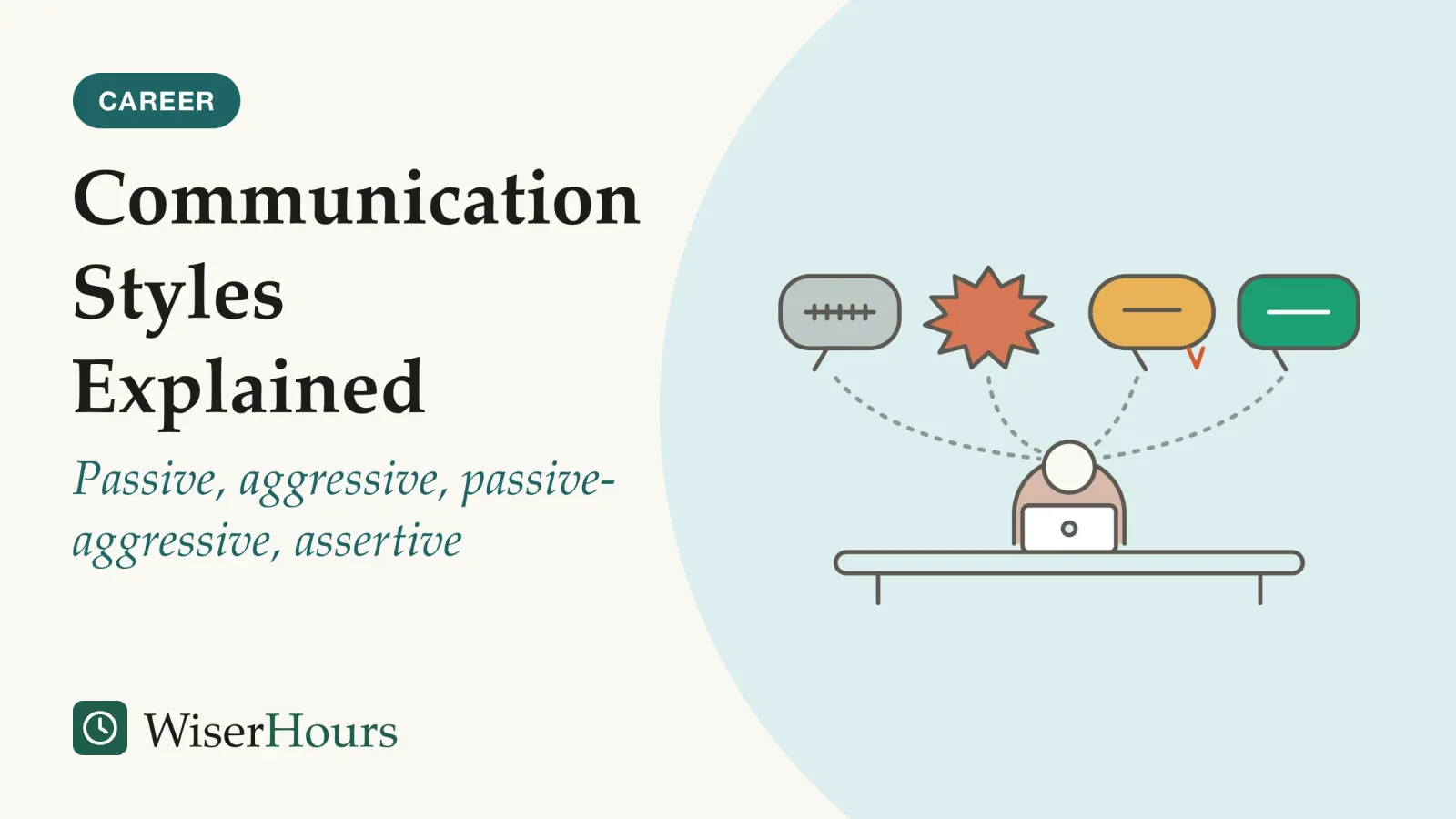
Nobody has just one communication style. In three experience-samplingdiary study: A study in which people record what they do or feel repeatedly, often daily or when prompted at random moments, close to when it happens; the prompted form is called experience sampling. It relies less on memory, but it is still self-report.Full entry in the glossary studies published in 2001, US college students who rated their own behavior several times a day, including how talkative and assertive they had been, varied from one report to the next about as much as they differed from one another.1 The same person can give way in one meeting and dig in at the next.
Communication styles are the four ways people tend to handle a moment when what they want and what someone else wants pull apart: passive (giving way and keeping quiet), aggressive (getting your way at the other person’s expense), passive-aggressive (resisting indirectly) and assertive (saying plainly what you want while respecting the other person). The model grew out of assertiveness training, a behavior-therapy technique that took shape between the late 1940s and the 1970s, and it was built to change behavior, not to sort people into types.2 So the useful question is less “which style am I?” than “which style do I slip into, and when?”
Prefer to watch? The video covers the same ground as this article.
What the four communication styles sound like when your week is full
Each of the four communication styles answers two questions differently: do you say what you want directly, and do you respect the other person’s rights while you say it? The University of Sydney’s counseling service defines the styles along roughly those lines, and the grid below lays them out.3
Each wrong answer fails in its own way. Holding back leaves the other person planning around a false picture of your week. Overriding them wins the point at their expense. Hiding the objection and letting it out later does a little of both, and leaves them unsure what you wanted.
Take one ordinary moment: your manager asks you to take on an extra piece of work by Friday when your week is already full. The replies in the table are illustrative; the descriptions come from the handout’s definitions.
| Style | What it might sound like | How the definitions describe it |
|---|---|---|
| Passive | “Sure, no problem.” Then you work the weekend and say nothing. | Not expressing honest thoughts and feelings, which violates your own rights3 |
| Aggressive | “That’s ridiculous. Plan better.” | Stating your position directly but at the other person’s expense3 |
| Passive-aggressive | “Fine.” Then the work arrives late with a pointed note that the timeline was always tight. | Expressing needs in an unclear, confusing way that leaves others feeling manipulated or frustrated3 |
| Assertive | “I can do it by Friday if the report moves to Monday. Which matters more to you?” | Direct, honest and appropriate, without violating the other person’s rights3 |
Only the assertive reply gives the manager accurate information and a real decision to make. Where assertive shades into aggressive is a question of its own; in this model, the test is whether the other person’s rights come through the sentence intact. If a plain no fits better than a trade, saying no at work has its own steps, from asking for time to offering a smaller yes. Before a hard conversation, draft the assertive line first: what you want, and what you are willing to trade for it.
The model began as assertiveness training
The four communication styles simplify ideas from assertiveness training, which psychologists Brittany Speed, Brandon Goldstein and Marvin Goldfried of Stony Brook University trace, in a 2018 review, to Andrew Salter’s 1949 book and Joseph Wolpe’s early behavior therapy. That tradition treats assertiveness as a continuum, with submissive behavior at one end and hostile, aggressive behavior at the other.2
Wolpe separated assertion from aggression as putting yourself up without putting the other person down. Robert Alberti and Michael Emmons, whose 1970 book was the first on assertiveness written for the public, described assertive behavior as acting in your own best interest and exercising your rights without denying the rights of others.2 Counseling handouts such as the University of Sydney’s list a fourth, passive-aggressive style: expressing needs in an unclear, confusing way that can leave others feeling manipulated or frustrated.3
Definition
In assertiveness training, communication styles are four broad patterns of behavior in moments of need or disagreement (passive, aggressive, passive-aggressive and assertive) that describe how someone handles a situation, not what kind of person they are.
The model was designed for people who wanted to change how they acted. The Stony Brook review explains that someone may fail to speak up because they lack the skill, because they fear how others will react, or both, and training targets whichever applies.2 A label that fixes you as “a passive person” works against that aim; a label for one response (“I went passive in that meeting”) gives you something to change.
A project lead who never objects in the weekly team meeting but argues firmly with suppliers lacks no skill. What differs is her sense of what objecting would cost her in front of the team, which is why the styles are best read as descriptions of moments.
Assertiveness is only one strand of the wider set of communication skills, but it is the strand this model was built to teach. Use the four labels on your own responses, one moment at a time, and keep them off yourself and your colleagues as fixed traits.
Your communication style shifts with the situation
Communication style changes with the setting and the people involved. In William Fleeson’s 2001 experience-sampling studies, college students’ ratings of how talkative, assertive and energetic they had just been swung widely from one report to the next, while each person’s average across the study period stayed remarkably stable.1
The study
Limited evidence
How far one person's behavior moves in two weeks
In the first of William Fleeson’s 2001 studies, 46 students at a small university in the southeastern US described how they had acted during the previous hour, five times a day for 13 days, using adjectives such as talkative and assertive. The typical student showed nearly every level of every trait over the fortnight, and people differed from themselves over time at least as much as they differed from each other. Yet each person’s average was almost perfectly stable, and two follow-up studies found the same broad pattern.1
You do have a usual way of acting, and you also move a long way from it depending on the hour, the company and the stakes. These were students rating themselves, and “assertive” was one adjective in a broader extraversion scale, not a measure of communication style.1
Assertiveness researchers saw the same pattern decades earlier. In a 1975 study, psychiatric inpatients role-played a set of situations, and their assertive behavior varied with the social context, which the researchers changed by making the partner male or female, familiar or a stranger.4
- Meeting with a senior leader: goes quiet and agrees to a deadline they doubt
- Team stand-up: says plainly what they need from a colleague
- Late email after a bad afternoon: comes out sharper than intended
- Client call: back close to their usual level
Top band: pushing too hard. Middle band: plain and direct. Bottom band: holding back. Dashed line: the person's usual level.
At work, the same person might speak plainly in a team stand-up, go quiet in front of a senior leader and fire off a sharp email after a bad afternoon. Rather than settle on a single label, map your own pattern: note the settings where you tend to go quiet and the ones where you push too hard.
Where passive-aggressive behavior comes from at work
Passive-aggressive behavior, resisting or retaliating indirectly instead of saying what is wrong, is often explained as a response to settings where open complaint feels risky. In a 1996 survey of 178 employed adults by researchers Robert Baron and Joel Neuman (the abstract does not say in which country), participants rated verbal and passive forms of aggression as more frequent in their workplaces than physical and active forms.5 The more recent changes, such as downsizing, people’s organizations had been through, the more workplace aggression they reported, an association that cannot show the changes caused it.5
One common explanation is that indirect resistance feels safer. In a 2022 paper developing a passive aggression scale with Korean adults, Young-Ok Lim and Kyung-Hyun Suh describe how feeling ignored or unfairly treated breeds resentment, and how, in societies where violence is strongly prohibited, people turn to indirect attacks expressed in words, timidly or without words at all.6 A missed meeting invitation, a slow reply or a pointed “as I said before” can each be explained away, which is exactly what makes them hard to address.
Take a colleague who agrees on Tuesday to review your draft by Thursday, then returns it the following Monday without a word. Calling that person passive-aggressive invites a denial. Naming the specific event and asking about it (“The review came back Monday rather than Thursday. Is something getting in the way?”) gives them a direct route to say what they could not say at the time.
The evidence here is thinner than the everyday talk suggests. A 2021 paper by clinical psychologists at Saarland University in Germany notes that research on aggression in mental disorders has focused on open aggression, and that passive-aggressive behavior has been studied less often, mainly because reliable ways to measure it were missing.7 If you lead a team, the resentment account above points to a second lever: make open disagreement easier, for example by asking for objections before a decision closes, so resistance has a direct route to take.
Assertiveness can be learned, and it can carry a likability cost
Assertiveness is treated as a learnable skill. The 2018 Stony Brook review describes training built on modeling, rehearsing conversations with feedback and challenging fears about how others will react, and reports that in early studies, including a 1980 randomized trial in which unassertive adults rated themselves, both rehearsal and rethinking those fears increased assertiveness. Most of that research dates from the 1970s to the 1990s and was done mostly in clinical settings, so how well it carries over to office life is much less clear.2
The review adds a clinical observation worth knowing. People who hold back usually fear that speaking up will make others think less of them, yet when asked, they often say it affects them badly when other people do not say what they want. The fear is often out of step with how others actually react.2
There is a real cost, though. In a 1982 study, college students who watched videotaped models handle conflict situations saw assertive models as skilled and able, but rated them much less likable than unassertive models.8 A 1986 study that asked people to rate the likability of assertive models found that adding empathic comments softened the negative impact of assertion.9 The review also cites research suggesting that women at work can face a double bind, judged harshly for assertiveness that breaks gender norms, yet also for failing to communicate effectively.2
A request can open with one sentence of recognition: “I know the launch is your priority, and I want it to go well. I can’t take on the extra testing this week; I can start it Monday.” The request stays clear, and the other person hears that their position was noticed.

What DISC and other style quizzes can tell you
Commercial style tests, including the many versions of DISC, have little independent evidence behind them, and the two independent evaluations found for this article raise more doubts than they settle. A 2013 review for the German psychological associations’ test board, by Cornelius König and Bernd Marcus, found that the persolog version reported no validation against job-related criteria, and concluded it could not be recommended for staff development or selection.10
The reviewers noted that the test rests on William Marston’s 1928 model of four emotional reaction patterns, which they judged of mainly historical interest by current standards, and that no evidence supported its sorting of people into types. Its scores were reasonably consistent when people retook it four weeks later, so the open question is what the results predict, not whether they repeat.10 A 2001 study of undergraduates found that the four dimensions of another DISC-type test were combinations of the widely researched Big Five personality traits rather than separate traits.11
DISC’s four letters are also a different scheme from the four communication styles, so a DISC result says nothing direct about passive or assertive behavior. Picture a team that spends a workshop afternoon sorting itself into four letters, after which one colleague starts explaining curt emails with “I’m a high D.” A quiz result can open a useful conversation about preferences. It should not decide who gets hired or promoted, or who handles a difficult client, and it should never excuse behavior.
The bottom line
Passive, aggressive, passive-aggressive and assertive describe what a person did in a particular moment, so use them on your own responses. The model comes from assertiveness training, and research on everyday behavior finds people shifting with the situation. Notice where you go quiet or push too hard, and prepare one clear, respectful sentence for those moments.
Frequently asked questions
What skills does being assertive include?
Psychologist Arnold Lazarus described four abilities in the early 1970s, as summarized in a 2018 review of assertiveness training: communicating your own wants and needs openly, saying no, expressing both positive and negative feelings, and starting, keeping up and ending conversations. Assertiveness is broader than standing your ground in a disagreement; it also covers asking for things and saying something warm.
Do gender and culture change how assertiveness is judged?
They appear to, but few studies have tested it. The authors of a 2018 review of assertiveness training note that gender, culture and ethnicity look important yet have rarely been studied as influences. Studies they cite found that the same assertive behavior can be judged differently depending on the situation and on gender.
How is passive communication different from passive-aggressive communication?
Passive communication holds back what you think and gives way, while passive-aggressive communication holds it back and then lets the resistance out indirectly. The University of Sydney's counseling service describes passive communication as not expressing honest thoughts and feelings, and passive-aggressive communication as expressing needs in an unclear, confusing way that can leave others feeling manipulated or frustrated.
Sources
- Toward a structure- and process-integrated view of personality: Traits as density distributions of states. Fleeson, W. (2001). Journal of Personality and Social Psychology, 80(6), 1011-1027
- Assertiveness training: A forgotten evidence-based treatment. Speed, B. C., Goldstein, B. L. & Goldfried, M. R. (2018). Clinical Psychology: Science and Practice, 25(1), e12216
- Effective communication (student handout). Counselling and Psychological Services, The University of Sydney (handout 1117/CAPS24)
- Situational determinants of assertive behaviors. Eisler, R. M., Hersen, M., Miller, P. M. & Blanchard, E. B. (1975). Journal of Consulting and Clinical Psychology, 43(3), 330-340
- Workplace violence and workplace aggression: Evidence on their relative frequency and potential causes. Baron, R. A. & Neuman, J. H. (1996). Aggressive Behavior, 22(3), 161-173
- Development and Validation of a Measure of Passive Aggression Traits: The Passive Aggression Scale (PAS). Lim, Y.-O. & Suh, K.-H. (2022). Behavioral Sciences, 12(8), 273
- Development and Psychometric Properties of the Test of Passive Aggression. Schanz, C. G., Equit, M., Schäfer, S. K., Käfer, M., Mattheus, H. K. & Michael, T. (2021). Frontiers in Psychology, 12, 579183
- Interpersonal reactions to assertive and unassertive styles when handling social conflict situations. Kelly, J. A., St. Lawrence, J. S., Bradlyn, A. S., Himadi, W. G., Graves, K. A. & Keane, T. M. (1982). Journal of Behavior Therapy and Experimental Psychiatry, 13(1), 33-40
- Assertive, empathic assertive, and conversational behavior: Perception of likability, effectiveness, and sex role. Wildman, B. G. & Clementz, B. A. (1986). Behavior Modification, 10(3), 315-331
- TBS-TK Rezension: Persolog Persönlichkeits-Profil. König, C. J. & Marcus, B. (2013). Report Psychologie, 38(7/8), 305-306; also Psychologische Rundschau, 64(3), 189-191
- Validation of an ipsative personality measure (DISCUS). Martinussen, M., Richardsen, A. M. & Vårum, H. W. (2001). Scandinavian Journal of Psychology, 42(5), 411-416
How we researched this
A September 2026 search combined Crossref, OpenAlex, Europe PMC and open-web queries on assertiveness, indirect aggression at work, how much one person's behavior varies across a day, and independent checks of commercial style tests; a University of Sydney handout illustrates how the model is taught. The oldest source is from 1975, the newest from 2022. Main limitation: the assertiveness literature is mostly decades old, five of the eleven sources could be read only as abstracts, and almost no study tests the four-style model in workplaces.
Keep reading
What Are Communication Skills? A Plain-English Guide to the Core Set
Communication skills explained: the core six, the two tests they are judged on, and why email senders in a 2005 study expected 78 percent accuracy but got 56.
Email Etiquette: 20 Rules Worth Keeping and a Few to Drop
Email etiquette for work: 20 rules by stage, from CC and reply-all to after-hours sending, plus 3 outdated rules to drop and what the research says.
Conversational Narcissism: How to Stop Making Every Conversation About You
Conversational narcissism is the habit of turning talk back to yourself. Derber's 2 kinds of reply, the research on follow-up questions, and 5 steps to stop.
Email Subject Lines for Work: How to Get Emails Opened and Answered
Email subject lines for work, not marketing: 5 rules, before-and-after examples for 6 common emails, and what a UK field experiment found about deadlines.