Conversational Narcissism: How to Stop Making Every Conversation About You
Conversational narcissism is the habit of turning talk back to yourself. Derber's 2 kinds of reply, the research on follow-up questions, and 5 steps to stop.

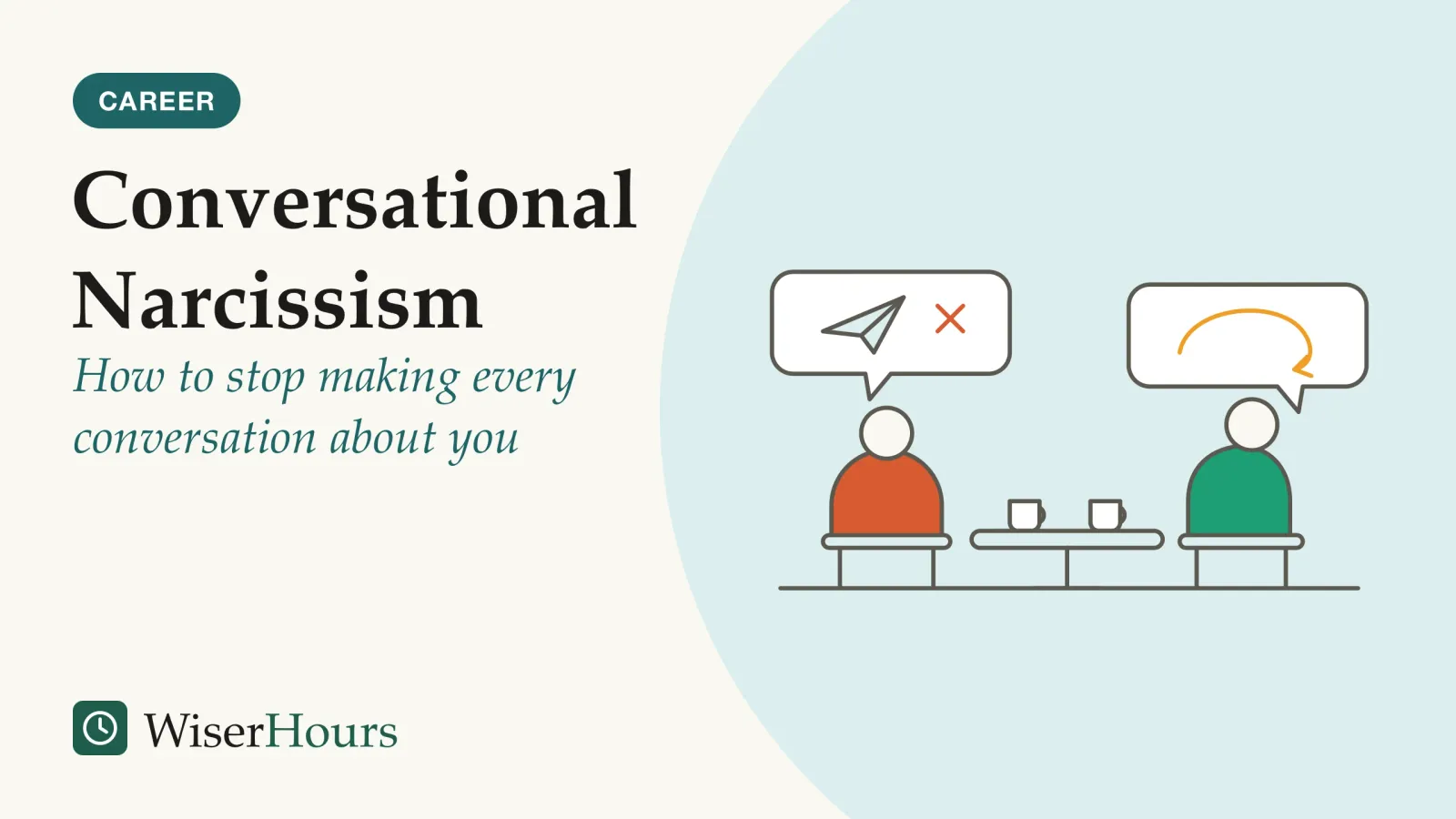
A colleague mentions that her flight home was cancelled and she spent the night at the airport. Before she gets to the rebooking desk, someone at the table says, “That’s nothing. I was stuck in Frankfurt for two days once,” and the next five minutes belong to Frankfurt. Nobody meant any harm, and nobody asked how she got home.
Conversational narcissism is the sociologist Charles Derber’s name for that move: steering a conversation back to yourself, usually through small replies that sound friendly. He described it in his 1979 book The Pursuit of Attention.1 It is a habit, and habits can be changed. The clearest evidence on what to do instead comes from Harvard experiments published in 2017, in which strangers liked people who asked them more questions, follow-ups above all.2 To stop making every conversation about you:
- Notice the urge to shift
- Give a support response first
- Ask a follow-up question
- Share your story once they feel heard
- Ask only questions you want answered
Conversational narcissism is one listening habit among many, and what communication skills are and how they fit together maps the wider set.
What is conversational narcissism?
Conversational narcissism is the habit of pulling the attention in a conversation toward yourself. The sociologist Charles Derber argued that people compete for attention in everyday talk, and that they mostly do it subtly, because nobody wants to be judged an egotist.3
Derber built the idea from ordinary talk: the journalist Kate Murphy reports that he recorded and transcribed more than a hundred informal dinner conversations.4 He tied the habit to American life in particular, arguing that weak social support pushes people to compete for attention.3 That cultural claim comes from one sociologist looking at one country, so treat it as his interpretation. The replies he described turn up in meetings and family dinners in any language.
At work it rarely looks like a monologue. A teammate says the client pushed the launch back a month, and the reply is “Same thing happened to us at my last job.” Each turn is short and polite. Over an hour, though, the attention keeps drifting to the same person.
Later researchers tested whether people recognize the pattern. In six studies published in 1990, Anita Vangelisti, Mark Knapp and John Daly found that people linked conversational narcissism to behaviors such as boasting, steering the topic back to themselves, and glazing over while others talk. People who role-played those behaviors were rated as less socially attractive.5 You will usually spot these replies in a colleague long before you hear them in your own voice, which is why the steps later in this guide start with noticing.
Shift response vs support response
A shift response moves the focus from the speaker to the person replying; a support response keeps the focus on the speaker and their topic. Wikipedia’s summary of Derber’s book gives the classic example: to “I’m feeling really starved”, “Oh, I just ate” shifts, while “When was the last time you ate?” supports.3 A summary in The Art of Manliness adds that most people with the habit mix the two, using just a few more shift responses until the topic is theirs.6
- Shift response: "I'm feeling really starved." "Oh, I just ate." The topic moves to the person replying.
- Support response: "I'm feeling really starved." "When was the last time you ate?" The topic stays with the speaker.
Murphy uses a second example. Someone says their dog got out and took three days to find. “My dog is afraid of his own shadow” shifts. “Oh no, where did you finally find him?” supports. In Derber’s recordings, she writes, shift responses were the more common kind.4
The same summary describes three forms a support response can take, each more engaged than the last: background acknowledgments (“uh-huh”), supportive assertions (“that’s great”) and supportive questions (“what are you going to do now?”). It also describes a quieter, passive form of the habit. Instead of jumping in with your own story, you hold back support responses until the other person’s topic runs out of air and the floor comes to you.6
A shift is not rude in itself. Conversations need both kinds of reply, and a single shift can be an offer of fellow feeling. The trouble starts when shifts are your default and support responses only fill the pauses.
A quick test
Listen to the first word of your reply. “I” and “my” usually mark a shift; “what”, “how” and “you” usually mark support.
Why talking about yourself feels so good
Talking about yourself feels rewarding because, in brain-imaging and behavioral experiments by Harvard psychologists Diana Tamir and Jason Mitchell, published in 2012, sharing your own thoughts engaged the same reward system that responds to food and money. People would even pay to do it.7
In one of their studies, 37 people chose, trial after trial, between answering questions about themselves, judging someone else’s opinions, or answering a factual question, with each task paying a slightly different amount. Choosing to talk about themselves cost them, on average, about 17 percent of what they could have earned.7 The sums were cents, so the finding shows a preference, not an addiction. It still suggests that the pull toward your own story is an ordinary response to reward and no verdict on your character.
The authors suggest the urge may serve people well, for example by building social bonds.7 Each sample was small, the studies were run at US institutions, and a lab tasklaboratory experiment: An experiment run under conditions the researchers set up and control, often with students doing short tasks. Control makes cause and effect easier to pin down, but the tasks are simpler than real life, so results do not always carry over to work or home.Full entry in the glossary is far from a lunch conversation. Even so, an urge this ordinary is easier to manage with a plan for what to do with it than with an effort to stop feeling it.
Is talking about yourself a sign of narcissism?
Talking about yourself is not, on its own, a sign of narcissism. Conversational narcissism describes a pattern of replies that most people slip into. Narcissistic personality disorder is a diagnosis in the DSM-5-TR manual that, according to the US hospital group Cleveland Clinic, a healthcare provider, usually a psychiatrist or psychologist, makes through a clinical conversation; an online quiz cannot.8
Cleveland Clinic describes the disorder as more than arrogance or selfishness: an excessive need to impress others or feel important, strong enough to drive harmful behavior.8 Telling a colleague about your weekend is nowhere near that. Derber’s word borrows from the clinical term to describe a habit of conversation.
- Myth
- If you keep turning conversations to yourself, you are probably a narcissist.
- Fact
- Conversational narcissism is a habit of replies. Narcissistic personality disorder is a clinical diagnosis that only a qualified professional can make.
Self-disclosure is also part of being good company. The people in Vangelisti’s 1990 studies named situations where focusing on yourself was the appropriate move, and the authors concluded that whether it reads as narcissism depends on what both people want from the conversation.5 When a friend asks how your interview went, answering at length is responsive. The habit to watch is taking the floor when the other person was still using it.
If you worry that a pattern in yourself or someone close to you goes beyond conversation, for example it keeps damaging relationships, Cleveland Clinic advises seeing a trained, qualified provider instead of relying on an online test. Wherever you live, a family doctor or a licensed mental health professional can be a first step. Anyone with thoughts of harming themselves or others should call their local emergency number now (911 in the US).8
Follow-up questions make people like you more
Asking more questions makes people like you more, and follow-ups account for much of the effect, according to experiments by Karen Huang and colleagues at Harvard published in 2017. Their explanation is responsiveness: a good question shows that you listened, understood and care to know more.2
The study
Moderate evidence
Strangers warmed to the partner who kept asking
Huang’s team brought 398 strangers into a US university lab and paired them for a 15-minute online chat whose stated aim was to get acquainted. Each pair’s condition was set at random, and one partner in every pair got a private instruction: ask nine questions or more, or ask four or fewer. Chat partners rated the high-question group as more likable, and across this and a second chat study the paper traced the effect mainly to follow-up questions. Speed-dating records pointed the same way: daters who asked more follow-ups had better odds of a yes to a second date. The researchers also found that people do not expect question-asking to raise liking. An independent audit led to a 2025 correction of several small reporting errors, and the conclusions stood.2
The researchers defined a follow-up as a question on something the partner had just mentioned, almost always in the previous turn, so you cannot ask one without listening.2 The partners were strangers getting acquainted, and a good impression after 15 minutes says little about trust built over months with a colleague. The habit itself transfers to any conversation. When a teammate says the client pushed the launch back, “What reason did they give?” beats “That happened to us too,” and it costs nothing.
The finding that people did not see this coming matters most here. If you underrate questions, you will keep reaching for a story when a question would do more.
Boomerasking: questions that come back to you
Boomerasking is asking someone a question only so you can answer it yourself, a pattern named by Alison Wood Brooks of Harvard Business School and Michael Yeomans of Imperial College London in a 2025 paper. You ask “How was your weekend?”, wait through the answer, then explain that yours was amazing.9
The paper describes three types: ask-bragging, which leads into good news about yourself; ask-complaining, which leads into a complaint; and ask-sharing, which leads into something neutral, such as a strange dream. People who boomerask think they make a good impression. According to the paper’s summary, their partners see them as insincere and less interested in the partner’s view, and prefer people who simply share outright.9 The full paper was not open to read, so this guide reports no effect sizes or study details beyond its summary.
The boomerask is a shift response dressed as a support response, which is why it can fool the person doing it. If you want to share your news, share it plainly. If you ask a question, follow up on the answer before you offer yours.
How to stop making conversations about yourself
To stop making conversations about yourself, change what you do in the few seconds after someone finishes a sentence. These five steps put the research above in the order you would use them. The evidence behind each is uneven, so treat them as practice suggestions.
1. Notice the urge to shift
Expect the pull toward your own story. A reliable sign is that you have stopped listening and started rehearsing. When you catch yourself waiting for a gap, hold the story for one more turn.
2. Give a support response first
Make your first reply about the speaker’s topic. A supportive question keeps them talking more than a nod or a “that’s great” does.6 When a colleague says the audit took all week, “What took the longest?” keeps the floor with them.
3. Ask a follow-up question
Build your next question from their last answer, the kind Huang’s team linked to being liked.2 The easiest follow-up borrows a word they used: if they said the meeting was “tense”, ask what made it tense. To check you have understood a hard conversation, the restating habits in active listening do the rest.
4. Share your story once they feel heard
Your story is welcome once the other person has told most of theirs. The Art of Manliness’s reading of Derber suggests letting the speaker finish first, then sharing your experience, then turning back to them.6 Keep yours shorter than theirs and end it with a question: “That happened to me in Frankfurt once. How did you finally get home?”
5. Ask only questions you want answered
Ask a question when you want the answer, and follow up on it. If you mostly want to tell your own news, tell it directly and skip the question.
After your next conversation
A one-week practice plan
A week of small, deliberate practice gives each new reply a day or two of use before the next one is added. No one has tested this plan as a whole; it simply orders the steps above from easiest to hardest, using everyday conversations you already have.
- Day 1Only notice. In one conversation, count your shift responses without changing anything.
- Day 2In one conversation, give a support response before every reply about yourself.
- Day 3Ask one follow-up question in each conversation, built from a word the other person used.
- Day 4Hold your own story until the other person has finished theirs, then hand back with a question.
- Day 5Watch your questions. Drop any you were asking only to give your own answer.
- Day 6Try all four moves in one longer conversation, such as a lunch or a one-on-one.
- Day 7Count your shift responses again, in a conversation like the one on day 1.
Days 1 and 7 give you a rough before and after. The count will be imperfect, since you are listening to yourself while talking, but a lower number on day 7 may suggest the new replies are starting to come more easily. If one step feels forced, repeat that day before moving on.
Which of these claims rest on solid ground?
Research on conversational narcissism is uneven: Derber’s distinction rests on his observations and on later summaries, while the strongest tests come from short lab conversations between strangers. The table rates each claim this guide relies on.
| Claim | What the best evidence found | Evidence |
|---|---|---|
| Shift and support responses | Derber’s analysis of recorded dinner conversations; known mostly through summaries of his book | Observational, limited4 |
| People recognize conversational narcissism and judge it | Six studies linked it to boasting and topic-shifting; role-players acting it out were rated less socially attractive | Mixed designs, limited (abstract only)5 |
| Talking about yourself is rewarding | Reward regions responded to self-disclosure; people gave up money to talk about themselves | Lab experiments, moderate7 |
| Follow-up questions raise liking | Strangers told to ask many questions were better liked, much of it through follow-ups | Randomized trials, moderate2 |
| Boomerasking backfires | Boomeraskers seemed insincere; plain sharing was preferred | Experiments, limited (abstract only)9 |
The bottom line
Make your first reply about the other person’s topic, and ask one follow-up before you offer anything of your own. Your stories still have a place, after theirs. Start with day 1 of the plan in your next conversation and count your shift responses.
This article is general information, not medical advice. If you're worried about your health, talk to a doctor or another qualified professional.
Frequently asked questions
Is sharing a similar experience always a shift response?
No. A related story can show that you understand, and a 1990 set of six studies by Anita Vangelisti and colleagues found people could name situations where focusing on yourself is appropriate. Timing decides how it lands. The Art of Manliness's summary of Derber's work suggests letting the other person tell most of their story first, then sharing yours and looping the conversation back to them.
What are the three kinds of support response?
The Art of Manliness's summary of Charles Derber's book describes three, in rising order of engagement. Background acknowledgments are small signals such as "uh-huh" or "hmm". Supportive assertions show you are following, such as "that's great". Supportive questions ask for more, such as "what are you going to do now?" Questions do the most to keep a speaker going.
Has conversational narcissism been studied by researchers?
Yes, though not often. Besides Charles Derber's 1979 book, communication researchers Anita Vangelisti, Mark Knapp and John Daly published six studies in 1990. People described conversational narcissism through behaviors such as boasting, steering the topic back to themselves and glazing over when others spoke, and role-players who acted it out were rated as less socially attractive.
Sources
- The Pursuit of Attention: Power and Individualism in Everyday Life (library record). Derber, C. (1979). Boston: G. K. Hall; reprinted by Oxford University Press, 1983; record at the Internet Archive
- It doesn't hurt to ask: Question-asking increases liking. Huang, K., Yeomans, M., Brooks, A. W., Minson, J. & Gino, F. (2017). Journal of Personality and Social Psychology, 113(3), 430-452; correction 2025, 128(3), 669
- Conversation (section: Narcissism). Wikipedia, accessed November 2026
- Are You a Conversational Narcissist? Here's How to Find Out. Murphy, K. (2020). Next Big Idea Club magazine, 7 April 2020
- Conversational narcissism. Vangelisti, A. L., Knapp, M. L. & Daly, J. A. (1990). Communication Monographs, 57(4), 251-274
- How to Avoid Conversational Narcissism. McKay, B. & McKay, K. (2020, first published 2011). The Art of Manliness, summarizing Derber's The Pursuit of Attention
- Disclosing information about the self is intrinsically rewarding. Tamir, D. I. & Mitchell, J. P. (2012). Proceedings of the National Academy of Sciences, 109(21), 8038-8043
- Narcissistic Personality Disorder. Cleveland Clinic (US), medically reviewed, last updated 3 August 2023
- Boomerasking: Answering your own questions. Brooks, A. W. & Yeomans, M. (2025). Journal of Experimental Psychology: General, 154(3), 864-893
How we researched this
In November 2026 this guide's sources were gathered from Crossref, OpenAlex, PubMed and general web searches, looking for Charles Derber's idea and for experiments on self-disclosure, question-asking and boomerasking. Tamir and Mitchell (2012) and Huang and colleagues (2017) were read in full; for Vangelisti and colleagues (1990) and Brooks and Yeomans (2025) only abstracts were available. Derber's book could not be opened, so its content comes from published summaries. Nearly all the experiments involve brief chats between strangers, in US labs or online.
Keep reading
Active Listening Explained: What It Is and How to Practice It
Active listening, from its 1957 origin to the experiments: what it is, what feeling heard does for a speaker, and five steps to practice it at work.

Email Etiquette: 20 Rules Worth Keeping and a Few to Drop
Email etiquette for work: 20 rules by stage, from CC and reply-all to after-hours sending, plus 3 outdated rules to drop and what the research says.

Email Subject Lines for Work: How to Get Emails Opened and Answered
Email subject lines for work, not marketing: 5 rules, before-and-after examples for 6 common emails, and what a UK field experiment found about deadlines.

The Culture Map Explained: Eight Scales for Working Across Borders
The Culture Map's 8 scales, from feedback to scheduling, why relative position matters, what the research behind it shows, and a team mapping exercise.