Wage Garnishment Explained: How It Works and What Protections Exist
Wage garnishment explained: how a debt becomes a paycheck deduction, US limits such as 15% for federal student loans, protected income and free help.

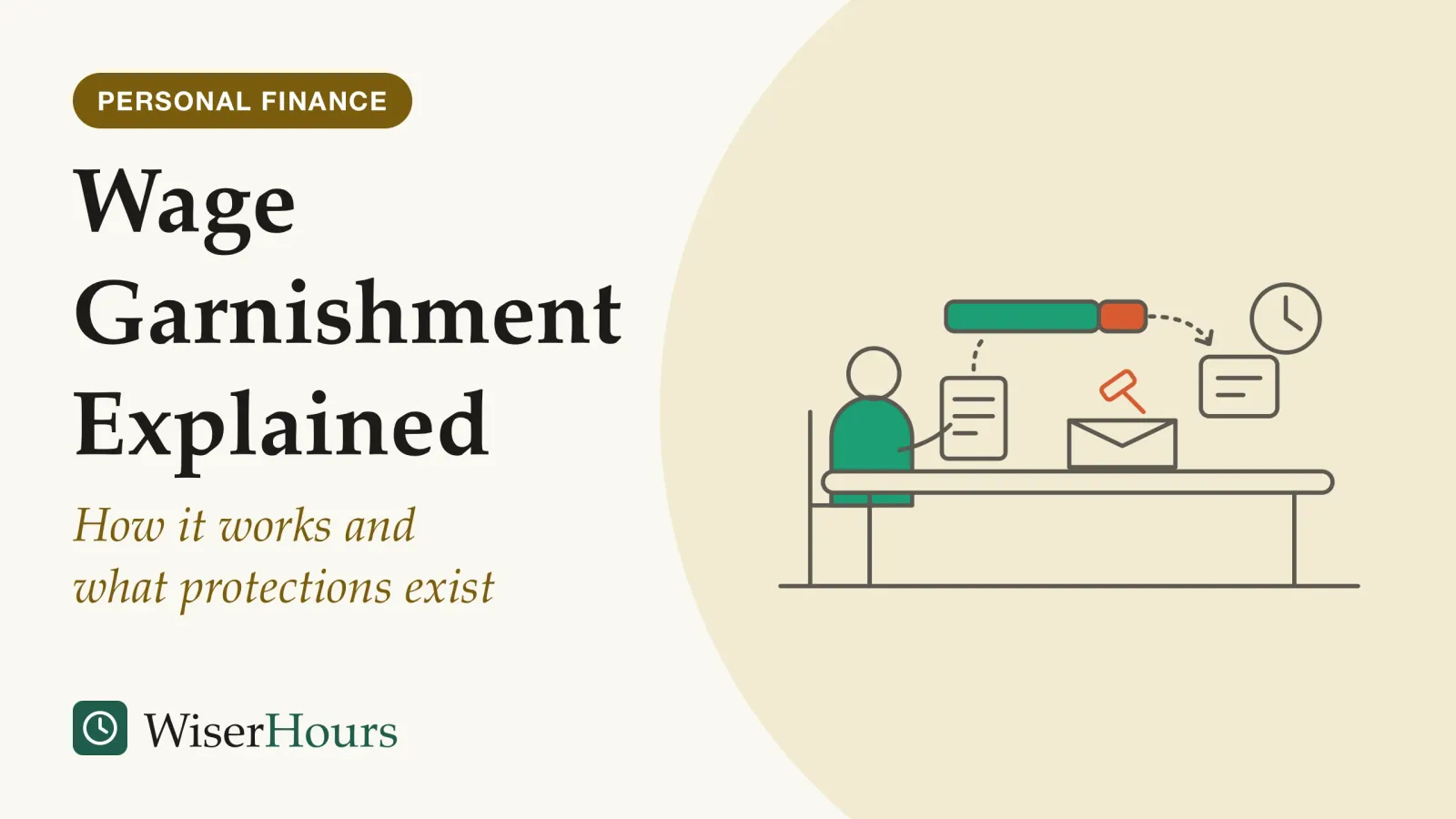
In the US and in England and Wales, falling behind on a debt does not, by itself, let an ordinary creditor reach into your pay. Wage garnishment is a legal order that makes your employer hold back part of each paycheck and send it to someone you owe, and it comes at the end of a sequence: a debt goes unpaid, a creditor wins a court judgment (or a government agency uses its own collection powers), the employer receives the order, and the deductions run until the debt is paid or the order is lifted.
The protections are real but local. In the US, federal law caps how much an ordinary creditor can take, protects most federal benefits and stops an employer from firing you over garnishment for one debt, and many states go further. Other countries have their own versions, such as the attachment of earnings order in England and Wales. If papers have already arrived, three things matter most: the deadline printed on them, the legal cap on the deduction, and free advice before that date.
If you are earlier in the story, with a balance growing but no court involved yet, start with how principal, interest and time drive what you owe. More on borrowing, credit records and repayment is in the debt and credit section.
How wage garnishment works, from missed payment to payslip
Under US Department of Labor guidance, a wage garnishment is any legal or equitable procedure that requires part of a person’s earnings to be withheld to pay a debt, and most are made by court order. Tax agency levies and federal agencies’ administrative garnishments for non-tax debts also count.1
A court sits in the middle because your pay is yours until a judge, or an agency with its own legal power, says otherwise. In the US, a card issuer or a hospital cannot simply write to your employer; it has to sue, win and ask for an order. The Consumer Financial Protection Bureau (CFPB) explains that most creditors can garnish wages only once a court has issued a judgment, and the order generally covers the judgment plus interest, fees or collection costs.2
- 1Debt unpaidpayments stop
- 2Lawsuitcourt papers with a reply deadline
- 3Judgmentthe court rules you owe it
- 4Order to employeror an agency acts on its own power
- 5Deductionseach payday until paid or lifted
Seen from the debtor’s side, letters from a collector arrive and are put in a drawer. Then a set of court papers arrives with a date on it. Whether anyone answers it decides much of what happens next.
The court papers are the point where you still have the most choices. The Federal Trade Commission (FTC) tells US readers to respond by the date in the papers, in person or through a lawyer, and warns that ignoring a lawsuit can cost you the chance to fight a garnishment order.3
- Myth
- A debt collector can start taking your pay as soon as you fall behind.
- Fact
- In the US, most creditors need a court judgment first. The exceptions are mainly government debts: taxes, federal student loans and child support.
Can wages be garnished without a court order?
Yes, for some debts owed to government. The CFPB says federal and state agencies can sometimes garnish pay, benefits or bank accounts without a court order: states can generally garnish wages to pay child support, and federal agencies such as the IRS or the Department of Education can take up to 15 percent of Social Security benefits.2
Two routes matter most in the US, alongside child support:
- Taxes: the IRS says that once it levies your wages, part of each paycheck goes to it until the tax is paid, you make other arrangements or the levy is released. The amount you keep is worked out from the standard deduction and your dependents, and your employer gives you a form to return within three days; if you miss that, the exempt amount is figured as if you were married filing separately with no dependents.4
- Federal student loans: the Department of Education’s rules require written notice at least 30 days before it starts. Before garnishment begins, you can inspect the records, agree a repayment plan or ask for a hearing, including on whether you have been back at work for less than 12 months after losing a job involuntarily. A hearing request made by the deadline in the notice holds off the order until a decision is made.5
Student loan collection is also in flux. In January 2026 the Department of Education announced a temporary delay of administrative wage garnishment on federal student loans while it put repayment changes in place.6 As of October 2026 we found no restart date announced by the Department of Education, so check StudentAid.gov or your loan servicer before relying on the pause.
If the letter comes from a government agency rather than a court, read the deadline first. The hearing and repayment options are offered before the deductions start.5
How much of my paycheck can be garnished?
For ordinary debts in the US, federal law lets a creditor take at most 25 percent of your disposable earnings, and less, or nothing, if your pay is low, according to the Department of Labor’s December 2024 fact sheet on the Consumer Credit Protection Act. “Disposable earnings” means pay left after legally required deductions such as taxes, Social Security and Medicare, not after voluntary ones such as union dues or health insurance.1
The study
Strong evidence
US Department of Labor, Fact Sheet #30 (December 2024)
For ordinary garnishments, the weekly amount is the lesser of two figures: a quarter of disposable earnings, or the amount by which disposable earnings exceed 30 times the federal minimum wage (US$7.25 an hour as of October 2026). So weekly disposable earnings of US$217.50 or less cannot be garnished at all. The cap holds however many orders the employer receives, and where a state law allows less to be garnished, the lower amount applies.1
Under the federal rule, the floor is what keeps low pay safe from ordinary creditors. The fact sheet’s own worked example: a worker with US$233 of disposable earnings in a week can have only US$15.50 garnished, the part above the floor.1 The drawing below shows the same tests for three weekly paychecks.
- Protected floor: weekly disposable earnings of $217.50 or less (30 times the $7.25 federal minimum wage) cannot be garnished for an ordinary debt
- Just above it: between $217.50 and $290, only the amount above $217.50 can be taken
- $290 or more: at most 25% of disposable earnings, however many orders the employer receives
paid to the worker most that can be garnished (US federal rule, weekly pay; amounts illustrative)
Some debts get higher limits. Child support and alimony orders can take up to 50 percent of disposable earnings if the worker supports another spouse or child, or 60 percent if not, plus 5 percent more when payments are over 12 weeks behind. Defaulted federal student loans and other federal non-tax debts are capped at 15 percent, and the percentage limits do not apply to tax debts or certain bankruptcy court orders.1
To check your own deduction, take one payslip, subtract only the deductions the law requires, and apply both tests. If the employer took more, the Department of Labor’s Wage and Hour Division enforces these limits against employers and answers questions free of charge on 1-866-487-9243.1 Bring the payslip and the order.
Can my employer fire me because of a wage garnishment?
Not over a single debt, under US federal law. The Consumer Credit Protection Act bars an employer from firing a worker whose pay is garnished for any one debt, however many levies or proceedings are brought to collect that one debt.1
The gap is a second debt. Federal law protects you for one debt, not two. Suppose a card balance is already being garnished and an old medical bill then reaches judgment as well (an illustrative case): the federal job protection no longer covers both, so a second creditor’s order is the point to check your state’s law or ask legal aid.
What income cannot be garnished?
Most federal benefits are generally off-limits to ordinary creditors in the US. The FTC lists Social Security, Supplemental Security Income, veterans benefits, federal student aid, military annuities, railroad retirement and federal disaster aid among benefits generally exempt from court-ordered garnishment, except to pay taxes, child or spousal support, or student loans.3
The protection follows the money into your bank account, up to a point. The CFPB says banks must protect two months’ worth of directly deposited federal benefits before freezing or garnishing an account, and that you can claim the same protection for benefits deposited by check.2
Some pay does not count as earnings under the US federal rule: tips beyond the cash wage and any tip credit, and employer education assistance payments. Bonuses, commissions and severance pay do count.1 States add their own exemptions, and the CFPB points readers to LawHelp.org to find what their state protects and how to claim it.2
The difference is who has to act. The two months of directly deposited benefits are for the bank to protect; benefits paid by check, and state exemptions, may have to be claimed, and the CFPB suggests a consumer lawyer can help you claim them.2 If an account that receives benefits is frozen, keep the statements that show which deposits are benefits.
Attachment of earnings and the rules elsewhere
Outside the US, the same idea runs under other names, and an international labour standard sets the principle. The International Labour Organization’s 1949 Protection of Wages Convention says wages may be attached only within limits set by national law.7
Wages shall be protected against attachment or assignment to the extent deemed necessary for the maintenance of the worker and his family.
In England and Wales, a creditor with a county court judgment that is not being paid can ask the court for action, including a deduction from earnings; Scotland’s law is different.8 The tool is an attachment of earnings order. The order sets a “normal deduction rate” and a “protected earnings rate”, the minimum you must still take home, and the employer cannot make the normal deduction if it would take you below that rate. Orders for maintenance or fines take priority over those for civil debts, and an employer that fails to deduct can be fined.9
There is a UK route without a court as well. The Department for Work and Pensions can ask an employer to take benefit overpayments from pay through a Direct Earnings Attachment, at percentages that rise with earnings.10
Elsewhere, check your country’s own rules with a government consumer or money service, a court service or a free debt advice charity.
How do I stop a wage garnishment?
You may be able to stop or reduce one by acting early: answer court papers, check the deduction against the legal cap, claim exemptions, ask for an affordable plan, and get free advice. Which steps apply depends on who issued the order and where you live.
Deadlines come first
Court papers and agency notices carry dates. Find the date first: every step below works best, and some work only, before it passes.
1. Answer the court papers
The FTC tells US readers to respond by the date in the papers, yourself or through a lawyer, and not to ignore the lawsuit.3 GOV.UK explains that in England and Wales you can ask to have a judgment set aside if you do not owe the money or never received the original claim, and can ask the court to change the payment terms.8
2. Check the deduction against the cap
Use one payslip and the two tests above. If the deduction is higher than the US federal or state limit, raise it with payroll first and then with the Wage and Hour Division, which enforces the federal limits.
3. Claim exemptions
Benefits, part of your wages and some bank balances may be protected, as described above. Ask the court named on the order, legal aid or a consumer lawyer how to claim those protections where you live.
4. Ask for a payment plan
The route depends on who issued the order. Both IRS levies and Department of Education garnishment, described above, leave room to arrange payment. In England and Wales, you can apply to change the payment terms of a judgment with form N245, saying what you can realistically afford.8
5. Get free advice
For US readers, the CFPB says most credit counselingcredit counseling: Help with budgeting and debts from a trained counselor, which in the US usually comes from a non-profit organization and may include a debt management plan. Not every provider is non-profit or free, and some have defrauded people, so check fees and credentials first.Full entry in the glossary organizations are non-profits whose help is free or cheap, though some charge fees; ask what any service will cost before you sign up.11 Legal aid offices can help with court papers. In England and Wales, GOV.UK sends readers to MoneyHelper to find a free debt adviser, who can ask for Breathing Space on your behalf: up to 60 days in which, according to GOV.UK, enforcement action cannot be taken against you, though repayments must continue.12
If an order or notice arrives
Who to call first, by how urgent it is
Free help exists at every level of urgency, and the right first contact for a garnishment depends on how close a deadline or a crisis is.
- Now: if you are having thoughts of suicide or of hurting yourself, whatever the cause, call your local emergency number now, or a suicide prevention line in your country. In the US, the 988 Suicide & Crisis Lifeline is free and confidential, open around the clock by phone, text or chat.13 In the UK, a free call to Samaritans on 116 123 reaches someone at any hour.14
- Soon, within days: if court papers, a notice of proposed garnishment or an order has arrived, contact legal aid, a non-profit credit counselor or a free debt adviser early enough to meet the date in the papers.
- Routine: if pay is already being garnished at the right amount, ask a free adviser whether a plan, an exemption or another option fits your situation better.
The bottom line
Wage garnishment is the end of a sequence, and most of your choices sit earlier in it, at the court papers or the agency notice. If an order is already running, check it against the legal cap, claim what is protected and ask for a plan you can afford. Legal aid and national debt advice services are often free, and non-profit counselors usually charge little or nothing, so ask before any deadline passes.
This article is general education, not financial advice. For decisions about your own money, speak to a qualified, regulated adviser.
This article is general information, not legal advice. Rules differ by country and change over time; for your own situation, speak to a qualified lawyer or an official advice service where you live.
Frequently asked questions
Is a voluntary wage assignment the same as a garnishment?
No. Under the US Department of Labor's definition, garnishment does not include voluntary wage assignments, where an employee agrees that the employer may pass part of their pay to a creditor. A garnishment is a legal or equitable procedure that requires the withholding, most often by court order. Read any payroll deduction form before you sign it, because the US federal garnishment limits are written for garnishments.
Can more than one creditor garnish my wages at the same time?
Several orders can arrive, but in the US the federal limit applies to the total, however many orders the employer receives, according to the Department of Labor. Which order is paid first is set by state or other federal law. In its own example, a child support order already above 25 percent of pay left no room for a consumer debt garnishment that week.
How long does a wage garnishment last?
Usually until the debt is paid or the order is lifted. The US Consumer Financial Protection Bureau says an order generally covers the judgment plus interest, fees or collection costs. The IRS says a wage levy runs until the tax is paid, other arrangements are made or the levy is released. In England and Wales, GOV.UK tells employers to stop once the debt is paid off.
Can a creditor take money from my bank account instead of my wages?
In the US, yes, with a court order, says the Federal Trade Commission. The Consumer Financial Protection Bureau adds that banks must protect two months of directly deposited federal benefits, such as Social Security, before freezing or garnishing an account. In England and Wales, GOV.UK lists freezing money in a bank account among the steps a court can order after a judgment.
Sources
- Fact Sheet #30: Wage Garnishment Protections of the Consumer Credit Protection Act (CCPA). U.S. Department of Labor, Wage and Hour Division (December 2024)
- Can a debt collector take or garnish my wages or benefits? Consumer Financial Protection Bureau (US), last reviewed 2 August 2023
- Debt Collection FAQs. Federal Trade Commission (US), Consumer Advice, March 2023
- Information about wage levies. Internal Revenue Service (US), last reviewed or updated 13 March 2026
- 34 CFR Part 34: Administrative Wage Garnishment. U.S. Department of Education regulations, Electronic Code of Federal Regulations (current as of September 2026)
- U.S. Department of Education Delays Involuntary Collections Amid Ongoing Student Loan Repayment Improvements. U.S. Department of Education, press release, 16 January 2026
- Protection of Wages Convention, 1949 (No. 95). International Labour Organization (1949)
- County court judgments for debt. GOV.UK (England and Wales)
- Make debt deductions from an employee's pay. GOV.UK (England and Wales)
- Make benefit debt deductions from an employee's pay. GOV.UK (UK)
- What is credit counseling? Consumer Financial Protection Bureau (US), last reviewed 2 August 2023
- Options for dealing with your debts. GOV.UK (England and Wales; Scotland noted), updated 8 November 2024
- 988 Suicide & Crisis Lifeline. 988 Suicide & Crisis Lifeline (US)
- Contact a Samaritan. Samaritans (UK and Ireland)
How we researched this
In October 2026 we read the US Department of Labor's Fact Sheet 30, consumer pages from the CFPB, FTC and IRS, the US Department of Education's garnishment regulations and its January 2026 announcement, GOV.UK guidance for England and Wales, and the ILO's Protection of Wages Convention. Sources date from 1949 to 2026. Main limitation: rules change by country and US state, and we found no recent independent data on how many workers are garnished.
Keep reading
How to Pay Off Credit Card Debt: A Practical Order of Operations
How to pay off credit card debt in six steps. Our US example: minimum-only payments on US$5,000 at 22% take about 19 years; a fixed one, under 5.

How to Build Credit From Scratch When You Have No History
About 7 million US adults had no credit record in 2020, the CFPB says. How to build one in order, the trap in each step, and how long a first score takes.
Debt Snowball vs. Debt Avalanche: What the Research Says
Debt snowball vs avalanche: paying the highest rate first costs least, yet in UK card data only about 1 in 10 people did it. Which fits your situation.
Buy Now, Pay Later Explained: How It Works and Where the Risks Hide
Buy now pay later usually splits a purchase into four interest-free payments. Where the risks hide, the UK rules since 15 July 2026, and where to get help.