Digital Minimalism: A Beginner's Guide
Digital minimalism explained: Cal Newport's idea, what randomized trials found about cutting back on social media, and a 5-step plan to start.

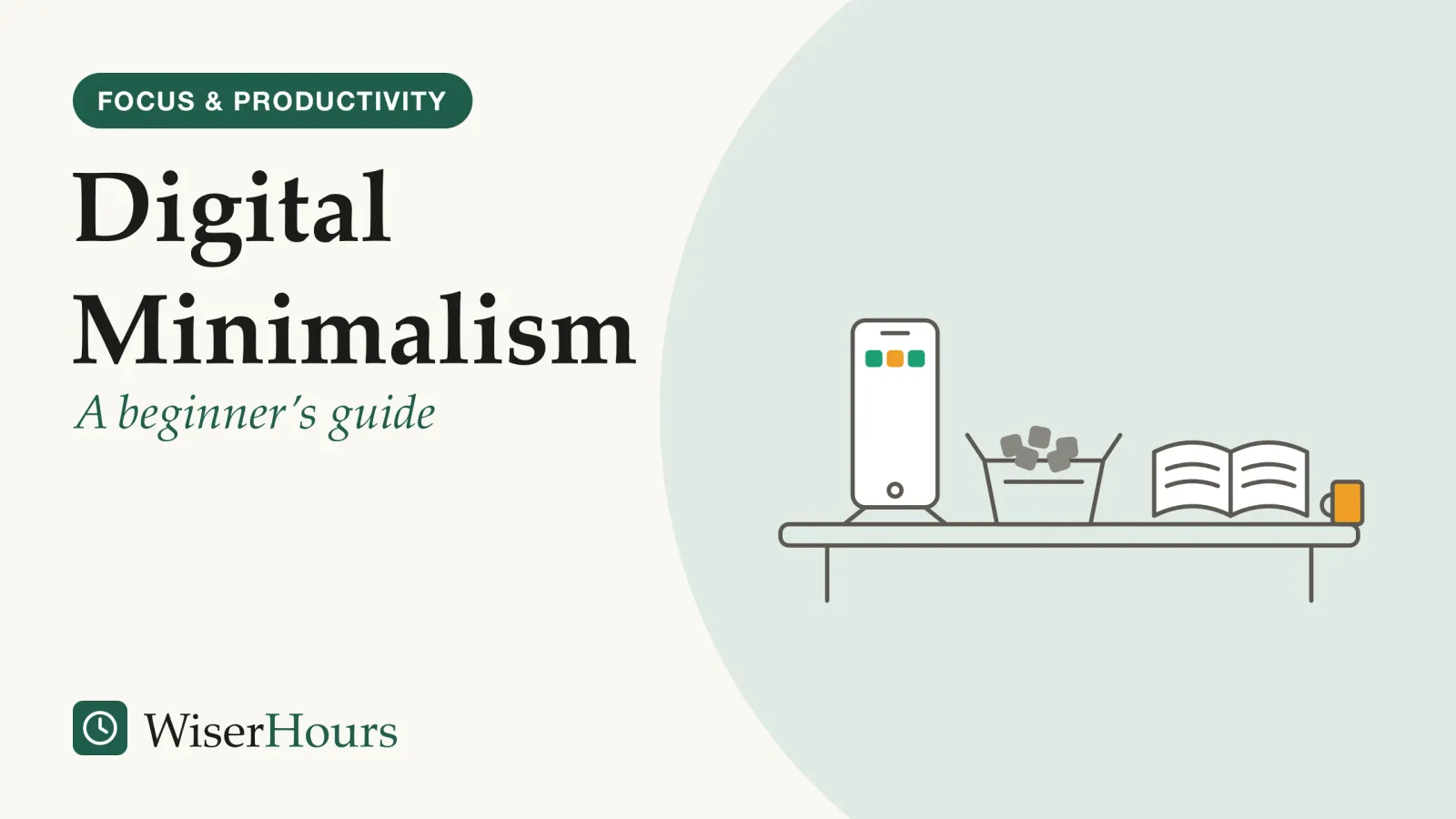
You pick up your phone to check the weather. Twenty minutes later you have read a stranger’s argument, watched half a cooking video and answered a message that could have waited, and you still do not know whether to take an umbrella.
Digital minimalism is computer scientist Cal Newport’s name for a different default: keep the few digital tools that clearly serve something you value, use them on purpose, and let the rest go without regret.1 A beginner’s version takes five steps:
- Write down what matters to you and what each app is for
- Pick a trial: cut back, or take a full break
- Plan what will fill the freed time
- Tame the interruptions you keep
- Bring back only what earns its place
The approach fits the research better than a dramatic purge. A 2025 meta-analysis of randomized trials reported in 32 articles found that restricting social media improved wellbeing slightly, which its authors describe as only weak support for restricting use. They suggest studying the specific ways social media helps or harms instead.2 Digital minimalism starts from a similar place: the question is less how many hours you spend than which uses are worth keeping.
What digital minimalism means, in Newport’s own words
Cal Newport, a Georgetown University computer scientist and author, first sketched digital minimalism in a 2016 blog post as a philosophy for questioning which digital tools add the most value to your life and clearing away low-value noise.1 His 2019 book, Digital Minimalism, turned the idea into a method.3
It is a framework, not a research finding, adapted from the minimalism movement’s question about possessions. Two of his principles do most of the work. First, start from what you value, and ask of each online activity whether it adds significant value to something important to you. Second, useful is not enough: ask whether it is the best way to serve that value.1
Why be so strict? Almost every app offers something, so “could this be useful?” lets everything in. Newport’s own example is someone who told him she used Twitter for a wider range of news than the major papers covered: he did not doubt it helped, but asked whether a Twitter feed was really the best tool for staying informed.1
The second question is the one that does the sorting. A family group chat that keeps you close to a parent passes both easily, because nothing else does that job as well. The news app you open while the kettle boils may pass the first and still fail the second, if one daily briefing would serve the same purpose.
Two questions for any app
For each app on your phone’s first screen, ask both questions. Keep what passes both and decide when and how you will use it; question anything that passes only the first.
A digital minimalism reset is more than a detox
Newport’s method starts with a 30-day break from what he calls optional technology, but he treats the break as a prelude to rebuilding, not as the goal.4 His publisher’s description says tips such as switching off notifications, or an occasional screen-free day, do not go far enough; people need a way to decide which tools to use, for what purposes and under what conditions.3
The part people underestimate, by Newport’s account, is the gap the phone leaves. Readers who tried his declutter told him they barely missed the apps after about a week; the real problem was the free time. His tentative explanation is that phones start out filling idle moments and gradually push other activities aside, so taking them away exposes the space they took over. One reader he quotes described wandering around the house looking for something to do.4
These are reader stories he chose to publish, not a study: a preview, not evidence of what happens to most people. Still, the picture is familiar: a wet evening, you are tired, and the reflex to scroll has nowhere to go.
- Myth
- Digital minimalism means giving up technology.
- Fact
- Newport describes it as an embrace of the tools that serve what you value, used deliberately, with the rest left out.
So before you cut anything, name two or three offline things you would like more of, such as a walk, a book or a call with a friend, and put the first one in your calendar for the first evening.
A month without Facebook: what the largest early trial found
The best-known test of quitting social media is a 2018 US experiment by the economists Hunt Allcott, Matthew Gentzkow and two colleagues, who paid Facebook users to deactivate their accounts for the four weeks before the midterm elections and compared them with users randomly assigned to carry on as usual.5
The study
Moderate evidence
Paid to log off before an election: a randomized Facebook trial (American Economic Review, 2020)
Deactivating Facebook freed up about 60 minutes a day, partly for offline activities. Deactivators reported small improvements in happiness, life satisfaction, depression and anxiety, knew less about current news, and used Facebook less after the study ended. About 80% agreed afterward that deactivating had been good for them.5
Small is the right word for the wellbeing change: the authors put it at roughly a quarter to two-fifths of the average effect of psychological interventions such as self-help therapy, which is noticeable across a large group and easy to miss in one person. Participants were younger, more educated and more left-leaning than the average user, and the month ended with an election, so a quieter month might look different.5
The trial’s most useful lesson is about displacement. Time taken from one activity goes to others: for these deactivators, partly to friends and family and partly to television alone. And the news the feed used to deliver stopped arriving, so they knew less about current events.5 A break is really a swap, and what it does for you depends on what you swap in and what you give up.
Think of the ten minutes on the train home that used to go to the feed: they might become a call to a friend, a chapter of a book or simply another app, and only the first two change much. So before a break, decide where the freed minutes should go and what you will lose. If the feed is how you keep up with the news or a far-flung family, set up a replacement first.
Does cutting back on social media make people happier? The evidence is mixed
Experiments that ask people to limit or quit social media find, on average, small benefits on some measures and none on others. The broadest review, Burnell and colleagues’ 2025 meta-analysis of randomized trials, found small improvements in both positive and negative sides of wellbeing, with no consistent differences by age, gender, length of the change or type of change.2
Other studies pull in different directions. A 2025 meta-analysis of full breaks by Lemahieu and colleagues found no clear effect on mood or life satisfaction; stepping away, its authors conclude, made people feel neither better nor worse.6 A depression-focused meta-analysis found that cutting back on social media reduced self-rated depression symptoms by a small amount, but only in young adults, over three weeks or less, and mostly in people who did not need to be depressed to take part.7 A small, often-quoted trial with University of Pennsylvania students pointed the same way.8 Neither shows that cutting back treats depression.
Why so mixed? Most trials were short and many used students, and a break removes the good with the bad: what people lose, such as contact and news, may offset what they gain. Lemahieu and colleagues offer that trade-off as one explanation, though their data could not confirm it, and add that effects may differ a great deal from person to person.6
An illustration: two colleagues quit Instagram for a month. One used it mostly to compare herself with others and feels lighter; the other used it to keep up with a sister abroad and feels cut off. The average says “small effect”, yet neither experience was small. An average tells you what to expect across many people, not what will happen to you.
Run it as a test on yourself
Before you start, pick one or two things you want to improve, such as evenings with more reading or less comparing yourself with others, and check them honestly at the end.
Cutting back may work better than quitting
Reducing use, rather than quitting outright, may be the better default. A 2024 narrative review in Pediatrics by Marciano and colleagues concluded that cutting social media or smartphone time showed more beneficial effects on wellbeing than total abstinence, while calling the overall evidence limited. Its explanation is that a moderate cut can keep what phones and social media do well while trimming the harm.9 Burnell’s larger meta-analysis, though, found no consistent difference by type of change, so treat this as a lead rather than a settled answer.2
In a German experiment, one group went a week without their phones and another cut an hour a day. Both changes were followed by better wellbeing scores, but most effects were stronger and more stable over the next four months in the group that cut back, and the authors concluded that complete abstinence is not necessary.10
That fits the displacement lesson: a cut can keep the useful parts and still free up time. In practice, it might mean keeping a messaging app on your phone, deleting the feed app and checking it on a laptop twice a week. If a full break feels unrealistic, a limit like that is a reasonable start in its own right.
Further reading
Digital Minimalism: Choosing a Focused Life in a Noisy World
Newport's own account of the approach this guide explains, including the 30-day declutter. The method as a whole has not been tested.
As an Amazon Associate WiserHours earns from qualifying purchases.
A beginner’s plan for digital minimalism
A workable plan joins Newport’s value test to what the experiments suggest: a trial with an end date, a plan for the freed time, and a strict test for what comes back.
1. Write down what matters to you and what each app is for
List three to five things you want more of: people, work you are proud of, health, learning. Then go through the apps on your phone and write one line on what each is for. Run each one through the two questions above.
- Does it support something I value?: if not, let it go
- Is it the best way to support that value?: if not, look for a better tool
- What gets through: keep it, and decide when and how you will use it
2. Pick a trial: cut back, or take a full break
Newport’s method is a 30-day break before you rebuild.4 The 30 days are his choice, and the trials above tested simpler, mostly shorter breaks and limits, so treat either as an experiment on yourself, not a prescription. If work or family rule out a break, a firm limit, such as a daily cap on each app, is the alternative. Either way, set an end date and write down what you will check at the end.
Keep whatever you rely on. Marciano’s review notes that social media’s effects depend partly on the kind of use, such as finding support rather than comparing yourself with others.9 Our own advice, not a research finding: leave out of any break the calls and messages people may need to reach you by, tools your work or caring depends on, and online groups where you get support.
3. Plan what will fill the freed time
Pick activities for the hours the phone used to take, especially the tired, idle ones: a walk after dinner, a book by the bed, a standing call with a friend.
4. Tame the interruptions you keep
For the tools that stay, the focus guide covers batching notifications and checking email at set times, along with the disputed evidence on keeping the phone out of view. Taking a tempting app off your home screen also changes the cue that starts the habit, one of the two routes research on breaking habits points to.
5. Bring back only what earns its place
At the end, reintroduce a tool only if it passes both questions, and set a rule for when and how you will use it. Then look at the one or two things you chose to check. If nothing changed, that is useful too, and a tool you missed may be one worth keeping.
Setting up a digital minimalism trial
Which parts are tested, and which rest on Newport’s word?
Newport’s filter is a framework rather than a tested intervention; the experiments behind it mostly measure short breaks or limits on social media, with small and uneven effects. The framework tells you what to ask; the experiments tell you roughly how much to expect.
| What it is | What the best evidence found | Evidence |
|---|---|---|
| Newport’s two-question filter | Not tested as a whole | Expert opinion1 |
| Quitting Facebook for four weeks | Small gains in self-rated wellbeing, less news knowledge, less use afterward | Trial, moderate5 |
| Limiting or quitting social media | Small improvement in wellbeing; weak support for broad time cuts | Meta-analysis, mixed2 |
| Full breaks from social media | No clear change in mood or life satisfaction, mostly week-long breaks | Meta-analysis, mixed6 |
| Limiting or quitting, depression symptoms | Small reduction in self-rated symptoms in young adults, over three weeks or less; most trials did not require depression at the start | Meta-analysis, limited7 |
| Cutting back versus quitting | Cutting an hour a day did as well or better over four months, in one German study | Experiment, limited10 |
When the problem is bigger than your phone
Changing your screen habits is not a treatment for depression or anxiety. If a low or anxious mood persists, or you have thoughts of suicide or self-harm, the US National Institute of Mental Health (NIMH) and the UK’s NHS advise getting help, urgently in a crisis. The tiers below are our ordering of their advice.
- Now: in the US, if you are struggling or having thoughts of suicide, NIMH says to call or text the 988 Suicide and Crisis Lifeline, and to call 911 in a life-threatening situation.11 In the UK, if you have seriously harmed yourself or feel you may be about to, the NHS says to call 999 or go to A&E. For other help, it lists free helplines including NHS 111 and Samaritans on 116 123, and suggests asking a GP for an emergency appointment.12 Elsewhere, call your local emergency number.
- Soon: NIMH lists persistent sadness, loss of interest, trouble sleeping and difficulty concentrating among the signs of depression, and advises talking to a health care provider if signs persist or do not go away.11 Outside the US, read that as your family doctor or GP.
- At your next appointment: if you have tried to cut back and cannot, your phone use is causing trouble at work or at home, or you are being treated for a mental health condition and want to change how you use online support, it is reasonable to raise it with your doctor or therapist. This is our suggestion, not a clinical guideline.
The bottom line
Digital minimalism is a way of choosing, not a cure: Newport’s framework asks what each tool is for and keeps only the best ones. Experiments suggest stepping back from social media brings small, uneven benefits, and cutting back may serve many people as well as quitting. Run a short, deliberate trial, plan the time you free up, and keep what earns its place.
This article is general information, not medical advice. If you're worried about your health, talk to a doctor or another qualified professional.
Frequently asked questions
Does digital minimalism apply to work email and chat?
Not directly. In the 2016 blog post where he first sketched the idea, Cal Newport wrote that his principles apply almost entirely to technology in your personal life and are largely separate from his thinking about technology at work. The same two questions can still help at work, but work tools come with obligations to colleagues, so changes to them are best agreed with your team.
Did people use Facebook less after the deactivation experiment ended?
Yes, for a while. In the 2018 US experiment by Hunt Allcott and colleagues, people who had deactivated Facebook for four weeks reported using its phone app about 22 percent less than the comparison group several weeks later, and 5 percent still had their accounts switched off nine weeks after the study. They were also more likely to say they had uninstalled the app.
How long should a social media break last?
Nobody has pinned down an ideal length. Most experiments have lasted one to three weeks, and a 2025 meta-analysis of social media breaks found no clear link between how long a break lasted and how people felt. Newport's own method uses 30 days. A trial with a clear end date and one or two specific things to check is a sensible way to find out what suits you.
Sources
- On Digital Minimalism. Newport, C. (2016, December 18). Study Hacks blog, calnewport.com
- The effects of social media restriction: Meta-analytic evidence from randomized controlled trials. Burnell, K., Meter, D. J., Andrade, F. C., Slocum, A. N. & George, M. J. (2025). SSM - Mental Health, 7, 100459
- Digital Minimalism: Choosing a Focused Life in a Noisy World. Newport, C. (2019). Portfolio, Penguin Random House (publisher's description)
- On the Pleasures and Sorrows of Life Without Screens. Newport, C. (2019, May 31). Study Hacks blog, calnewport.com
- The Welfare Effects of Social Media. Allcott, H., Braghieri, L., Eichmeyer, S. & Gentzkow, M. (2020). American Economic Review, 110(3)
- The effects of social media abstinence on affective well-being and life satisfaction: a systematic review and meta-analysis. Lemahieu, L., Vander Zwalmen, Y., Mennes, M., Koster, E. H. W., Vanden Abeele, M. M. P. & Poels, K. (2025). Scientific Reports, 15, 7581
- Reducing Social Media Use Decreases Depression Symptoms: A Meta-Analysis of Randomised Controlled Trials. May, W., Malouff, J. M. & Meynadier, J. (2025). European Journal of Investigation in Health, Psychology and Education, 15(11)
- No More FOMO: Limiting Social Media Decreases Loneliness and Depression. Hunt, M. G., Marx, R., Lipson, C. & Young, J. (2018). Journal of Social and Clinical Psychology, 37(10)
- Digital Detox and Well-Being. Marciano, L., Jindal, S. & Viswanath, K. (2024). Pediatrics, 154(4)
- Finding the “sweet spot” of smartphone use: Reduction or abstinence to increase well-being and healthy lifestyle?! An experimental intervention study. Brailovskaia, J., Delveaux, J., John, J., et al. (2023). Journal of Experimental Psychology: Applied, 29(1)
- Depression. National Institute of Mental Health, National Institutes of Health (NIH Publication No. 24-MH-8079, revised 2024)
- Help for suicidal thoughts. NHS (UK), page last reviewed 26 April 2024
How we researched this
We searched Europe PMC, Crossref and the web in September 2026 for randomized trials and meta-analyses of quitting or limiting social media and smartphone use, and read Cal Newport's own descriptions of his framework and his publisher's summary of the book. Sources date from 2016 to 2025. Main limitation: most trials last one to three weeks, often recruit students and rely on self-reports, so long-term effects are largely unmeasured.
Keep reading
Doomscrolling: Why You Do It and How to Stop
In 2021 experiments, 2 to 4 minutes of COVID-19 news on social media lowered positive mood. Why doomscrolling hooks you, and 5 habits that may help.
How Much Screen Time Is Too Much for Adults?
WHO sets no daily screen limit for adults, and Canada's 3-hour leisure cap (2020) is about sitting. What research says matters more than the hours.
Digital Eye Strain: Causes and Prevention
Digital eye strain is common and temporary: its causes, what trials found on the 20-20-20 rule, why blue-light glasses disappoint and which signs need a doctor.
How to Reduce Screen Time: 15 Practical Steps
15 ways to reduce screen time, graded by the trials behind them: firm app limits, fewer alerts, grayscale, phone placement and what tends to fade.