Phantom Vibration Syndrome and Nomophobia: Modern Phone Anxieties Explained
Phantom vibration syndrome, a buzz that never came, is common and rarely bothersome. Why it happens, what nomophobia is, and 5 simple steps.

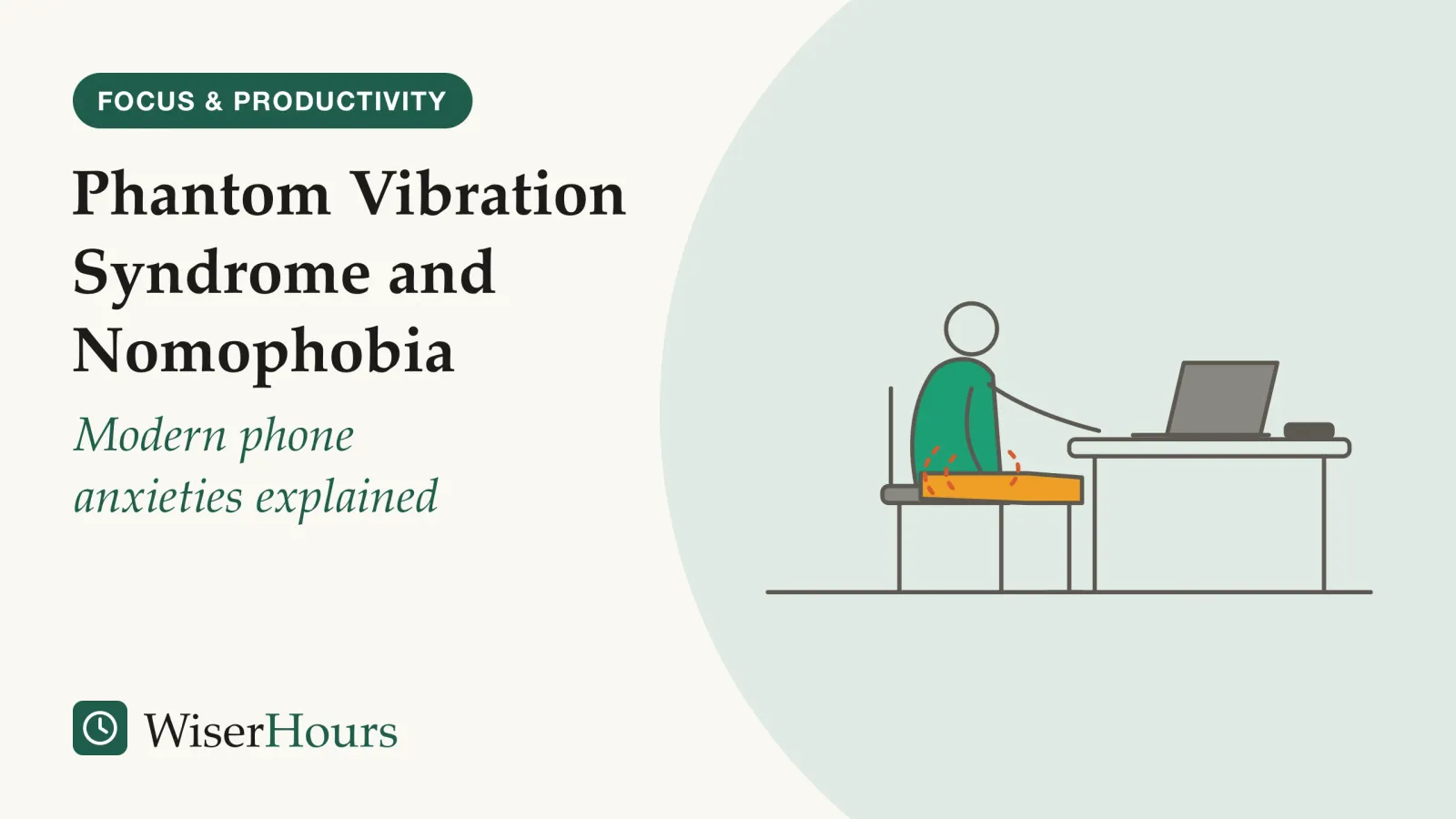
A buzz in the pocket from a phone that turns out to be silent is one of the most ordinary parts of carrying one. Phantom vibration syndrome is the name for that false alarm, a body sensation the brain misreads as an alert, and despite the clinical-sounding name it is not a disorder. A 2014 systematic review by Amrita Deb of the Indian Institute of Technology Hyderabad found phantom vibrations common among phone users, and few people found them bothersome.1
Nomophobia, the fear of being without your phone, is a separate worry measured by questionnaire, and neither the DSM-5DSM-5: The Diagnostic and Statistical Manual of Mental Disorders, fifth edition, the American Psychiatric Association's handbook of criteria for diagnosing mental disorders; the current version is the text revision, DSM-5-TR. Burnout and impostor feelings are not diagnoses in it.Full entry in the glossary nor ICD-11ICD-11: The World Health Organization's International Classification of Diseases, eleventh revision, the global standard for recording diseases and health conditions, in effect since 2022. It also lists some factors that are not illnesses, such as burnout, classed as an occupational phenomenon.Full entry in the glossary lists it as a diagnosis. Both tend to go with stress and with how closely you are waiting for a message. If the false buzzes annoy you, three small changes are the place to start: switch off vibrate, carry the phone away from your body and cut the alerts that keep you on watch (the steps are below). Both belong to the wider project of digital minimalism for beginners.
Is phantom vibration syndrome real?
The sensation is real, but phantom vibration syndrome is not a medical condition, and “syndrome” is a nickname that stuck. The idea is older than smartphones: the cartoonist Scott Adams joked about “phantom-pager syndrome” in a 1996 Dilbert strip, and in 2012 Australia’s Macquarie Dictionary made “phantom vibration syndrome” its word of the year.2
Michael Rothberg, the US physician who led one of the first published surveys of it in 2010, called it a sensory hallucination: the brain registers a buzz that is not there.3 In this sense, the word means a perception without a matching stimulus, and researchers in Taiwan who followed medical interns concluded that the sheer commonness of phantom vibrations shows “normal brain mechanisms are at work”.4
A commuter who reaches for a silent phone on the bus is showing how closely they are tuned to it. On its own, the reach is no cause to treat it as a symptom.
How common are phantom vibrations?
Most people who carry a phone on vibrate have felt one. Two small US surveys are the ones usually quoted, and neither can say how common phantom vibrations are in the wider population.
Rothberg’s team at Baystate Medical Center in Massachusetts surveyed 176 medical staff, and 68 percent of those who answered the question reported phantom vibrations.3 In 2012, psychologist Michelle Drouin and colleagues at an Indiana university surveyed 290 undergraduates and found that 89 percent had felt them, on average about once every two weeks.5 Both samples were small and relied on people’s memory of the experience, and neither group is typical of all phone users, so the figures may not carry over.
Deb’s review added that the literature was thin: prevalence across different populations, causes and treatment were still largely unstudied, and there were no clinical criteria for the condition.1
Counts vary between studies, but in most of them a majority of phone users report the occasional phantom vibration or ring.2
A student who feels a false buzz every couple of weeks matches the average in Drouin’s sample. Judge your own by how often they come and whether they bother you, since that decides whether the fixes below are worth trying.
Why do I feel my phone vibrate when it isn’t?
One explanation treats the brain as a detector set to catch a faint, important signal. When you are waiting for a buzz, it lowers the bar for what counts as one, so a twitch of muscle, a rub of fabric or a shift in your pocket gets read as an alert. Kruger and Djerf at the University of Michigan describe phantom calls as a signal-detection problem with psychological influences.6
- Not expecting anything: only a strong, real buzz clears the bar
- Waiting for a message: the bar drops, and a muscle twitch or a rub of fabric clears it too
Habits feed the same detector. In Rothberg’s survey, phantom vibrations were more common in people who carried their device for more hours and used vibrate mode more often, and in those who wore it in a breast pocket rather than on a belt.3 Lin and colleagues in Taiwan suggested that a signal that matters, met again and again while you are on alert, can leave you hypervigilant and lower the threshold for perceiving it when it is absent; being on call keeps people on exactly that alert.4
For a job seeker waiting to hear after a final interview, every small pressure near the pocket becomes a possible call. The Michigan study fits that picture: its authors report that expecting a call, or worrying about something you might be contacted about, interacted with attachment anxiety (an ongoing fear that the people close to you may not be there when needed) in the direction they had predicted.6 When the false alarms bunch around one awaited message, a set time to check the phone can take the place of constant pocket checks.
Is phantom vibration syndrome a sign of anxiety?
Not on its own. The best evidence, which is still limited, suggests phantom vibrations rise with stress and expectation, and that anxiety explains only a small part of that rise. The clearest study followed one group of young doctors through a hard year.
The study
Limited evidence
Phantom buzzes that rose and fell with a hard year of hospital work in Taiwan
Researchers at Chang Gung Memorial Hospital in Taiwan surveyed 74 medical interns five times, before, during and after a year of long shifts. About 78 percent reported phantom vibrations before the internship, more than 90 percent in its third and sixth months, and half two weeks after it ended. Anxiety and depression scores rose and fell over the same year, but they were not clearly correlated with the phantom vibrations themselves.4
A 2020 reanalysis of the same interns, led by the same first author, estimated that anxiety accounted for a small share of the stress-linked rise in phantom vibrations, and depression for a similar share.7 With a single small group of interns, treat that as a hint about mechanism that may not hold for everyone.
Two smaller findings point in the same direction. In Drouin’s student survey, people who reacted strongly to text messages were more bothered by phantom vibrations.5 The Michigan study found that people high in attachment anxiety reported phantom calls and notifications more often overall.6 Both studies looked for links between traits and experiences, which cannot show which comes first.
A new manager in her first month, watching for messages from a boss she is still learning to read, may notice more phantom buzzes than she did in a settled job, and they may ease as the role settles, much as they eased for many of the interns. That pattern points first to the pressure and the alerts; anxiety disorders have their own signs, listed near the end.
Phantom buzzes can still carry some signal. A 2026 US study of people aged 12 to 34 found that 83 percent of those assessed as being at clinical high risk of psychosis had felt one, against 61 percent of healthy volunteers, and the high-risk group found them more bothersome.8 With 159 people recruited through one US university, the authors call phantom vibrations a marker worth more research; buzzes that come with voices or other hallucinations belong in the help section below.
What is nomophobia?
Nomophobia, short for “no mobile phone phobia”, is distress at being unable to use your phone: a dead battery, no signal, or a phone left at home. The word came from a 2008 UK Post Office study of about 2,000 adults.9
A widely used measure is the Nomophobia Questionnaire (NMP-Q), built by Caglar Yildirim and Ana-Paula Correia at Iowa State University in the US and published in 2015. They interviewed nine students who relied heavily on their phones and found four themes: not being able to communicate, losing connectedness, not being able to access information, and giving up convenience. The finished questionnaire has 20 statements, such as “If I could not use my smartphone, I would be afraid of getting stranded somewhere”, each rated on a 7-point scale.10
Scores run from 20 to 140, and published bands call them mild, moderate or severe.11 Those bands are not a diagnosis. A 2026 study in BMC Psychology notes that nomophobia is not formally recognized in DSM-5 or ICD-11, so no clinically validated cut-off exists.12
A 2022 meta-analysis of 52 studies of young people in 20 countries found that about one in five scored in the severe range, but that is a share of questionnaire scores above a cut-off.9
- Myth
- Nomophobia is an official phobia, like fear of flying.
- Fact
- Nomophobia is measured with questionnaires and is not listed as a diagnosis in DSM-5 or ICD-11. Researchers disagree about whether it should be.
That disagreement is live. Italian researchers Nicola Bragazzi and Giovanni Del Puente proposed in 2014 that nomophobia be considered for the DSM.13 A 2023 study of 537 students in Iran, while finding nomophobia scores linked with anxiety, argued against adding it to diagnostic manuals.14 Across 16 studies, a 2023 meta-analysis found nomophobia scores moderately correlated with anxiety, in mostly cross-sectional data that cannot show which drives which.15
If the NMP-Q statements describe you, list what the phone does for you in a normal day: contact with family, directions, payments, news. Part of the unease at a dead battery may be the plain worry of losing those tools, and a backup such as a paper note of a few key numbers or a charged power bank can take the edge off it.
How do you stop phantom vibrations?
You may be able to quiet phantom vibrations by changing what your body has learned to expect: switch off vibrate, carry the phone elsewhere and cut the alerts that keep you waiting. No trial has tested any fix, so treat the steps below as low-risk habits suggested by survey findings.
If you must stay reachable
Carers, people on call and anyone who must be contactable in an emergency can leave the single alert they depend on as it is and apply these changes to everything else.
1. Turn off vibrate where you can
Among Rothberg’s hospital staff who tried to stop phantom vibrations, about three in four of those who switched off vibrate mode said it worked, and changing where the device was carried helped many too, though success rates for the different strategies did not clearly differ.3 A ringtone or a screen alert takes away the vibration your body has learned to listen for, so ordinary twitches stop sounding like it.
2. Carry the phone somewhere else
A bag, a desk or a jacket pocket away from the skin gives your body fewer sensations to mistake for a buzz. Given Rothberg’s breast-pocket finding, a shirt pocket is a sensible first place to give up.3
3. Cut the notifications that keep you waiting
Fewer alerts mean fewer moments of expectation. Leave calls and personal messages on, and silence feeds, shopping and game alerts, using the steps to reduce screen time.
4. Read the pattern
If phantom buzzes cluster in exam weeks, on-call shifts or while you wait for news, they track pressure more than the phone.
5. Practice short, planned gaps
For the nomophobia side, leave the phone behind in another part of the home for a short, planned spell, such as a meal or a walk, and tell anyone who might need you. A few low-stakes gaps let you see what, if anything, goes wrong while you are away.
Quieting phantom buzzes
None of the evidence on phantom vibrations or nomophobia rates better than limited, and the people studied are mostly students and health workers.
| Question | Findings so far | Design and strength |
|---|---|---|
| How common are phantom vibrations? | Common among phone users; few are bothered | Small surveys and a review, limited1 |
| Does stress raise them? | Rose during a hard internship and eased after it, in medical interns in Taiwan | Longitudinal study, limited4 |
| Is nomophobia linked to anxiety? | Moderately correlated, mostly in one-time surveys | Meta-analysis of 16 studies, limited15 |
Phone worry that is worth a doctor’s time
A phantom buzz on its own needs no medical attention, but unease about the phone can sometimes be one strand of a broader anxiety problem.
- Now: if anyone is in danger or having thoughts of suicide or self-harm, phone your local emergency number at once. The International Association for Suicide Prevention’s crisis page points to Find A Helpline, a directory of verified helplines in over 150 countries.16 Voices urging harm to yourself or others, or hallucinations that are getting worse fast, are an emergency too: the NHS (UK) gives 999 or A&E for this, and in other countries your local emergency number does the same job.17
- Soon: the World Health Organization describes anxiety disorders as fear and worry that is intense and excessive, difficult to control, usually present for at least several months, and disruptive to everyday life; it adds that highly effective treatments exist.18 If that matches your experience, phone or no phone, see a doctor in the coming days or weeks. Hearing voices or seeing things that others do not is a different matter from a phantom buzz; for that, the NHS (UK) points people to an urgent GP slot or NHS 111; elsewhere, ask a doctor for an urgent appointment.17
- Routine: if dread of a flat battery or a dead zone decides where you will go, raise it at your next routine visit. Adults in England can contact NHS talking therapies for anxiety directly, without a GP referral; in other countries, ask your doctor which local services exist.19
The bottom line
A phantom buzz usually says more about what you are waiting for than about your health, and in the study that followed interns through a hard year it eased once the internship ended. Try a week with vibrate off and the phone kept on the desk or in a bag; if worry about being without it stays intense for months, raise it with a doctor.
This article is general information, not medical advice. If you're worried about your health, talk to a doctor or another qualified professional.
Frequently asked questions
Is phantom ringing the same as phantom vibration?
They are close cousins: phantom ringing is hearing a ringtone that never played. In a 2013 study of medical interns in Taiwan, phantom ringing was much less common than phantom vibration before their internship, rose sharply during it and fell after it ended. Ringtones sit in a range of pitches human hearing is sensitive to, which may help explain why a shower or a television can produce one.
How often do phantom vibrations happen?
For most people, occasionally. In Michelle Drouin's 2012 survey of US undergraduates, students who had felt them did so about once every two weeks on average. In Michael Rothberg's 2010 survey of hospital staff in Massachusetts, 13 percent reported feeling them daily. Both were small samples, so treat the figures as rough.
Is nomophobia more common in young people?
It is studied mostly in young people, so nobody knows for sure. A 2022 meta-analysis of 52 studies from 20 countries, led by Haitham Jahrami in Bahrain, covered youth and young adults and found university students in non-Western cultures the most likely to score in the severe range. Its authors note that most participants fell in a narrow age range and call for studies of older adults.
Sources
- Phantom vibration and phantom ringing among mobile phone users: A systematic review of literature. Deb, A. (2015; published online 2014). Asia-Pacific Psychiatry, 7(3), 231-239
- Phantom vibration syndrome. Wikipedia (checked 24 October 2026)
- Phantom vibration syndrome among medical staff: a cross sectional survey. Rothberg, M. B., Arora, A., Hermann, J., Kleppel, R., St Marie, P. & Visintainer, P. (2010). BMJ, 341, c6914
- Prevalent Hallucinations during Medical Internships: Phantom Vibration and Ringing Syndromes. Lin, Y.-H., Lin, S.-H., Li, P., Huang, W.-L. & Chen, C.-Y. (2013). PLoS ONE, 8(6), e65152
- Phantom vibrations among undergraduates: Prevalence and associated psychological characteristics. Drouin, M., Kaiser, D. H. & Miller, D. A. (2012). Computers in Human Behavior, 28(4), 1490-1496
- High Ringxiety: Attachment Anxiety Predicts Experiences of Phantom Cell Phone Ringing. Kruger, D. J. & Djerf, J. M. (2016). Cyberpsychology, Behavior, and Social Networking, 19(1), 56-59
- Investigation of the Role of Anxiety and Depression on the Formation of Phantom Vibration and Ringing Syndrome Caused by Working Stress during Medical Internship. Lin, Y.-H., et al. (2020). International Journal of Environmental Research and Public Health, 17(20), 7480
- Phantom vibrations: An understudied marker of clinical risk for psychosis. Pokorny, V. J., Kaka, T., Vargas, T., Pinkham, A. E. & Mittal, V. A. (2026). Schizophrenia Research, 291, 81-87
- The Prevalence of Mild, Moderate, and Severe Nomophobia Symptoms: A Systematic Review, Meta-Analysis, and Meta-Regression. Jahrami, H., Trabelsi, K., Boukhris, O., et al. (2023; published online 30 December 2022). Behavioral Sciences, 13(1), 35
- A new questionnaire measures people's “no mobile phone phobia” or nomophobia. Jarrett, C. (2015). Research Digest, British Psychological Society, 7 May 2015
- Internal consistency and structural validity of the nomophobia questionnaire (NMP-Q) and its translations: A systematic review with meta-analysis. Jahrami, H., Saif, Z., Trabelsi, K., Bragazzi, N. L. & Vitiello, M. V. (2023). Heliyon, 9(4), e15464
- How do the core symptoms of nomophobia differ between males and females: a network analysis. Wang, Y., Luo, F., Liu, Y. & Xin, T. (2026). BMC Psychology, 14, 697
- A proposal for including nomophobia in the new DSM-V. Bragazzi, N. L. & Del Puente, G. (2014). Psychology Research and Behavior Management, 7, 155-160
- Nomophobia (No Mobile Phone Phobia) and Psychological Health Issues among Young Adult Students. Abdoli, N., Sadeghi-Bahmani, D., Salari, N., et al. (2023). European Journal of Investigation in Health, Psychology and Education, 13(9), 1762-1775
- Systematic Review and Meta-Analysis of the Correlation Coefficients between Nomophobia and Anxiety, Smartphone Addiction, and Insomnia Symptoms. Daraj, L. R., AlGhareeb, M., Almutawa, Y. M., Trabelsi, K. & Jahrami, H. (2023). Healthcare, 11(14), 2066
- Crisis Centres & Helplines. International Association for Suicide Prevention (IASP) (checked 24 October 2026)
- Hallucinations and hearing voices. NHS (UK), page last reviewed 28 July 2025 (checked 24 October 2026)
- Anxiety disorders. World Health Organization, fact sheet of 15 September 2026 (checked 24 October 2026)
- Generalised anxiety disorder (GAD). NHS (UK), page last reviewed 22 October 2024 (checked 24 October 2026)
How we researched this
We searched Europe PMC, OpenAlex and the web in October 2026 for surveys, longitudinal studies, reviews and meta-analyses on phantom vibrations, phantom ringing and nomophobia, and read WHO and NHS pages for help routes. Sources span 2010 to 2026. Several key papers were read only as abstracts or through summaries. Main limitation: most studies are small one-time surveys of students or health workers.
Keep reading
Doomscrolling: Why You Do It and How to Stop
In 2021 experiments, 2 to 4 minutes of COVID-19 news on social media lowered positive mood. Why doomscrolling hooks you, and 5 habits that may help.
How Much Screen Time Is Too Much for Adults?
WHO sets no daily screen limit for adults, and Canada's 3-hour leisure cap (2020) is about sitting. What research says matters more than the hours.
Digital Minimalism: A Beginner's Guide
Digital minimalism explained: Cal Newport's idea, what randomized trials found about cutting back on social media, and a 5-step plan to start.
Analog Hobbies That Rest a Screen-Tired Brain
14 analog hobbies in 4 groups, with cost, time and space for each, what research links them to, and how to start one that replaces the evening scroll.