Conflict Resolution at Work: A Step-by-Step Guide
Six steps for settling a conflict with a colleague. In a 2025 Acas survey, 44% of working-age adults in Great Britain had conflict at work in the past year.

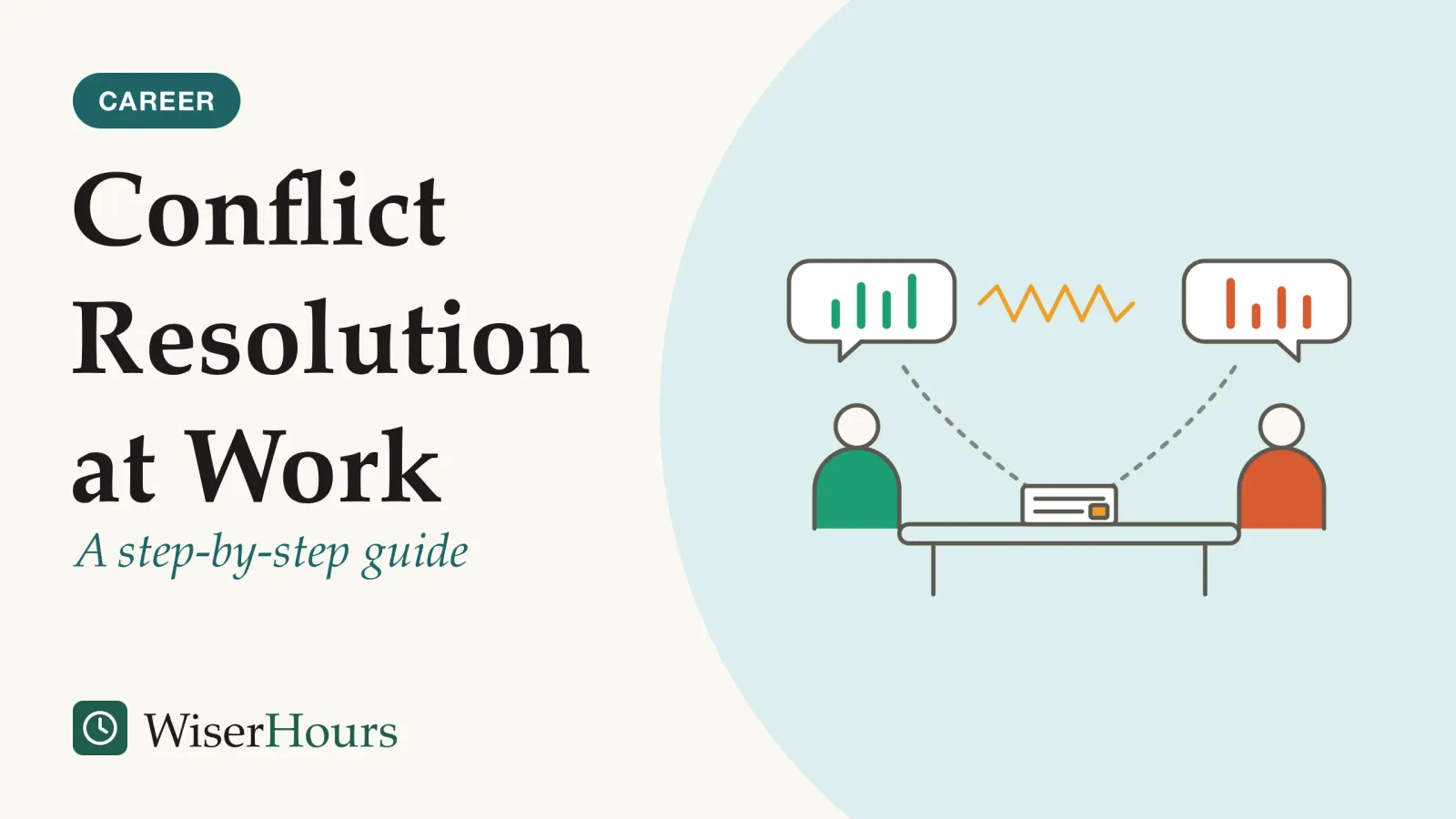
Two colleagues have disagreed for a week about which figures belong in a client report. What began as a question about numbers now shows up in clipped replies, in a meeting where one talks over the other, and in a quiet sense on both sides that the other is being difficult. Neither has said anything directly.
Conflict resolution at work means turning a dispute like this back into a problem two people can solve, before it hardens. Acas, the workplace conciliation service for Great Britain, advises raising a problem informally first, and research on work teams suggests the key is keeping the dispute on the work itself, not on each other. The six steps, in order:
- Cool down before you talk
- Work out what the disagreement is really about
- Talk privately, and early
- Hear their side first, then give yours in specifics
- Agree on next steps and check back
- If talking fails, bring in someone else
The skills involved, managing your own reaction and reading the other person’s, are part of emotional intelligence; more on working relationships is gathered under emotional intelligence at work.
Conflict at work is common, and talking is the usual response
Conflict at work is widespread, and the usual response is a conversation, not a formal complaint. In a 2025 survey of 4,558 working-age adults in Great Britain, run for Acas by the National Centre for Social Research, 44 percent said they had experienced conflict at work over the past 12 months. The survey counted disagreements, disputes and difficult relationships, one-off or ongoing, with colleagues, managers, direct reports or customers.1
What people did next is the more useful finding. The most common actions were a discussion with their own manager and an informal talk with the other person; far fewer raised a formal grievance, and about a fifth did nothing at all. Of those who talked directly with the other person, about half said that conversation was the most important thing in settling it.1 These are self-reports, not a test of what works best, but they show that the informal route is the ordinary one.
Figures on the cost of conflict deserve more caution. The claim that US employees spend 2.8 hours a week dealing with conflict comes from a 2008 survey of 5,000 full-time employees in nine countries, commissioned by CPP, which publishes the Thomas-Kilmann conflict questionnaire. It is a company survey, not a peer-reviewed study, and the same report put the nine-country average lower, at about 2 hours.2 Treat such numbers as a sign that conflict eats into working time, not as a measure of how much.
Taking no action, as about a fifth did, sometimes worked, Acas notes, but its wider research shows that unaddressed issues can stay below the surface and come back.1 The lesson for you: plan on a conversation, and have it before the silence sets in.
Why disagreements about the work turn personal
Disagreements about the work and friction between people are different problems, and research on teams treats them separately. In their 2003 meta-analysismeta-analysis: A study that combines the results of earlier studies on the same question into one overall estimate. Pooling makes the estimate more precise, but it cannot repair the studies it pools: a meta-analysis of surveys is still survey evidence.Full entry in the glossary, Carsten De Dreu and Laurie Weingart defined task conflict as disagreement about the work itself, such as resources, procedures or how to read the facts, and relationship conflict as friction over values, taste or personal style.3
For years, management textbooks taught that task conflict is healthy and only relationship conflict does harm. De Dreu and Weingart put that belief to the test.
The study
Moderate evidence
De Dreu and Weingart (2003), Journal of Applied Psychology
Both kinds of conflict went with lower team performance, to about the same degree, and relationship conflict went with lower member satisfaction more strongly than task conflict did. The two kinds were strongly correlated: teams that reported many disagreements about the work tended to report personal friction too. Task conflict looked less harmful in studies where the two were only weakly linked.3
The main caveat is the design. Every study measured conflict rather than creating it, so, as the authors note, poor performance may breed conflict as much as conflict hurts performance.3 A larger 2012 update by Frank de Wit, Lindred Greer and Karen Jehn, covering 116 studies, found stable negative links between relationship conflict and group outcomes but no strong negative link between task conflict and group performance. Task conflict looked better where it was weakly tied to relationship conflict, in top management teams, and where performance meant decision quality or financial results.4
Why would a disagreement about numbers turn into dislike? De Dreu and Weingart cite earlier studies indicating that as conflict intensifies, it uses up the mental capacity people need for flexible thinking, and that the two kinds travel together more closely in teams with low trust.3 In the report dispute, “your figures use last quarter’s exchange rate” is task conflict. “You always assume I’m careless” is relationship conflict. The first can be checked and settled in an afternoon; nothing you can check will settle the second.
- Task conflict: a disagreement about the work itself, such as facts, procedures or resources
- Relationship conflict: friction about each other, such as values, taste or personal style
- Steering back: name the problem with the work and agree on next steps together
Everything below builds on the third panel.
Team-level conflict, and how leaders keep it safe, belongs with what makes a team effective.
Further reading
Difficult Conversations: How to Discuss What Matters Most
A method for the private talk this guide recommends: hear their side first, then describe the impact without blaming.
Getting to Yes: Negotiating Agreement Without Giving In
The classic case for separating the people from the problem, which is how this guide keeps a dispute pointed at the work.


As an Amazon Associate WiserHours earns from qualifying purchases.
Conflict resolution at work, step by step
The six steps draw on uneven evidence: the first rests on anger research, the others on correlational team studies, official guidance and practitioner interviews. No trial has tested the sequence as a whole.
1. Cool down before you talk
Wait until you can discuss the problem without replaying the insult. Letting off steam feels as if it should help, but in a 2002 experiment by Brad Bushman with 600 angered college students, those who hit a punching bag while thinking about the person who had provoked them ended up angrier and more aggressive than those who simply sat quietly for a couple of minutes. It was a lab study, and aggression meant blasting the supposed provoker with loud noise, but the result points one way: in that experiment, rehearsing the grievance kept the anger going rather than draining it.5 A 2024 meta-analysis by Sophie Kjærvik and Bushman, pooling 154 studies, points the same way: calming activities such as deep breathing were linked to less anger and aggression, while arousing ones such as hitting a bag showed no clear effect overall.6
- Myth
- Venting your anger gets it out of your system.
- Fact
- In a 2002 lab experiment, students who vented while thinking about their provoker ended up angrier than students who sat quietly.
In practice, cooling down means letting some time pass without rehearsing the grievance: not drafting the reply in your head, and not firing back an email. Then set a time to talk soon, while the problem is still small.
2. Work out what the disagreement is really about
Before you talk, write one sentence that describes the problem as a work issue: the client report needs one set of figures by Friday, and we disagree on which. De Dreu and Weingart’s main practical advice, aimed at team leaders, was to diagnose which kind of conflict has emerged and then manage it accordingly.3 If you cannot write that sentence without mentioning the other person’s character, the dispute has already turned personal, and your first aim is to steer it back to the task.
3. Talk privately, and early
Raise it privately, before it grows. Acas advises that it is usually best to try raising a problem informally first, because that can resolve it more quickly and help keep working relationships positive; it suggests someone you feel comfortable with, such as your line manager, another manager or HR.7 A 2026 draft update of its statutory Code of Practice, not yet in force, is more direct: when a worker is concerned about someone’s behavior, it says it is often best to try to speak with them, and to turn to a line manager or someone else who can help if that is not possible or comfortable.8 For harassment, bullying or discrimination, read the last section first.
Timing and wording matter. In a 2025 study for Acas based on 33 interviews with managers and practitioners, participants said informal resolution works best before a conflict has become entrenched, and found neutral phrases such as “an open and honest conversation” more constructive than words like “dispute”.9 An opener as plain as “Could we find twenty minutes to sort out the figures for the report? I think we’re seeing them differently” does the job.
4. Hear their side first, then give yours in specifics
Start by asking how they see it, and let them finish before you make your case. In the Acas interviews, informal resolution typically began with each person holding only their own view, moved toward a shared understanding and ended with agreement on next steps. Practitioners sometimes coached people to avoid accusatory or judgmental statements and to say how an issue made them feel, and in some cases a shared understanding was all it took.9 Those accounts involve a manager or mediator, but the same arc suits a conversation between two people. Ask rather than assume what they think; guessing a colleague’s view often goes wrong.
When it is your turn, describe what happened and what it did to the work, not what it says about them.
What it can sound like
Instead of “You never check anything,” try “The report went out with two sets of figures, and the client asked which one was right. Can we agree on one source before the next version?”
People also have habitual styles: a questionnaire Ralph Kilmann and Kenneth Thomas described in 1977 sorts conflict-handling behavior into five modes (competing, collaborating, compromising, avoiding and accommodating), but for this conversation the aim is a joint look at the problem.10
5. Agree on next steps and check back
End with something specific: who will do what, and by when. In the Acas interviews, when understanding alone did not settle a conflict, the parties agreed on steps to resolve it, sometimes defining their own and sometimes committing to steps a manager proposed.9 A short message afterward confirming what you agreed gives you both something to check back against.
6. If talking fails, bring in someone else
If a direct conversation does not work, or the problem feels too serious for one, take it to your manager. Under Acas guidance, an employer can talk privately to the other person, hold an informal meeting with you both, or suggest mediation, in which an independent, impartial person helps both sides find a solution. If informal steps fail, you can raise a formal complaint, known as a grievance. Those are the routes in Great Britain; elsewhere, Acas’s tip to check your employer’s own policy first is still a useful start.7
Before and after the conversation
Which steps have the best evidence?
The best-supported advice is the least surprising: cool down without rehearsing the grievance, and keep the dispute about the work. The rest rests on official guidance and practitioners’ experience rather than on tests of the steps themselves.
| What it is | What the best evidence found | Evidence |
|---|---|---|
| Cool down without venting | Venting while thinking about the provoker left students angrier than sitting quietly; a later review linked calming activities to less anger | Trial, limited (one lab study of students); meta-analysis of 154 studies, not graded56 |
| Keep it about the work | Relationship conflict linked to worse team outcomes; task conflict less harmful when weakly tied to it | Meta-analyses, moderate (correlational team studies)34 |
| Talk informally, early | The most common response in a survey of Great Britain; about half who talked to the other person said it mattered most | Observational, limited (self-reported)1 |
| Listen first, agree next steps | How experienced managers and practitioners describe informal resolution | Expert, limited (qualitative interviews)9 |
| Manager, mediation, grievance | Routes set out in official guidance for Great Britain | Expert (official guidance)7 |
So when time is short, do the first two well: let the anger cool without replaying it, and write the problem down as a work problem.
When a conflict is not yours to settle alone
Some conflicts are not disagreements at all. If a colleague’s behavior involves harassment, bullying or discrimination, the aim shifts from finding common ground to making it stop. In Great Britain, Acas notes that no specific law bans bullying, but bullying linked to a protected characteristic such as age, race or sex can be discrimination under the Equality Act 2010, and employers have a duty of care that includes dealing with bullying.11
For discrimination, Acas says it is usually best to raise it informally first, with a manager, HR or someone senior, but that not every situation suits informal resolution. It suggests keeping a record of what happened, when, and who saw it; you can raise a formal grievance, and if that fails, consider a claim to an employment tribunal, which has strict time limits.12 Before making a claim you must notify Acas, which offers early conciliation: a voluntary attempt to reach a legal agreement with your employer. Raising the problem with your employer first does not change the tribunal time limits, Acas warns.13
In the US, most of the laws the Equal Employment Opportunity Commission (EEOC) enforces require you to file a charge before you can sue, with the EEOC or a state or local fair employment agency, within strict time limits; federal employees have a different process.14 Rules and routes differ in other countries, so for a specific case, look for your national labor or equality authority, a trade union or an employment lawyer.
The bottom line
People who try to settle a conflict at work mostly do it by talking, so the skill lies in making that conversation go well. Cool down without rehearsing the grievance, frame the problem as something about the work, talk privately and early, listen before you argue, and leave with named next steps. If that fails, or the problem is harassment, bullying or discrimination, use your manager and the formal routes rather than trying harder alone.
This article is general information, not legal advice. Rules differ by country and change over time; for your own situation, speak to a qualified lawyer or an official advice service where you live.
Frequently asked questions
What are the most common causes of conflict at work?
In Acas's 2025 survey of working-age adults in Great Britain, capability and performance issues were the most common topic of conflict, reported by 38% of people who had a conflict. People most often had the conflict with colleagues in their own organization or with their line manager. The survey covered Great Britain only, and other countries may differ.
Is some conflict at work healthy?
Possibly, but the research disagrees. A 2003 meta-analysis by De Dreu and Weingart found disagreements about the work linked to lower team performance. A 2012 update by de Wit, Greer and Jehn found no strong negative link overall, and a more positive one in top management teams and where decision quality was measured. Both rest on correlational studies.
Do most workplace conflicts get resolved?
About half do, by people's own account. In Acas's 2025 survey of Great Britain, half of those who had a conflict at work said it was fully or largely resolved, while 31% said it was mainly or completely unresolved. Very few conflicts reached an employment tribunal: under 0.5% of people with a conflict had filed a claim.
Sources
- How prevalent is individual conflict at work in Great Britain in 2025? Acas (2025). Independent research by the National Centre for Social Research, published 20 November 2025
- Workplace Conflict and How Businesses Can Harness It to Thrive. CPP, Inc. (2008). CPP Global Human Capital Report, July 2008 (company research, not peer-reviewed)
- Task versus relationship conflict, team performance, and team member satisfaction: A meta-analysis. De Dreu, C. K. W. & Weingart, L. R. (2003). Journal of Applied Psychology, 88(4), 741-749
- The paradox of intragroup conflict: A meta-analysis. de Wit, F. R. C., Greer, L. L. & Jehn, K. A. (2012). Journal of Applied Psychology, 97(2), 360-390
- Does venting anger feed or extinguish the flame? Catharsis, rumination, distraction, anger, and aggressive responding. Bushman, B. J. (2002). Personality and Social Psychology Bulletin, 28(6), 724-731
- A meta-analytic review of anger management activities that increase or decrease arousal: What fuels or douses rage? Kjærvik, S. L. & Bushman, B. J. (2024). Clinical Psychology Review, 109, 102414
- How to raise a problem: Talking with your employer about a problem. Acas (Advisory, Conciliation and Arbitration Service, Great Britain), last updated 29 August 2025
- Draft Code of Practice on disciplinary and grievance procedures. Acas (2026). Draft for consultation, 30 July to 23 September 2026; not yet in force
- Defining and enabling informal workplace conflict resolution. Bhattachary, D., Curran, T., Altman, B. & Thakrar, S., The Social Agency, for Acas (2025). Independent research, published 30 June 2025
- Developing a forced-choice measure of conflict-handling behavior: The "MODE" instrument. Kilmann, R. H. & Thomas, K. W. (1977). Educational and Psychological Measurement, 37(2), 309-325
- Bullying at work: What bullying is. Acas (Advisory, Conciliation and Arbitration Service, Great Britain), last updated 16 December 2025
- If you've been discriminated against at work. Acas (Advisory, Conciliation and Arbitration Service, Great Britain), last updated 1 May 2024
- Early conciliation: What early conciliation is. Acas (Advisory, Conciliation and Arbitration Service, Great Britain), last updated 30 January 2026
- How to File a Charge of Employment Discrimination. U.S. Equal Employment Opportunity Commission
How we researched this
To find meta-analyses on task and relationship conflict, experiments on venting anger, official guidance on resolving problems at work and surveys of how common conflict is, the September 2026 search ran through PubMed, OpenAlex, Crossref, the Acas site and the US EEOC site. The chosen sources span 1977 to 2026. Biggest limitation: the steps have never been trialled as a sequence, and the team studies are correlational.
Keep reading
Signs of a Toxic Workplace: A Checklist
Five research-backed signs of a toxic workplace, plus a checklist. Over 1 in 5 workers in a 2022 ILO survey reported violence or harassment at work.
Empathy at Work: What It Is and What It Isn't
Empathy at work means understanding and sharing what a colleague feels. A review of 43 definitions shows how it differs from sympathy and compassion.
What Is Emotional Intelligence? A Clear Guide to a Fuzzy Term
Emotional intelligence names two ideas; in a 2010 meta-analysis, ability EI tests explained an extra 0.2% of job-performance variance beyond IQ and personality.