Occupational Health Services Explained: What They Do and When to Use Them
Occupational health services advise on how work affects health and health affects work. WHO says only 15% of workers can use one. When to refer, who sees what.

Occupational health services are independent advisers on two questions: how the work affects a person’s health, and how their health affects the work. The International Labour Organization’s Convention No. 161, adopted in 1985, defines them by their mainly preventive job: advising the employer, the workers and their representatives on a safe and healthy workplace and on fitting the work to people’s physical and mental health.1
That definition makes them advisers outside HR who do not make the employer’s decisions. Most workers never meet one: the World Health Organization estimates that only about 15 percent of workers worldwide have access to a specialized occupational health service.2 WHO has used the same figure since at least 2014.3 In most workplaces there is no such team to call. Where one does exist, it is one of the practical levers in the wider picture of employee wellbeing.
Bring in occupational health when someone’s health and their job are pulling against each other and nobody is sure what to do next. Make the referral with the person’s agreement. Expect a report about what they can do at work, not a diagnosis.
Prefer to watch? The video covers the same ground as this article.
What occupational health services do: prevention, surveillance, fitness and adjustments
Occupational health services do four kinds of work, grouped from the eleven functions in Article 5 of ILO Convention No. 161: preventing harm, watching the health of workers exposed to hazards, advising on fitness for work and return to work, and adapting the work to the worker. The convention lets each service take on only the functions that fit the risks of the workplace it covers.1
The spread exists because the job is the meeting point of work and health, not illness in general. WHO describes occupational health as the maintenance of workers’ health and working capacity together with better working conditions and work organization, drawing on occupational medicine, nursing, ergonomics, psychology, hygiene and safety.4 Great Britain’s Health and Safety Executive puts it in one line.
Put simply this means the effect of work on health and that of health on work.
In practice, a bakery whose staff breathe flour dust may need prevention advice on extraction and masks, and health surveillance, meaning regular checks for early signs of harm. An accountant back from surgery needs a fitness-for-work view and a return plan. A warehouse picker with a long-term back condition needs advice on changing tasks or equipment. A 2023 UK government consultation lists the services commonly offered in Great Britain, and most are the last three: fitness-for-work assessments, advice on workplace adjustments and return-to-work plans, plus signposting to, and sometimes providing, treatment such as physiotherapy.6
- Prevention: finding and assessing health risks in the workplace and advising on work design, equipment and protection
- Health surveillance: regular checks on the health of workers exposed to particular hazards at work
- Fitness-for-work and return-to-work advice: whether someone can do the job safely, and how they can come back after illness or injury
- Adapting the work: changes to tasks, hours or equipment so the job fits the worker’s health, and help with rehabilitation
If you are choosing a provider, ask which of the four it covers. A service that only writes absence reports is doing a small part of what the ILO convention describes.
When should a manager make an occupational health referral?
A manager should consider an occupational health referral when someone’s health may be affecting their work, or the work may be affecting their health, and the right next step is not obvious. Acas, Great Britain’s official workplace advisory service, lists the usual situations (2025 guidance).7
- Someone is struggling with their physical or mental health at work.
- Someone has been off sick for a long time, or is about to come back.
- You want to reduce how much time people need to take off sick.
- A disabled worker may need reasonable adjustmentsreasonable adjustments: Changes an employer makes so that a disabled job applicant or worker is not put at a disadvantage, such as extra time in a test or changed hours. Great Britain calls them reasonable adjustments and the US reasonable accommodations; what the law requires depends on the country.Full entry in the glossary, and you are unsure which.
- Pressure at work or bullying is putting someone’s mental health at risk.
- You need help keeping to health and safety rules, such as required health checks.
What links the six is uncertainty: the manager does not know what the person can safely do, and the person may not know what the job could allow. A referral hands that question to someone trained to answer it for this job. The situations are not peculiarly British; what changes between countries is which of them the law makes compulsory.
Great Britain’s fit note is a related route. A GP or other eligible clinician can mark someone “may be fit for work” with suggested changes, and the UK government’s 2023 guidance for employers says that advice is not binding and that a referral to occupational health can help in complex cases.8
The sixth situation is often a legal duty rather than a choice. Article 14 of the EU’s 1989 framework directive on safety and health at work requires health surveillance suited to the risks workers face, available at regular intervals to any worker who wants it.9 In the US, specific OSHA standards set medical screening and surveillance rules for certain hazards, with surveillance aimed at finding and removing the hazards behind health trends.10 Work injuries in the US are a separate route: workers in private companies and state or local government are directed to their state’s workers’ compensation system.11 Elsewhere, check your national labor inspectorate or health and safety regulator.
How the referral is worded matters as much as when it is sent. A manager might ask occupational health to “confirm the back pain is real” for someone off sick. ILO Convention No. 161 rules that request out: the employer may not require the service to verify the reasons for someone’s absence.1 A useful referral asks three things instead: what the person can do now, what would help, and when to look again.
Before you refer someone
What happens at an occupational health assessment
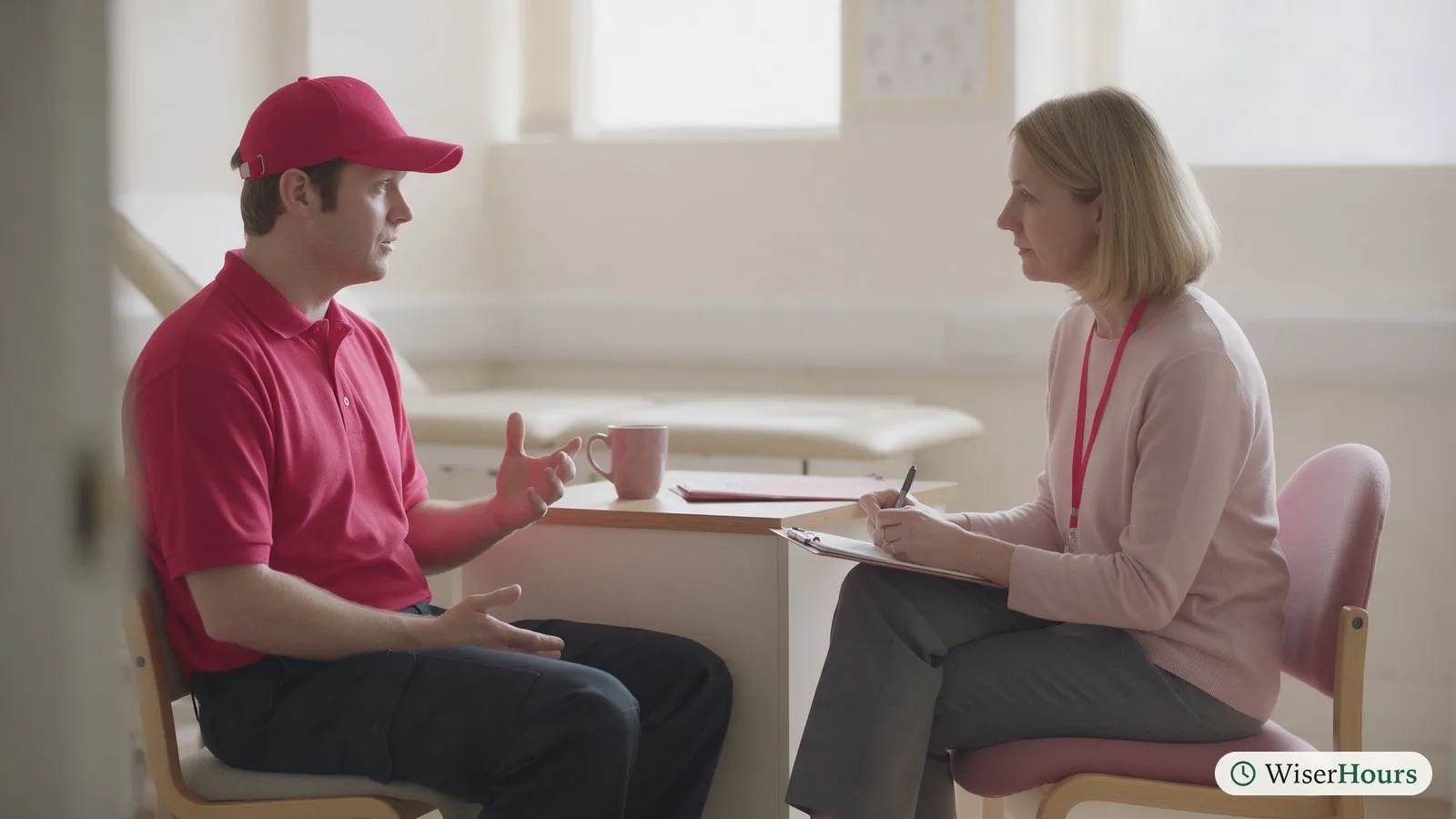
At an occupational health assessment, an adviser talks with the worker about their health, any treatment and any worries about returning to work, according to Acas guidance for Great Britain (updated 2025). If the adviser needs detail from the worker’s own doctor, the worker should be told why and asked to sign a consent form. The assessment differs from a GP’s view because it looks at the job: Acas describes it as more focused on how someone does their work and how the work might affect their health. Possible outcomes include more time off, physiotherapy or counseling, a different chair or other workspace changes, or a phased return with shorter hours or lighter duties.12
Two safeguards come from the 2014 ICOH ethics code: results must be explained to the worker, and workers must be told they can challenge a fitness conclusion they think is against their interest.13
Take an invented example: a delivery driver back after a knee operation. The adviser asks about pain, kneeling and stairs, then suggests four weeks of shorter routes and a review; the manager hears that, not the surgical details. The changes themselves are where adjusting work for a health condition comes in.
Does workplace help with returning shorten time off? A 2015 Cochrane systematic reviewsystematic review: A review that fixes its question and its rules for including studies in advance, then searches out every study that fits and weighs them together. Some systematic reviews pool the results into a meta-analysis; others describe what the studies found without combining the numbers.Full entry in the glossary gives a cautious yes.
The study
Moderate evidence
Back sooner, but back for good? A 2015 Cochrane review of 14 return-to-work trials (van Vilsteren and colleagues)
Workplace interventions for sick-listed workers shortened the time to a first return to work compared with usual care (moderate-quality evidence) and cut total sickness absence (high-quality evidence). They did not clearly speed up lasting return to work (very low-quality evidence), and one trial found more repeat sick leave with the intervention.14
The trials tested workplace help that lowers barriers to returning and gets the key people working together, not occupational health services as a whole, so they back the return-to-work part of the job rather than every service. A 2022 review of 20 trials in four countries by Tingulstad and colleagues, covering broader work-related programs for long-term sick leave, found no conclusive evidence of which approach works best.15 The Cochrane review’s weakest result is the most practical one: getting someone back sooner is not the same as keeping them back, so look at the plan again a few weeks after the return. Absence data alone will not tell you which happened; reading absence next to working while ill helps.
Can occupational health share my medical information with my employer?
Occupational health should not share your medical details with your employer without your consent; what managers normally receive is advice about fitness and limits for the job. The ICOH’s 2014 ethics code says the results of legally required examinations go to management only in terms of fitness for the work or medically needed limits on tasks or exposures, and that medical files stay secured under the occupational health physician or nurse.13
National law fills in the detail. In the UK, the Information Commissioner’s Office’s 2025 guidance, now under review, says the occupational health adviser should, as far as possible, hold the medical information and tell the manager only the results of the assessment. Releasing what a worker told a health professional to non-medical staff generally needs explicit consent, and employers should not normally ask for a worker’s entire medical record.16 Acas adds that a worker in Great Britain can refuse a report from their own doctor, see it before the employer does and ask for corrections.17 In the US, the Americans with Disabilities Act (1990) requires that medical examinations of employees be job-related and consistent with business necessity, and that the results be kept as confidential medical records.18 Elsewhere, including the EU, check the rules of your national data protection authority.
| Usually goes to the manager | Usually stays with occupational health |
|---|---|
| Whether the person is fit for the job, and any limits | Diagnosis, test results and clinical notes13 |
| Suggested adjustments and a review date | The full medical record, which employers should not normally request16 |
To plan the work, a manager needs “no lifting for four weeks, review on the 20th”; the name of the condition adds nothing to the schedule and a lot to the risk of gossip or unfair treatment.
There is one exception. Where a worker’s condition is likely to endanger other people, the ICOH code says the worker must be told, and in a particularly hazardous situation management, and the authorities where rules require it, must be told what is needed to keep others safe.13
Is occupational health the same as HR?
Occupational health is not HR. ILO Convention No. 161 says occupational health staff must enjoy full professional independence from employers, workers and their representatives.1 HR manages the employment relationship on the employer’s behalf; occupational health gives clinical and technical advice to both sides.
That independence is what makes the advice usable. A worker who suspects the adviser reports to HR has a reason to hold things back, and an employer who suspects the adviser sides with staff has a reason to ignore the report.
The split also shows when the report arrives. In Great Britain, Acas says it is up to the employer to decide whether to put an occupational health assessment’s recommendations in place, guided by the organization’s needs and its legal duties to the worker, such as making reasonable adjustments for a disabled worker.12 Treat the report as expert input to a decision someone still has to own: a manager can note why each recommendation was or was not taken up, and an employee can ask what was decided and why.
Who staffs an occupational health service
Occupational health services are meant to be multidisciplinary, according to ILO Convention No. 161, and can be run inside one company, shared by several, or provided by public authorities, social security institutions or other approved bodies.1 The International Commission on Occupational Health’s 2014 ethics code lists occupational health physicians and nurses first, then a wider group including hygienists, psychologists and specialists in ergonomics and rehabilitation.13
The mix follows the questions: measuring dust or noise is a hygienist’s task, judging whether a worker’s hearing or breathing has changed is a clinician’s, and reshaping a workstation is an ergonomist’s.
Qualifications are national. In Great Britain, the Health and Safety Executive’s guidance (updated 2024) tells employers to check a doctor’s registration with the General Medical Council and an occupational medicine qualification, and a nurse’s registration with the Nursing and Midwifery Council and an occupational health qualification. Technicians may run tests such as hearing or lung-function checks under supervision, but must not interpret the results.19
Coverage is patchy even in rich countries. The same 2023 consultation estimated that 45 percent of workers in Great Britain had access to occupational health, found large employers far more likely than small ones to provide any, and noted that France, Finland and the Netherlands enforce access by law.6
For a small organization, the question is not whether it has a full team but whether it can reach a qualified professional when needed, and how to check that person’s registration in your country.
When to get medical help instead of a referral
Occupational health advises on work; it is not an emergency service, so pick the route by urgency. If anyone’s safety is at stake right now, call your local emergency number first.
- Now: two country examples. The US National Institute of Mental Health points people facing a life-threatening emergency to 911 or an emergency department, and anyone who feels suicidal or is in emotional distress to the 988 line, which takes calls and texts.20 Britain’s NHS says to dial 999 or attend A&E when a person’s life is in danger, and names Samaritans (116 123) as a free listening service.21 Look up the equivalent numbers where you live.
- Soon: new or worsening symptoms, at work or after an injury, belong with your own doctor or local health service, who can also advise on time off.
- Routine: a long-term condition that makes parts of the job harder is a good reason to ask your employer about an occupational health referral.7
The bottom line
An occupational health service is an independent adviser on where work and health meet, and what reaches a manager should be advice about the job, with the worker’s agreement. Refer early with specific questions about the work, and look at the plan again once the person is back.
This article is general information, not medical advice. If you're worried about your health, talk to a doctor or another qualified professional.
This article is general information, not legal advice. Rules differ by country and change over time; for your own situation, speak to a qualified lawyer or an official advice service where you live.
Frequently asked questions
Does an employee have to attend an occupational health appointment?
Usually not. Acas, Great Britain's workplace advisory service, says a worker does not have to agree to an occupational health assessment. Agreeing can help, Acas adds, because it keeps the employer from making big decisions without important information. Elsewhere, check your contract and local law, because health surveillance can be a legal duty in some hazardous jobs.
Who pays for occupational health?
Workers should not pay for work-related health checks: ILO Convention No. 161, binding on countries that ratify it, says health surveillance related to work should be free of charge to workers, involve no loss of earnings and take place in working hours where possible. In Great Britain, Acas says whether time at appointments is paid should be in the organization's policy.
What if my employer has no occupational health service?
Many do not. WHO's work on wider coverage includes helping primary care centers give working people preventive and rehabilitation care, so a family doctor is a reasonable first stop. In Great Britain, the government's fit note guidance notes that occupational health is sometimes provided by NHS or local authority services.
Can I see my occupational health report?
Generally yes. The ICOH ethics code says examination results must be explained to the worker. In the UK, the Information Commissioner's Office says an occupational health provider acting in its professional capacity is likely to be a controller and must answer workers' subject access requests.
Sources
- Convention (No. 161) concerning occupational health services (Occupational Health Services Convention, 1985). International Labour Organization (adopted 26 June 1985); United Nations Treaty Series, vol. 1498, No. 25799
- Expanding health coverage to all workers. World Health Organization (undated activity page; checked 11 October 2026)
- WHO calls for scaling up of workers' health coverage. World Health Organization news release (27 April 2014)
- Occupational health (health topic). World Health Organization
- Occupational health: Overview. Health and Safety Executive, Great Britain (updated 29 January 2025)
- Occupational Health: Working Better (consultation). Department for Work and Pensions and Department of Health and Social Care, UK (July 2023)
- Using occupational health at work. Acas, Great Britain (last updated 17 December 2025)
- Getting the most out of the fit note: guidance for employers and line managers. Department for Work and Pensions, UK (updated 6 October 2023)
- Council Directive 89/391/EEC on the introduction of measures to encourage improvements in the safety and health of workers at work (Framework Directive), Article 14. European Union (1989); text as published on legislation.gov.uk
- Medical Screening and Surveillance: Overview. Occupational Safety and Health Administration, US Department of Labor
- Workers' Compensation. US Department of Labor
- Occupational health assessments. Acas, Great Britain (last updated 17 December 2025)
- International Code of Ethics for Occupational Health Professionals, third edition. International Commission on Occupational Health (2014)
- Workplace interventions to prevent work disability in workers on sick leave. van Vilsteren, M., van Oostrom, S. H., de Vet, H. C. W., Franche, R.-L., Boot, C. R. L. & Anema, J. R. (2015). Cochrane Database of Systematic Reviews, CD006955
- Effectiveness of work-related interventions for return to work in people on sick leave: a systematic review and meta-analysis of randomized controlled trials. Tingulstad, A., Meneses-Echavez, J., Evensen, L. H., Bjerk, M. & Berg, R. C. (2022). Systematic Reviews, 11, 192
- Employment practices and data protection: information about workers' health. What if we use occupational health schemes? Information Commissioner's Office, UK (page dated 10 September 2025; marked as under review after the Data (Use and Access) Act)
- Getting a doctor's report about a worker's health. Acas, Great Britain (last updated 20 May 2025)
- Enforcement Guidance on Disability-Related Inquiries and Medical Examinations of Employees under the ADA. US Equal Employment Opportunity Commission (2000)
- Occupational health: Assess the competence of occupational health professionals. Health and Safety Executive, Great Britain
- Help for Mental Illnesses. National Institute of Mental Health, US National Institutes of Health
- Where to get urgent help for mental health. NHS (UK), page last reviewed 26 April 2023
How we researched this
ILO, WHO, ICOH, EU, UK (HSE, Acas, ICO, DWP) and US (OSHA, EEOC, Department of Labor) pages were read in full in October 2026, plus the 2015 Cochrane review on workplace return-to-work interventions (abstract only) and a 2022 review of work-related return-to-work programs (full text). Sources date from 1985 to 2025. Main limitation: rules on referral, consent and medical records differ by country, and the official pages used are mostly from the UK, the US and the EU.
Keep reading
Sitting All Day: What Employers Can Do About Sedentary Work
Of the workplace fixes in a 34-study Cochrane review, only sit-stand desks cut sitting consistently. What employers can do about sedentary work, by evidence.
Absenteeism vs. Presenteeism: Measuring the Cost of Working While Unwell
Presenteeism, working while ill, is far harder to count than absence, which took 2.0% of UK working hours in 2025. How to measure both, and what drives each.
Do Workplace Wellness Programs Work? What the Randomized Trials Found
Do workplace wellness programs work? In 2 large randomized US trials, spending and absence did not fall. Why earlier savings claims misled.
Psychosocial Hazards at Work: What They Are and How to Manage Them
Psychosocial hazards are work conditions such as overload, low control and bullying. What counts as one, and the 4-step loop safety codes use to manage them.