How Much Caffeine Is Too Much? What Health Agencies Say
The FDA, EFSA and Health Canada set 400 mg of caffeine a day as a ceiling for healthy adults, not a target. Pregnancy, teens and some conditions call for less.

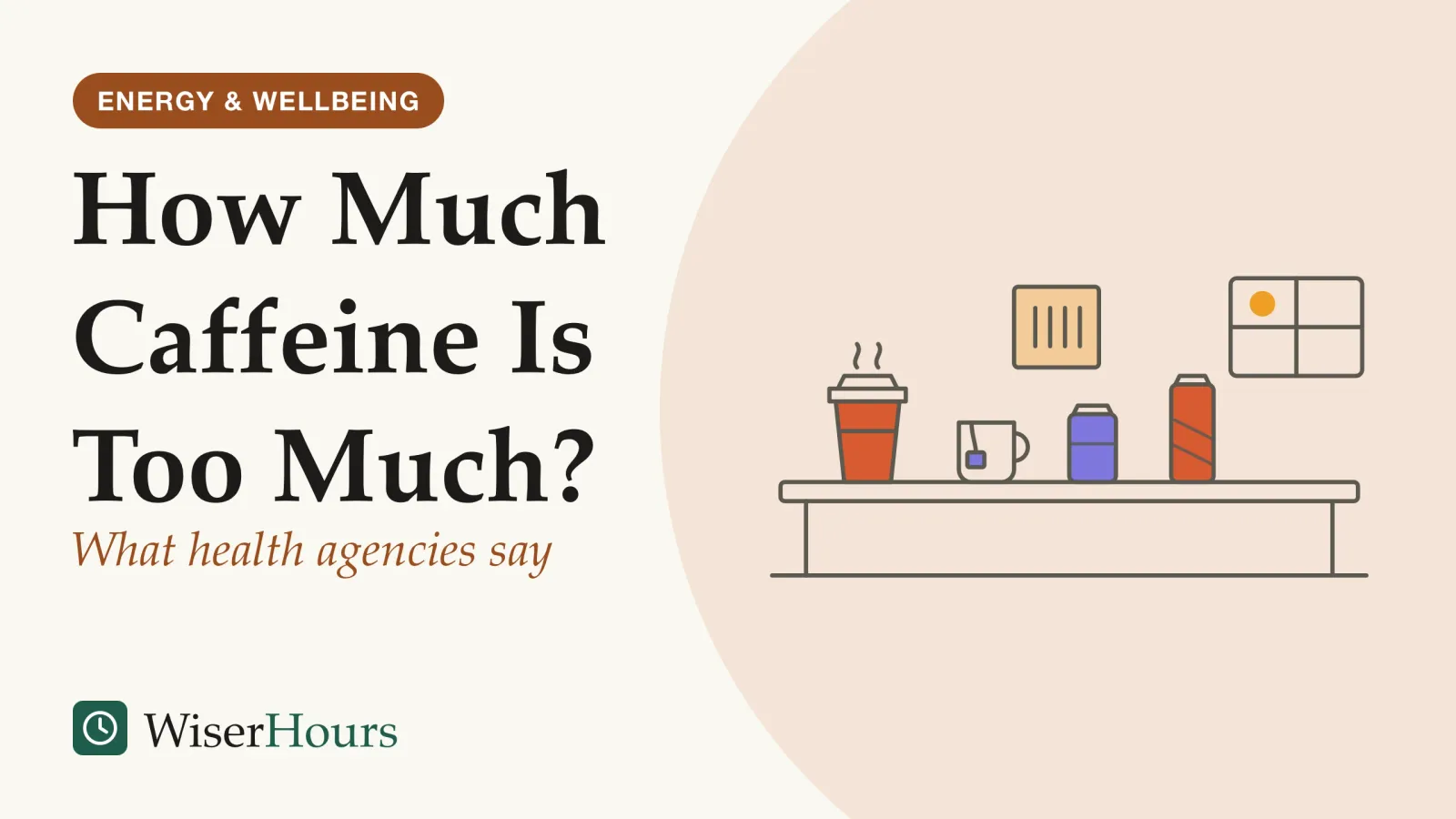
A large coffee on the commute, a mug of tea at the desk, a can of cola with lunch and an energy drink before the late meeting. Each comes from a different shelf, so the caffeine in them rarely gets added together.
How much caffeine is too much depends more on who you are than on what you drink. For healthy adults, the US Food and Drug Administration (FDA), the European Food Safety Authority (EFSA, in 2015) and Health Canada each set 400 milligrams a day, from all sources combined, as the upper limit; by the FDA’s reckoning, that is about two to three 12-ounce cups of coffee.123
The same agencies set lower limits for pregnancy and for children and teenagers, and the adult figure was never meant for people with certain health conditions or on certain medicines. Among our guides to energy, nutrition and exercise, this page covers the daily amount and who it fits; the hour of your last cup is linked further down.
How much caffeine is too much for a healthy adult?
For a healthy adult who is not pregnant, the limit shared by the FDA, EFSA and Health Canada is an upper edge to stay under, not an amount to aim for. The FDA’s consumer page (last updated in 2024) describes it as an amount not generally associated with negative effects, and adds that sensitivity to caffeine, and the speed at which the body clears it, vary widely between individuals.1
The reason for that spread lies in what caffeine does. MedlinePlus, run by the National Library of Medicine in the US, explains that it stimulates the central nervous system, raises blood pressure and increases stomach acid, and that its level in the blood peaks within an hour.4 The same effects give you the lift you want in the morning and the jitters or heartburn you don’t want at a higher dose. For caffeine’s place among other alertness habits, see habits that shape focus.
In practice, two colleagues can drink the same three coffees and have quite different afternoons: one feels alert, the other shaky and unable to settle. Neither is doing anything wrong. The agency figure marks a level at which studies of healthy people found no clear harm; it does not promise that you will feel fine there.
- Myth
- Four coffees a day is fine for anyone.
- Fact
- The adult limit applies to healthy adults who are not pregnant, and a cup can hold a little or a lot of caffeine depending on its size and how it was made.
The working rule: read the adult figure as the top of a range that suits most healthy people, and let how you feel decide where you sit inside it.
How much caffeine is in coffee, tea and energy drinks?
Serving size and preparation change caffeine content more than the name of the drink does. The US Department of Agriculture’s FoodData Central database and the FDA publish typical amounts, and a coffee can hold far more caffeine than a cup of tea.
| Drink and serving | Typical caffeine | What the figure is |
|---|---|---|
| Brewed coffee, 8 fl oz (237 ml) | About 95 mg | Single value in the USDA’s food composition data5 |
| Brewed coffee, 12 fl oz (355 ml) | 113 to 247 mg | Range across products, reported by the FDA1 |
| Brewed black tea, 8 fl oz (237 ml) | About 47 mg | Single value in the USDA’s food composition data5 |
| Energy drink, 16 fl oz (473 ml) | 54 to 328 mg | Range across products, reported by the FDA1 |
The widest ranges belong to large coffees and energy drinks, so they are the drinks most likely to push a day’s total up. A tally that stops at coffee also runs short, because tea, cola, chocolate and some medicines add more (the questions at the end list where caffeine hides).
Worked example: one day's drinks, added up
Go back to the day in the opening lines: a 12-ounce coffee-shop coffee, a mug of black tea, a can of cola and a 16-ounce energy drink. Using the table’s figures and the USDA’s value for a can of cola, the day comes to somewhere between about 250 mg and about 650 mg, and the coffee and the energy drink account for all of the gap. Those two labels, or a question at the counter, decide whether the day stays under the adult limit.
So count the big, variable drinks first. A mug of tea adds a modest amount; a large coffee-shop coffee or a tall energy drink can move the total a long way.
A daily total is not a single-dose limit
A daily limit assumes the caffeine arrives spread across the day. EFSA’s 2015 assessment gives healthy adults a second, lower figure for caffeine taken in one go, about half the daily one, and notes that an even smaller single dose may affect sleep in some adults when taken close to bedtime.2
Timing is the reason to keep the two apart. Because caffeine peaks in the blood within an hour of a drink, as MedlinePlus notes, a large amount taken at once peaks all together, while the same amount sipped over a working day is spread out. In the worked example, the large coffee and the energy drink, downed together before a presentation, can reach the single-dose figure in minutes even on a day whose total stays under the limit. For how long each dose lingers and when to stop for the day, see how late caffeine affects sleep.
What stands behind the adult figure
Two assessments since Health Canada’s 2003 review back the adult figure. EFSA reached the same 400 milligrams separately, in its own 2015 assessment.2 A systematic reviewsystematic review: A review that fixes its question and its rules for including studies in advance, then searches out every study that fits and weighs them together. Some systematic reviews pool the results into a meta-analysis; others describe what the studies found without combining the numbers.Full entry in the glossary from 2017 re-checked the evidence behind Health Canada’s figures and came to the same view for healthy adults, and the FDA’s consumer page cites it as confirming the adult figure.1 That review was sponsored by an industry-funded institute, and we could read only its abstract.
The study
Moderate evidence
An industry-sponsored 2017 review of caffeine safety studies
Health Canada’s figures come from a 2003 review. This team checked whether the studies published since then still supported them, across acute toxicity, the heart and blood vessels, bone, behavior, and reproduction and development. For healthy adults and for healthy pregnant women, they concluded that the evidence generally did; for children and teens, the data were limited, and the body-weight figure remained appropriate on what there was.6
Two things temper that result. The review was sponsored by the North American branch of the International Life Sciences Institute (ILSI), which also received unrestricted grants from the American Beverage Association and the National Coffee Association; the authors say the two associations took no part in the review, and that neither they nor ILSI influenced how the data were graded or interpreted. And it covered only healthy people, which is why its authors call for research on more sensitive groups.7
The lesson is about scope. For the healthy adults who were studied, the limit rests on a large body of evidence and on agencies in Europe and North America reaching the same number separately. For anyone the studies left out, it says little.
Pregnancy and breastfeeding: lower limits that differ by country
Pregnancy is where the agencies set their lowest adult limits and where they differ most. The UK’s NHS (pregnancy advice last reviewed in 2026) advises no more than 200 milligrams a day, counting tea, cola, energy drinks and chocolate as well as coffee.8 EFSA’s 2015 assessment found no safety concern for the fetus up to the same amount, while Health Canada (guidance updated in 2025) sets a maximum of 300 milligrams for people who are pregnant, breastfeeding or planning a pregnancy.23
The reason for the extra caution is that the baby shares the caffeine: MedlinePlus notes that it passes through the placenta, and that a small amount reaches a breastfed baby.4 In the US, the American College of Obstetricians and Gynecologists (ACOG) concluded in 2010, and reaffirmed in 2026, that intake below 200 milligrams a day does not appear to be a major contributing factor in miscarriage or preterm birth. It called the link to restricted fetal growth undetermined, and said two large studies of higher intake and miscarriage had reached contradictory conclusions.9
Not everyone accepts that consensus. A 2021 narrative review by Jack James of Reykjavík University found that most observational studies and meta-analyses linked caffeine in pregnancy to miscarriage, stillbirth and low birth weight, often with no threshold below which the link disappeared, and argued that pregnant women should be advised to avoid caffeine. Observational studies cannot by themselves prove cause, though James argues the repeated dose-response pattern points that way.10
In practice, if you are pregnant, breastfeeding or trying to conceive, your country’s figure is a starting point for a conversation with your midwife or doctor, not a line that settles the question.
- Healthy adults: a ceiling of 400 mg a day (FDA in the US, EFSA in the EU, Health Canada)
- Pregnancy and breastfeeding, Canada: a ceiling of 300 mg a day (Health Canada)
- Pregnancy, UK and EU: a ceiling of 200 mg a day (NHS, EFSA); in the US, ACOG describes less than 200 mg as moderate
- A teenager weighing 50 kg: a ceiling of about 125 to 150 mg a day, worked out from Health Canada’s 2.5 mg and EFSA’s 3 mg per kg of body weight
Children and teenagers: limits that scale with body weight
For children and teenagers, Health Canada and EFSA set limits by body weight rather than a fixed amount: 2.5 milligrams per kilogram a day in Canada and 3 in the EU. Health Canada calls its figure precautionary, because data for teenagers are thin, and says healthy older and heavier teens, aged 14 to 18, may handle caffeine much as healthy adults do.32
A per-kilogram rule makes the limit grow with the child. For a teenager weighing 50 kilograms (about 110 pounds), the two rules work out at ceilings of 125 and 150 milligrams a day, roughly one ordinary brewed coffee, and a single large energy drink can pass both.
The FDA gives no figure for children and teens. It points instead to the American Academy of Pediatrics, which advises against energy drinks for children and teens, and to the Dietary Guidelines for Americans, which say children under 2 should avoid caffeinated drinks; it adds that too much caffeine in children and teens can cause a fast heart rate, palpitations, high blood pressure, anxiety and sleep problems.1
The practical upshot for families: a teenager’s ceiling sits far below a parent’s, so a drink that suits the adult can be too much for the child, and energy drinks are the product the pediatricians single out. A child’s own doctor is the person to ask about a particular child.
Who the adult limit was not written for
The adult limit was set for healthy people, and EFSA states that its assessment did not cover people with a disease or medical condition, or caffeine taken together with medicines.2
MedlinePlus suggests asking a health care provider whether to limit or avoid caffeine if you have a sleep disorder, migraines or other chronic headaches, anxiety, reflux (GERD) or ulcers, a heart rhythm problem or high blood pressure, or if you take stimulants, certain antibiotics, asthma medicines or heart medicines.4
If any item on that list describes you, the adult figure is not your figure. The useful question for your doctor or pharmacist is what your own limit should be, and whether any medicine you take changes it.
Signs you have had more caffeine than suits you
The FDA lists the signs of too much caffeine as a faster heart rate, palpitations, raised blood pressure, insomnia or disrupted sleep, anxiety, jitters, an upset stomach, nausea and headache. It notes that “too much” varies with body weight, medicines, health conditions and individual sensitivity, so these signs can appear below the adult limit. If you decide to cut back, it suggests doing so gradually, and says withdrawal is unpleasant but not considered dangerous.1
Several of these signs match the effects described near the top of this page: MedlinePlus links the extra stomach acid to an upset stomach or heartburn, and lists restlessness, shakiness and a fast heart rate among the problems too much caffeine can cause.4 Your own reactions are the more personal measure: a day that ends with a racing heart and a sleepless night is too much for you, whatever the total.
Checking your own caffeine
Getting help: from a routine question to an emergency
Trouble breathing, confusion, seizures or an irregular heartbeat can mean a caffeine overdose and need emergency help right away. Signs of too much that keep coming back are worth a doctor’s appointment, while a question about being pregnant, a health condition or a medicine can wait for a regular visit. The three levels are our own grouping of US and UK health advice.
- Now: breathing trouble, seizures, confusion and a rapid or irregular heartbeat are among the overdose symptoms MedlinePlus lists, and it advises getting medical help immediately; in the US, that means 911 or the Poison Help line on 1-800-222-1222.11 In the UK, the NHS directs emergencies to 999 or A&E. In England, it says its 111 service, by phone or online, can help when you think you need medical help right now; Scotland and Wales run their own versions of the service.12 Anywhere else, ring your country’s emergency number.
- Soon: the FDA suggests speaking with a health professional about your caffeine intake if you notice signs of too much, such as palpitations or a racing heart.1
- At a routine visit: MedlinePlus suggests raising caffeine with a health care provider during pregnancy or breastfeeding, with one of the conditions listed above, or when taking a medicine or supplement that may interact with caffeine.4
The bottom line
The 400-milligram figure that US, EU and Canadian agencies share is a ceiling for healthy adults, spread across the day and counting every source. Pregnancy, childhood and the teenage years bring lower or weight-based limits, and people with heart, sleep or anxiety problems, or on interacting medicines, fall outside the figure altogether. Add up the large coffees and energy drinks first, since their caffeine varies the most, and let your own reactions keep you below the number, never past it.
This article is general information, not medical advice. If you're worried about your health, talk to a doctor or another qualified professional.
Frequently asked questions
Does caffeine in tea or chocolate count the same as caffeine in coffee?
Yes. According to the FDA in the US, the body handles caffeine the same way, and it is just as safe, whether it occurs naturally in coffee and tea or is added to a product, so every source counts toward a daily total. The FDA adds that caffeine turns up in less obvious places too, including energy bars, ice cream, chewing gum, supplements and some over-the-counter medicines.
Is it safe to mix caffeine and alcohol?
MedlinePlus, run by the National Library of Medicine in the US, calls the mix dangerous: caffeine can interfere with recognizing how drunk you are, which can lead to drinking more. EFSA's 2015 assessment reached a narrower conclusion: single doses of caffeine up to 200 mg were unlikely to mask how drunk people felt at alcohol levels up to about the drink-driving limit in many countries. EFSA did not assess binge drinking or drinking in pregnancy.
Is pure caffeine powder dangerous?
It can be. The FDA in the US estimates that toxic effects such as seizures can occur with rapid consumption of around 1,200 mg of caffeine, less than half a teaspoon of the pure powder, and says pure and highly concentrated caffeine products can have serious consequences, including death. The FDA has acted against these products, but says some remain on sale.
Do medicines contain caffeine?
Some do. MedlinePlus lists pain relievers, cold medicines and over-the-counter products for staying alert among those that can contain added caffeine, and the FDA names over-the-counter medications among products that may include it. Check the label, and ask a pharmacist whether a medicine's caffeine, or an interaction with the caffeine you already drink, matters for you.
Sources
- Spilling the Beans: How Much Caffeine is Too Much? U.S. Food and Drug Administration (content current as of 28 August 2024)
- Caffeine. European Food Safety Authority (EFSA), topic page summarizing its 2015 Scientific Opinion on the safety of caffeine
- Caffeine in Foods. Health Canada (page modified 2 April 2025)
- Caffeine. MedlinePlus, US National Library of Medicine (last updated 8 September 2021)
- FoodData Central (SR Legacy entries for brewed coffee, brewed black tea and regular cola). U.S. Department of Agriculture, Agricultural Research Service (SR Legacy, published April 2019)
- Systematic review of the potential adverse effects of caffeine consumption in healthy adults, pregnant women, adolescents, and children. Wikoff, D., Welsh, B. T., Henderson, R., et al. (2017). Food and Chemical Toxicology, 109(Pt 1), 585-648
- Key Findings and Implications of a Recent Systematic Review of the Potential Adverse Effects of Caffeine Consumption in Healthy Adults, Pregnant Women, Adolescents, and Children. Doepker, C., Franke, K., Myers, E., et al. (2018). Nutrients, 10(10), 1536
- Foods to avoid in pregnancy. NHS (UK), page last reviewed 15 June 2026
- Moderate Caffeine Consumption During Pregnancy (Committee Opinion No. 462). American College of Obstetricians and Gynecologists (2010, reaffirmed 2026). Obstetrics & Gynecology, 116, 467-468
- Maternal caffeine consumption and pregnancy outcomes: a narrative review with implications for advice to mothers and mothers-to-be. James, J. E. (2021). BMJ Evidence-Based Medicine, 26(3), 114-115
- Caffeine overdose. MedlinePlus Medical Encyclopedia, US National Library of Medicine (review date 1 July 2025)
- When to use NHS 111 online or call 111. NHS (UK), page last reviewed 14 November 2022
How we researched this
We searched the websites of the US FDA, EFSA, Health Canada, the NHS, ACOG and MedlinePlus, the USDA's FoodData Central database, PubMed and Europe PMC in September 2026 for current limits and the most recent systematic reviews. Sources span 2010 to 2026. The main limitation: the limits rest mostly on studies of healthy people, and on observational studies for pregnancy; EFSA's 2015 opinion was read through EFSA's own summary, and a 2017 industry-sponsored systematic review as its abstract, alongside its authors' full-text summary.
Keep reading
How Much Water Do You Really Need? Hydration Myths and Facts
EFSA puts adult water needs at about 2 liters a day for women and 2.5 for men, counting food, tea and coffee. No study backs eight glasses of plain water.
Do You Need 10,000 Steps a Day? Where the Number Came From
The 10,000-step goal began as a 1965 Japanese pedometer's name. A 2025 review of 57 studies found the steepest gains up to about 5,000 to 7,000 steps.
Does Exercise Give You More Energy? What the Research Says
Does exercise give you energy? Randomized trials say yes on average, by a modest amount that builds over 6 weeks or more, with one key exception.
How to Eat for Steady Energy All Day: The Basic Principles
6 eating habits for steadier daytime energy, graded by evidence: why sugar is a poor pick-me-up, how lunch meets the afternoon dip, and glucose spikes.