How Late Is Too Late for Coffee? Caffeine's Half-Life and Your Sleep
Caffeine's half-life is about 3 to 7 hours in adults, so an afternoon coffee is still working at bedtime. How dose, timing and your body set your cutoff.

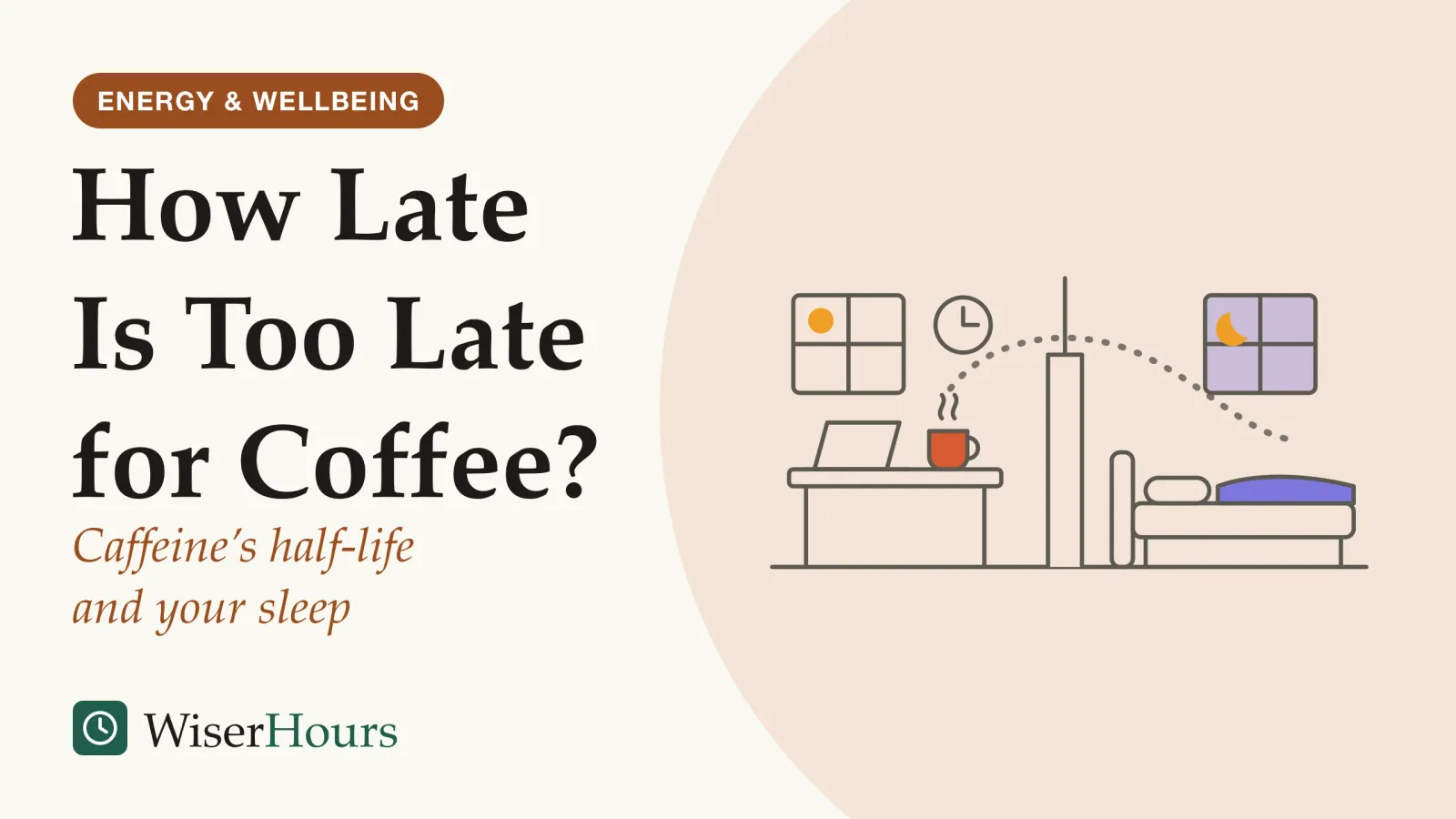
Caffeine outlasts its buzz. A coffee’s caffeine peaks in your blood within an hour, and you may feel it for several hours.1 The caffeine itself leaves more slowly, and part of an afternoon cup is usually still in your body when you turn out the light.2
The research on caffeine and sleep puts the last coffee earlier than most people expect. Caffeine’s half-life in adults is about 3 to 7 hours, a 2017 review reports.2 In a 2023 meta-analysismeta-analysis: A study that combines the results of earlier studies on the same question into one overall estimate. Pooling makes the estimate more precise, but it cannot repair the studies it pools: a meta-analysis of surveys is still survey evidence.Full entry in the glossary of controlled studies in healthy adults, the closer to bedtime caffeine was taken, the more sleep was lost. Its model estimated that a typical cup of coffee should be finished about 9 hours before bedtime to avoid a statistically significant loss of sleep.3 If you go to bed at 10 p.m., that puts the last cup in the early afternoon; stronger drinks need longer, and weaker ones less.
In practice, that means counting back from your bedtime rather than forward from the cup, giving a large or strong drink a longer gap than an ordinary coffee, and then adjusting by how rested you wake. The exact hour is still debated: UK and US health advice allows a shorter gap than the 2023 model, and a later trial by the model’s own authors found no clear effect from a coffee-sized dose even in the evening. Moving the last coffee earlier is one of the habits that help most adults sleep better, and the one with the clearest research on dose and timing.
Caffeine’s half-life: why the afternoon cup is still working at bedtime
Caffeine’s half-life, the time your body takes to clear half of what you drank, is about 3 to 7 hours in adults, a 2017 review of caffeine safety in Frontiers in Psychiatry reports. The liver breaks it down, mainly through one enzyme, so the amount in your blood falls by halves rather than all at once.2
A leftover fraction matters because of what caffeine does. It blocks the brain’s receptors for adenosine, and so is thought to dampen sleep pressure, the drive to sleep that builds while you are awake, along with the feeling of tiredness.3 A 2022 review by sleep researchers in Switzerland and the Netherlands calls adenosine an important regulator of sleep and notes that caffeine reaches the brain about half an hour after you drink it.4 That muffled drowsy signal is what you want mid-morning and what you do not want at bedtime.
Halving is easy to underestimate. Take a coffee at 3 in the afternoon and assume a half-life in the middle of the range: about half the caffeine is left by early evening and about a quarter after midnight, long after the lift has worn off.
- The cup: a coffee at 3 p.m.; all of its caffeine is still to be cleared
- About half left: at 8 p.m., if your half-life is 5 hours, the middle of the adult range
- About a quarter left: at 1 a.m. on the same assumption
- Dashed lines: a 3-hour and a 7-hour half-life, the ends of the adult range in a 2017 review: faster clearers are lower, slower ones higher
The practical lesson is to count back from bedtime, not forward from the cup. The useful question is not whether you still feel the coffee but how much of it will be there when you lie down.
How late is too late for coffee? What the timing studies found
The most direct evidence on timing is the 2023 meta-analysis, by researchers at the Australian Catholic University, which reviewed 24 controlled studies of healthy adults and, from those that reported the dose and timing, modeled how the size and timing of the last dose changed total sleep. The closer to bedtime and the larger the dose, the more sleep was lost.3
The cutoff is not a half-life calculation. The model looks for the latest time a dose can be taken without a statistically significantstatistical significance: A result that a statistical test says would be unlikely to turn up if there were no real effect. It does not carry the everyday sense of significant: it says nothing about how big the effect is or whether it matters in practice.Full entry in the glossary cut in total sleep, and the authors note that the cutoffs this produces arrive well before timings based on the typical half-life. The same model shows why no single rule fits every drink. A cup of black tea, with less than half the caffeine of their reference coffee, had no cutoff at all. A standard serving of pre-workout supplement, with about twice a coffee’s caffeine, had to be taken early in the morning, even with lights out at 10 p.m.3
Its authors spell out the limits. The cutoffs rest on statistical significance, not on how much lost sleep matters to a person; the studies mostly involved light and moderate caffeine users; and the results may not apply to teenagers, older adults or heavy users. They suggest treating the cutoffs as a starting point and adjusting to how you sleep.3
What this means for you: “afternoon coffee” and “safe for sleep” are not the same thing. For most bedtimes, the model’s cutoff for an ordinary cup falls around lunchtime or soon after.
A bigger dose needs a bigger gap
The size of the dose matters alongside the time on the clock, and the clearest test of that is a 2025 randomized, double-blind, placebo-controlled trial by the Australian group behind the meta-analysis, published in the journal SLEEP, which gave two doses at three times before bed.
The study
Limited evidence
The 2025 SLEEP trial that varied both the dose and the hour
Each man slept at home after a placebo or one of the two doses, taken at one of the three times. The smaller dose, close to one cup of coffee, made no clear difference to sleep even at the latest time. The larger one delayed falling asleep and changed the structure of sleep at every timing, the earliest included, and broke sleep up more at the two later ones. Yet the men rated their sleep worse only after the large dose at the latest time, and the authors see this as a hint that people may find it hard to judge caffeine’s effect on their own sleep.5
The trial supports a sliding rule rather than a fixed hour, and for an ordinary cup it is more lenient than the 2023 model: its authors conclude that a dose of about one cup can be taken up to 4 hours before bed, while a large single dose may disrupt sleep if taken within 12 hours.5 With so small and uniform a sample, though, it says little about women, older adults or people who are sensitive to caffeine. These are trial results, not advice: if you are pregnant or breastfeeding, have a health condition or take other medicines, ask a doctor or pharmacist whether to limit caffeine.1
Not every analysis agrees on dose. A 2025 meta-analysis of crossover trials by researchers in Taiwan, read here only as its published abstract, found that high and low doses each reduced total sleep, without a statistically significant difference between the two.6 One reasonable reading is that a smaller dose buys more room, not a free pass.
Why you may not notice what late caffeine costs you
Late caffeine can cost sleep you do not notice losing. In a small 2013 US trial at Henry Ford Hospital in Detroit, a single 400-milligram dose taken 6 hours before bed still cut sleep measured by a home monitor by more than an hour, yet the participants’ own sleep diaries did not register a clear difference at that timing. It used healthy adults and caffeine pills and was funded by a grant from Zeo, the company that made the sleep monitor it used; its authors say the small sample may have made the diaries less able to detect a difference.7
Part of the reason is that caffeine does not only delay sleep. In the 2023 meta-analysis, it also added time awake after falling asleep and swapped some deep sleep for light sleep, and the authors suggest that brief awakenings like these may go largely unnoticed.3 In everyday terms: a late-afternoon coffee, no trouble dropping off, and a morning that feels vaguely unrested for no obvious reason.
- Myth
- If coffee doesn't stop me falling asleep, it isn't affecting my sleep.
- Fact
- Caffeine can also add wake time during the night and trim deep sleep, and in one small trial, sleep diaries missed the sleep a 400 mg dose lost when taken 6 hours before bed.
So falling asleep easily is a weak test. A fairer one is to move your last coffee a few hours earlier for a week or two and notice how rested you feel, in line with the review authors’ advice to adjust from their cutoffs by how you sleep.
Your own half-life can be much longer or shorter than average
People differ widely both in how sensitive they are to caffeine and in how fast they eliminate it, the US Food and Drug Administration says, so the average half-life is only a starting point for any one person.8
The 2017 review lists the main reasons. Smoking roughly doubles the rate at which caffeine is cleared, by speeding up the liver enzymes that break it down. Oral contraceptives tend to double caffeine’s half-life, pregnancy lengthens it considerably, and liver disease and heavy drinking can slow clearance too.2
Genes add another layer. The 2022 review describes experiments in which people who rated themselves as caffeine-sensitive did show more disturbed sleep brain waves after caffeine, and in which insomnia-like changes appeared only in people with a common variant of ADORA2A, the gene for one of the adenosine receptors that caffeine blocks.4 You do not need a gene test to use this: your own nights after a late cup are the more practical guide.
Picture two colleagues on the same mid-afternoon coffee run, one who smokes and one who takes the pill. On these findings, the first is likely to clear the caffeine faster and the second more slowly, so the same cup may still be affecting one of them at midnight. That is an illustration, not a measured result, but it is why a rule of thumb that works for a friend may not work for you.
Caffeine and sleep: setting a cutoff that fits your bedtime
Official advice sets shorter gaps than the 2023 research model. The UK’s NHS, in insomnia guidance reviewed in 2024, advises against tea or coffee within 6 hours of going to bed.9 The US National Heart, Lung, and Blood Institute (NHLBI), whose sleep advice was last updated in 2022, warns that caffeine’s effects can linger for up to 8 hours, so a late-afternoon coffee can make it hard to fall asleep.10
| What it is | What it found | Evidence |
|---|---|---|
| 2023 meta-analysis model | With lights out at 10 p.m.: a typical coffee by early afternoon, a pre-workout serving before 9 a.m., one cup of black tea at any time | Meta-analysis, moderate; dose effect and cutoff mixed3 |
| 2025 dose-and-timing trial | A small dose was tolerated much closer to bedtime than a large one | Trial, limited5 |
| 2013 timing trial, 12 adults | 400 mg taken 6 hours before bed still cut measured sleep by more than an hour, unnoticed in diaries | Trial, limited7 |
| 2025 meta-analysis of crossover trials | High and low doses each reduced total sleep; the difference between them was not significant | Meta-analysis, limited (abstract only)6 |
Worked example: an 11 p.m. bedtime
The NHS’s 6 hours puts the last coffee at 5 p.m. Reading the NHLBI’s “up to 8 hours” as a gap puts it at 3 p.m., and the 2023 model puts an ordinary cup at about 2 p.m.3 The 2025 trial’s 4 hours for a coffee-sized dose would allow 7 p.m.5 A large or strong drink needs an earlier cutoff than any of them.3
The agencies give general advice for everyone; the model is more specific but built on healthy adults and a statistical threshold. A cautious approach that fits all three is to start from the earliest cutoff for your usual drink and bedtime, then adjust by how you sleep.
Count every source, not just coffee. MedlinePlus notes that caffeine is also in tea, colas, chocolate, energy drinks and some pain relievers and cold medicines.1 If you work shifts, the NHLBI suggests confining caffeine to the early part of each shift.10
Setting your caffeine cutoff
Signs that call for a doctor, a pharmacist or emergency help
Symptoms of a caffeine overdose, such as breathing trouble or seizures, need emergency help at once. Poor sleep that outlasts an earlier coffee cutoff is worth booking a doctor’s appointment for, and questions about pregnancy, health conditions or medicines suit a routine visit. We arranged these three levels ourselves from US National Library of Medicine and UK NHS advice.
- Now: MedlinePlus lists breathing trouble, confusion, seizures, and a fast or irregular heartbeat among the symptoms of a caffeine overdose and says to seek medical help right away; in the US, call 911 or the Poison Help hotline (1-800-222-1222).11 For the UK, the NHS points people to 999 or A&E in an emergency, and to NHS 111 for urgent help that is not an emergency.12 Outside the US and UK, use your local emergency number.
- Soon: the NHS suggests a GP appointment when better sleep habits have not worked, the trouble has gone on for months, or it is making everyday life a struggle.9 If poor nights persist after you move your last coffee earlier, reading about the different types of insomnia and their causes can help you describe the problem at the appointment.
- At your next appointment: MedlinePlus advises checking with a health care provider about limiting caffeine if you are pregnant or breastfeeding, have insomnia or another sleep disorder, anxiety, migraines, an irregular heartbeat or high blood pressure, or take stimulants, certain antibiotics, or asthma or heart medicines, which can interact with it.1
The bottom line
Caffeine clears by halves, so the question to ask about a coffee is how much of it will be left when you go to bed, not whether you still feel it. For an ordinary cup, the evidence ranges from early afternoon in a 2023 model to about 4 hours before bed in a small 2025 trial; bigger doses need longer, and smoking, the pill or pregnancy can move your own timing a long way from the average. Start from the earliest cutoff that fits your bedtime, then adjust by how rested you wake.
This article is general information, not medical advice. If you're worried about your health, talk to a doctor or another qualified professional.
Frequently asked questions
Does decaf coffee affect sleep?
Less than regular coffee, but decaf is not caffeine-free. The US Food and Drug Administration says decaffeinated coffees and teas have less caffeine than regular ones, that decaf coffee typically contains 2 to 15 milligrams in an 8-ounce cup, and that people who react strongly to caffeine may want to avoid decaf too. No study in this article tested decaf against sleep directly.
If I drink coffee every day, does it still affect my sleep?
It can. A 2022 review of adenosine and caffeine research by Reichert, Deboer and Landolt says the time it takes to fall asleep seems to adapt to daily caffeine, but that the extent of tolerance in humans is not clearly established and that daily caffeine still changes sleep brain waves. The 2023 meta-analysis by Gardiner and colleagues likewise says tolerance has not been clearly established in humans.
Can a nightcap cancel out a late coffee?
There is no evidence that it does. MedlinePlus, from the US National Library of Medicine, warns that mixing alcohol and caffeine is dangerous, partly because caffeine can make it harder to tell how drunk you are. A 2017 review in Frontiers in Psychiatry adds that heavy drinking slows caffeine clearance, so the caffeine lingers longer.
Do teenagers need an earlier caffeine cutoff than adults?
The timing research cannot say. The 2023 meta-analysis studied adults aged 18 to 65, and its authors caution that the cutoffs may not apply to adolescents. MedlinePlus says children and teens should not have as much caffeine as adults, that children can be especially sensitive to it, and advises asking a health care provider about limits.
Sources
- Caffeine. MedlinePlus, US National Library of Medicine (last updated 8 September 2021)
- The Safety of Ingested Caffeine: A Comprehensive Review. Temple, J. L., Bernard, C., Lipshultz, S. E., Czachor, J. D., Westphal, J. A. & Mestre, M. A. (2017). Frontiers in Psychiatry, 8, 80
- The effect of caffeine on subsequent sleep: A systematic review and meta-analysis. Gardiner, C., Weakley, J., Burke, L. M., et al. (2023). Sleep Medicine Reviews, 69, 101764
- Adenosine, caffeine, and sleep-wake regulation: state of the science and perspectives. Reichert, C. F., Deboer, T. & Landolt, H.-P. (2022). Journal of Sleep Research, 31(4), e13597
- Dose and timing effects of caffeine on subsequent sleep: a randomized clinical crossover trial. Gardiner, C. L., Weakley, J., Burke, L. M., et al. (2025). SLEEP, 48(4), zsae230
- Age- and dose-specific effects of caffeine on sleep: A meta-analysis of controlled crossover trials. Chang, Y.-H., Cheng, Y.-C. & Cheng, W.-J. (2025). Sleep Medicine, 136, 106874
- Caffeine Effects on Sleep Taken 0, 3, or 6 Hours before Going to Bed. Drake, C., Roehrs, T., Shambroom, J. & Roth, T. (2013). Journal of Clinical Sleep Medicine, 9(11), 1195-1200
- Spilling the Beans: How Much Caffeine is Too Much? U.S. Food and Drug Administration (content current as of 28 August 2024)
- Insomnia. NHS (UK), page last reviewed 19 March 2024
- Sleep Deprivation and Deficiency: Healthy Sleep Habits. National Heart, Lung, and Blood Institute, National Institutes of Health (last updated 24 March 2022)
- Caffeine overdose. MedlinePlus Medical Encyclopedia, US National Library of Medicine (review date 1 July 2025)
- When to use NHS 111 online or call 111. NHS (UK), page last reviewed 14 November 2022
How we researched this
Sources were found through PubMed, Europe PMC and the NHS, NHLBI, FDA and MedlinePlus websites in September 2026; we read the full texts of a 2023 meta-analysis, two randomized trials and two reviews on caffeine and sleep. Sources date from 2013 to 2025. Main limitation: the timing studies are small or pooled from short lab studies in healthy adults, mostly light to moderate caffeine users, and one 2025 meta-analysis was read as its abstract only.
Keep reading
Sleep Trackers: How Accurate Are They, and What Can They Tell You?
A 2025 review of 24 studies found wrist trackers misjudge sleep and wake time. What trackers get right, what they miss, and which symptoms need a doctor.
Sleep Debt Explained: Can You Really Catch Up on Lost Sleep?
Sleep debt builds night by night. In lab trials, 1 long night or a weekend of lie-ins repaid only part of it. What recovery really takes.
Insomnia Explained: Types, Common Causes, and When to See a Doctor
Insomnia is trouble sleeping when you had the chance to sleep. What the 3-night, 3-month line means, what causes it, and when to see a doctor.
Chronotypes Explained: Are You a Lark, an Owl, or Somewhere in Between?
Most people are neither larks nor owls. How chronotypes are measured, what 351 gene regions, age and light do to them, and what owl headlines omit.