What Is an MVP? How to Test a Business With the Smallest Possible Version
A minimum viable product is the smallest test that could prove a business guess wrong. 5 MVP types, how to set a pass mark first, and when to stop.

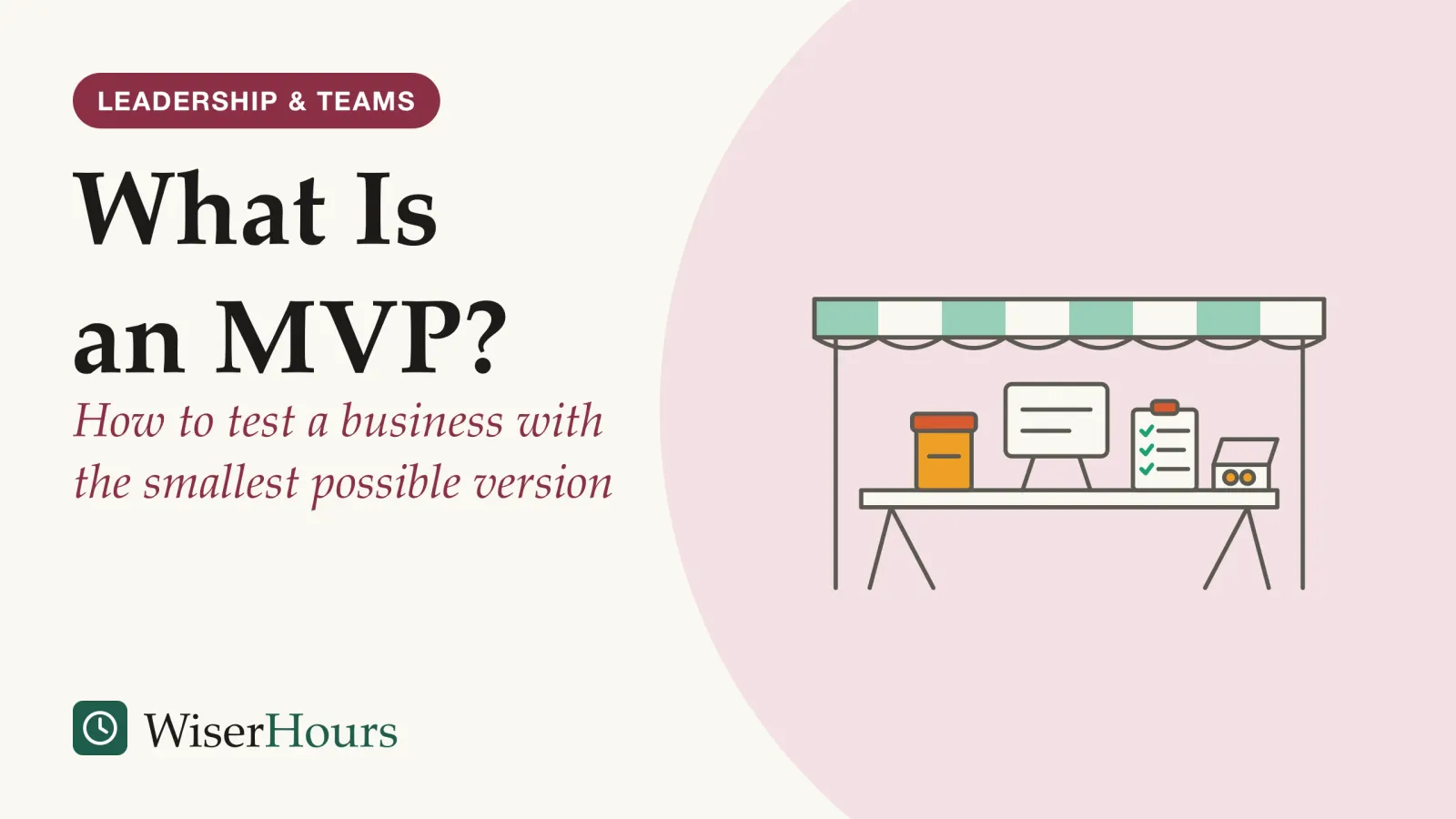
The smallest version of a business is often not a product at all. It can be a web page for something that does not exist yet, a service run by hand, or an order form for goods nobody has made. A minimum viable product (MVP) is whichever of these can show, for the least time and money, whether your main guess about customers is wrong. What makes it an MVP is what you learn.
Running one comes down to four decisions, all made before launch: the one guess to test, the kind of MVP that can test it, the score that would count as success, and the most you will spend.
Prefer to watch? The video covers the same ground as this article.
What is a minimum viable product?
A minimum viable product is the version of a new product that teaches a team the most about customers for the least effort. The term was coined in 2001 by Frank Robinson of the product-development firm SyncDev, and popularized by Steve Blank and Eric Ries.1
Eric Ries defined the MVP in 2009 as the version of a product that yields the most validated learning about customers for the least effort, and wrote that, despite the name, it is not about creating minimal products.2 His 2011 book, The Lean Startup, made the idea mainstream and placed it inside a loop: build something, measure how customers respond, learn, and then decide whether to persevere or pivot.3
Every business rests on guesses: that a problem exists, that people will pay to solve it, that you can reach them. Building the full product first means spending the most money when you know the least. An MVP reverses the order.
Take someone who wants to open a meal-prep service for new parents. The full version needs a kitchen, packaging, delivery and a website. The guess that could sink it is simpler: will tired parents pay a set price each week for someone else’s cooking? Ten paid trial weeks, cooked in a rented kitchen, answer that for a fraction of the cost. So before building anything, put the one question your MVP must answer into a single sentence.
An MVP is an experiment that answers one question
The most common misreading treats an MVP as a stripped-down or unfinished product released early to save money. The Agile Alliance, a non-profit that maintains a glossary of agile practice, lists the typical errors: treating the MVP as the smallest set of features a team can ship, stressing “minimum” over “viable”, and ignoring the feedback once it arrives.4
- Myth
- An MVP is the cheapest, most basic version of the product you can put on sale.
- Fact
- An MVP is a test built to answer one question about customers. A test that could never show you were wrong is not viable, however little it cost.
A product too rough to judge tells you about the bugs, not the demand: a tutor who launches a glitchy booking app and gets few bookings cannot tell whether parents do not want tutoring or simply gave up on the app. A release with no question attached produces numbers nobody knows how to read. The glossary adds that proper use of an MVP means a team may change the product dramatically or drop it altogether.4
Showing an idea early has costs too. In a 2023 study of about 1,200 US software start-ups, Andrea Contigiani found that after a 2014 US Supreme Court ruling weakened patent protection, the start-ups affected became less likely to test early versions in the market, a sign that founders weigh learning against the risk of being copied.5 In a 2018 Wharton interview about the research, he also raised the still-untested worry that bad early feedback may harm a reputation.6 If your idea is easy to copy, think about what your test reveals and to whom.
Five kinds of MVP, from a web page to a pre-sale
MVPs come in a handful of standard forms, each suited to a different guess.
- Landing page or smoke test: describes the product before it exists, to see whether strangers click or leave an email
- Concierge: you deliver the service by hand, openly, to learn what customers need
- Wizard of Oz: looks automated to the customer while a person does the work behind the scenes
- Single feature: one working feature, to see whether people use it and come back
- Pre-sale: customers pay before the product is made: the strongest signal, and a promise you must keep
Landing page or smoke test
You describe the product on a web page before it exists and see whether strangers act. Before building Buffer, a tool for scheduling social-media posts, Joel Gascoigne tested it with a two-page site whose aim, he wrote, was to check whether people would even consider using the app; he then added a pricing page to see whether anyone clicked on paid plans.7
Concierge
You deliver the service by hand, openly, to a few customers, which shows what they need before you automate anything. Airbnb’s first test in 2007 was close to this: two of its founders put an air mattress in their San Francisco living room for visitors to a design conference, when lodging in the city was hard to find.8
Wizard of Oz
The customer sees what looks like an automated service, which the Agile Alliance describes as fully manual behind the scenes.4 The name comes from human-computer interaction research of the early 1980s, where a hidden experimenter played the part of the computer.9 Zappos’s early test fits the pattern: in Ries’s telling, founder Nick Swinmurn tested whether people would buy shoes online by photographing local stores’ stock, posting the pictures and buying each pair at full price only after a customer ordered it.3
Single-feature product
You build one working feature and see whether people use it and come back. The software company ProductPlan notes that the location app Foursquare started with only check-ins and game-style rewards.10 Buffer’s first real product was similarly bare, and Gascoigne reports a first paying customer within 4 days of launch.7
Pre-sale
You take orders or deposits before the product is made. It gives the strongest signal of the five, because money has changed hands, and it also creates the heaviest obligation, covered below.
| MVP type | What it can tell you | What it cannot |
|---|---|---|
| Landing page or smoke test | Whether strangers are interested enough to click or sign up | Whether they will pay, or keep paying7 |
| Concierge | What customers need when you serve them by hand | Whether the service works at scale8 |
| Wizard of Oz | Whether people use the finished experience | What it will cost to automate4 |
| Single-feature product | Whether the core feature earns repeat use | Whether the rest of the plan is needed10 |
| Pre-sale | Whether people will pay now | Whether you can deliver on time and on budget11 |
When two types could answer your question, choose the one that asks the customer for more (time rather than a click, money rather than time), as far as you can afford: its answer is easier to trust.
Designing the test: five decisions before launch
A useful MVP test fixes the question, the evidence and the decision before anything goes live, so the result cannot be argued away afterwards. The firmest support for that habit comes from randomized trialsrandomized controlled trial: A study that assigns participants to the treatment or the comparison group at random, so the groups start out alike and a difference in what happens next can be put down to the treatment. Random assignment makes the two groups comparable; it does not make the people in the trial representative of anyone else.Full entry in the glossary in which founders were taught to treat their ideas as hypotheses.
Across four such trials with 759 firms in Italy and the UK, reported in 2024, founders given the training dropped ideas more often, and tended to change course a few times rather than never or constantly.12 An observational study of 152 US teams in a government-funded start-up program found that writing hypotheses, testing them with customers and settling on an idea went together as the method predicts, which is evidence of a link, not of cause.13 Turning an idea into guesses and interviewing customers are covered in validating a business idea through interviews and early tests; the decisions below start where that leaves off, with one guess ready to test.
1. Pick the one guess the MVP must answer
Write out everything that has to hold for the idea to work, then circle the one that would end it if false. For a dog-walking app, the fatal guess may not be whether the app works but whether owners will trust a stranger with their dog.
2. Match the MVP type to that guess
Trust is tested by a concierge week of walks booked by message; willingness to pay by a pre-sale; interest by a landing page. Build nothing the question does not need.
3. Write down the number that means yes
Record the result that would count as success, how many people you need to see it in, and the day you will look. A rule such as “at least 8 of the first 40 visitors from the ad book a paid walk within two weeks” is illustrative, not a benchmark; the point is that you set it before the numbers can flatter you.
4. Set a ceiling on hours and money
Set a limit on time and spending that you could lose without harm. Test with money you can afford to lose before you put savings into the business or borrow for it, and remember that a passing MVP shows interest, not future profit. Leaving a salary is a bigger decision, weighed in the evidence on quitting a job to go it alone. If a larger commitment depends on your savings, debts or household income, a regulated financial adviser or an accountant in your country can go over those figures with you first.
5. Read the result against the rule you wrote
When the deadline arrives, compare the result with the mark you wrote. Pass, and you run the next riskiest test. Miss narrowly, and you change one thing (the customer, the offer or the price) and test again. Miss badly, and stopping is the method working. The sunk-cost effectsunk-cost effect: The pull to keep putting time, money or effort into something because of what has already been spent on it, rather than because of what it will bring from now on.Full entry in the glossary pulls the other way, which is why the written rule matters most on the day the result disappoints.
Your MVP test plan
Download PDF
Pre-selling: the strongest signal, and a real promise
Pre-selling tests the guess that matters most, whether people will pay, but the money comes with a duty to deliver. Evidence on what happens after a pre-sale comes from a survey of backers on the crowdfunding site Kickstarter.
The study
Limited evidence
Nine in 100 funded Kickstarter projects failed to deliver rewards, a 2015 backer survey found
Ethan Mollick of the Wharton School surveyed 456,751 randomly selected backers of 65,326 funded Kickstarter projects from April 2009 to May 2015; 47,188 replied. About 9% of projects failed to deliver their rewards (backers never expected them, or got something other than promised), and 65% of backers agreed their reward arrived on time. Kickstarter ran the backer survey with questions developed with him and co-published the results; Mollick states he was not paid by Kickstarter and that the analysis was his own. He adds that the results apply only to Kickstarter, not to crowdfunding in general.11
The finding cuts both ways. Most founders who pre-sold did deliver, which makes a pre-sale a workable MVP. But a meaningful minority did not, and lateness was common: in an earlier study of more than 48,500 crowdfunding projects, Mollick found that most founders fulfilled their obligations but more than three quarters delivered later than expected.14
Picture a candle maker who takes a few hundred pre-orders for a winter gift box. She has proved demand, then learns that her jar supplier needs longer than she assumed and her kitchen can pour only so many candles a day. Promise a delivery date you could meet with room to spare, and plan the refund before you take the first payment.

Rules also apply the moment you take money or personal details, and they depend on where your buyers live; the examples below were checked in September 2026. In the US, a Federal Trade Commission business guide says sellers must have a reasonable basis for any shipping date they state, or for shipping within 30 days if they state none, and must promptly refund customers who do not agree to a delay; it adds that an FTC advisory opinion allowed “dry-testing” a product not yet available on conditions, including telling buyers it is only planned and may not ship.15 In the European Union, EU consumer law usually lets people who buy online cancel within 14 days of receiving goods without giving a reason.16 Collecting emails on a landing page usually means processing personal data (information about an identifiable person), and the EU’s GDPRGDPR: The General Data Protection Regulation, the European Union's main data protection law, applied since 2018. It sets rules for how organizations collect and use personal data about people in the EU, including organizations based elsewhere, and gives people rights over that data.Full entry in the glossary applies to businesses outside the EU that offer goods or services to people in it.17 Elsewhere, check your own country’s consumer-protection and data-protection authority before you launch a pre-sale or a sign-up form; a lawyer can confirm what applies to a larger pre-sale.
What no study has yet tested about MVPs
The research supports testing ideas with explicit hypotheses and pass marks, but it has not isolated the MVP itself. The trials above taught a whole way of deciding, of which building a small test is one part. A 2020 article in Long Range Planning also sums up critics’ objections to the lean startup approach: thin guidance on where good hypotheses come from, the limits of learning from customer feedback, and experiments whose outcomes tend to be incremental; the authors reply that the method was built for testing ideas, not generating them.18
The famous examples also need care. Zappos, Airbnb, Foursquare and Buffer are remembered because they grew; MVPs that answered “no” rarely get written up. They show what an MVP looks like, but not how often one leads to a business.
The bottom line
A minimum viable product is a question you put to customers in the cheapest form that can give an honest answer. Pick the assumption that would sink the business, choose the smallest test that could prove it wrong, and write the pass mark before launch. Treat a pre-sale as a promise, and treat stopping after a clear “no” as money saved.
This article is general education, not financial advice. For decisions about your own money, speak to a qualified, regulated adviser.
This article is general information, not legal advice. Rules differ by country and change over time; for your own situation, speak to a qualified lawyer or an official advice service where you live.
Frequently asked questions
Is a prototype the same as a minimum viable product?
Not quite. A prototype shows whether something can be built or how it might work, often to the team or a few testers. An MVP is judged by what it teaches about customers, so it has to reach real prospective buyers. The Agile Alliance glossary notes that an MVP may be no more than a landing page or a manual service, which is less than most prototypes.
How long should an MVP test run?
Research offers no right length, so set one in advance that fits how often your customers buy. A weekly service might show repeat use within a month; a yearly purchase needs a pre-order or deposit instead of waiting for repeat sales. In his 2009 guide, Eric Ries recalls that his company IMVU's first MVP took six months, and that two weeks spent building a feature nobody wanted was far too long.
Can a shop, café or service business have an MVP?
Yes. A market stall, a pop-up, a one-day workshop or a trial menu can each test one assumption before you sign a lease or buy equipment. Two of the Airbnb founders began in 2007 by renting out air mattresses in their own San Francisco apartment during a design conference, a hand-run test of whether strangers would pay to stay in a home.
How much should an MVP cost?
No study gives a sensible budget, and it depends on the question. The rule of thumb in Ries's definition is the least effort that still teaches you something reliable. Set a cap in money and hours before you start, keep it to an amount you could lose without harm, and treat going over it as a signal to stop and rethink.
Sources
- Minimum viable product. Wikipedia, accessed 2026-09-28
- Minimum Viable Product: a guide. Ries, E. (2009, 3 August). Startup Lessons Learned (blog)
- Lean startup. Wikipedia, accessed 2026-09-28 (citing Ries, E., The Lean Startup, Crown, 2011)
- Minimum Viable Product (MVP). Agile Alliance, Agile Glossary, accessed 2026-09-28
- Experimentation and appropriability in early-stage ventures: Evidence from the US software industry. Contigiani, A. (2023). Strategic Management Journal, 44(9), 2128-2174
- The Limitations of Lean Startup Principles. Knowledge at Wharton (2018, 28 September), interview with Andrea Contigiani
- Idea to Paying Customers in 7 Weeks: How We Did It. Gascoigne, J. (2011, 16 February). Buffer (company blog)
- Airbnb. Wikipedia, accessed 2026-09-28
- Wizard of Oz experiment. Wikipedia, accessed 2026-09-28
- Minimum Viable Product (MVP). ProductPlan (product-management software company), glossary, accessed 2026-09-28
- The Kickstarter Fulfillment Report. Kickstarter (2015), reporting an independent study by Ethan Mollick, Wharton School, University of Pennsylvania; accessed 2026-09-28
- A scientific approach to entrepreneurial decision-making: Large-scale replication and extension. Camuffo, A., Gambardella, A., Messinese, D., Novelli, E., Paolucci, E. & Spina, C. (2024). Strategic Management Journal, 45(6), 1209-1237
- The lean startup method: Early-stage teams and hypothesis-based probing of business ideas. Leatherbee, M. & Katila, R. (2020). Strategic Entrepreneurship Journal, 14(4), 570-593
- The dynamics of crowdfunding: An exploratory study. Mollick, E. (2014). Journal of Business Venturing, 29(1), 1-16
- Business Guide to the FTC's Mail, Internet, or Telephone Order Merchandise Rule. US Federal Trade Commission, accessed 2026-09-28
- Returns. Your Europe, European Union, last checked by the publisher 28 April 2026, accessed 2026-09-28
- Data protection under GDPR. Your Europe, European Union, last checked by the publisher 5 August 2026, accessed 2026-09-28
- Lean Startup and the business model: Experimenting for novelty and impact. Bocken, N. & Snihur, Y. (2020). Long Range Planning, 53(4), 101953
How we researched this
Definitions come from Eric Ries's 2009 guide, the Agile Alliance glossary and encyclopedia entries; examples from founders' own posts and reference works. Evidence on testing comes from randomized trials, observational studies of US start-ups (abstracts read) and a 2015 Kickstarter backer survey. Rules are summarized from official US and EU pages, checked September 2026. Main limitation: little rigorous research tests MVPs as such.
Keep reading
Client Retention: Why Keeping Customers Beats Finding New Ones
Client retention for freelancers and small firms: measure it from your own invoices, trace the famous profit claim, and use 6 habits that keep good clients.
Scope of Work: How to Define It So Projects Don't Sprawl
A scope of work in 8 sections: objective, counted deliverables, exclusions, assumptions, milestones, revision limits, acceptance and change rules.
How to Validate a Business Idea Before You Quit Your Job
How to validate a business idea in 5 steps: write testable guesses, ask for commitments rather than compliments, and set a stopping rule before you quit.
Co-Founders: How to Choose One and How to Split the Work
How to choose a co-founder in 5 steps: decide if you need one, pick for skills you lack, test the fit on real work, then put roles and equity in writing.