Scope of Work: How to Define It So Projects Don't Sprawl
A scope of work in 8 sections: objective, counted deliverables, exclusions, assumptions, milestones, revision limits, acceptance and change rules.

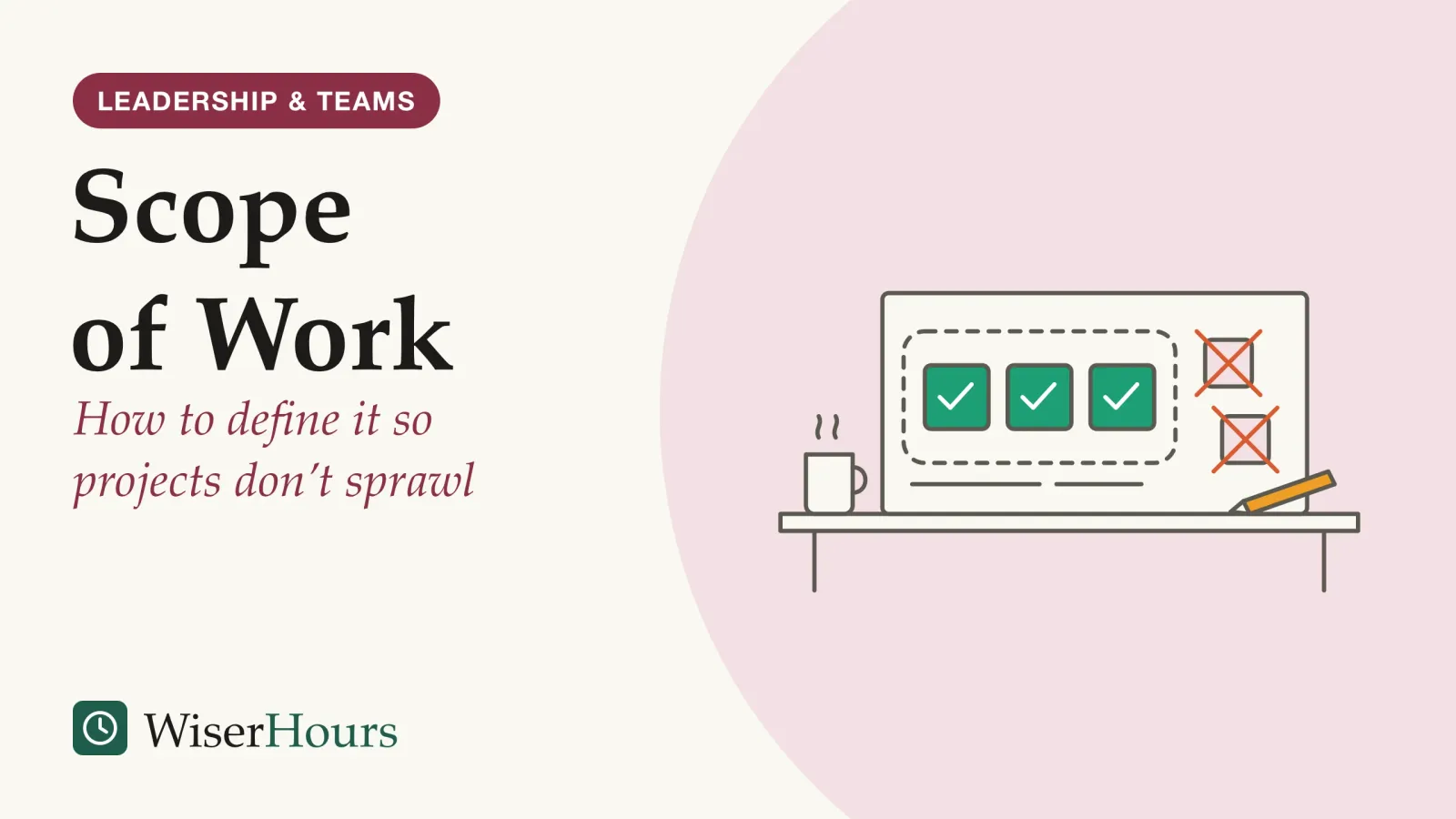
Two lists decide whether a fixed-fee job stays fixed: what you will deliver, and what you will not. A scope of work is the written document that holds both, along with the dates and the test each piece must pass before it counts as done. The Project Management Institute (PMI) defines project scope as the work performed to deliver a product, service or result with the specified features and functions.1 A useful scope of work answers eight questions, in this order:
- State the objective in one sentence.
- Name and count every deliverable.
- List what is out of scope.
- Write down assumptions and client responsibilities.
- Set milestones and dates.
- Cap the revision rounds.
- Define how each deliverable is accepted.
- Agree a rule for change requests.
The US Federal Acquisition Regulation, as of 2026, in its rules for performance-based service contracts, tells agencies to describe work by the results required as far as practicable, rather than by how it is to be done or how many hours it takes.2 A freelancer can borrow the principle: say what the client gets and how it will be checked. In the life of a deal, the scope sits between the proposal that wins the work and the contract that governs it, two more steps in running a small business.
Prefer to watch? The video covers the same ground as this article.
How to write a scope of work, section by section
Each section closes a gap that a client would otherwise fill with an assumption. The clinic used throughout is invented to show the format: a freelance web designer rebuilding a small physiotherapy clinic’s website for a fixed fee.
- Inside: the objective and every deliverable, named and counted
- The fence: what is out of scope, the assumptions and what the client provides
- The posts: milestones, revision limits and acceptance criteria: fixed points that say when each piece is done
- The gate: the change-request rule, the only way new work comes in
1. State the objective in one sentence
The objective is the test every later request gets measured against, so every deliverable should serve it. For the clinic: “Replace the current site with a mobile-friendly site of five pages that lets patients request appointments online.” When a new idea fails to serve that sentence, it is a candidate for the out-of-scope list.
2. Name and count every deliverable
PMI defines a deliverable as any unique and verifiable product, result or capability to perform a service that must be produced to complete a process, phase or project.1 “Verifiable” is the useful word: someone can point at it and check it. Write “five pages: home, services, team, prices, contact,” not “website pages.” For larger jobs, a work breakdown structure that splits deliverables into smaller parts makes counting easier.
3. List what is out of scope
A UK law firm’s guide to statements of work, published by Sprintlaw, notes that many explain what will be done but say nothing about what is excluded, and that clients may assume training, implementation support or fixes after the project are included.3 For the clinic, the list might read: copywriting, photography, a new logo, hosting fees, paid search ads and maintenance after launch. List anything a reasonable client might expect to come free.
4. Write down assumptions and client responsibilities
Oregon’s 2018 state procurement guide (US) asks writers to divide responsibilities between buyer and contractor and to state what the buyer will supply and at what stage.4 Our own suggestion: give each assumption a consequence, so that if the client’s content arrives late, the launch moves by the same number of working days.
5. Set milestones and dates
Oregon’s guide recommends due dates for each deliverable and control points where the buyer reviews, approves, accepts or rejects work.4 Count dates from signing and tie each to the client’s inputs. On fixed-fee work, including value-based pricing for results rather than hours, milestones also make natural invoice points.
6. Cap the revision rounds
“A reasonable number of revisions” invites an argument. The law firm’s guide recommends capped revision rounds and stating any limits on revisions.3 Define a round as one combined set of comments from the named contact, then set the number. No standard number exists; pick one that fits the work.
7. Define how each deliverable is accepted
Acceptance criteria are the conditions a deliverable must meet before the client accepts it.1 The law firm’s guide suggests stating how long the client has to accept or reject a deliverable and when acceptance is deemed to happen if nobody responds; without that, work can drift through endless informal requests.3 For a website, that might mean named browsers and devices, a working form, and a fixed window to report defects.

8. Agree a rule for change requests
The law firm’s guide says a scope should state how either side asks for a change, who approves it, and what happens to timing and fees once it is accepted.3 A simple rule: anything not listed is a change, priced and dated in writing before work starts. The fuller routine for logging and weighing requests is covered in how to control scope creep on a project.
Here is the clinic’s scope in full, on one page, as an illustration of the format rather than a template with legal effect:
Example: scope of work for a clinic website rebuild
- Objective: replace the clinic’s current website with a mobile-friendly site where patients can request appointments online.
- Deliverables: five pages (home, services, team, prices, contact) and one appointment-request form that emails the clinic.
- Out of scope: copywriting, photography, logo design, hosting fees, paid ads, maintenance after launch.
- Assumptions and client inputs: the clinic supplies all text and photos by the end of week 2, names one contact for feedback and keeps its current domain. Late inputs move the launch by the same number of working days.
- Milestones: page plan approved in week 1, design approved in week 3, site ready for review in week 5, launch in week 6.
- Revisions: two rounds of combined comments at design, one at build; further rounds quoted separately.
- Acceptance: all five pages work on current Chrome, Safari and Firefox on phone and desktop, and the form reaches the clinic’s inbox. The clinic has five working days to report defects against this list; after that, the site counts as accepted.
- Changes: anything not listed above is a change. The designer replies within two working days with the cost and the new dates, and work starts after written approval.
Check your own draft the same way.
Eight-point scope check
Vague versus precise: rewriting the risky words
Vague words let each side read its own meaning into a promise. Oregon’s guide tells writers to avoid ambiguous words such as “assist”, “work with”, “help”, “best efforts”, “reasonable”, “acceptable”, “necessary”, “good”, “they” and “we”, and to write in the active voice so it is clear who does what.4
Rewritten for the clinic example (our illustrations):
| Vague | Precise |
|---|---|
| “Assist with the launch” | “Upload the five approved pages and connect the clinic’s domain on launch day” |
| “A reasonable number of revisions” | “Two rounds of combined comments at design, one at build” |
| “A good, modern design” | “Design uses the clinic’s existing logo and colors and is approved at the week 3 milestone” |
| “We will provide the content” | “The clinic supplies all page text and photos by the end of week 2” |
| “The site will be tested” | “The designer tests every page on Chrome, Safari and Firefox before handover” |
Scope of work vs statement of work vs contract
Freelancers and clients often use “scope of work” and “statement of work” interchangeably, for the document that describes the work. Public buyers often separate them. Oregon’s guide treats the scope of work as the buyer’s description of its needs when it asks for bids, and the statement of work as the work both parties agree in the contract.4
PMI’s lexicon defines a statement of work as a narrative description of the products, services or results to be delivered.1 The contract is the wider agreement: payment, liability, ownership of the work and how the deal can end. Many businesses sign one master agreement and then attach a separate statement of work for each project, so the legal terms do not need renegotiating every time.3
| Document | The question it answers | Where it usually lives |
|---|---|---|
| Scope of work (procurement sense) | What does the buyer need? | The request sent to possible suppliers4 |
| Statement of work | What exactly will be delivered, by when, and how is it accepted? | Signed as part of the contract4 |
| Contract | What are the legal terms: payment, liability, ownership, ending the deal? | The main agreement, sometimes a master agreement covering several statements of work3 |
When a large client’s buying team sends a “scope of work” with its request for quotes, read it as their list of needs. The version both of you sign is the one you will be held to.
- Myth
- A scope of work and a statement of work are two different documents a freelancer needs.
- Fact
- Outside public procurement the two terms are often used interchangeably. What matters is the specific version both sides accepted in writing.
Is a scope of work legally binding?
A scope of work can be binding when it forms part of an agreement that counts as a contract under the law that applies; by itself, it only describes the work. The UK law firm’s guide says that in the UK a statement of work can be binding if it forms part of a signed contract or is otherwise incorporated into binding written terms.3
What makes an agreement a contract depends on the country. In Australia, Western Australia’s Small Business Development Corporation lists four elements a contract needs to be binding: an offer, an acceptance, an intention to create a legal relationship, and consideration, usually money. It adds that contracts can be spoken, written or a combination, but spoken ones are difficult to prove.5 Other legal systems set their own tests, so treat these as one jurisdiction’s rules, not universal ones.
Which document sits inside the contract also matters. In US federal contracting, the statement of objectives an agency gives bidders does not itself become part of the contract.2 So have the contract, or the signed proposal, name the scope document and its version or date, so it is clear later which description of the work applies.
How detailed should a scope of work be?
A scope of work needs enough detail for an outsider to check whether each deliverable arrived, and little more than that about methods. The UK Cabinet Office’s 2023 guidance on buying digital services says a clear specification does not mean a fixed idea of the solution, and calls over-specification the approach least likely to succeed in a fast-changing sector.6
Oregon’s guide draws a similar line: a performance-based statement of work describes the results needed and leaves the contractor room to find good methods.4 In the clinic example, “an appointment form that sends each request to the clinic’s inbox” is a result; naming a particular software plugin is a method. Record a method only when the client’s own systems depend on it.
Who writes the scope of work?
In freelance and agency work, the supplier usually drafts the first version, because it knows how the work will be done, and the client reviews it. The UK law firm’s guide describes this split and says the client should check that outcomes, acceptance steps and assumptions are captured before signing.3
Public procurement often runs the other way. Under the US federal rules, an agency may write a performance work statement itself, or issue a statement of objectives and let each bidder propose one.2 Even when a client sends a long brief, rewrite it into the eight sections and send it back for written agreement.
Does a clearer scope help projects finish on time?
Research on scope definition is sparse, and what exists comes mostly from large capital projects, but it leans one way: projects whose scope was better defined before work began tended to keep to schedule. The link with cost is less clear, and nobody has studied freelance or agency work this way.
The study
Limited evidence
Ten Namibian mining projects: the best-defined scopes delivered in full by the planned date
T. S. Kagogo and Herman Steyn scored how completely the scope of 10 capital projects at seven Namibian mining companies had been defined, using a construction-industry checklist called the Project Definition Rating Index. The five projects with the most complete definition all reported every deliverable complete at the originally planned completion date, while the four with the least complete definition did not. Better definition also went with better schedule performance, but the link with cost was inconclusive.7
The sample is tiny and came from a convenience sampleconvenience sample: A group of study participants chosen because they were easy to reach, such as students, app users or online volunteers, rather than drawn at random from the population of interest. Results from such samples may not hold for other people.Full entry in the glossary, and the authors stress that correlation does not show cause: a well-run company might both define scope carefully and deliver on time for other reasons. The measures are rough: one of the five best-defined projects still overran its schedule by half.7
A scope cannot guarantee a date, but each question left open at the start becomes a decision made mid-project, under time pressure.
Who can check your scope before you sign
This guide cannot tell you how a contract will be read where you work. Places to ask, starting with the highest stakes:
- For a large, long or unusual deal: a contract lawyer where you or the client are based can check that the scope, the contract and any master agreement fit together.
- For your standard templates: the US Small Business Administration says it and its partner network offer counseling and training locally, free or at low cost;8 GOV.UK lists free business advice by phone, email or webchat, with a separate service for each UK nation;9 and Western Australia’s Small Business Development Corporation gives small businesses there free advice.5 In other countries, try your government’s small-business or enterprise agency first.
The bottom line
A scope of work earns its keep by making each promise checkable: counted deliverables, explicit exclusions, dates for both sides’ inputs, capped revisions, acceptance criteria and a rule for changes. The evidence that this keeps projects on schedule is thin, so treat it as protection against disputes. Write it in plain, active sentences, and make sure the contract names it.
This article is general information, not legal advice. Rules differ by country and change over time; for your own situation, speak to a qualified lawyer or an official advice service where you live.
Frequently asked questions
Should a scope of work include the price?
It often does, or it sits next to the price in the same agreement. A UK law firm's guide to statements of work lists pricing among the things a scope should spell out, and suggests stating what triggers each invoice, such as signature, completion of a milestone or acceptance of a deliverable. Whatever the format, the fee should point to the exact version of the scope it pays for.
Can a scope of work be changed after it is signed?
Usually yes, if both sides agree, and the change process written into the scope is the way to do it; the main contract may also say how changes must be made. PMI's lexicon calls a change request a formal proposal to modify a document, deliverable or baseline. A practical scope says how either side asks for a change, who approves it, and what happens to dates and fees once it is accepted, with the new version agreed in writing.
Do I need a written scope for a small job?
A short written scope is still worth having. Western Australia's Small Business Development Corporation notes that contracts can be spoken, written or both, but spoken agreements rely on everyone's good faith and can be difficult to prove, so it advises putting business arrangements in writing where possible. For a small job, a one-page email that the client confirms can cover the eight sections.
What is a statement of objectives?
It is a US federal contracting document that sets out what the government wants to achieve and leaves bidders to propose the detailed work. Under the Federal Acquisition Regulation, it covers at least the purpose, scope or mission, period and place of performance, background, required results and operating constraints. Bidders use it to write their own performance work statement, and it does not itself become part of the contract.
Sources
- PMI Lexicon of Project Management Terms, Version 4.0. Project Management Institute (2024); archived copy accessed 2026-10-11
- FAR 37.602 Performance work statement. US Federal Acquisition Regulation (FAC 2026-01, effective 2026-03-13), accessed 2026-10-11
- Statement of Work Sample: How to Write a Clear SOW Contract for UK Businesses. Solo, A. (2026). Sprintlaw UK, law firm practitioner guide, published 2026-09-25, accessed 2026-10-11
- Statement of Work (SOW) Writing Guide, Version 2. Oregon Department of Administrative Services, Procurement Services, US (2018), accessed 2026-10-11
- Contracts and agreements. Small Business Development Corporation, Government of Western Australia, accessed 2026-10-11
- The Digital, Data and Technology Playbook. UK Cabinet Office (June 2023), accessed 2026-10-11
- Effect of scope readiness on capital projects in mining: a Namibian case study. Kagogo, T. S. & Steyn, H. (2019). South African Journal of Industrial Engineering, 30(1), 257-269
- Local assistance. US Small Business Administration, accessed 2026-10-11
- Get help and support for your business. GOV.UK (UK government), accessed 2026-10-11
How we researched this
We collected sources in October 2026: project-management standards (PMI's lexicon), US federal and state procurement guidance, UK government sourcing guidance, government small-business advice pages from three countries (US, UK, Australia), a UK law firm's practitioner guide, and the only open-access study we found that links scope definition to project results. The main gap: scope documents in freelance or small-agency work have not been studied, and the one study cited covers ten mining projects.
Keep reading

Hourly vs. Value-Based Pricing: Which Model Fits Your Work?
Hourly or value-based pricing? 2 questions decide it: can the work be defined before it starts, and can the client put a number on the result?

Client Retention: Why Keeping Customers Beats Finding New Ones
Client retention for freelancers and small firms: measure it from your own invoices, trace the famous profit claim, and use 6 habits that keep good clients.

How to Validate a Business Idea Before You Quit Your Job
How to validate a business idea in 5 steps: write testable guesses, ask for commitments rather than compliments, and set a stopping rule before you quit.
What Is an MVP? How to Test a Business With the Smallest Possible Version
A minimum viable product is the smallest test that could prove a business guess wrong. 5 MVP types, how to set a pass mark first, and when to stop.