How to Make a Vision Board That's More Than Decoration
No trial has tested vision boards, but studies of the picturing behind them suggest showing the steps, not just the prize. Build a better board in 5 steps.

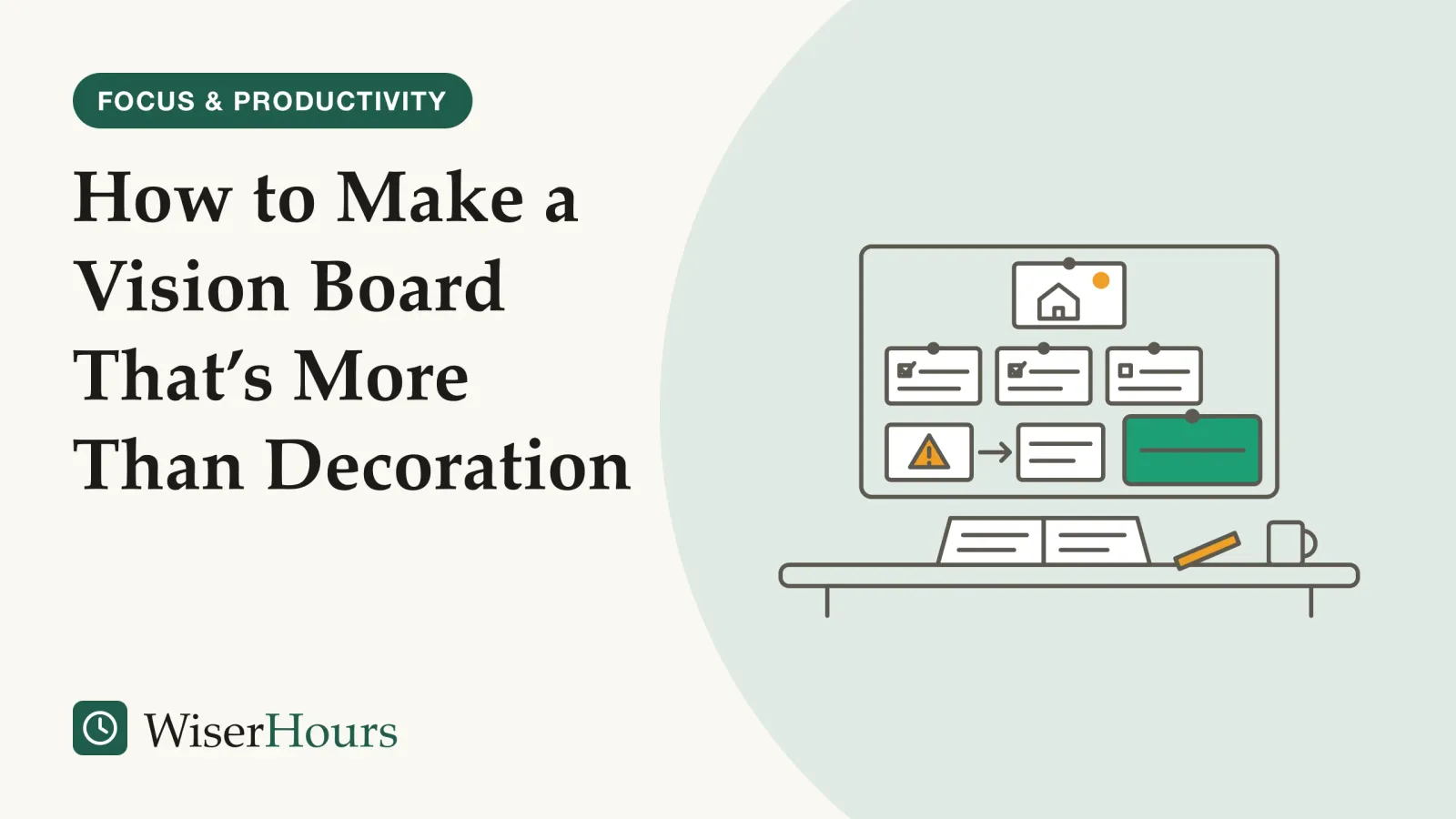
A typical vision board is a wall of finish lines: a beach house, a sports car, a job title cut from a magazine, the word “abundance” in gold letters. It can hang above a desk for months while the life it shows comes no nearer. The board was built to be looked at, and it was.
Here is how to make a vision board that earns its wall space: shrink the picture of the destination and give most of the board to the road. No trial has tested vision boards themselves, but experiments on the kind of picturing they invite point to five changes to the usual collage:
- Start with one goal you expect you can reach
- Picture the steps, not the finish line
- Pin up your likeliest obstacle, with its answer
- Make the next action the biggest card
- Put the board where the work happens, and edit it
Choosing the goal itself, and the obstacle-first planning method called WOOP, belong to the step-by-step method for setting goals that last. What follows concerns the board.
Nobody has tested a vision board, but the idea behind one has been tested
We found no randomized trialrandomized controlled trial: A study that assigns participants to the treatment or the comparison group at random, so the groups start out alike and a difference in what happens next can be put down to the treatment. Random assignment makes the two groups comparable; it does not make the people in the trial representative of anyone else.Full entry in the glossary of vision boards in September 2026 searches of PubMed and OpenAlex. Published papers describe how counselors and teachers run the activity, without measuring whether people then reach more goals. What has been tested is the belief most boards rest on: that vividly picturing a result helps bring it about.
A 2016 counseling-journal article, for example, presents vision boards as a creative technique that helps clients set and visualize goals, in line with solution-focused therapy, and explains how to run the session.1
The testing came from psychologists who study imagination. Summarizing their research program in 1998, Shelley Taylor’s group at UCLA in the US contrasted two kinds of mental rehearsal. Self-help writers had long told readers to picture themselves already in the role they wanted; the UCLA studies found that picturing the process of reaching a goal produced progress, and picturing its successful completion did not.2
Their explanation is practical. Running a scene through your mind makes it feel real, and when the scene is a sequence of actions, it also lays out the order of steps a plan needs.2 A board full of finish lines gives your imagination nothing to rehearse except the celebration.
The useful test of a board is not whether it inspires you but what it makes you rehearse.
Why picturing the dream can drain the drive
People with the most glowing fantasies about a first job, a romance, an exam or recovery from hip surgery put in less effort and did less well weeks to two years later, across four studies Gabriele Oettingen and Doris Mayer published in 2002. Expectations worked the other way: people who judged success likely tried harder and did better.3
The job study is the clearest. Male students at a university in Munich, Germany, who expected to finish their degrees within a year, described their thoughts and images about starting work and said how often these had lately been positive. Two years later, those with the most frequent glowing fantasies reported sending fewer applications, getting fewer job offers and earning less. Because the researchers tracked people rather than assigning them daydreams, and the samples were small, the study cannot prove the fantasies caused the shortfall.3
A later set of experiments did assign them. Heather Barry Kappes and Oettingen asked US undergraduates to imagine an ideal future, such as a great week ahead, or a neutral, doubtful or negative version. Across four small experiments, those told to fantasize positively showed less energy, measured by a drop in blood pressure or by their own ratings; in the week-long study, they also reported handling the week’s challenges less well.4 As Kappes and Oettingen read it, a glowing fantasy lets you enjoy the future in advance, so the mind does not gear up to chase it. We found no large independent replicationreplication: Running a study again with fresh data and the same method, to see whether the original result comes back. A finding that fails to replicate is not automatically wrong, but it stops being something you can lean on.Full entry in the glossary of these experiments, and all four drew on students in one country.
Consider how this plays out on an ordinary evening. You scroll through saved photos of a renovated kitchen and feel, briefly, that the project is under way. The feeling is real; the progress is not. Nothing in the experience tells you to call a builder or open a savings account.
Rehearse the work, not the reward
Picturing the process of reaching a goal worked better than picturing the result in a 1999 experiment by Lien Pham and Shelley Taylor, in which UCLA students in the US, preparing for a midterm, pictured either themselves studying or themselves seeing a top grade. It is the closest test we found of what a board should show.
The study
Limited evidence
The midterm experiment: picture the studying, picture the grade, or both
Students pictured, on several days before the exam, either the time, place and manner of their own studying, or the moment of finding a high grade, or both, while a control group simply logged its study hours. Picturing the process led to clearer plans, less anxiety and more hours of study. Students who pictured only the process scored about 81 out of 100 on average, against about 73 for those who pictured only the grade. Students who pictured the grade studied about 5 hours less than they had expected to, and aimed for a lower grade by the day before the exam.5
In plain terms, rehearsing the work made the work more likely to happen, and rehearsing the reward did not. The main effects sat at the edge of statistical significance, and the process group still knew what grade it wanted; the authors suggest stating the goal clearly and then keeping your attention on the process.5
envisioning the desired outcome did not prompt effective actions to bring about the desired goal.
Wider reviews of imagery research support picturing, with caveats. A 2018 meta-analysismeta-analysis: A study that combines the results of earlier studies on the same question into one overall estimate. Pooling makes the estimate more precise, but it cannot repair the studies it pools: a meta-analysis of surveys is still survey evidence.Full entry in the glossary by Dominic Conroy and Martin Hagger pooled 26 studies of imagery interventions on health behaviors and found small effects on behavior, larger when instructions were detailed and when studies ran longer. Those headline results come from the abstract; we could not open the full paper, so its finer detail is left out here.6
A broader 2021 meta-analysis led by Scott Cole in the UK, pooling 123 results from experiments in which people imagined a behavior, is more cautious. Picturing the goal alone brought a small benefit, picturing the steps alone a small one that was not statistically reliable, and both together a larger one, from only eight results; even the gaps between these were not statistically reliable. The authors add that Pham and Taylor’s process group did not beat its control group by a reliable margin.7 For a board, the fair reading is Pham and Taylor’s own: keep the goal in view, and give most of the space to the road.
Take someone who wants to lead a team. An outcome card says “Head of Operations.” A process card shows the Thursday team meeting they will run themselves and the colleague they will ask for feedback afterwards. The first card is a wish; the second is a scene they can rehearse on the way to work. Before any picture goes on your board, ask whether it shows a place you could walk into tomorrow and something you would do there.
- A board of finish lines: only pictures of the result; daydreaming over pictures like these is what small studies link to less effort
- The goal, kept small: one picture at the top, so you know what the steps are for
- The steps: the time, place and way you will work, pictured as scenes you can rehearse
- The likeliest obstacle: pinned next to your if-then answer to it
- The next action: the biggest card on the board, and the one you change most often
How to make a vision board that works, step by step
A vision board that works gives the goal one small picture and fills the rest with the route: the steps, the obstacle and the next action. Steps 1 to 3 come straight from the experiments above; steps 4 and 5 are sensible extensions that nobody has tested.
1. Start with one goal you expect you can reach
Choose a single goal that matters to you and that you judge to be within reach, and give it one small picture near the top edge. In Oettingen and Mayer’s studies, expecting success predicted more effort even as glowing fantasies predicted less.3 If you cannot honestly call the goal likely, shrink it until you can, and keep the larger ambition elsewhere. For a direction that stretches over years, the board can hold the first year of a five-year plan written as a direction.
2. Picture the steps, not the finish line
Fill most of the board with the process, shown as scenes: the desk at 7 a.m. with the course open, the running shoes by the door, the calendar block labelled “draft chapter.”
Then use the board as Pham and Taylor’s students used their imagery, which they were asked to practice for 5 minutes a day: run through where, when and how the next session will go.5
3. Pin up your likeliest obstacle, with its answer
Add one card for the thing most likely to stop you, and beside it your response written as an if-then planimplementation intention: A plan in if-then form that ties a specific action to a specific situation, such as 'if it is nine o'clock, then I open the report.' It hands the decision about when and where to act to the situation itself.Full entry in the glossary: “If the meeting runs late, then I do 20 minutes after dinner.” In Kappes and Oettingen’s first experiment, students who imagined a desirable future (wearing glamorous high heels) and then questioned it kept up their energy, while those who only fantasized lost it.4
4. Make the next action the biggest card
Give the largest space on the board to the single next action, in words, and replace it whenever it is done. In the 1999 experiment, students who pictured the process studied about as much as they had planned, while those in the other groups overestimated how much they would study.5 A next-action card keeps the board pointed at that gap between plan and practice. Making it the biggest card is our design choice, not a tested one.
5. Put the board where the work happens, and edit it
Hang the board, or set the phone or desktop version, where you will see it at the moment you could act: above the desk, not in the hallway. Once a week, move finished cards off, swap the next action and check whether the obstacle has changed. No study has tested placement or edit schedules for boards. Longer imagery programs had larger effects in the 2018 health meta-analysis.6 The broader 2021 review found no such link, so a board you keep using is a sensible bet, not a proven one.7
Your board, card by card
What the law of attraction gets wrong
The law of attraction, popularized by Rhonda Byrne’s 2006 book The Secret, holds that your thoughts cause what happens to you, so a pictured outcome is drawn toward you. No research we found supports that mechanism, and a 2023 study of people who believe it found them more confident about success but no more successful.8
Lucas Dixon, with two co-authors from the University of Queensland in Australia, surveyed about a thousand adults online across three studies, recruited in the US for at least the first two. More than a third endorsed beliefs in manifesting success through positive self-talk, visualization or cosmic forces. Believers rated themselves as more successful and expected more future success, yet earned no more and were no better educated than non-believers. Believers also leaned more toward risky investments and get-rich-quick thinking, and more often reported a past bankruptcy.8
Surveys cannot show which came first, the belief or the choices, and these studies were not preregistered.8 Set beside the fantasy experiments, though, the picture is consistent: the part of a vision board that promises results by attraction is the part with no evidence behind it.
Picture two cards. One says “I attract a promotion”; the other says “Friday: ask my manager what the next level requires.” Only the second gives you something to do this week.
- Myth
- Pinning up pictures of what you want draws it toward you, as the law of attraction claims.
- Fact
- No research shows pictures attracting outcomes. In lab experiments, indulging in a pictured result was linked to less energy; rehearsing the steps has small, early support.
What a board can honestly do is more modest: remind you of a goal, cue a planned action and give you something concrete to rehearse.
Which vision board advice has evidence, and how much?
The best evidence on vision boards is indirect: experiments on what people picture, not on boards. Picturing the process has one small randomized test and an uncertain wider record, outcome daydreams have small studies against them, and the law of attraction has no support.
| What it is | What the best evidence found | Evidence |
|---|---|---|
| A vision board as a whole | No randomized trial found; published papers describe the technique without testing it | Gap: expert description only1 |
| Picturing the steps to a goal | Clearer plans, less anxiety and more study, with higher exam scores than picturing the grade | One randomized experiment, limited5 |
| Picturing the goal, the steps or both | Small benefit from the goal alone, no reliable one from the steps alone, a larger one from both | Meta-analysis, mixed (few results per kind)7 |
| Imagery of behavior in general | Small effects on health behaviors, larger with detailed instructions and longer programs | Meta-analysis, limited (abstract only)6 |
| Glowing fantasies about the outcome | Linked to less effort and poorer results weeks to two years later | Four small follow-up studies, limited3 |
| Fantasies induced in the lab | Less energy than neutral, doubtful or negative imagery | Four small experiments, limited4 |
| Expecting success | Linked to more effort and better results | Four small follow-up studies, limited3 |
| The law of attraction | Believers felt more successful but earned no more; more risky financial choices | Online surveys, limited; no support for the mechanism8 |
The bottom line
A vision board has never been tested, but what you put on it has, indirectly. Give the finish line one small picture and fill the rest with the route: the scenes of the work, your likeliest obstacle and its answer, and the next action in the biggest space. Then look at it long enough to rehearse tomorrow’s first step, not just to enjoy the view.
Frequently asked questions
Should a vision board have any pictures of the goal itself?
One small one is reasonable. In Lien Pham and Shelley Taylor's 1999 exam experiment, students who pictured their studying still knew the grade they wanted, and the authors suggest stating the goal clearly and then concentrating on the process. What the research warns against is a board made only of finish lines that you enjoy instead of working toward.
Is a digital vision board as good as a paper one?
No published comparison of the two turned up in our searches, so choose by where you will see it while you work. A phone lock screen or a desktop background can show the next action at the moment you could act on it, which fits the advice in this guide. A paper board on a wall you pass but never work at is easier to ignore.
How often should I look at my vision board?
Nobody has tested a schedule for boards. In Pham and Taylor's 1999 experiment, students were asked to rehearse their imagery for 5 minutes a day in the week before an exam. A broad 2021 meta-analysis led by Scott Cole found that practicing more often or for longer did not reliably add to the benefit, so a few minutes each workday, with a weekly edit, is a reasonable reading.
Do counselors and teachers use vision boards?
Yes. A 2016 article in the Journal of Creativity in Mental Health by Lisa Burton and Jonathan Lent describes vision boards as a creative counseling technique that helps clients set and picture goals, aligned with solution-focused therapy. Articles like this describe how to run the activity; they do not test whether clients reach more of their goals.
Sources
- The Use of Vision Boards as a Therapeutic Intervention. Burton, L. & Lent, J. (2016). Journal of Creativity in Mental Health, 11(1), 52-65
- Harnessing the imagination: Mental simulation, self-regulation, and coping. Taylor, S. E., Pham, L. B., Rivkin, I. D. & Armor, D. A. (1998). American Psychologist, 53(4), 429-439
- The motivating function of thinking about the future: Expectations versus fantasies. Oettingen, G. & Mayer, D. (2002). Journal of Personality and Social Psychology, 83(5), 1198-1212
- Positive fantasies about idealized futures sap energy. Kappes, H. B. & Oettingen, G. (2011). Journal of Experimental Social Psychology, 47(4), 719-729
- From thought to action: Effects of process- versus outcome-based mental simulations on performance. Pham, L. B. & Taylor, S. E. (1999). Personality and Social Psychology Bulletin, 25(2), 250-260
- Imagery interventions in health behavior: A meta-analysis. Conroy, D. & Hagger, M. S. (2018). Health Psychology, 37(7), 668-679
- Synthesizing the effects of mental simulation on behavior change: Systematic review and multilevel meta-analysis. Cole, S. N., Smith, D. M., Ragan, K., Suurmond, R. & Armitage, C. J. (2021). Psychonomic Bulletin & Review, 28(5), 1514-1537
- “The Secret” to success? The psychology of belief in manifestation. Dixon, L. J., Hornsey, M. J. & Hartley, N. (2025; online 2023). Personality and Social Psychology Bulletin, 51(1), 49-65
How we researched this
Our September 2026 search across PubMed, OpenAlex, Crossref and the wider web turned up no vision-board trials, so we gathered experiments and reviews on positive fantasies, mental simulation and belief in manifestation, reading full texts wherever we could. Sources span 1998 to 2025. Main limitation: the core experiments are small, mostly with US and German students, and come from few research teams.
Keep reading
How to Create a Five-Year Plan Without Pretending to Predict the Future
How to create a five-year plan in 5 steps that expect you to change: set a direction, test it against several futures and detail only the first year.
New Year's Resolutions: Why They Fail and How to Fix Them
The claim that 80% of New Year's resolutions fail by February traces to no study. What follow-ups of real resolvers found, and what helps.
SMART Goals Explained With 20 Examples
SMART goals explained letter by letter, with 20 examples, where the 1981 acronym came from, and why goal research says aim higher than realistic.
OKRs for Your Personal Life: A Practical Guide
Personal OKRs in 5 steps, each checked against goal research. A 2024 review mapped 47 OKR studies, mostly in companies; none we found tested personal use.