Why Managers Struggle to Delegate (and How to Let Go)
Delegation is hard because work you shaped looks better to you and control feels good in itself. 5 habits drawn from the research help managers let go.

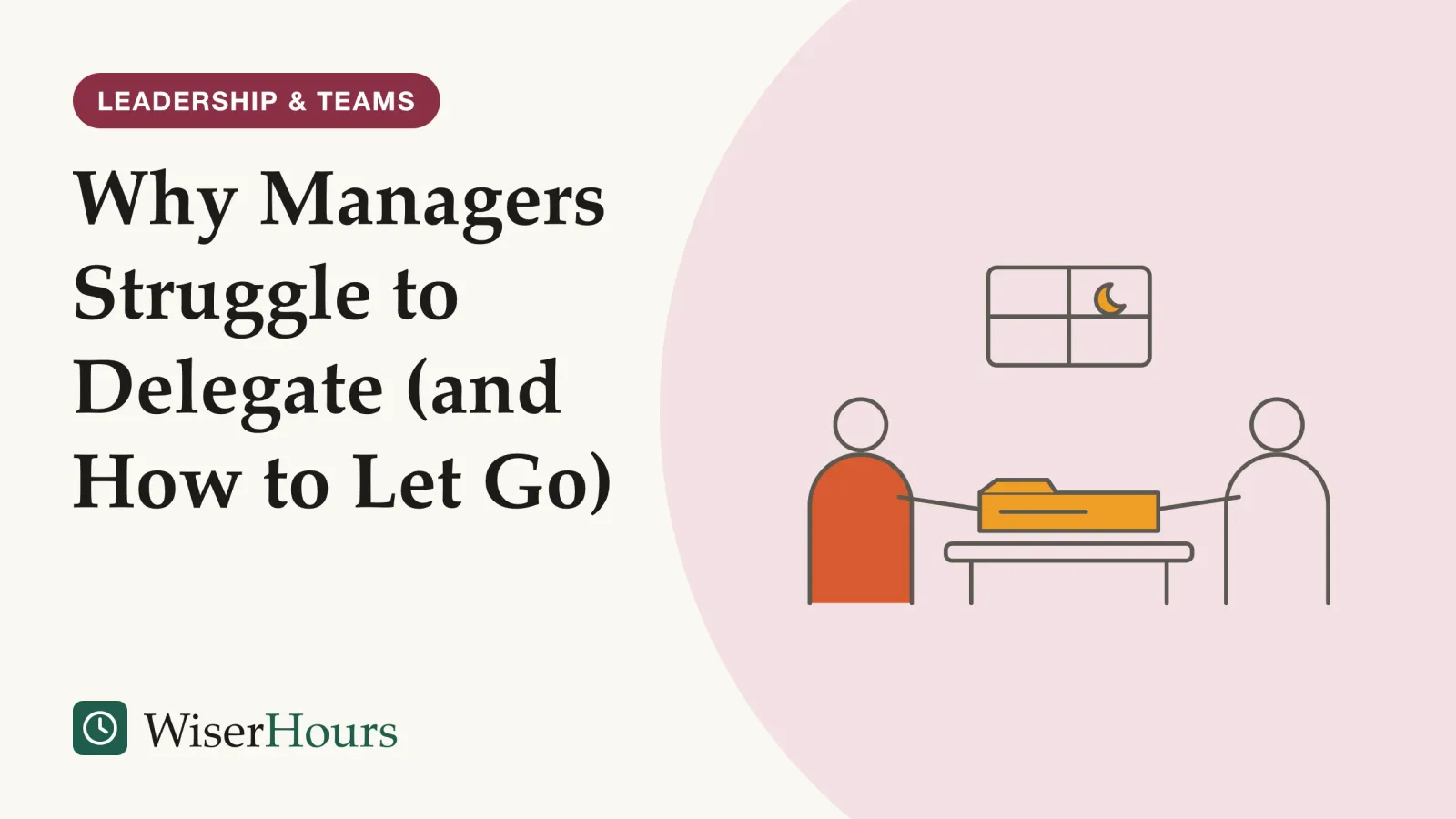
It is nine in the evening and you are rewriting the project update your analyst sent at five. Nothing in it was wrong. It just was not how you would have put it, and by the time you finish, the work is yours again. Tomorrow you will wonder, again, why nobody on the team takes ownership.
Delegation is hard partly because of predictable pulls on the manager toward keeping control, pulls that can operate even when handing the work over would pay. Research finds that work you had a hand in looks better to you,1 and that holding a decision feels valuable in itself. In a 2014 experiment published in Econometrica, Björn Bartling, Ernst Fehr and Holger Herz found that most people who could hand a decision to a partner valued keeping it for its own sake, beyond anything it paid them.2 Letting go is a set of habits you can practice on the next task you are tempted to keep:
- Name the pull before you keep a task.
- Write down what the work must do before you hand it over.
- Match the authority to the person and the stakes.
- Treat the handover as development, not a favor.
- Hand over support along with the work.
If you try only one this week, make it the second. Before tonight’s rewrite, three written lines about what the update had to do would have told you whether it needed you at all.
Why work you handed off looks worse to you
Work you handed off tends to look worse to you than the same work would if you had shaped it, because people rate work more highly the more involved they were in producing it. A 1998 study by Jeffrey Pfeffer, Robert Cialdini and colleagues found that participants judged the identical piece of work better as a supervisor’s involvement in it increased.1
The authors named two effects behind this. Faith in supervision is the tendency to see work done under a supervisor’s control as better than identical work done with less supervision. Self-enhancement comes on top of it: ratings were higher still when the evaluator had been more involved in supervising the work personally. The authors offer both as possible reasons managers hold back from delegation, and in their study a team-based, empowerment orientation curtailed both.1
Leadership, as researchers define it, is influence on a group working toward a shared goal. A manager whose sense of quality is tied to their own involvement keeps drifting from influencing back to doing. Research on the IKEA effect, outside work, points the same way: in four studies, people who assembled IKEA boxes, folded origami or built Lego sets saw their amateur creations as close in value to experts’ and expected others to agree, but only when they had finished the task.3
Back to the evening rewrite. The analyst’s update is being compared with a version that exists only in your head, and that version carries your fingerprints. It is a hard comparison for anyone else to win.
- Myth
- If I want it done right, I have to do it myself.
- Fact
- Part of what feels right is familiarity: in a 1998 study, people rated the identical work higher the more involved they had been in supervising it.
The practical test: before you rewrite delegated work, ask whether it misses the standard or only misses your style. Only the first is a reason to step in.
Control is worth something for its own sake
Many people value holding a decision for its own sake, not only for what it gets them, so handing one over can feel like a loss even when it pays. Björn Bartling, Ernst Fehr and Holger Herz of the University of Zurich measured this intrinsic value of decision rights directly in their 2014 Econometrica experiment.2
Their design rules out the obvious explanation, that people keep control simply to get a better result. One player could either choose a project and do the costly work herself or hand both choices to a partner. The researchers found the point at which keeping and handing over felt equal to her, then asked her separately, outside the game, what each resulting gamble was worth. The gap between the two answers is the value she placed on control itself.
The study
Moderate evidence
The price of handing over a choice, measured in a Zurich lab
On average, people who held a decision right would hand it over only when doing so was worth about 17 percent more to them in money than keeping it, judged by their own separate valuation of the two outcomes. About 8 in 10 of them placed a positive value on control itself, and each person’s value stayed fairly stable across the ten versions of the game.2
So some of the pull to keep work is not about the work at all. The value players put on control grew roughly in line with the stakes, and it was lower when the two players’ interests clashed more.2 The obvious limit is who took part: students making abstract money choices in a laboratory, not managers with teams, reputations and deadlines.
A separate 2014 experiment found the same kind of pull by a different route. People choosing whether to bet on their own answer to a quiz question or on a partner’s picked themselves more often than their own beliefs about who would be right could justify, giving up expected earnings to keep control.4
In everyday work this looks like insisting on approving every client email. Each approval is a small moment of being in charge, and it feels like quality control even when the emails would have been fine. The way out is to hand the decision over in pieces: routine replies go out without you, and only the ones that commit money or a deadline come to you first.
When managers hold on tighter
Managers share less power when their own position feels unstable, and some feel guilty handing work over, according to a 2020 set of studies by Sanne Feenstra and colleagues and a 2018 paper by Modupe Akinola, Ashley Martin and Katherine Phillips. Both findings are about the manager’s situation and feelings as much as the other person’s ability.56
Across five studies, Feenstra’s team found that leaders whose hold on power was unstable shared less of it. In a later study, distrust helped explain that link, and in the last one the route through distrust of a team member’s good intentions and ability was more pronounced toward relatively senior team members than junior ones.5 Picture a new manager in a reorganization who keeps the biggest client off the plate of the most experienced person on the team. The person best placed to take the work is the one who feels most like a rival.
Akinola’s five studies found that women saw delegating as more assertive than men did, had more negative associations with it and felt more guilt about it. Those associations went with women delegating less and, when they did delegate, having lower-quality interactions with the people they delegated to. The authors trace this to gender-role expectations that make an assertive-seeming act feel less fitting for women, and reframing delegation as communal, a relational act, softened women’s negative associations with it.6
Further reading
Grove's manager's handbook matches oversight to each person's experience with a task, and treats a handover without follow-up as abdication.

As an Amazon Associate WiserHours earns from qualifying purchases.
An older field study also found the situation mattering where temperament did not. In a 1986 study of 44 supervisors and 198 claims adjusters at an insurance company, how supervisors saw the adjuster, their own workload and how important the decisions were all predicted how much settlement authority they handed over, while their personality and general inclination to share authority were not significantly related to it.7
The practical lesson: if you notice you keep work away from your strongest person, ask whether the reason is their readiness or your own position.
Pulls to keep it
- Work you had a hand in looks better to you (Pfeffer and colleagues, 1998)
- Holding a decision feels valuable in itself (Bartling, Fehr and Herz, 2014)
- A shaky position, distrust or guilt (Feenstra and colleagues, 2020; Akinola and colleagues, 2018)
What handing it over offers
- Links to better performance and creativity in the person who gets the authority (Lee and colleagues, 2018)
- Time freed for the manager, the benefit delegation is usually credited with (Akinola and colleagues, 2018)
How to let go: five habits for better delegation
We found no trial of a program that helps managers let go, so the five habits below are built from the studies above, and nobody has put them to a test as a method. Try them on your next handover and keep what works. Each is shown on the project update from the opening.
1. Name the pull before you keep a task
When you feel the urge to keep something, say which pull it is: your version looks better to you, deciding feels good, your position feels shaky, or handing it over feels like imposing. For the project update, the honest answer might be “I like how my version reads”, which is style, not a standard. In the Zurich experiment most people valued holding a decision beyond what it paid, so feeling the pull is ordinary rather than a verdict on your team.2 Naming it will not make it go away, as research on why knowing about a bias is not enough shows, which is why the next habit changes the process instead.
2. Write down what the work must do before you hand it over
Before the task leaves your hands, write two or three things the finished work must do, and share them. For the update, that might be: it names the decisions leadership needs this week, it flags any date at risk, and it fits on one page. When it comes back, check it against those lines only, and send style notes separately, marked as preferences. Present the list as the team’s standard rather than yours: in the 1998 study, a team-based, empowerment orientation curtailed both rating biases.1
3. Match the authority to the person and the stakes
Hand decisions over in stages. First the analyst drafts and you approve; next they send the update and you read it afterwards; later they own it and you hear only about exceptions. Move up a stage once the work has met the written standard a few times in a row. In an experiment reported in Carrie Leana’s 1987 paper, how important a decision was, how much the employee knew and whether their goals matched the manager’s all predicted whether managers said they would rather delegate it or decide it jointly.8
4. Treat the handover as development, not a favor
Describe the task, to yourself and to them, by what it lets the other person learn or be seen doing: “you’ll present the numbers to the directors” rather than “could you take this off my plate”. In a small randomized role-play in Akinola’s fifth study, MBA students told that delegating helps the other person develop, learn and grow felt less guilt about overburdening them, and the women among them felt less anxious about delegating.6 It was one short classroom exercise, but the framing costs nothing to try.
5. Hand over support along with the work
At the handover, agree how they will ask for help and when you will next look: for the update, a question slot the day before it is due and a short read-through afterwards. A regular one-on-one that your report sets the agenda for gives those questions a standing place. The next section explains why this habit matters; no study we found tested it directly.
Before you hand over the next task
What handing over does for the person who takes it
Sharing authority is linked to better performance, more helpful behavior and more creativity in the people who receive it, according to a 2018 meta-analysismeta-analysis: A study that combines the results of earlier studies on the same question into one overall estimate. Pooling makes the estimate more precise, but it cannot repair the studies it pools: a meta-analysis of surveys is still survey evidence.Full entry in the glossary of empowering leadership by Allan Lee, Sara Willis and Amy Wei Tian, though related research warns that more authority can also mean more strain.9
Pooling 105 samples, Lee’s team found positive links at both individual and team level; for individuals, the links ran partly through trust in the leader and a sense of being empowered.9 A 2007 study of 171 supervisor-employee pairs in China found that delegation was linked to better task performance through employees’ sense of their own worth to the organization and of being an insider.10
There is a second face. A 2016 study by Minyoung Cheong and colleagues described an enabling route, in which empowering leadership went with higher confidence and performance, and a burdening route, in which some empowering behaviors went with more job-induced tension, which weakened the gain.11 A 2019 review by the same group called the overall results incongruent and mixed, and raised the possibility that good performers are simply given more authority, rather than authority making people perform.12
The difference shows in an ordinary handover. Giving a junior colleague next quarter’s vendor review with no background is authority plus worry. The same handover with a short walk-through of last year’s file, and a named person to ask, is authority plus support.
The five habits rest on thin and uneven evidence.
| Habit | What the research found | How strong |
|---|---|---|
| Name the pull | People valued holding a decision beyond what it paid them | One lab experiment with students (trial)2 |
| Write the standard first | Identical work was rated higher the more the rater had supervised it; a team-based orientation curtailed this | One study; only the abstract was available1 |
| Match authority to person and stakes | Decision importance, the employee’s knowledge and shared goals predicted managers’ preference to delegate | Two studies, one experimental, abstract read8 |
| Frame it as development | A relational framing softened women’s negative associations with delegating | Five studies; the framing test was one small randomized role-play with MBA students (trial)6 |
| Send support with authority | Empowering behaviors were linked to better performance but also to job-induced tension | One study; only the abstract was available11 |
The bottom line
The research on delegation points less at the people you could hand work to than at the pulls on the person handing it over: work looks better when you shaped it, and holding the decision feels good in itself. Write the standard down before the work leaves your hands, judge the result against it, and send support along with the authority. The first evening rewrite you skip is where letting go starts.
Frequently asked questions
Does delegating actually save a manager time?
It is expected to, but we found no study that measured it. Modupe Akinola and colleagues' 2018 paper describes delegation as freeing managers' time and developing their people's skills, which is how the research frames the benefit. Until someone measures it, a sensible place to start is a task that recurs, because the time you spend explaining it is spent once while the handover keeps paying.
Is delegating the same as asking your team for input?
No. In a 1987 Journal of Applied Psychology paper, Carrie Leana separated delegation, where the manager hands a decision to someone else, from participation, where manager and employee decide together. She found managers used them under different conditions, and that objective measures of employees' performance correlated with the use of delegation but not with participation.
Does delegation work the same way in every culture?
Not necessarily. In a 2007 study of 171 supervisor-employee pairs in China, Zhen Xiong Chen and Samuel Aryee found that delegation was linked to commitment, task performance and innovative behavior through employees' sense of their own worth to the organization and of being an insider. The links from delegation to those two senses were stronger for employees who held less traditional values. It is one study in one country, so it counsels care rather than setting a rule.
Sources
- Faith in Supervision and the Self-Enhancement Bias: Two Psychological Reasons Why Managers Don't Empower Workers. Pfeffer, J., Cialdini, R. B., Hanna, B. & Knopoff, K. (1998). Basic and Applied Social Psychology, 20(4), 313-321
- The Intrinsic Value of Decision Rights. Bartling, B., Fehr, E. & Herz, H. (2014). Econometrica, 82(6), 2005-2039
- The IKEA effect: When labor leads to love. Norton, M. I., Mochon, D. & Ariely, D. (2012). Journal of Consumer Psychology, 22(3), 453-460
- The Control Premium: A Preference for Payoff Autonomy. Owens, D., Grossman, Z. & Fackler, R. (2014). American Economic Journal: Microeconomics, 6(4), 138-161
- Antecedents of leaders' power sharing: The roles of power instability and distrust. Feenstra, S., Jordan, J., Walter, F. & Stoker, J. I. (2020). Organizational Behavior and Human Decision Processes, 157, 115-128
- To Delegate or Not to Delegate: Gender Differences in Affective Associations and Behavioral Responses to Delegation. Akinola, M., Martin, A. E. & Phillips, K. W. (2018). Academy of Management Journal, 61(4), 1467-1491
- Predictors and Consequences of Delegation. Leana, C. R. (1986). Academy of Management Journal, 29(4), 754-774
- Power relinquishment versus power sharing: Theoretical clarification and empirical comparison of delegation and participation. Leana, C. R. (1987). Journal of Applied Psychology, 72(2), 228-233
- Empowering leadership: A meta-analytic examination of incremental contribution, mediation, and moderation. Lee, A., Willis, S. & Tian, A. W. (2018). Journal of Organizational Behavior, 39(3), 306-325
- Delegation and Employee Work Outcomes: An Examination of the Cultural Context of Mediating Processes in China. Chen, Z. X. & Aryee, S. (2007). Academy of Management Journal, 50(1), 226-238
- Two faces of empowering leadership: Enabling and burdening. Cheong, M., Spain, S. M., Yammarino, F. J. & Yun, S. (2016). The Leadership Quarterly, 27(4), 602-616
- A review of the effectiveness of empowering leadership. Cheong, M., Yammarino, F. J., Dionne, S. D., Spain, S. M. & Tsai, C.-Y. (2019). The Leadership Quarterly, 30(1), 34-58
How we researched this
We searched OpenAlex, Crossref, Semantic Scholar and publisher pages in September 2026 for experiments, field studies, meta-analyses and reviews on why managers do or do not delegate and what delegation does, dated 1986 to 2020. Main limitation: few studies test ways to help managers let go, and for most sources only the abstract was available, so we report only what those abstracts state.
Keep reading
How to Manage an Underperforming Employee: A Step-by-Step Guide
How to manage an underperforming employee in 5 steps: check expectations were clear, diagnose the cause, agree a plan, review it, and know when HR takes over.
Leadership vs. Management: What's the Difference and Why It Matters
Leadership vs management: Kotter's 1990 essay split the work into 3 pairs of tasks, then warned that strong leadership with weak management can be worse.
Leadership Styles Explained: Which One Fits You and Your Team?
How 6 leadership style models compare on evidence: the modern styles overlap heavily, and hands-off leadership has the clearest record of harm.

How to Run One-on-One Meetings That Employees Actually Value
One-on-one meetings make up nearly half of all workplace meetings, yet a 2023 review found no empirical research on them as a topic.