How to Manage an Underperforming Employee: A Step-by-Step Guide
How to manage an underperforming employee in 5 steps: check expectations were clear, diagnose the cause, agree a plan, review it, and know when HR takes over.

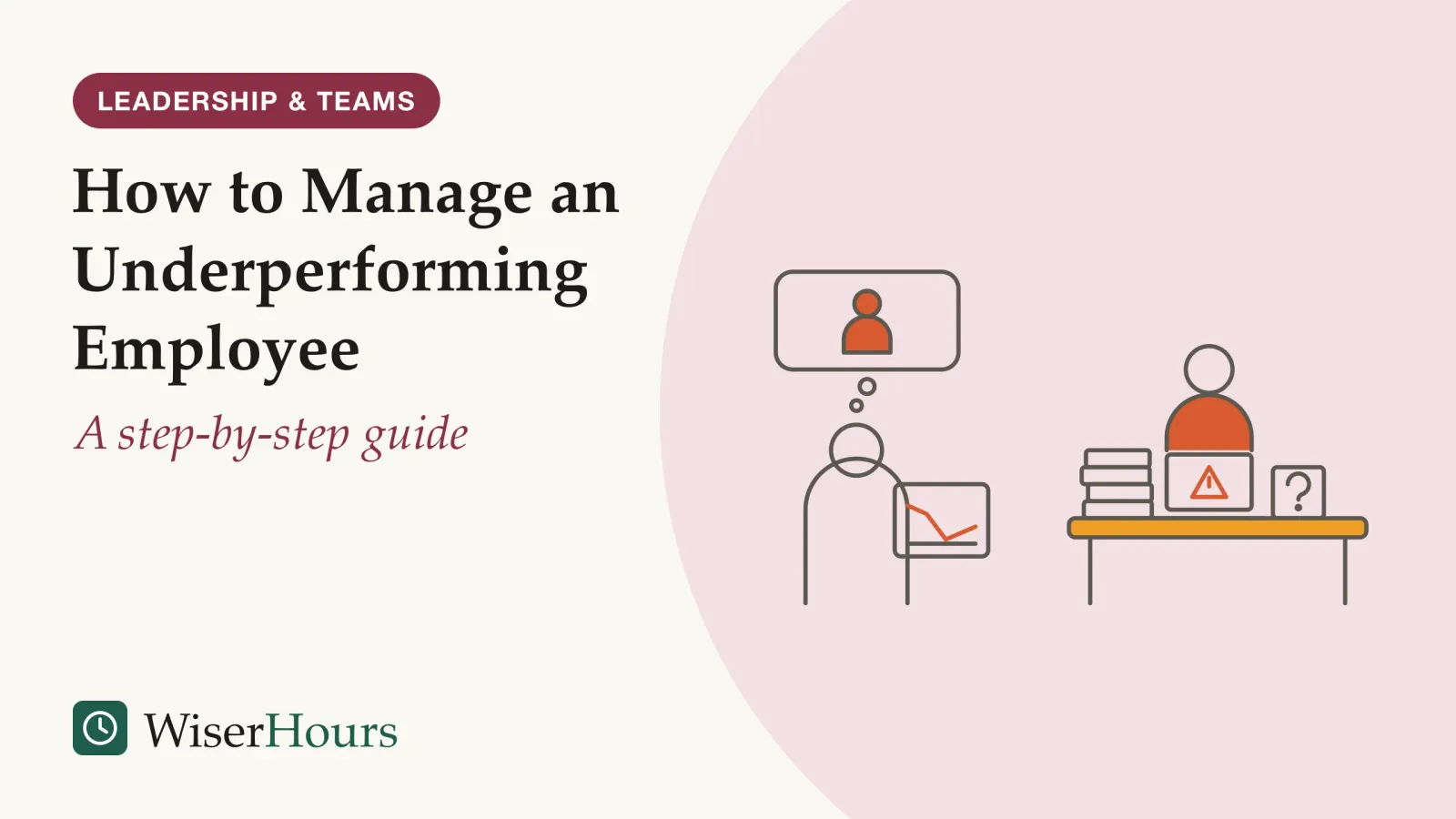
Take a made-up but familiar case: a coordinator who used to send the weekly sales report on Friday morning starts sending it at four in the afternoon, and her manager decides she has grown careless. What actually changed is that finance now releases its figures at noon on Friday, so she has become the last link in a slower chain. A warning about attention to detail would leave the report exactly as late.
Here is how to manage an underperforming employee without falling into that trap, drawing on research into how managers judge poor performance and on employment guidance, with Great Britain and the US as examples:
- Check that the expectation was clear.
- Diagnose the cause before you respond.
- Agree a specific plan together.
- Review progress on a fixed schedule.
- Know when HR takes over.
Only about half of US employees, 49 percent in the first half of 2026, strongly agreed that they knew what was expected of them at work, Gallup reported from its panel surveys.1 Gallup is an analytics and advisory company, and the figure is its own research rather than peer-reviewed work, but the warning holds: before asking what is wrong with someone’s work, ask whether they knew what good work looked like. It is the first page on performance problems in the leadership and management section.
Your first explanation is probably about the person
A classic model of leadership predicts that managers explain a report’s poor performance by something inside the person, such as low effort or low ability, rather than by the task or the circumstances, and pick their response to match. Terence Mitchell and Stephen Green set out the model in a 1978 conference paper, published in fuller form in 1979. The reason is what an observer can see. You see the missed deadline and its effects, but not the half-broken tool, the conflicting requests or the brief that changed on Tuesday; the person who missed it sees little else. The model also predicts that when a report’s failure could reflect badly on the manager, blaming the person becomes the more comfortable story.2
Part of that reasoning leans on a textbook idea, that people blame circumstances for their own failures and character for other people’s, and the idea is weaker than textbooks suggest. A 2006 meta-analysismeta-analysis: A study that combines the results of earlier studies on the same question into one overall estimate. Pooling makes the estimate more precise, but it cannot repair the studies it pools: a meta-analysis of surveys is still survey evidence.Full entry in the glossary by Bertram Malle, covering 173 published studies, found almost no overall gap between how people explain their own behavior and other people’s, though the gap did appear when the event being explained was negative.3 A missed target is exactly that kind of event.
The explanation matters because it picks the remedy. In Mitchell and Green’s model, a manager who concludes “not trying” reaches for a reprimand; “can’t do it yet” suggests training; “the task is the problem” suggests redesigning it; bad luck calls for support.2 The coordinator’s manager, settled on “careless”, would reprimand her, and the report would arrive no sooner.
The study
Limited evidence
Managers chose harsher discipline than staff members did alone
Managers and members of their work groups each decided, on their own, how to discipline a group member described in scenarios of poor performance, and then the groups met to agree a decision together. The managers’ decisions were more severe than those of individual group members, though no more severe than the groups’ joint decisions. The authors report that how the poor performance was explained and how serious its outcome was both influenced how severe the decisions were.4
The experiment points at two things a manager rarely notices weighing: the story told about a shortfall and the size of the damage it did. Its limit is that the cases were hypothetical, and people deciding on paper may judge differently from a manager facing a real report.
An earlier test by Neal Ashkanasy in 1989, using descriptions of subordinates’ performance, also supported the model’s links between what a supervisor knows, the cause they infer and how they rate the person.5 So before you name a cause, write down two things in the situation that could produce the same result, and check those first.
How to manage an underperforming employee, one step at a time
The sequence runs from the cheapest check to the most formal one, and each step keeps the next one fair. Acas, the British advisory body on employment, states the principle plainly in its 2026 guidance: employers should try to help someone improve before starting any formal disciplinary procedure.6
1. Check that the expectation was clear
A shortfall can only be measured against a standard the person knew. Across studies, not knowing what is expected, which researchers call role ambiguityrole ambiguity: Not knowing clearly what is expected of you at work: your duties, your authority or how your work will be judged. Its opposite, role clarity, is linked in workplace surveys to better satisfaction and performance, though most of that evidence is cross-sectional.Full entry in the glossary, went with lower job performance: a 2000 meta-analysis by Travis Tubre and Judith Collins found a modest negative correlation.7 Modest means clarity alone will not rescue weak work, but it is the cheapest cause to rule out.
Ask the person to describe, in their own words, what a good month in their role looks like, then compare it with what you would say. If the lists differ, you have found the first problem, and it is partly yours. When the confusion is about who owns which decision, a RACI chart that maps who decides and who is consulted settles it faster than a conversation.
2. Diagnose the cause before you respond
Johnny C. Taylor Jr., chief executive of SHRM, the US professional body for human resources, advised a manager in 2024 to avoid jumping to conclusions: meet privately, express concern, listen, and look together for root causes such as personal problems, workplace stress or changes in the job.8
An opening that asks before it judges
Describe what you have seen, then ask. “The last three reports came in after the deadline, and that is not like your earlier work. What is getting in the way?” Then listen to the whole answer before you offer a fix.
Acas draws the line that decides what comes next. A capability problem is about someone’s ability to do the work, and calls for support such as coaching, mentoring or training; a conduct problem is about behavior the person usually controls, such as repeated lateness. Acas also notes that the two can overlap: regular lateness might stem from a disability, in which case the employer needs to consider reasonable adjustmentsreasonable adjustments: Changes an employer makes so that a disabled job applicant or worker is not put at a disadvantage, such as extra time in a test or changed hours. Great Britain calls them reasonable adjustments and the US reasonable accommodations; what the law requires depends on the country.Full entry in the glossary before any disciplinary step.6
US guidance runs parallel. The EEOC’s 2008 guidance says an employer may ask an employee with a known disability who is having performance problems whether an accommodation would help, and that an accommodation never requires excusing poor performance, though the employer must still consider one when asked.9
Mitchell and Green borrowed three questions from the psychologist Harold Kelley that help you test your first explanation.2
- Only on this task? failing on one task while doing well on others points to the situation, such as the task itself or a broken tool (Kelley's term: distinctiveness).
- Every time? failing at the same work again and again points more toward the person, in skill or in effort (consistency).
- Everyone? if others fail at the same work too, it points to the work (consensus).
If the answers point to the work, fix the work first: for the coordinator, that means a conversation with finance, not with her. If they point to the person, ask next whether the gap is one of skill or of motivation, because the plan differs for each.
3. Agree a specific plan together
A plan works when both people could tell, on any given day, whether it is being met. In the goal-setting experiments Edwin Locke and Gary Latham reviewed in 2002, people given specific, difficult goals performed better, again and again, than people asked simply to do their best. The reason, they explain, is that “do your best” sets no outside standard, so almost any result can pass as success.10
One exception matters here. When a task is complex for the person, the same review notes, a specific performance goal can make people anxious and scattered, and a specific learning goal works better, such as finding and trying three ways to cut the report’s turnaround.10 For a capability gap, that suggests setting the learning goal first and the output target second. The wider evidence is in how to set goals that you keep.
Acas lists what a written plan should hold: specific objectives, a reasonable timeline, and any support or training the person needs, talked through so they understand it and shared as a written record.6 A US employment lawyer, James McDonald, added a limit in a talk reported by SHRM in 2025: goals must be things the employee can actually control.11 A formal performance improvement plan is a later, more serious step with rules of its own.
4. Review progress on a fixed schedule
Locke and Latham report that people need summary feedback showing where they stand against a goal, and that goals combined with feedback work better than goals alone.10 A 2017 meta-analysis of randomized goal-setting tests by Tracy Epton and colleagues, mostly with students, found that adding feedback did not strengthen the effect of goals, so the evidence on this step is mixed.12 Either way, put the review dates in the calendar the day you agree the plan.
McDonald recommended weekly or biweekly check-ins during a formal plan, with a written summary of each one given to the employee, and was blunt about managers who skip them.11
If the manager cannot commit to that check-in and feedback process, don’t start the PIP.
These reviews fit into a well-run one-on-one. Before you leave the room, note what was agreed, what changed and the date of the next review.
5. Know when HR takes over
The informal stage ends when the plan has run its course without enough change, or earlier if the problem is serious. From then on, your organization’s procedure and, in most places, employment law set the process.
In Great Britain, the Acas Code of Practice on disciplinary and grievance procedures covers poor performance as well as misconduct. It asks employers to establish the facts, tell the employee about the problem in writing, hold a meeting where they can put their case and bring a companion, decide and confirm in writing, and offer an appeal. A written warning should state the improvement required and its timescale.13 The 2015 Code is still in force; Acas consulted on a draft replacement until 23 September 2026, so check its website for changes.
Acas treats dismissal for capability as a last resort, after support, and suggests trying changed duties or a different role first; the employer needs evidence of both the poor performance and the steps taken to help. Without HR, employers in Great Britain can ask the Acas helpline.14 In the US, a 2024 SHRM report quotes a workplace consultant advising employers to consult legal counsel before firing someone and to apply internal policy consistently.15 Elsewhere, check your own country’s rules. Where ratified, the ILO’s 1982 Termination of Employment Convention says workers should get a chance to answer conduct or performance allegations before dismissal.16
Six checks before anything goes on file
What each step rests on
The five steps stand on different ground: the diagnosis and goal steps on experiments and meta-analyses, the procedural steps on employment codes. The whole sequence has never been tested in a trial.
| Step | What the research or guidance found | Evidence |
|---|---|---|
| Look at the situation before the person | How the shortfall was explained, and how serious its outcome was, went with how severe decisions on hypothetical cases were | Scenario experiment, abstract read (trial)4 |
| Make the expectation clear | Role ambiguity went with lower job performance, a modest correlation | Meta-analysis, abstract read (meta)7 |
| Set specific goals | Specific difficult goals beat “do your best”; learning goals help on tasks complex for the person | Review of meta-analyses, moderate (expert)10 |
| Follow a fair procedure before formal action | Tribunals in Great Britain take the Code into account | Statutory code, Great Britain (expert)13 |
So spend your own effort on looking past the person and on clear, specific goals, the steps with the most research behind them.
When to involve HR, and how soon
Some situations go to HR the same day, some before the next step, and some only need HR kept informed, because the stakes rise as the process moves toward decisions about someone’s job. The timing below is our suggestion, not a legal rule; the duties behind it come from Acas (Great Britain) and EEOC (US) guidance.
Straight away. Suspected gross misconduct, which the Acas Code illustrates with theft or fraud, physical violence, gross negligence or serious insubordination, goes to HR the same day.13 So does any mention of a disability or health condition, because of the duties described in step 2. If someone mentions thoughts of suicide or self-harm, their safety comes first: call your local emergency number or crisis line. In the US, for example, call or text 988, or 911 if a life is in danger.17 In the UK, call 999 or go to A&E if a life is in danger, or NHS 111 for urgent help.18
Before the next step. Talk to HR before any written warning, formal improvement plan, change of role or dismissal. In Great Britain, tribunals can adjust awards in relevant cases by up to 25 percent when an employer or employee unreasonably fails to follow the Acas Code.13
Keep them informed. Let HR know when informal support begins, so records are consistent, and ask what help your organization offers. Taylor’s column points to employee assistance programs when personal problems lie behind a drop in performance.8
Picture a review in which the person mentions that a health condition has made mornings hard. Thank them, pause the performance discussion, and call HR that day rather than deciding alone what adjustment is fair.
The bottom line
The decisive work on underperformance happens before anyone says the word. Check that the standard was clear, test your first explanation against the situation, and agree goals the person controls with review dates on the calendar. If that does not work, hand the process to HR early and keep a record of what you tried, because if a decision is ever challenged, that record is your evidence of the help you offered.
This article is general information, not legal advice. Rules differ by country and change over time; for your own situation, speak to a qualified lawyer or an official advice service where you live.
Frequently asked questions
Do I need to involve HR before the first conversation?
Usually not for the first, informal conversation. The 2015 Acas Code of Practice in Great Britain says many problems can be resolved informally and that a quiet word is often all that is needed. Acas also advises keeping a record of every performance conversation, and your employer's own policy may require HR to be told early, so check it before you start.
How long should an improvement period last?
No study we found sets a length. Acas guidance in Great Britain asks for a reasonable timeline tied to specific objectives. James McDonald, a US employment lawyer speaking at SHRM's 2025 conference, said formal improvement plans need at least 30 days, with 60 or 90 days more customary. Long enough to show change on the real work is the practical test.
What if the employee says a health condition is behind the problem?
Pause and involve HR. In the US, the EEOC's 2008 guidance says an employer may ask whether an accommodation is needed and should discuss one when an employee asks, though it never has to excuse past poor performance. In Great Britain, Acas says employers must make reasonable adjustments for a disabled employee, and should consider them before any disciplinary action. Elsewhere, check local disability law.
Should I tell the employee their job could be at risk?
Not in the first conversation about a gap, but before any formal stage, yes. In Great Britain, the 2015 Acas Code says a written warning should set out the improvement required, the timescale and the consequences of not improving. A 2024 SHRM report on US dismissals for poor performance puts honesty about how performance is judged first among its practices, so the outcome is never a surprise. Rules elsewhere differ.
Sources
- Employee Engagement Remains Flat as AI Adoption Accelerates. Harter, J. (21 July 2026). Gallup. Web surveys of the Gallup Panel, 43,262 responses from US employees, first half of 2026; company research, not peer-reviewed
- Leader Responses to Poor Performance: An Attributional Analysis. Mitchell, T. R. & Green, S. G. (1978). Paper presented at the American Psychological Association convention, Toronto; ERIC ED166619. Conference version of Green & Mitchell (1979), Organizational Behavior and Human Performance, 23(3), 429-458
- The actor-observer asymmetry in attribution: a (surprising) meta-analysis. Malle, B. F. (2006). Psychological Bulletin, 132(6), 895-919
- Management of poor performance: A comparison of manager, group member, and group disciplinary decisions. Liden, R. C., Wayne, S. J., Judge, T. A., Sparrowe, R. T., Kraimer, M. L. & Franz, T. M. (1999). Journal of Applied Psychology, 84(6), 835-850
- Causal Attribution and Supervisors' Response to Subordinate Performance: The Green and Mitchell Model Revisited. Ashkanasy, N. M. (1989). Journal of Applied Social Psychology, 19(4), 309-330
- Problems with an employee's performance. Acas (Great Britain; last updated 23 June 2026; checked current 25 September 2026)
- Jackson and Schuler (1985) Revisited: A Meta-Analysis of the Relationships Between Role Ambiguity, Role Conflict, and Job Performance. Tubre, T. C. & Collins, J. M. (2000). Journal of Management, 26(1), 155-169
- Ask HR: How to Respond When an Employee's Performance Declines. Taylor, J. C., Jr. (1 October 2024). SHRM (Society for Human Resource Management, a US professional body); advice column
- Applying Performance and Conduct Standards to Employees with Disabilities. US Equal Employment Opportunity Commission (2008), technical assistance document EEOC-NVTA-2008-3
- Building a Practically Useful Theory of Goal Setting and Task Motivation: A 35-Year Odyssey. Locke, E. A. & Latham, G. P. (2002). American Psychologist, 57(9), 705-717
- 8 Steps for Effective Performance Improvement Plans. Maurer, R. (14 July 2025). SHRM report of a talk by James McDonald, employment lawyer at Fisher Phillips, at the SHRM25 conference
- Unique effects of setting goals on behavior change: Systematic review and meta-analysis. Epton, T., Currie, S. & Armitage, C. J. (2017). Journal of Consulting and Clinical Psychology, 85(12), 1182-1198
- Code of Practice on disciplinary and grievance procedures. Acas (Great Britain; in force since 11 March 2015; a draft replacement was under consultation until 23 September 2026; checked current 25 September 2026)
- Dismissals for capability or conduct. Acas (Great Britain; last updated 23 June 2026; checked current 25 September 2026)
- Best Practices for Firing an Employee for Poor Performance. Lobell, K. O. (23 February 2024). SHRM news report quoting US employers and consultants
- Termination of Employment Convention, 1982 (No. 158). International Labour Organization (1982; in force 23 November 1985; binding only on countries that ratify it; checked current 25 September 2026)
- Suicide Prevention. National Institute of Mental Health (US), last reviewed August 2026; checked current 25 September 2026
- Where to get urgent help for mental health. NHS (UK), page last reviewed 26 April 2023; checked current 25 September 2026
How we researched this
In September 2026 we searched PubMed, Crossref, Semantic Scholar, ERIC and the websites of Acas, the US EEOC, the ILO, SHRM and Gallup for research and guidance on how managers explain and respond to poor performance. Sources run from 1978 to 2026. Main limitations: no trial has tested a whole sequence for managing underperformance, several attribution studies could be read only as abstracts, and the employment guidance covers Great Britain and the US as examples, plus one ILO convention; readers elsewhere should check their own country's rules.
Keep reading
Leadership vs. Management: What's the Difference and Why It Matters
Leadership vs management: Kotter's 1990 essay split the work into 3 pairs of tasks, then warned that strong leadership with weak management can be worse.
Leadership Styles Explained: Which One Fits You and Your Team?
How 6 leadership style models compare on evidence: the modern styles overlap heavily, and hands-off leadership has the clearest record of harm.
Why Managers Struggle to Delegate (and How to Let Go)
Delegation is hard because work you shaped looks better to you and control feels good in itself. 5 habits drawn from the research help managers let go.
How to Run One-on-One Meetings That Employees Actually Value
One-on-one meetings make up nearly half of all workplace meetings, yet a 2023 review found no empirical research on them as a topic.