Conspicuous Consumption vs. Quiet Wealth: Why Visible Spending Misleads
Conspicuous consumption, Veblen's 1899 term, is spending meant to be seen. Why visible spending is a poor guide to wealth, and how quiet wealth looks.

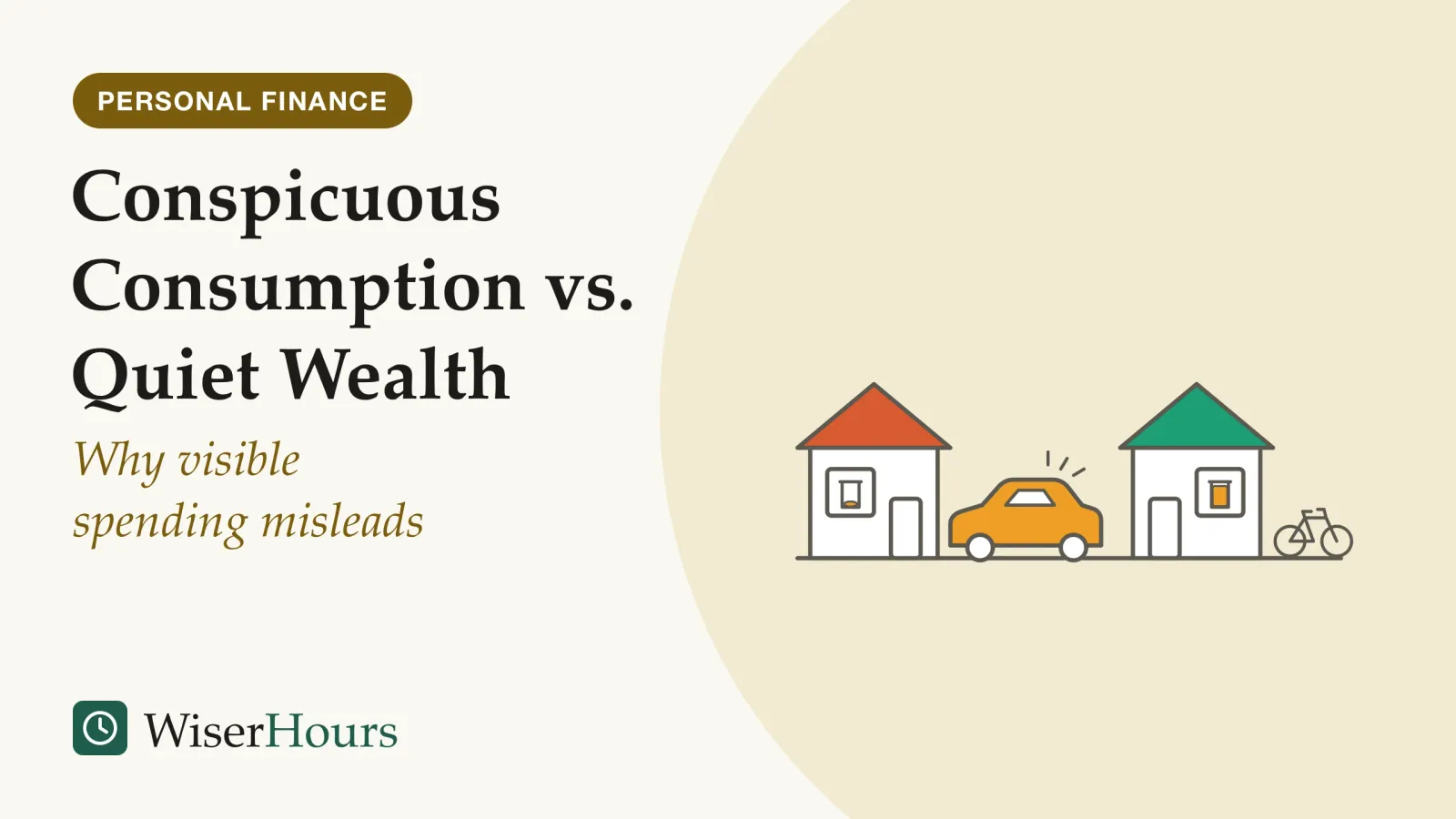
Conspicuous consumption is spending on goods and services chosen mainly so that other people can see you afford them. The economist Thorstein Veblen coined the term in his 1899 book The Theory of the Leisure Class, arguing that wealth has to be put on display to earn respect.1 He was describing the newly rich of the late nineteenth century, who used their fortunes to show social power.2
The idea outlived its era because strangers still cannot see anyone’s accounts. What it does badly is tell you who is well off. A 2009 Quarterly Journal of Economics study, using nationally representative US spending data, found that households spent more on visible goods such as clothing, jewelry and cars when the wider group they belonged to earned less on average.3 Visible spending tracks the audience a household wants to impress. Savings, debts and net worth stay out of sight, which is why a quiet household can be the richer one.
For where beliefs about money come from in the first place, start with the guide to what a money mindset is.
What is conspicuous consumption? Veblen’s 1899 answer
Conspicuous consumption, in Thorstein Veblen’s 1899 account, is buying valuable things in order to be seen buying them, so that others will rank you by your visible wealth. Veblen wrote mainly about the very rich, but he argued that no class, not even the poorest, gives up display entirely, and that each class copies the spending of the class just above it.1 Later writers have applied the idea to middle-class and working-class spending too.2
Conspicuous consumption of valuable goods is a means of reputability to the gentleman of leisure.
Veblen’s reasoning was practical. Wealth cannot be seen directly, so it has to be shown through things that cost a lot and serve little extra purpose. He saw the pressure as strongest in cities, where people meet strangers in churches, theaters, hotels and shops, and a passer-by can judge you only by your clothes and possessions. By his account, city families spent a larger share of their income on appearances than farm families with the same income, and lived closer to hand-to-mouth as a result.1
A neighbor you barely know judges you by your car, not your pension. A colleague at a conference sees your watch, not your mortgage. The more a purchase is aimed at people who know little about you, the more it is about signaling and the less it is about use.
An example of conspicuous consumption: Veblen’s silver spoon
Veblen’s own example of conspicuous consumption was a spoon. A hand-wrought silver spoon cost some ten to twenty US dollars in 1899, he wrote, while a machine-made aluminum spoon cost ten to twenty cents, and the costly one was no more useful.1 His point was that much of the pleasure people take in costly things is pleasure in the cost itself.1 The extreme case now carries his name: a Veblen good is a luxury whose demand rises as its price rises, because the price is part of the appeal.4
Later work asked which spending counts as visible. In a 2011 study, the economist Ori Heffetz used a survey to rank kinds of spending by how noticeable they are to other people. A signaling model in Veblen’s spirit predicts that spending on visible things rises faster with income, and in US data his ranking predicted up to a third of the differences between categories in how spending responds to income.5
A purchase is conspicuous because of its audience, whatever its price. An expensive bed is rarely conspicuous; a modest car with a prestige badge can be.
Why visible spending is a poor guide to wealth
Visible spending is a poor guide to wealth because it reflects whom a household wants to impress and how uncertain its standing is, not how much it owns. The clearest evidence comes from US research showing that visible spending was higher when a household’s comparison group was poorer on average.3
The study
Moderate evidence
Who US households dress up for: the 2009 visible-goods study
The economists Kerwin Kofi Charles, Erik Hurst and Nikolai Roussanov studied visible goods such as clothing, jewelry and cars, the spending other people notice. They found that Black and Hispanic households spent larger shares of their budgets on these goods than comparable White households. Their status-signaling model predicted that visible spending should fall as the average income of a household’s reference group rises, and the data bore this out within each racial group. Accounting for reference-group income explained most of the racial difference.3
The authors’ explanation is signaling: standing out from a poorer comparison group is worth more. In the 2007 working-paper version, the reference group was people of the same race living in the same state, and the authors noted that money spent on display has to come out of saving or other spending.3 The data are observational, so they fit a signaling story without proving anyone’s motive.
The finding does not travel everywhere unchanged. A 2013 study of South African household data by Wolfhard Kaus found that Black and Coloured households spent relatively more on visible goods than comparable White households, but the core prediction about reference-group income failed to hold among White South Africans.6 Status signaling seems real, but it plays out differently by society.
Separate two numbers that are easy to confuse. Spending is what goes out; net worthnet worth: Everything you own on a given day minus everything you owe that day. It is a snapshot of wealth rather than income, and much of it can be tied up in things that are hard to turn into cash, such as a home.Full entry in the glossary is the value of everything you own after your debts are subtracted. Take two colleagues earning the same salary: one drives a new car bought on a loan, the other keeps an old hatchback and saves the difference. At work the first looks better off; on paper, if everything else is equal, the second is ahead.
- Myth
- People with expensive cars, clothes and watches are wealthy.
- Fact
- Visible goods show what someone spends, not what they own. In US data, visible spending rose when a household's peers were poorer, a sign that display tracks the audience.
Quiet wealth: what The Millionaire Next Door observed
The best-known case for quiet wealth is a 1996 book, The Millionaire Next Door by Thomas J. Stanley and William D. Danko. Profiling American millionaires, they reported that most did not live extravagantly, spent little on cars, watches and clothing, and lived below their means.7
They contrasted the “balance sheet affluent”, with real wealth, and the “income affluent”, with high earnings but little wealth, and found millionaires clustered in middle-class and blue-collar neighborhoods more than in affluent ones, to their own surprise, and suggested that high-earning professionals were more likely to spend on status items at the expense of saving.7
Treat the book as observation, not proof: it cannot show that frugality caused anyone’s wealth. The writer Nassim Nicholas Taleb criticized it for survivorship bias: it leaves out savers whose investments did badly, and it came out when the US had just been through what he called the greatest bull market in its history.7 What the book supports is narrower: you cannot read a neighbor’s net worth from their driveway, and a high income spent on display can leave a household with little to show on paper.
How to read visible spending, yours and other people’s
A useful habit is to read any visible purchase as news about a choice, not about a balance sheet, and to apply the same rule to your own spending. The questions below, suggestions drawn from the research rather than rules, ask who is watching and what the badge costs.
Before you buy something people will see
- Who would notice this, and do they know anything else about my finances?
- Would I buy the same thing if nobody could see it?
- What would the difference between this and a plainer version add to my savings?
- Am I paying for a better product, or for a better-known badge?
The second question matters most, because it separates what a purchase does for you from what it says about you. Take a phone that still works and a new model whose main change is that people can tell you upgraded. If your honest answer to the second question is no, the price gap is buying an audience, and the third question tells you what that audience costs.
Spending to be seen is not always a mistake: a well-chosen suit for an interview can serve a real purpose. The cost comes when display crowds out saving without you noticing. Whether a purchase makes you happier is another matter, examined in the research on whether money buys happiness. If the pull is to buy right now rather than to be seen, tactics to stop impulse buying fit better.
What is inconspicuous consumption, or quiet luxury?
Inconspicuous consumption means spending that signals status only to people who know what to look for, or that does not show at all. Quiet luxury, the version seen in fashion, means high-quality goods with no visible logos, and the term spread widely in the 2020s as showy display lost favor in some wealthy circles.8
Two marketing studies explain why the signal goes quiet. Across four studies reported in 2010, Jonah Berger and Morgan Ward found that people with more cultural capital in an area preferred subtle signals, because insiders can read them and they set the wearer apart from the mainstream.9 In a separate 2010 study, Young Jee Han, Joseph Nunes and Xavier Drèze found that wealthy consumers with a low need for status preferred quiet goods only their peers would recognize, while wealthy consumers with a high need for status chose loud logos to set themselves apart from the less affluent.10 Those who wanted status but could not afford real luxury used loud counterfeits.
In her 2017 book The Sum of Small Things, Elizabeth Currid-Halkett went further. As the geographer Danny Dorling summarized it in a review, she argued that very rich Americans now spend more on private education, healthcare and help at home and a smaller share on material goods; Dorling replied that her data could be read other ways, and that spending on elite education is hardly small.11
Quiet does not mean cheap. Moving from a logo to an unmarked sweater can be a change of audience rather than of budget.
Is being busy the new status symbol?
Veblen’s rich showed status through leisure, but research from 2017 suggests that in the US, looking busy now does the same job. In online and lab experiments run by Silvia Bellezza, with Neeru Paharia and Anat Keinan, American participants rated people who described long hours and little free time as higher in status. The authors traced the effect to perceptions that a busy person is competent and ambitious, and scarce and sought after in the job market.12
The effect depended on culture. Italian participants did the opposite, granting more status to a man of leisure than to an overworked one and explaining long hours as a sign that someone had to work to support his family.12 The studies used mostly online samples and imagined people, so they show how observers judge others, not how status works in real workplaces.
The everyday version is the colleague who answers “How are you?” with “Slammed.” Long hours on display are no proof of success, and spending on time-saving services to look in demand is one more form of conspicuous consumption.
Why do people spend money to show status?
People spend to show status mainly because income and wealth are hidden, and others judge them by what they can see. Signaling models in economics treat visible goods as a costly indicator of a household’s economic position, and in the US data that indicator was used more where peers were poorer.3
Comparison with people better off can raise the pressure. In a 2016 study of US households, Marianne Bertrand and Adair Morse found that households below the top spent a larger share of their income, and more of it on visible goods, where top incomes were higher, a pattern they linked to keeping up status.13 A move to a street or a job where people earn more can make a car that felt fine start to feel like a statement. When the urge to upgrade arrives with a new audience rather than a new need, consider waiting.
If keeping up appearances has left you with debts you cannot manage, free advice exists in many countries. In the US, credit counseling groups are usually non-profits whose advice costs little or nothing, according to the Consumer Financial Protection Bureau, which relays a Federal Trade Commission warning that some debt-plan sellers have defrauded people.14 UK residents can get impartial debt advice at no charge via the Money and Pensions Service, whose sponsor is the UK government.15 In other countries, look for a free debt service from your government or a charity; the guide to money anxiety and debt help lists routes in several countries. Before a large money decision tied to your own situation, consult a regulated adviser, preferably one paid a fee instead of commission.
If money worries ever bring thoughts of harming yourself, call your local emergency number now. Find A Helpline, a directory the International Association for Suicide Prevention points to, lists free, confidential helplines in more than 150 countries.16
The bottom line
Conspicuous consumption is spending aimed at an audience, and research since Veblen suggests that how much people show depends on their audience as well as their bank balance. A visible purchase tells you about a spending choice; net worth, the thing that matters for security, stays out of sight. When you judge others, look past the driveway. When you judge yourself, track what you own and owe, and decide how much of your spending you want to be for show.
This article is general education, not financial advice. For decisions about your own money, speak to a qualified, regulated adviser.
Frequently asked questions
What is a Veblen good?
A Veblen good is a luxury good for which demand rises as its price rises, the opposite of the usual pattern, according to Wikipedia's summary of the economics. It is named after Thorstein Veblen. The high price itself is part of the appeal, because it makes the item work as a status symbol that few others can own.
Did Veblen think only the rich spend to be seen?
No. In The Theory of the Leisure Class (1899), Thorstein Veblen wrote that no class of society, not even the poorest, gives up all customary conspicuous consumption. He argued that each class sets its idea of decent spending by copying the class just above it, so standards drift down from the wealthiest.
Is quiet luxury cheaper than showy luxury?
Not necessarily. In a 2010 Journal of Marketing study of brand prominence, Young Jee Han, Joseph Nunes and Xavier Drèze reported that wealthy consumers with a low need for status pay a premium for quiet goods that only people like them can recognize. Discreet can cost as much as loud, or more.
Sources
- The Theory of the Leisure Class. Veblen, T. (1899). Macmillan; Project Gutenberg eBook #833
- Conspicuous consumption. Wikipedia, accessed 2026-10-11
- Conspicuous Consumption and Race. Charles, K. K., Hurst, E. & Roussanov, N. (2009). Quarterly Journal of Economics, 124(2), 425-467
- Veblen good. Wikipedia, accessed 2026-10-11
- A Test of Conspicuous Consumption: Visibility and Income Elasticities. Heffetz, O. (2011). Review of Economics and Statistics, 93(4), 1101-1117
- Conspicuous consumption and “race”: Evidence from South Africa. Kaus, W. (2013). Journal of Development Economics, 100(1), 63-73
- The Millionaire Next Door. Wikipedia, accessed 2026-10-11 (on Stanley, T. J. & Danko, W. D., 1996)
- Quiet luxury. Wikipedia, accessed 2026-10-11
- Subtle Signals of Inconspicuous Consumption. Berger, J. & Ward, M. (2010). Journal of Consumer Research, 37(4), 555-569
- Signaling Status with Luxury Goods: The Role of Brand Prominence. Han, Y. J., Nunes, J. C. & Drèze, X. (2010). Journal of Marketing, 74(4), 15-30
- The Sum of Small Things: A Theory of the Aspirational Class, by Elizabeth Currid-Halkett (review). Dorling, D. (2017). Times Higher Education, 1 June 2017
- Conspicuous Consumption of Time: When Busyness and Lack of Leisure Time Become a Status Symbol. Bellezza, S., Paharia, N. & Keinan, A. (2017). Journal of Consumer Research, 44(1), 118-138
- Trickle-Down Consumption. Bertrand, M. & Morse, A. (2016). Review of Economics and Statistics, 98(5), 863-879
- What is credit counseling? Consumer Financial Protection Bureau (US), last reviewed 2 August 2023; accessed 2026-10-11
- Money and Pensions Service. GOV.UK (UK government), accessed 2026-10-11
- Crisis Centres & Helplines. International Association for Suicide Prevention (IASP), accessed 2026-10-11
How we researched this
We read Veblen's 1899 text on Project Gutenberg and searched Crossref, OpenAlex, RePEc, Google Scholar and publisher sites in October 2026 for research on visible consumption, status signaling, brand prominence and busyness as a status symbol, published from 2009 to 2017. Main limitation: most evidence is observational US spending data or short online experiments, and four papers were read as abstracts only.
Keep reading
Does Money Buy Happiness? How the Research Has Evolved
Does money buy happiness? From the $75,000 plateau of 2010 to the 2023 truce: what income studies, lottery winners and the Easterlin debate show.

Financial Infidelity: What It Is, Why It Happens, and How to Rebuild Trust
Financial infidelity is hiding money from a partner. In a 2018 US poll, about 1 in 5 partnered adults hid an account. What counts, and how to rebuild trust.

Scarcity Mindset: What It Is and What the Research Shows
A scarcity mindset is the narrow focus that comes with having too little. What 2 Science studies found, why the evidence is disputed, and what helps.
Buyer's Remorse: Why It Happens and How to Shop With Fewer Regrets
Buyer's remorse is regret after a purchase. Why it happens, when the UK and EU give you 14 days to cancel, and 5 steps to shop with fewer regrets.