Financial Infidelity: What It Is, Why It Happens, and How to Rebuild Trust
Financial infidelity is hiding money from a partner. In a 2018 US poll, about 1 in 5 partnered adults hid an account. What counts, and how to rebuild trust.

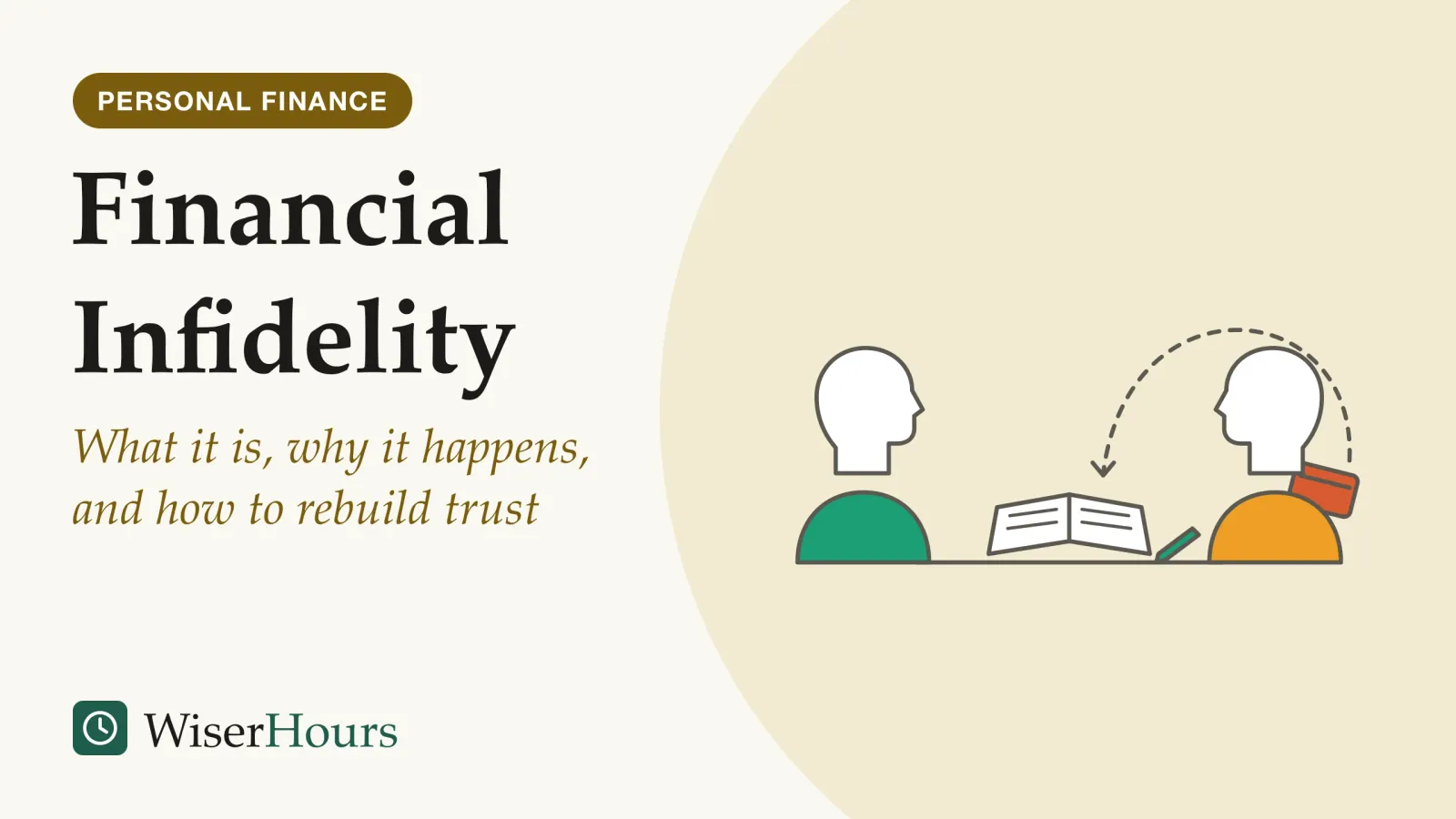
Financial infidelity is deception about money inside a relationship: hiding a debt, keeping a secret account or credit card, concealing purchases, or lying about income. A 2020 research definition by Emily Garbinsky, Joe Gladstone, Hristina Nikolova and Jenny Olson needs two things at once: a money choice your partner would be expected to disapprove of, and a deliberate decision not to tell them.1
It is not rare. In a nationally representative US poll that Ipsos ran for CreditCards.com, a credit card comparison site, in December 2018, about 1 in 5 adults living with a partner were hiding an account, and most said finding $5,000 of hidden card debt would upset them without ending the relationship.2 If hidden money has just come to light, the repair below, drawn from researchers’ advice but not yet tested, has four parts: the partner who hid it tells everything at once, you write one list of every account and debt, you agree a check-first spending limit, and you review the list monthly. Each partner also brings their own money mindset to those talks.
What counts as financial infidelity?
Financial infidelity covers any money behavior you expect your partner to object to and deliberately keep from them, under the definition Garbinsky and colleagues set out in a 2020 Journal of Consumer Research paper.
The paper’s own examples draw the line. Lavish spending on clothes that a spouse knows about is not financial infidelity, however much they disapprove, and quietly saving for a spouse’s birthday present is not either, because nobody expects an objection. The amount does not decide it, since a trivial sum for one couple can be a large one for another. When the authors asked married people for examples, six kinds came up most often: hiding spending, hiding savings, undisclosed debt, giving money to others, gambling, and hiding income.1
- Your partner would object, and knows: an open disagreement about money; uncomfortable, but nothing is hidden
- Your partner would object, and it is hidden: financial infidelity: both conditions in the 2020 definition are met
- Your partner would not mind, and knows: agreed private money, such as a personal account you both know about
- Your partner would not mind, and it is hidden: a surprise gift: concealed, but no objection is expected
The same team then tested whether people who lean toward this behavior hide money in practice.
The study
Moderate evidence
What 1,169 couples' money-app users let their partners see
The team built a 12-item questionnaire measuring how prone a person is to financial infidelity, then matched it with the account settings of 1,169 users of a couples’ money-management app, where each partner decides what the other can see. Higher scorers were more likely to make an account fully private, or to show their partner only the balance. In lab studies, higher scorers buying something a spouse would dislike leaned toward cash, unmarked packaging and personal rather than joint cards.1
The questionnaire tracks real concealment, though it cannot show what causes it: app users chose to take part, and the authors note that nobody can ethically assign couples to hide money. Cash, a personal card and a plain parcel all have innocent uses, so concealment can be hard to spot.
Some kinds hurt more than others. In a 2021 online survey of 203 married or cohabiting US adults, Michael Mong and colleagues found people expected to be most upset by a partner who filed for bankruptcy without telling them, gambled money away or lied to cover up a debt, and least upset by unannounced spending on the children.3 A quick test for anything you have not mentioned is two questions: would my partner object if they knew, and am I keeping it from them on purpose? Two yeses mean it belongs in a conversation.
Is having a secret bank account financial infidelity?
A separate bank account is financial infidelity only when it is hidden and your partner would object to it. A personal account that both partners know about, with an agreed purpose, is ordinary private money, and the comparison of joint and separate bank accounts covers why many couples keep one.
- Myth
- Any account in your own name is a form of cheating.
- Fact
- Private money both partners know about is an agreement. It becomes financial infidelity when it is hidden from a partner who would object.
Privacy is also the reason people give most often. In the National Endowment for Financial Education’s 2021 US poll, people who admitted a financial deception most often said some aspects of their finances should remain private.4 The belief is reasonable; the trouble starts when one partner applies it alone. Telling your partner the account exists, roughly why you keep it and whether they can see the balance turns concealment into an agreement.
One kind of hidden account is different. In 2020, Sarah Porretta of the UK’s Money and Pensions Service noted that a secret savings account could act as a buffer for someone who wants to escape a difficult relationship.5 A 2026 survey of 882 women in China points the same way: among those facing economic abuse, a tendency to hide money was linked to less financial harm, though overall it went with lower financial well-being.6 Money put aside to stay safe from a controlling partner is a safety plan, and nothing in this article asks anyone to give it up.
Deception or control: where infidelity ends and abuse begins
Financial infidelity is deception about money; financial abuse is control over it. The UK charity Surviving Economic Abuse describes economic abuse as control over a partner’s income, spending, bank accounts, bills and borrowing, and as a form of coercive and controlling behavior.7
A partner who hides a credit card is keeping something back; a partner who takes your wages or makes you account for every purchase is limiting what you can do.
When hidden money is about control
Loans or cards opened in your name without your agreement, or because you were afraid to refuse, are what Surviving Economic Abuse calls coerced debt.8 The guide to recognizing financial abuse and where to find support lists helplines in several countries. If you are in danger, your local emergency number comes before anything else. The trust-rebuilding steps below assume both partners are safe and can disagree openly.
How common is financial infidelity?
Estimates of financial infidelity vary more than twofold, depending on who was asked and how. Most figures come from US and UK polls paid for by financial companies, charities or public bodies, and the peer-reviewed studies used online samples, so each is a rough guide.
| Survey | Who was asked | What they found |
|---|---|---|
| Jeanfreau and colleagues, published 2018 | 414 married or cohabiting adults recruited online via MTurk (US accounts) and Facebook (a convenience sample) | 27% said they had kept a financial secret; 53% ticked at least one of 14 hiding behaviors9 |
| NEFE poll by The Harris Poll, US, June 2021 | 1,248 adults who had ever combined finances, surveyed online | 43% had committed at least one financial deception4 |
| Ipsos for CreditCards.com, US, December 2018 | 636 adults married or living with a partner, from a probability-based panel | 19% were hiding a checking, savings or credit card account at the time2 |
| Money and Pensions Service, UK, 2020 | More than 5,200 UK adults; figure for those in relationships | 45% had a money product their partner did not know about5 |
The figures differ because the questions do. Some ask whether you have ever deceived a partner, others what you are hiding now; some count only people who combined their money. The most representative sample, Ipsos’s, answered the narrowest question.
Labels matter too. In Michelle Jeanfreau’s 2018 study, roughly twice as many people ticked a specific hiding behavior as admitted a financial secret, and the most common behaviors were small, such as hidden purchases or a fib about a price. The authors suggest people either did not own up or did not see such small deceptions as infidelity.9
Outside the US and UK, published figures are scarce, so whether these patterns hold elsewhere is an open question. A headline saying 2 in 5 people hide money and another saying 1 in 5 can both rest on real polls; before comparing either with your own relationship, check whether the question asked about ever or now, and who answered.
Why people hide money from a partner
People most often say they hid money because they believe some finances should stay private, because they feared their partner’s disapproval, or because they were embarrassed or afraid about their finances, according to NEFE’s 2021 US poll of adults who had combined money with a partner.4
Each reason postpones a conversation the person expects to go badly, and where the fear itself is the bigger problem, ways to ease money anxiety may help first. Take someone who brings a credit card balance into a relationship and plans to clear it before mentioning it. Each month it stays, the eventual conversation gets harder, because it now has to cover the debt and the delay.
How a couple runs its money seems to matter. In Jeanfreau’s study, people with individual accounts, or who paid bills as they came in, were more likely to report hiding money than people with joint accounts or a budget, a link from a single survey that does not prove budgeting prevents it.9 Garbinsky’s team found a similar pattern over time: people less satisfied with how they and their spouse handled money scored as more prone to financial infidelity about nine months later.1
A couple can lower that cost by agreeing in advance that a confessed money mistake gets a plan and a deadline rather than a punishment.
Can a relationship recover from financial infidelity?
Many couples expect to recover, and some say a discovery brought them closer, according to US polls. No study we found has followed couples after a discovery or tested which steps help, so the evidence is limited to snapshots of what people report or predict.
In NEFE’s poll, most people touched by a deception said it had affected the relationship, most often through arguments and less trust.4 These are self-reports and predictions, not follow-ups of real couples. Jeanfreau’s team, writing for clinicians, suggest couples build a financial balance sheet, budget and plan together and review it regularly, the backbone of the steps below.9
How to rebuild trust after financial infidelity
The steps draw on the researchers’ suggestions and on consumer-protection guidance; no trial has tested them yet.
1. Tell the whole story in one conversation
The partner who hid something does best to lay out all of it at once: every account, card and debt, the amounts, and how long it has gone on. If more comes out later, the other partner has to start again from wondering what else is missing. The partner who found out can ask for time before deciding anything about the relationship.
2. Make one list of accounts, debts and income
Write down every account, debt, regular bill and income for both of you, with balances, and use credit reports to check nothing is missing. The US Federal Trade Commission says each of the three national credit bureaus lets you check your report free once a week through AnnualCreditReport.com.10 The UK’s Information Commissioner’s Office says a statutory credit report costs nothing.11 Elsewhere, check your country’s credit bureaus or financial regulator for how to get a report.
3. Check what you now owe together
A hidden debt may already be partly yours. The US Consumer Financial Protection Bureau says each holder of a joint credit card owes the whole balance.12 In the UK, StepChange, a debt charity, says you are usually jointly responsible for joint debts whoever spent the money.13 Rules differ by country, so check with your lender or a free debt adviser in your own country.
4. Agree a spending limit and some private money
Pick an amount above which either partner checks with the other before spending, and a personal sum each can spend without explaining. The limit spells out which purchases a partner would object to, and the personal sum keeps the privacy people most often give as their reason for hiding money.
5. Hold a regular money check-in
Set a recurring time, such as once a month, to go through the list, the limit and anything that has changed. Jeanfreau’s team recommend regular reviews, and in their survey people with a budget less often reported hiding money.
6. Bring in outside help when talks stall
If the debt is too large to handle alone, or every conversation turns into the same argument, free debt advice can help with the numbers and a couples counselor with the trust.
Rebuilding trust after hidden money comes out
Where to get help with hidden debt or a stuck conversation
Some situations need someone outside the relationship; they are ordered by urgency.
- Now: if you are in danger, contact your local emergency number; if a partner controls your money, use the helplines in the financial abuse guide linked above. For thoughts of suicide or self-harm, contact your local emergency number or a crisis line; the International Association for Suicide Prevention points to a free directory of helplines in more than 150 countries.14 In the US, the 988 Suicide & Crisis Lifeline is free and confidential, every hour of every day.15
- Soon, if hidden debt is causing missed payments or distress: the US CFPB describes credit counselors as mostly non-profit groups offering free or low-cost advice.16 In England and Wales, GOV.UK points to free debt advisers through MoneyHelper,17 and StepChange also gives free debt advice.13 Australia’s National Debt Helpline offers free advice on 1800 007 007.18 Elsewhere, a government or charity debt service may offer the same help at no cost.
- Routine: if talks about the hidden money keep breaking down, a couples counselor or a therapist who works with money issues can help both partners.
The bottom line
Financial infidelity is hiding money your partner would object to; private money you both know about is something else. If you are hiding something from a partner you feel safe with, tell all of it in one conversation and bring the paperwork. If you found something, check what you owe jointly, then agree one list, a spending limit and the date of your next money check-in.
This article is general education, not financial advice. For decisions about your own money, speak to a qualified, regulated adviser.
This article is general information, not legal advice. Rules differ by country and change over time; for your own situation, speak to a qualified lawyer or an official advice service where you live.
Frequently asked questions
Is lying about the price of something financial infidelity?
It can be, if your partner would object and you hide it on purpose. The 2020 definition by Garbinsky and colleagues sets no minimum amount, because a small sum for one couple can be a large one for another. In Jeanfreau and colleagues' 2018 online survey, about 1 in 7 people who said they had never kept a financial secret still admitted lying about a price they paid; the authors suggest they saw such lies as too trivial to count.
Do men or women commit financial infidelity more often?
The evidence is mixed. In NEFE's 2021 US poll, run by The Harris Poll, men who had combined finances with a partner were more likely than women to report a financial deception. In Jeanfreau and colleagues' smaller 2018 online study, the share who admitted a money secret did not differ clearly between men and women. Both studies relied on people reporting their own behavior.
Can a couples' money app stop financial infidelity?
Not on its own. In the 2020 study by Garbinsky and colleagues, users of a couples' money-management app chose for each account what their partner could see, and those more prone to financial infidelity more often kept accounts private or showed only the balance. An app shares what each partner decides to put in it, so it works best alongside an agreement about what goes on the shared list.
What if my partner took out credit in my name?
That is more serious than a hidden purchase. Surviving Economic Abuse, a UK charity, describes a partner taking out credit in your name without your consent as coerced debt, a form of coercive and controlling behavior. Checking your credit report shows accounts opened in your name. If you feel unsafe, call your local emergency number, and contact a domestic abuse helpline or a free debt adviser before you challenge the debt.
Sources
- Love, Lies, and Money: Financial Infidelity in Romantic Relationships. Garbinsky, E. N., Gladstone, J. J., Nikolova, H. & Olson, J. G. (2020). Journal of Consumer Research, 47(1), 1-24
- 1 in 5 is Hiding a Bank or Credit Card Account From Their Spouse or Partner. CreditCards.com (US), press release, 24 January 2019; survey by Ipsos, December 2018; accessed 2026-10-18
- When Your Partner Cheats: Financial Infidelity in Committed Couples. Mong, M. D., Stadthagen, H., Noguchi, K. & Jeanfreau, M. (2021). Journal of Financial Therapy, 12(1), article 7, 127-135
- 2 in 5 Americans Admit to Financial Infidelity Against Their Partner. National Endowment for Financial Education (US), 18 November 2021; poll by The Harris Poll, June 2021; accessed 2026-10-18
- Four in 10 'have kept money secrets from family and friends'. LBC (UK), 9 November 2020, reporting a Money and Pensions Service survey for Talk Money Week; accessed 2026-10-18
- A Covert Way Out?: Financial Infidelity Buffers the Harms of Economic Abuse. Li, Khan & Kong (2026). Family Relations, published online 19 August 2026 (abstract read)
- What is economic abuse? Surviving Economic Abuse (UK charity), accessed 2026-10-18
- What is coerced debt? Surviving Economic Abuse (UK charity), accessed 2026-10-18
- Financial Infidelity in Couple Relationships. Jeanfreau, M., Noguchi, K., Mong, M. D. & Stadthagen, H. (2018). Journal of Financial Therapy, 9(1), article 2
- Free Credit Reports. Federal Trade Commission (US), Consumer Advice, accessed 2026-10-18
- Credit. Information Commissioner's Office (UK), accessed 2026-10-18
- Am I responsible for charges on a joint credit card account if I didn't make them? Consumer Financial Protection Bureau (US), last reviewed January 22, 2024; accessed 2026-10-18
- How can joint debts affect me? StepChange Debt Charity (UK), accessed 2026-10-18
- Crisis Centres & Helplines. International Association for Suicide Prevention, accessed 2026-10-18
- 988 Suicide & Crisis Lifeline. 988 Suicide & Crisis Lifeline (US), accessed 2026-10-18
- What is credit counseling? Consumer Financial Protection Bureau (US), last reviewed August 2, 2023; accessed 2026-10-18
- Options for dealing with your debts: Breathing Space (Debt Respite Scheme). GOV.UK (UK government), accessed 2026-10-18
- National Debt Helpline: free financial counselling. National Debt Helpline (Australia), accessed 2026-10-18
How we researched this
We searched Crossref, Google Scholar and the Journal of Financial Therapy archive in October 2026 for peer-reviewed research on financial infidelity and secrecy in couples, read the three main papers (2018 to 2021) in full, and compared them with US and UK polls from 2018 to 2021. Newer studies (2024 to 2026) were screened by title and abstract; one, from China, is cited from its abstract. Help pages from US, UK and Australian bodies were checked on 2026-10-18. Main limitation: the research is young, mostly US-based and built on self-reports, and no study we found has tested ways to rebuild trust.
Keep reading
Joint, Separate, or Both? What Research Says About Couples' Bank Accounts
In six studies of 38,000+ people, couples who pooled all their money reported happier relationships. What one US trial and joint-account rules add.
Financial Abuse: Recognizing Economic Control and Where to Find Support
Financial abuse is control of a partner's money, work or credit. Learn its 3 forms, how it differs from ordinary rows, and safe first steps to get help.
Scarcity Mindset: What It Is and What the Research Shows
A scarcity mindset is the narrow focus that comes with having too little. What 2 Science studies found, why the evidence is disputed, and what helps.
Conspicuous Consumption vs. Quiet Wealth: Why Visible Spending Misleads
Conspicuous consumption, Veblen's 1899 term, is spending meant to be seen. Why visible spending is a poor guide to wealth, and how quiet wealth looks.