When Rewards Backfire: The Overjustification Effect
The overjustification effect: expected prizes for things people already enjoy can cut their interest. What a 1973 study and a review of 128 studies found.

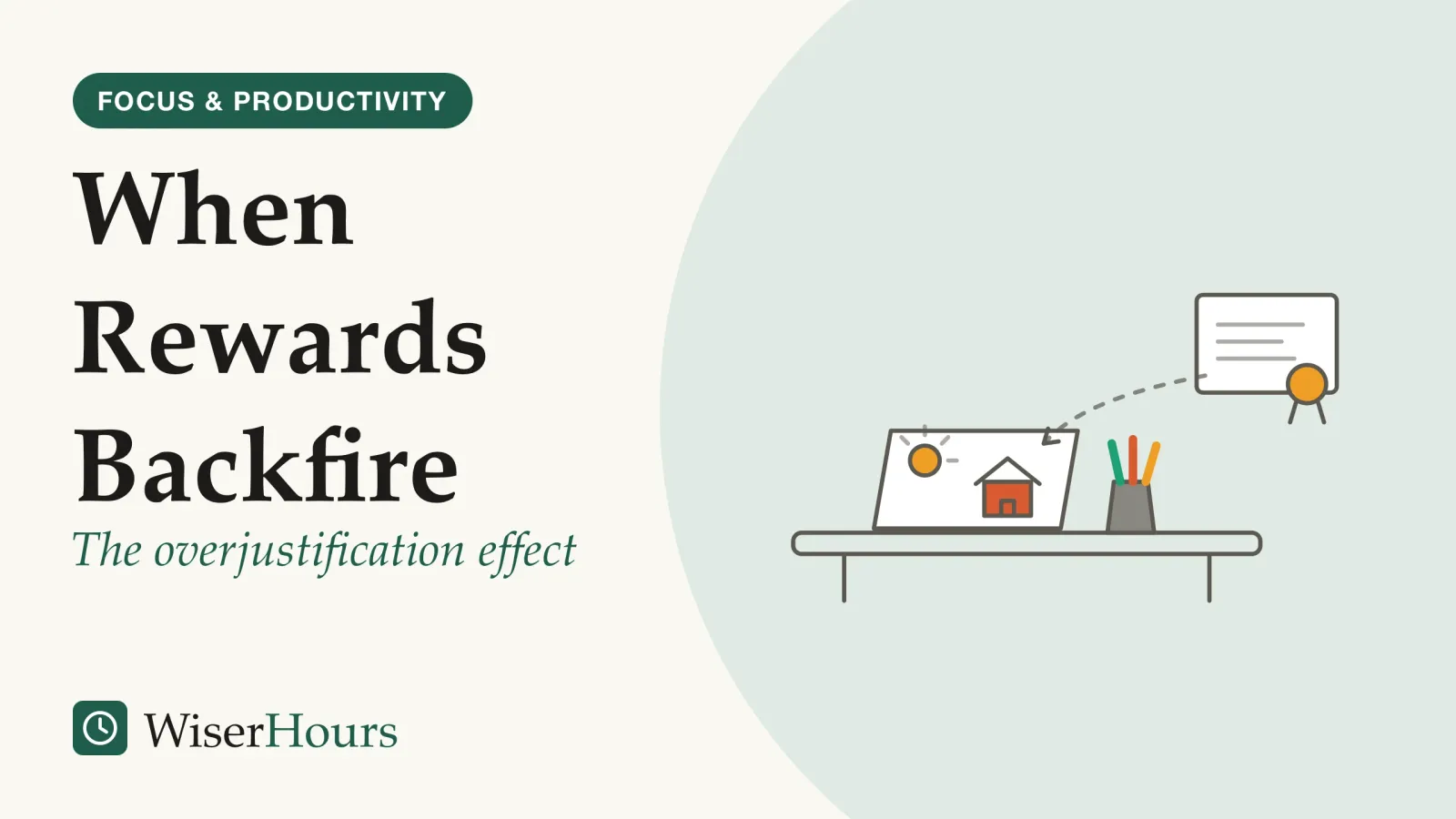
Children promised a prize for drawing, in a 1973 nursery school experiment, later chose to draw less in their free time, while children handed the same prize as a surprise showed no such drop. That pattern is the overjustification effect: when people expect a reward for something they already enjoy, their interest can fall once the reward stops, below where it would have been with no reward at all.1
The effect is narrower than its reputation. It shows up mainly with tangible prizes promised in advance for doing a task, rarely with surprise rewards or sincere praise, and not with rewards for dull chores.2 Rewards for chores and routine work are the safe case; for activities people already love, an announced prize is the risky choice, and specific thanks after the fact is the safer one.
Our guide to intrinsic and extrinsic motivation compares interest and incentives more broadly and explains the theory behind them; the category page collects more on what drives motivation and procrastination.
What is the overjustification effect?
The overjustification effect is a fall in intrinsic motivationintrinsic motivation: Doing something because it is interesting or enjoyable in itself, rather than for a separate outcome such as pay, a grade or approval. Self-determination theory contrasts it with extrinsic motivation and sees motivation as a range, not a fixed trait.Full entry in the glossary after an expected reward for an already enjoyable activity; Mark Lepper, David Greene and Richard Nisbett named it in a 1973 experiment. They built on Daryl Bem’s self-perception theory: people judge their own reasons partly by watching what they do and under what conditions.1
Definition
The overjustification effect is the loss of interest in an activity people already enjoy after they are given an expected, external reward for doing it. The reward becomes the apparent reason, so once it stops, they do the activity less.
The word itself describes the mechanism the researchers proposed. An activity that is fun already has one good reason behind it. Add a prize, and the behavior now has two reasons, more justification than it needs. When people later ask themselves why they did it, the visible prize wins and the quiet enjoyment gets discounted. Edward Deci found a similar pattern two years earlier with money and college students solving puzzles, and his camp calls it the undermining effect; both names appear on this page for the same thing.2
The effect concerns what happens after the reward. While a prize is on offer, people often do more. The cost appears later, in the free time when nobody is paying, which is why researchers measure it by watching what people choose to do once the reward has ended.3 Anyone judging a reward scheme can borrow that test: look at what people do in a week when the scheme pauses, because extra effort while it runs can hide a loss of interest.
The nursery school drawing experiment that named it
In the classic test, nursery school children who already liked a new drawing activity were randomly assigned to draw for a promised “Good Player” certificate, to draw and get the same certificate as a surprise, or to draw with no award. Later, the children who had expected the certificate spent less free time drawing than either other group.3
The study
Moderate evidence
Certificate promised or certificate as a surprise: nursery school drawing, 1973
Researchers put an attractive drawing activity into nursery school classrooms during free play and quietly recorded which children chose it. Children who showed interest were randomly assigned to an expected award, the same award given unexpectedly, or no award, and the sessions ran in a separate room. When the drawing materials returned to the classrooms one to two weeks later, children who had drawn for a promised certificate drew less than the others, spending about half as much of their free time on it, and less than they had at the start.1
The unexpected-award group is what makes the study persuasive. Those children drew in the same room, got the same certificate and the same adult attention, yet their interest did not drop. The difference lay in whether they saw the award coming while they drew, which points to the reason the reward gave them for drawing.3
The setting limits how far the result travels. It was a field experimentfield experiment: An experiment run in a real setting, such as a workplace, shop or website, with people going about their ordinary lives, usually with random assignment. It shows how an effect plays out in practice, though often for one setting and one group at a time.Full entry in the glossary at a single nursery school on the Stanford University campus in the US, with children aged about 3 to 5, a symbolic award and one 6-minute drawing session each.1
- Expected award: promised a certificate for drawing, then given it; later drew less in free time
- Unexpected award: given the same certificate as a surprise afterward; no drop
- No award: drew without any certificate; no drop
A reward that arrives as a surprise after something is done sends a different message from one dangled in advance, even when the prize is identical. When you plan a reward, decide when the person will hear about it as carefully as you choose the reward itself.
Do rewards decrease intrinsic motivation? Only under certain conditions
Rewards lowered intrinsic motivation mainly when they were tangible, expected and given for doing, finishing or doing well at an interesting task. Edward Deci, Richard Koestner and Richard Ryan reached that conclusion after pooling 128 studies; their 1999 meta-analysismeta-analysis: A study that combines the results of earlier studies on the same question into one overall estimate. Pooling makes the estimate more precise, but it cannot repair the studies it pools: a meta-analysis of surveys is still survey evidence.Full entry in the glossary found no such effect for unexpected rewards or for rewards unrelated to the task, and found that positive feedback raised interest. Their explanation turns on what a reward signals: a prize that feels like someone steering you becomes the reason you act, while feedback that you did well tells you something about your skill, and that tends to feed interest.2
| Kind of reward | What the 1999 meta-analysis found | Evidence |
|---|---|---|
| Tangible, promised in advance for doing, finishing or doing well at an interesting task | Lower free-time interest afterward | Pooled lab experiments, mixed2 |
| Tangible but unexpected, or not tied to the task (such as pay for taking part) | No measurable effect | Pooled lab experiments, moderate2 |
| Positive feedback that informs | Higher interest, more so in college students than in children | Pooled lab experiments, moderate2 |
| Rewards for dull, boring tasks | No reliable undermining | Pooled lab experiments, moderate2 |
Age and wording also counted. Tangible rewards tended to harm children more than college students. In a few studies, feedback that said someone had done very well “just as you should” lowered interest, while plain informational feedback raised it.2
A sticker chart for a child who already practices piano for fun, an invented example, would collect three yeses. The same chart for brushing teeth falls in the dull-task group, where the analysis found no harm.
Does the overjustification effect apply at work?
Workplace evidence is thinner, and it points to a narrower risk: incentives tied tightly to output can push interest out of the part it plays in good work. In a 40-year meta-analysis published in 2014, Christopher Cerasoli and colleagues found that interest mattered less to performance when incentives were directly tied to it; interest went with the quality of work, incentives with its quantity.4
Since most of the combined studies were correlational, the review links interest and incentives to performance without showing cause.4 Salary sits apart: Deci’s team classed pay for holding a job as a task-noncontingent reward, the type that left interest unchanged in their analysis.2
A design team given a bonus per mockup delivered, an invented case, would probably turn out more mockups. Whether each one stays thoughtful depends on whether the bonus becomes the reason for it. Cerasoli and colleagues advise making incentives less salient where creativity, teamwork and quality are valued, and keeping tightly tied incentives for simple tasks where output is the main concern.4
How to avoid the overjustification effect
The conditions above reduce to a few habits: reward dull tasks freely, keep tangible prizes for activities people love rare and unannounced, and praise sincerely and specifically. They come from lab and classroom experiments, so use them as starting defaults and adjust to how the person responds.
For parents and teachers
Rewards for chores are the safe case, since dull tasks showed no reliable undermining. For a child who already reads or draws for pleasure, leave out the advertised prize; Deci’s team note that an occasional surprise reward can show appreciation, though people start to expect “unexpected” rewards given too often.2
Praise helps most when it is sincere, credits causes the child can control, supports their autonomy and sets standards they can reach, according to a 2002 review by Jennifer Henderlong and Mark Lepper.5 “You kept trying new colors until the sky looked right” does that; “good job, just as you should” adds pressure.
For managers
Keep base pay steady and fair, and put tight per-unit incentives on simple, countable work only. For work judged on quality, make recognition specific and give it after the fact. Deci’s team also warn that reward schemes tend to bring surveillance, evaluation and competition, which have their own undermining effects.2
For turning a hobby into paid work
We found no research that tracked people as a hobby became a business, so this part extends the lab conditions and has not been tested. Payment per piece is the task-contingent kind of reward. A hobbyist who starts selling can protect the original reason by keeping some work unpaid and done purely for themselves, choosing projects where possible, and treating client feedback as information about the work.
A potter who begins selling mugs at a weekend market could, for instance, keep one unsold, experimental piece on the wheel each week.
Before you offer a reward
How big is the effect? Two camps and one shared warning
Researchers have argued for decades over how large and widespread the undermining effect is. Judy Cameron and David Pierce’s 1994 meta-analysis concluded that, overall, reward does not decrease intrinsic motivation, with a minimal negative effect only when expected tangible rewards were given simply for doing a task.6
Robert Eisenberger and Cameron argued in 1996 that harmful effects occur under highly restricted, easily avoidable conditions.7 Deci’s team replied in 1999 that the 1994 analysis had lumped dull tasks in with interesting ones, used unsuitable control groups and misclassified some rewards, and that a corrected analysis showed clear undermining.2
In 2001 Cameron, Katherine Banko and Pierce replied with a further meta-analysis. In their reading, rewards are not harmful to motivation in general, and the negative effects show up on high-interest tasks when rewards are tangible, announced beforehand and only loosely linked to performance. Our access to the three Cameron-camp papers was limited to their abstracts.8
A newer lab study found the core effect again. In a 2010 brain-imaging study of 28 university students in Japan, a performance-based payment for a stopwatch game reduced how often students chose to play it in free periods afterward, along with activity in brain areas the authors tie to valuing the task.9 As one small lab study, it adds weight to the effect without settling its size.
Both camps flag the same arrangement, an expected, tangible prize for a task someone already enjoys, so that is the case to design around whichever side you find more convincing.
Which popular examples are research, and which are stories
Many popular explanations of the overjustification effect rest on examples nobody has studied, told as though they were findings. The studied cases on this page are narrower: children drawing for a certificate, students paid to solve puzzles, students paid in a stopwatch game, and blood donors in Sweden.
The child paid a dollar a book is a common example. None of the studies we read paid children per book and tracked their reading, so it illustrates the drawing study’s conditions and proves nothing on its own. Wikipedia’s article on the effect lists star athletes whose form fell after large contracts, which is anecdote: form can change after a contract for many reasons, from age to injury.10
- Myth
- Big contracts make star athletes lose interest, and that proves the overjustification effect.
- Fact
- Those are anecdotes. The studied cases are experiments with a comparison group, such as children drawing for a certificate versus the same certificate as a surprise.
The blood donation study is a real test outside the lab. In a field experiment in Sweden published in 2008, Carl Mellström and Magnus Johannesson found that offering a small cash payment cut the number of women who signed up as donors by almost half, with no clear change for men; letting people give the payment to charity instead removed the drop.11 We could read just its abstract, and the outcome measured was signing up, so it cannot speak to years of giving.
Before trusting any claim that a reward backfired, ask who was rewarded, for what, and how their interest was measured afterward.
The bottom line
An expected, tangible reward for something a person already enjoys is the setup most likely to backfire. Before offering a prize, check whether the task is one the person likes; if it is, drop the announcement and give specific recognition after the fact.
Frequently asked questions
Who coined the term overjustification effect?
Mark Lepper, David Greene and Richard Nisbett used the term in their 1973 paper in the Journal of Personality and Social Psychology. They drew on Daryl Bem's self-perception theory: people infer their own reasons from what they see themselves doing, so an obvious reward can look like the reason. Edward Deci, who found a similar result in 1971, calls it the undermining effect.
Does the overjustification effect happen to adults?
Yes, although it seems weaker than in children. In the 1999 meta-analysis by Edward Deci, Richard Koestner and Richard Ryan, tangible rewards undermined interest in both children and college students but tended to be more harmful for children. The authors speculate that college students more readily read a reward as a sign of good work rather than as control.
Is the overjustification effect the same as motivation crowding out?
They describe the same pattern from two fields. Psychologists speak of overjustification or undermining, while economists call it crowding out: a payment pushes aside a motive that was already there, such as enjoyment or a sense of duty. A 2008 field experiment on blood donors in Sweden is a well-known economics test of the idea.
Sources
- Undermining children's intrinsic interest with extrinsic reward: A test of the "overjustification" hypothesis. Lepper, M. R., Greene, D. & Nisbett, R. E. (1973). Journal of Personality and Social Psychology, 28(1), 129-137
- A meta-analytic review of experiments examining the effects of extrinsic rewards on intrinsic motivation. Deci, E. L., Koestner, R. & Ryan, R. M. (1999). Psychological Bulletin, 125(6), 627-668
- Overjustification in a token economy. Greene, D., Sternberg, B. & Lepper, M. R. (1976). Journal of Personality and Social Psychology, 34(6), 1219-1234
- Intrinsic motivation and extrinsic incentives jointly predict performance: A 40-year meta-analysis. Cerasoli, C. P., Nicklin, J. M. & Ford, M. T. (2014). Psychological Bulletin, 140(4), 980-1008
- The effects of praise on children's intrinsic motivation: A review and synthesis. Henderlong, J. & Lepper, M. R. (2002). Psychological Bulletin, 128(5), 774-795
- Reinforcement, reward, and intrinsic motivation: A meta-analysis. Cameron, J. & Pierce, W. D. (1994). Review of Educational Research, 64(3), 363-423
- Detrimental effects of reward: Reality or myth? Eisenberger, R. & Cameron, J. (1996). American Psychologist, 51(11), 1153-1166
- Pervasive negative effects of rewards on intrinsic motivation: The myth continues. Cameron, J., Banko, K. M. & Pierce, W. D. (2001). The Behavior Analyst, 24(1), 1-44
- Neural basis of the undermining effect of monetary reward on intrinsic motivation. Murayama, K., Matsumoto, M., Izuma, K. & Matsumoto, K. (2010). Proceedings of the National Academy of Sciences, 107(49), 20911-20916
- Overjustification effect. Wikipedia (accessed October 2026)
- Crowding out in blood donation: Was Titmuss right? Mellström, C. & Johannesson, M. (2008). Journal of the European Economic Association, 6(4), 845-863
How we researched this
Our October 2026 search covered Crossref, PubMed, OpenAlex, Wikipedia and author and university copies of key papers, from the 1973 experiment to a 2014 meta-analysis. Six sources were read in full, including the Wikipedia article, and five only as abstracts, which the text notes for the key ones. The main limitation is that almost all of the evidence comes from short lab or school experiments, and the two research camps still disagree about how large the effect is.
Keep reading
Intrinsic vs. Extrinsic Motivation: Which Lasts Longer?
Rewards get people moving; interest and personal value keep them going. What 4 decades of research on intrinsic vs extrinsic motivation found.
How to Stop Being Lazy: A Compassionate, Practical Guide
How to stop being lazy: find what the feeling hides, then try 5 kind steps, from acting first to a two-minute start, and know when to see a doctor.
How to Build Self-Discipline From Scratch
Disciplined people resist temptation less often, not more. 5 steps to build self-discipline by designing your days instead of gritting your teeth.
How to Get Motivated When You Don't Feel Like Doing Anything
Waiting to feel ready can keep you stuck. 5 gentle steps for a flat day: shrink the task, start first, change the room, check the basics, add a reward.