Should You Make the First Offer? What the Research Says
Making the first offer usually pays in simple price haggles. A 2025 review of the research shows when to open, when to wait and what a bold number costs.


In a survey at one Israeli college, published in 2017, most first-year students said they would rather let the other side name a price first, while most second-years, who had been taught about economic behavior and decision biases, preferred to open.1 The trained instinct is closer to the evidence, but only under conditions that the classroom rule of thumb leaves out.
Should you make the first offer? Usually yes, when you know roughly what the deal is worth and it is a simple, one-off haggle over price. Hold back when the other side knows the market far better than you do, or when your opening would reveal what you care about. A 2025 meta-analysismeta-analysis: A study that combines the results of earlier studies on the same question into one overall estimate. Pooling makes the estimate more precise, but it cannot repair the studies it pools: a meta-analysis of surveys is still survey evidence.Full entry in the glossary found that the size of an opening offer predicts the final deal more reliably than the simple act of going first, and that bolder openings carry a real cost in deadlocks and bad feeling.2
Four questions settle most cases before anyone speaks:
- Do I know what similar deals settle at? If not, find out before you open.
- Does the other side know much more than I do? If so, let them name the first number.
- Would my offer show them a point we already agree on? Keep that point back.
- Will I need this person’s goodwill after the deal? If so, open less aggressively, or offer a choice.
Should you make the first offer? The number matters more than the turn
Making the first offer tends to pay in simple, one-off haggles over price, but the pull of a well-chosen number is more dependable than the advantage of speaking first. So concludes a 2025 review of first-offer research by Hannes Petrowsky, David Loschelder and colleagues, which the guide to where first offers fit in a full negotiation also covers. Here the focus is on the conditions that change the answer.2
The reason to open is anchoringanchoring: The tendency for an estimate or decision to be pulled toward a number seen beforehand, even an irrelevant one. It is one of the effects that held up when large teams ran the original experiments again.Full entry in the glossary: the first number on the table becomes the reference point that the other side’s counteroffer is built around. A seller who asks for a high price tends to receive higher counteroffers, and so a higher final price.2
The study
Moderate evidence
Opening turn versus opening number, across 90 studies
Pooled together, the studies favored the side that opened, and the opening figure and the final deal moved closely together. Before any correction, the authors express the go-first edge as a benefit in about six of ten negotiations. Once they adjusted for publication biaspublication bias: The tendency for studies with striking or statistically significant results to be published, while quieter ones stay in the drawer. Since the missing studies are mostly the unimpressive ones, a pooled result tends to overstate the effect until it is corrected.Full entry in the glossary, however, that edge could no longer be told apart from zero, while the tie between opening number and final deal survived. So did the costs of ambitious openings: more deadlocks, and a poorer experience for the people receiving them.2
Why would the turn matter less than the number? In studies that simply record who opened, the openers are a mix of bold and timid negotiators, which dilutes the average; experiments that fix the size of the opening compare bold with modest offers head to head, the authors explain.2 Nearly every pooled result came from a single role-play or lab task, so the finding describes a tendency, not a forecast for any one deal.
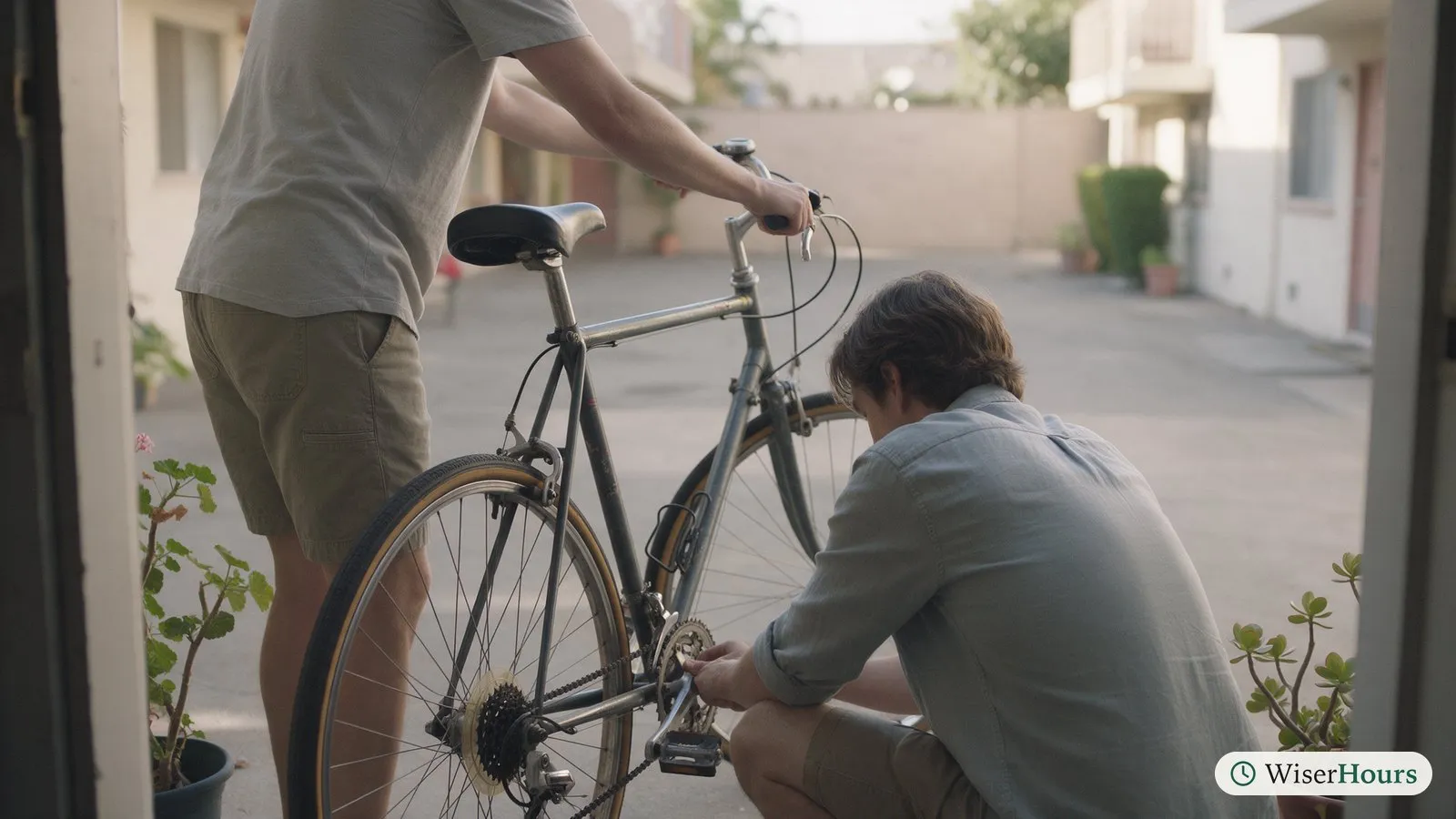
Picture selling a used bicycle. If you know what similar bikes fetch, an opening toward the upper end of that price gives the buyer’s counteroffer somewhere high to start from. So put your effort into the number and the reason behind it.
When letting the other side open is the better move
Letting the other side open is often wiser when they know the going rate and you do not. Experiments by Yossi Maaravi and Aharon Levy, published in 2017, found that in these lopsided situations the person who opened without knowing the market did worse than the one who waited. The mechanism is simple. If you guess, your guess becomes the anchor, and it may be far too generous. If the well-informed side opens instead, its number is shaped by what it knows, so its offer hands you information you did not have.1
In one of their studies, pairs of international students at an Israeli college role-played a business traveler in Namibia agreeing a waiting fee with a taxi driver who knew local rates. When the traveler opened, the pairs settled on more than four times the price reached when the driver opened.1 These were 43 short classroom exercises, so a gap that large may not appear on a real trip, but the direction held up: a 2019 study by Cheng-Ming Jiang and Jia-Tao Ma repeated the finding that the uninformed side does better moving second. It added a twist. When the uninformed buyer expected a price below the market, the informed seller did better opening, because waiting made a deadlock more likely.3
Across the top: does the other side know the going rate (open eye) or not (closed eye)? Down the side: do you?
- You both know the going rate: going first is the usual advice, though a counterpart who knows the market well is harder to pull
- Only you know it: the evidence points both ways: letting a less-informed person open can pay, but so can a confident first offer, depending on what they expect
- Only they know it: the best-tested case for holding back: let them open, or learn the market before you name a number
- Nobody knows it: any first number is a guess and can land too high or too low, so find a reference point before anyone opens
The Program on Negotiation at Harvard Law School gives an everyday case: in a typical job negotiation, the interviewer knows more about the likely salary range than the candidate, so the candidate should gather as much information as possible before naming a figure.4 The same holds for a first quote from a builder, a price in an unfamiliar market or a car you have not researched.
If they probably know more, you have two options. Close the gap first, with two or three comparable prices or quotes, or ask them what they had in mind. And if they do open, look at your own written target before you reply. In the last of three experiments that Adam Galinsky and Thomas Mussweiler published in 2001, thinking about one’s own target cancelled the effect of the other side’s first offer on the outcome (abstract only).5
A short homework step before you open
Look up two or three recent prices for the same thing, from listings, colleagues or past quotes, and write the range down. Then write the number you would open with and the one-sentence reason for it. If you cannot find a single comparison, that is your cue to let them go first.
An opening offer can give away more than a number
A first offer tells the other side what you want, and in deals with several issues they can use that against you. Two experiments by David Loschelder and colleagues, published in 2014, found that openers who revealed they wanted the same outcome as the other side on some issue lost the usual first-mover advantage and ended up at a disadvantage, while openings limited to issues where the two sides’ interests clash kept it. Recipients who cared mainly about their own gain were more likely to take advantage than cooperative ones (abstract only).6
The reason is tactical. Once the recipient learns you already agree on a point, they can pretend it matters to them and “give way” on it in exchange for something you do value. The 2025 review describes a candidate and a recruiter who both, without knowing it, want the candidate based in the same city: whoever reveals it first gives the other side something it can pretend to concede.2
The 2025 review also found that the benefits and costs of first offers both shrank as more issues were on the table. On average, opening still helped in complex deals; the disadvantage showed up in some of them, not all.2 An earlier set of four studies by Brian Gunia and colleagues found that first offers did their work through the issues where the two sides’ interests clash, not through the ones where they could both gain or already agreed (abstract only).7
In a deal with several parts, such as a job offer with salary, start date and location, open firmly on the parts where you and they clearly pull in opposite directions, and keep quiet about the ones you would happily accept until you have heard their view.
A bold opening pulls the price your way, up to a point
A study of more than 26 million real negotiations on eBay.com’s Best Offer platform in 2012 and 2013, with prices in US dollars, found that among deals that closed, lower buyer offers went with lower final prices in a straight line, while the risk of no sale rose sharply once offers fell below about 90 percent of the list price. Martin Schweinsberg, Hannes Petrowsky and colleagues published it in 2023 and describe it as the first large-scale test of the question.8
Weighing price and risk of no deal equally, the authors put the best buyer offer at about 80 percent of the list price, with the figure ranging widely by product type and demand. On an item listed at 200, in any currency, that is an opening of about 160. Putting more weight on a low price moves the best offer lower; putting more weight on securing the sale moves it higher. This is observational data from one online marketplace, and the seller’s list price was itself the first offer, so it describes how far to push a reply as much as an opening.8
The lab results match: an offer the other side sees as outrageous raises the chance that they simply walk away.2 A useful test is whether you could explain your number out loud, with a reason, without embarrassment. Precise figures and responses to low offers have their own guides in this series.
One way to open boldly without seeming rigid comes from six experiments by Geoffrey Leonardelli and colleagues, published in 2019: presenting several packages of equal value to you at the same time, and letting the other side choose, gave the opener better results than a single offer, because recipients saw it as a more sincere attempt to agree, and created a more cooperative climate (abstract only).9
The price of a bold opening: deadlocks and bad feeling
Ambitious first offers come with two costs that held up in the 2025 review even after its bias corrections: more negotiations ended with no deal, and the people receiving those offers felt worse about the process, the opener and the relationship. In the authors’ own experiments, anger at the opening explained much of that damage. Only 13 results sit behind the deadlock average, so the deadlock figure is a warning light rather than a measurement.2
That matters most when you will deal with the same person again. The review’s authors note that bad feeling can make a counterpart less willing to carry out the agreement or to work with you in future, though almost all the results they pooled came from one-time exchanges. Their advice follows from that: in a single, one-time haggle over price, go first and aim high; where the deal is complex, or the relationship counts for more than the price, it may be wiser to let the other side speak first or to open more gently.2
A freelancer quoting a long-term client, or a tenant renewing with a landlord they like, is in this spot. Winning a slightly better rate is worth little if the other person leaves the conversation annoyed. Before you open high, ask yourself how much you will need this person after the deal is signed.
Does the first-offer advantage hold across cultures?
The first-offer advantage held up across cultures in one set of studies, but most of the evidence still comes from Western participants. Brian Gunia and colleagues reported in 2013 that the advantage persisted across cultures and in multi-issue talks, and that negotiators with little power also gained by opening (abstract only).7
Against that, 77 of the 90 studies in the 2025 review used Western samples, and its authors call for research across cultures, suggesting as an untested idea that assertive openings may work better in “loose” societies with fewer strict social norms.2 Customs differ too, and the main negotiation guide covers how haggling norms vary from place to place. If you are shopping or dealing somewhere unfamiliar, watch what local buyers do, or simply ask whether the price can move, before deciding who opens.
How firm each first-offer finding is
Each row describes an average across many negotiators; your next deal may not follow it.
| Question | What the best evidence found | Evidence |
|---|---|---|
| Going first versus second | An edge for the opener on average, which faded once publication bias was allowed for | Meta-analysis of mostly lab role-plays, moderate2 |
| How bold to open | Lower buyer offers went with lower prices, and with a sharply higher risk of no sale | Observational data from 26 million eBay negotiations8 |
| When the other side knows more | Uninformed openers did worse than those who waited | Three small experiments, replicated once1 |
| Revealing a shared wish | The opener lost the usual advantage | Two experiments, abstract only6 |
| Costs of a bold opening | More deadlocks, and more bad feeling among recipients | Meta-analysis, few deadlock results, moderate2 |
The firm part is that opening numbers pull agreements toward them. Whether you should be the one to say it first depends on what you know, what the number reveals and how much you need the other person afterward.
The bottom line
Make the first offer when you know the going rate and the deal is a simple, one-off haggle, and make it as bold as a reason you can say out loud will support. Let the other side open when they know the market better than you, and in deals with several parts, keep quiet about the points on which you already agree. If you will need the other person’s goodwill later, a gentler opening or a choice of packages is the safer way to start.
Frequently asked questions
What should I say if the other side asks me to name a price first?
You do not have to answer straight away. When the other side knows more about the likely range, the Program on Negotiation at Harvard Law School advises gathering as much information as you can before naming a figure, so you can ask what they had in mind or what similar deals settled at. If you know the market well, a confident opening with a reason is the usual advice.
Does the first-offer advantage apply to buyers as well as sellers?
In the lab, yes. Galinsky and Mussweiler's 2001 experiments found that the side that opened got the better outcome whether it was the buyer or the seller, and that opening offers were a strong predictor of the final price. The tasks were brief buying-and-selling role-plays, and this article relied on the paper's abstract.
Is a price tag or a list price a first offer?
In effect, yes. The 2023 study of eBay negotiations treated each seller's list price as the seller's first offer and the buyer's offer as the reply, and Maaravi and Levy make the same point about price tags on clothes, homes and used cars. When you shop, the seller has usually opened already, so the question becomes how far to reply below the tag, or whether the price is fixed.
Sources
- When your anchor sinks your boat: Information asymmetry in distributive negotiations and the disadvantage of making the first offer. Maaravi, Y. & Levy, A. (2017). Judgment and Decision Making, 12(5), 420-429 (open access)
- The power and peril of first offers in negotiations: a conceptual, meta-analytic, and experimental synthesis. Petrowsky, H. M., Boecker, L., Escher, Y. A. and 12 others, with Loschelder, D. D. (2025). Organizational Behavior and Human Decision Processes, 191, 104448 (open access)
- “When your anchor sinks your boat”: A replication and extension study. Jiang, C.-M. & Ma, J.-T. (2019). Journal of Economic Psychology, 75, 102138
- Negotiation Advice: When to Make the First Offer in Negotiation. Shonk, K. (2026). Program on Negotiation at Harvard Law School, 24 September 2026 (accessed 2026-09-28)
- First offers as anchors: The role of perspective-taking and negotiator focus. Galinsky, A. D. & Mussweiler, T. (2001). Journal of Personality and Social Psychology, 81(4), 657-669
- The first-mover disadvantage: The folly of revealing compatible preferences. Loschelder, D. D., Swaab, R. I., Trötschel, R. & Galinsky, A. D. (2014). Psychological Science, 25(4), 954-962
- The remarkable robustness of the first-offer effect: Across culture, power, and issues. Gunia, B. C., Swaab, R. I., Sivanathan, N. & Galinsky, A. D. (2013). Personality and Social Psychology Bulletin, 39(12), 1547-1558
- Understanding the first-offer conundrum: How buyer offers impact sale price and impasse risk in 26 million eBay negotiations. Schweinsberg, M., Petrowsky, H. M., Funk, B. & Loschelder, D. D. (2023). Proceedings of the National Academy of Sciences, 120(32), e2218582120 (open access)
- Multiple equivalent simultaneous offers (MESOs) reduce the negotiator dilemma: How a choice of first offers increases economic and relational outcomes. Leonardelli, G. J., Gu, J., McRuer, G., Medvec, V. H. & Galinsky, A. D. (2019). Organizational Behavior and Human Decision Processes, 152, 64-83
How we researched this
Research for this article took place in September 2026. It covered the full text of the 2025 first-offer meta-analysis, a 2023 study of 26 million eBay negotiations and a 2017 set of experiments on information gaps, the abstracts of five experimental papers published between 2001 and 2019, and a Program on Negotiation article. The main limitation is that nearly all the evidence comes from short, mostly Western role-plays and lab tasks, and five papers could be checked only through their abstracts.
Keep reading
How to Respond to a Lowball Offer Without Losing the Deal
A lowball offer is an opening move, not an insult. 5 steps and sample wording to reply without countering off their number or losing the buyer.
Your Walk-Away Point: How to Know When a Deal Isn't Worth Taking
Work out your walk-away point in 4 steps: list your alternatives, pick the best real one, turn it into a number, and write it down before you talk.
The Five Negotiation Styles: Which One Do You Default To?
The 5 negotiation styles, from competing to accommodating: where the Thomas-Kilmann model comes from, a quick self-check, and when each style fits.
How to Prepare for a Negotiation in 30 Minutes
How to prepare for a negotiation in 30 minutes: 6 timed steps, from a target and a limit to a fair price range and your first two sentences.